
Search "how can I pay for a new roof" and you'll get a page of lenders. That answers a question you shouldn't be asking yet. The question that decides everything else is smaller: how much cash does your own policy require you to bring before your insurer pays a dollar?
That figure is your deductible, and on a wind or hail claim it's often a percentage of your dwelling coverage rather than a flat fee. It sets whether you need to borrow at all, how large the loan has to be, and whether filing a claim is even worth it.
What follows is the order that usually produces the cheapest outcome. Settle what insurance covers, work out the deductible and any depreciation gap, apply savings, then borrow only the remainder. Coverage rules and loan approvals vary by policy, lender and state, so check every number against your own paperwork.
Roof Funding Options Compared at a Glance
Homeowners rarely pay for a roof from a single account. They stack sources: an insurance settlement first, savings for whatever the claim leaves behind, then a loan for the rest. Comparing loan rates before you know what insurance will pay puts the decision in the wrong order.
The mix shifts with project size. Harvard University's Joint Center for Housing Studies found cash covered 78% of improvement projects under $10,000 but only 54% of projects at $50,000 or more (JCHS, Improving America's Housing 2019). The bigger the job, the more likely a second and third source enter the picture.
| Option | How it pays | Cash needed up front | Main risk |
|---|---|---|---|
| Insurance settlement | Insurer pays the covered amount after the deductible | Deductible plus any depreciation holdback | Claim denied, underpaid or delayed |
| Savings | You pay the contractor directly | Full invoice | Depletes your emergency reserve |
| Home-equity loan | Lump sum repaid on a fixed schedule | Closing and appraisal fees | Your home secures the loan |
| HELOC | Revolving line you draw on as work progresses | Fees and first draw | Variable rate can rise during repayment |
| Cash-out refinance | Replaces your mortgage with a larger loan | Closing costs | Resets your mortgage term and adds closing costs |
| Contractor financing | Loan arranged through the contractor | Usually little or none | Rates and fees vary; read the terms closely |
| HUD Title I loan | Government-backed home improvement loan | Program fees | Loans above $7,500 must be secured by the property |
| FEMA assistance | Grant or low-cost loan after a declared disaster | None if approved | Habitability test; deductibles generally not covered |
Treat the table as a sorting tool, not a menu. Two columns carry the weight: what you pay before the crew starts, and what you put at risk if something goes wrong. Everything else is a detail you can price later.
The order of use is short. Insurance goes first when wind, hail or a falling limb caused the damage, because a policy pays money that a loan can only advance. Savings cover the deductible and any uncovered gap, which keeps the financed balance small. Borrow for what remains. When credit or income rules out conventional borrowing, HUD improvement loans and disaster aid after a declared event are the next doors to try.
The order that matters: insurance, then the deductible, then savings, then borrowing.
Planning ahead changes which row you land in. A guide to sinking funds shows how to move a set amount each month into a dedicated account, so a storm deductible becomes a line item instead of an emergency. Before you weigh any option, get the project's realistic price: the average roof replacement cost in Kansas City gives you a range to measure every quote and loan against.
One quick self-check before you read further. If you can pay the full invoice from savings without draining your emergency reserve, cash is the simplest and cheapest route. If you can't, the sections that follow size each option, starting with the claim and the deductible, before you sign anything.
How to File a Storm or Hail Roof Claim
A storm claim is decided by documentation and timing, not by how bad the roof looks from the driveway. Insurers pay for sudden damage from wind, hail or a falling limb. They don't pay for a roof that wore out, and adjusters are trained to tell the difference.
The process below is the same one a claims adjuster expects to see when they pull up.
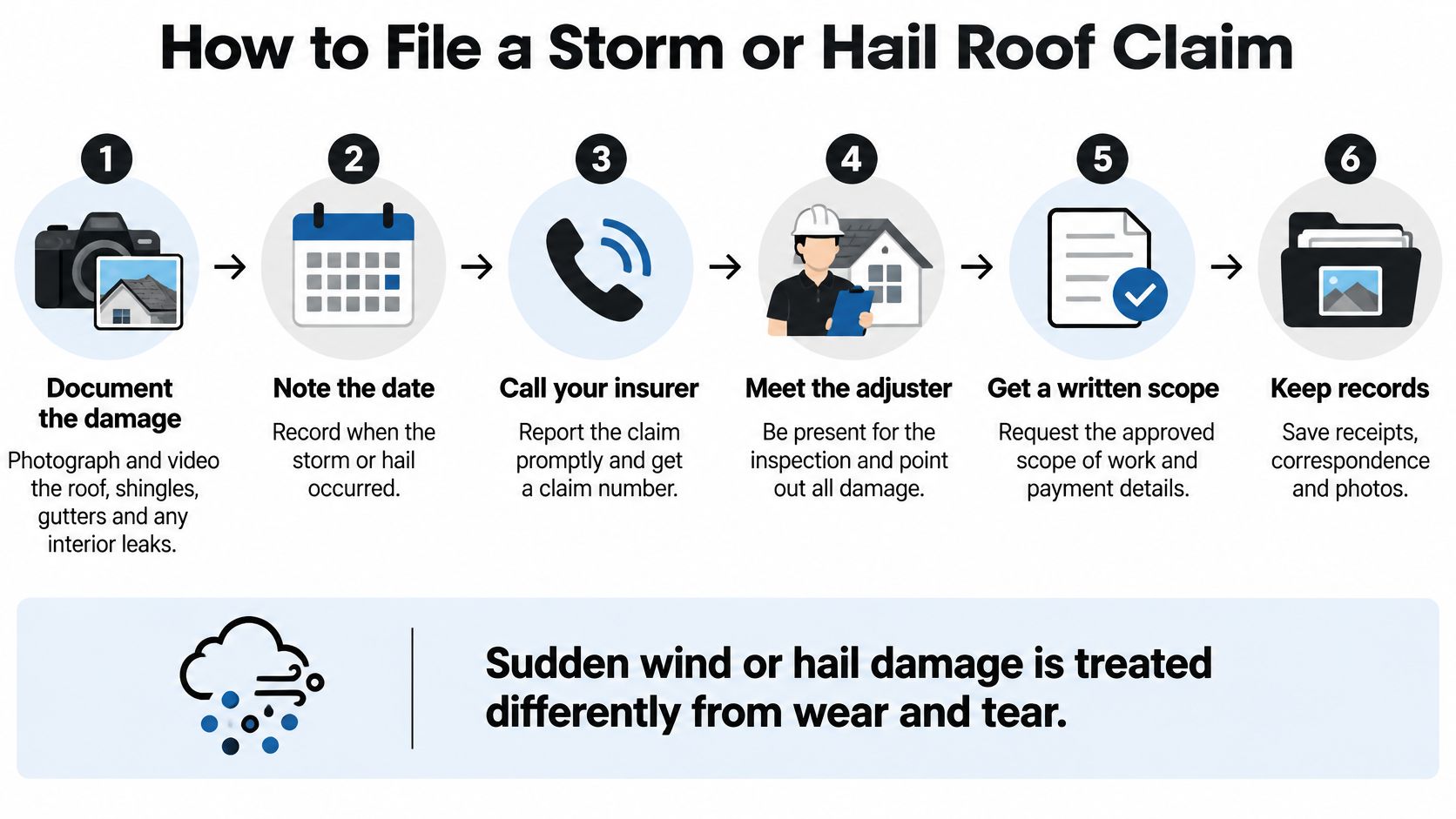
Seven Steps That Build a Claim File
- Photograph before anything moves. Shoot shingles, flashing, gutters, vents and any ceiling stain inside. Date the images. This is your proof the damage existed before a crew touched the roof.
- Stop further damage and keep receipts. A tarp or board-up is expected, not suspicious. Temporary repair costs are usually recoverable, so save every receipt.
- Report the loss and write down names. Record the claim number, the adjuster's name and the date you called. Filing deadlines vary by policy and state, so read that section of your policy early rather than at the end.
- Get your own written inspection. An independent roof report or contractor estimate gives you a scope to compare against the adjuster's. Without one, you're negotiating against a document you can't check.
- Walk the roof with the adjuster. Point to the shingles you photographed. Adjusters are fair but rushed, and anything not shown may not be measured.
- Read the settlement line by line. Check scope, materials, quantities, depreciation and the deductible. Ask what's held back and what releases it.
- Dispute gaps in writing and ask for a reinspection. If the scope misses a slope or a vent, put the omission in writing with photos attached. A polite written request with evidence moves more claims than a phone argument.
If you'd rather watch the process before you start, this walkthrough covers the same ground in plain language.
A complete claim file ends up holding dated photos, the independent inspection report, receipts for temporary repairs, the claim number, the adjuster's contact details and every piece of written correspondence. That folder does two jobs: it supports a dispute if the settlement comes in low, and it proves to a lender how much of the invoice insurance will cover. Our storm damage insurance claim process walks through how the inspection and adjuster meeting fit together.
Calculate the Deductible Before You Borrow
A wind and hail deductible is often written as a percentage of your dwelling coverage rather than a flat dollar figure. That one design choice turns a policy that looked reasonable at renewal into a large cash requirement the week the adjuster arrives. Wind and hail deductibles commonly run 1% to 5% of a home's dwelling coverage, and some policies pay actual cash value rather than replacement cost, which shrinks the insurer's share even more (Reviews.com roof damage claim guide).
The deductible sets how much cash you need on day one, so run this math before comparing a single loan rate. The table below assumes $300,000 of dwelling coverage and a $15,000 claim, the same figures used in the worked example.
| Deductible rate | Deductible amount | Insurer pays on a $15,000 claim |
|---|---|---|
| 1% | $3,000 | $12,000 |
| 2% | $6,000 | $9,000 |
| 5% | $15,000 | $0 |
The third row is the one to sit with. At 5%, the deductible equals the entire claim, so the insurer owes nothing toward it. You would be filing a claim that pays zero and still lands on your claims history.
One Worked Example
Take a $15,000 replacement with a 2% deductible on $300,000 of dwelling coverage. The deductible is $6,000, so the insurer's share is about $9,000 before any depreciation. Six thousand dollars is what you need in hand on day one, and that is the figure a loan has to cover if savings fall short.
Actual Cash Value Versus Replacement Cost
Policy type decides whether a second cash gap exists and how long it lasts. Under a replacement cost policy, the insurer usually withholds depreciation and releases it once the work is finished, so the gap is temporary. Under an actual cash value policy, the insurer pays only the depreciated amount and generally does not release the difference later, so the gap is permanent. Either way, a homeowner with a $6,000 deductible can need more than $6,000 before the project is paid for. Check which policy type you carry and ask the adjuster in writing what, if anything, is held back and what releases it.
An approval for $9,000 does not mean $9,000 lands in your account this week. Confirm the payment schedule before you borrow against a settlement.
When the repair estimate sits close to the deductible, filing may cost more in future premium than it returns. Paying privately and keeping the claim history clean is a legitimate choice, and it is one reason to get a contractor's number before you call the insurer at all.
Three figures decide how much to borrow: the immediate cash needed, the expected insurer payment, and the total balance to finance. The answer to how can I pay for a new roof changes completely once those three numbers are written down. For the middle step, what insurance pays for roof replacement shows how the payout itself is calculated under each policy type.
Choosing Between a Home-Equity Loan, HELOC or Refinance
Once you know the gap between your deductible, any holdback and the savings you have, the question shifts to which loan shape fits that gap. Three products let you borrow against the house you're already paying for, and they behave very differently under pressure.

A home-equity loan works like a bucket you fill once: a lump sum, a defined repayment schedule and a payment that stays predictable. A HELOC works like a tap you open and close as the project moves. It commonly carries a variable interest rate, so the amount you owe each month can climb while the roof is still going on. The bucket has a fixed price. The tap does not. For a one-time roof bill with a firm contractor estimate, the bucket is usually the simpler fit. For a project where hidden damage could push the total higher, the tap's flexibility may be worth the rate risk.
What to Compare Before Signing
- Annual percentage rate: the all-in borrowing cost, not the teaser rate on the mailer.
- Origination and appraisal fees: real money added to what can be a modest balance.
- Draw-period rules: for a HELOC, how long you can draw and what the payment becomes once repayment begins.
- Total finance charge: the sum paid across the whole term, which is where a low monthly payment hides its cost.
- Rate type: fixed or variable, and which caps apply if it's variable.
A cash-out refinance replaces your existing mortgage with a larger one and hands you the difference in cash. It can make sense when the new rate and closing costs beat every alternative, and it rarely makes sense when it resets a low-rate mortgage you've nearly paid off.
The tax rule is narrower than many assume. Interest is generally deductible only when debt secured by a main or second home is used to buy, build or substantially improve that residence, subject to applicable limits. A roof replacement can qualify as a substantial improvement; personal-use borrowing does not. Keep the invoices that show how the money was spent, and confirm your own situation with a tax professional.
Practical rule: the house secures these loans, so a missed payment can put the property at risk.
Unsecured options such as personal loans and credit cards avoid that risk because no house is pledged, but they usually cost more in interest and run for shorter terms. Use them for a small balance only, and compare the APR, monthly payment and total repaid exactly as you would a home-secured loan.
Government Loans and Contractor Payment Plans
If insurance won't cover the work, or you'd rather keep your reserves intact, a government-backed improvement loan is worth pricing against private borrowing. HUD's Title I Property Improvement Loan program caps a loan at $25,000 for a one-unit residential property, allows repayment terms reaching 20 years and 32 days, and requires any balance above $7,500 to be secured against the property (JCHS, Improving America's Housing 2023). The same Harvard research found whole-house roof replacements accounted for more than one-third of homeowner spending on energy-related improvement projects in 2021, roughly $38 billion nationwide.
| Term | Limit or rule |
|---|---|
| Maximum loan amount | $25,000 for a one-unit residential property |
| Maximum repayment term | 20 years and 32 days |
| Loan amount ceiling | Actual improvement cost plus allowable fees |
| Security requirement | Balances above $7,500 must be secured against the property |
Read the ceiling carefully. The loan can't exceed the actual improvement cost plus allowable fees, so it funds the work rather than a cushion. The security rule matters just as much, because a balance above $7,500 puts the home on the line the same way a home-equity loan does.
The Term Trade-Off
Say you need to finance a $12,000 balance. Spread it over a short term and you pay less total interest but carry a heavier monthly payment. Stretch it over a long term and the payment shrinks while the total repaid grows, sometimes by thousands of dollars. Ask for the total of payments on two or three term lengths and put them side by side.
Reading a Contractor Payment Plan
Contractor-arranged financing is convenient and often fast, which is exactly why it deserves a careful read. Four questions cover most of it.
- Who holds the loan? Many contractor plans are sold to a third-party lender after signing, so the company you shake hands with may not be the company you pay.
- What's the rate type? A promotional fixed rate and a variable rate look identical on a monthly payment line.
- Are there origination or processing fees? Add them to the balance before you compare against a bank.
- Is prepayment penalized? If you plan to clear the balance with an insurance check, a prepayment fee can eat the savings.
Draws should follow visible progress. A common structure releases money after the roof is dried in, again after inspection, and the remainder at final completion. No payment should go out before the work it pays for is on the roof and photographed. And when the insurance check arrives, it should be applied to the balance the lender expects, not to a fee added later at the kitchen table.
Funding Options When Credit or Savings Fall Short
Most payment guides assume good credit, usable equity and a funded reserve. Plenty of households have none of the three. Needed repairs in occupied U.S. housing totaled $198.4 billion in 2024, and Federal Reserve Bank of Philadelphia research on home repair costs notes that lower-income owners devote a disproportionate share of income to maintenance and repairs while often struggling to access home-improvement financing. Modest-income homeowners of color face particularly high denial rates for home-equity lending.
So the useful question isn't which loan has the lowest rate. It's what you can do when a loan is unavailable or unsafe.
Stabilize First, Replace Later
A tarp and a targeted leak repair can hold a roof for months while funds come together, and they cost a fraction of a replacement. The goal is to stop water from reaching decking, insulation and ceilings, because a wet deck turns a roofing job into a carpentry job. Keep the receipts; those temporary costs often fold into a later claim.
Programs Most Homeowners Never Ask About
Start with your city or county housing office and ask specifically for owner-occupied rehabilitation programs and emergency repair grants. Area agencies on aging sometimes fund roof work for older homeowners, and community development organizations run repair programs that never appear in a web search for roofing loans. These programs usually have income limits and waiting lists, so apply early and keep the application moving.
After a federally declared disaster, help may exist for uninsured or underinsured owners. FEMA's disaster assistance rules tie eligibility to habitability rather than appearance: minor staining may not qualify, while an actively leaking or structurally compromised roof tied to the declared event can. FEMA generally does not pay insurance deductibles, and it cannot duplicate benefits your insurer already covers.
Charity and public aid move on their own calendar. File the paperwork the same week you first notice the damage, then keep repairing and documenting while you wait.
If a claim or grant is pending and you need a short bridge, compare cash-advance apps and lending circles before signing anything tied to your next paycheck. The sequence that protects a household is temporary repair, insurance documentation, public assistance screening, and private borrowing only for what remains.
Confirm Your Payment Plan Before You Sign
By this point you should have three numbers and two or three quotes on paper. The last job is making sure the contract, the claim and the financing all describe the same roof.
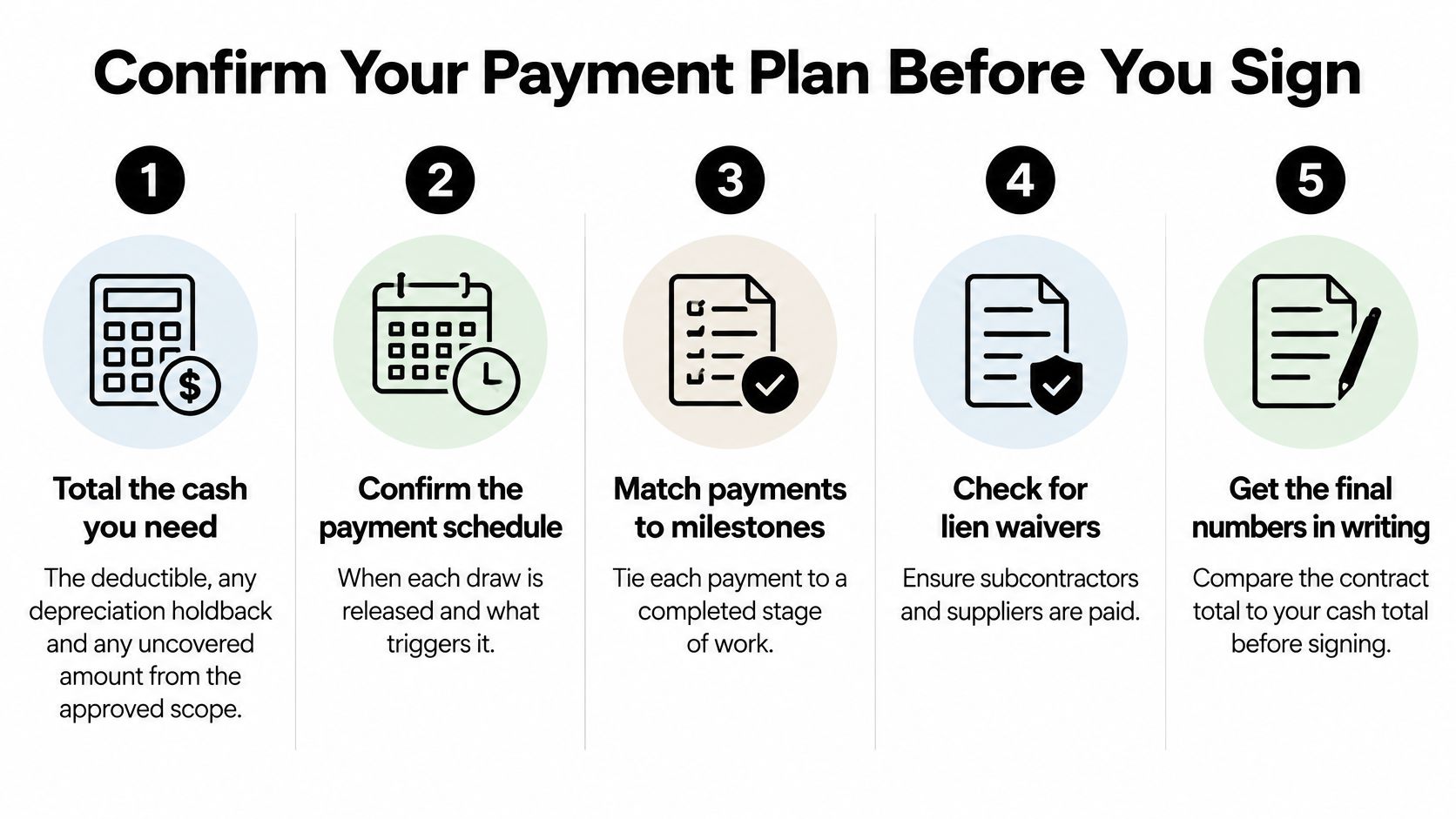
- Total the cash you need. Deductible, depreciation holdback and any line the approved scope doesn't cover. Write it as one number at the top of the page, because it's the figure every other decision gets measured against.
- Get three written quotes on identical scope. Same materials, same tear-off, same permits. Quotes describing different work can't be compared, and the cheapest one often leaves out decking, the dumpster or the permit fee.
- Compare loans on total cost. Rate type, term, fees and total finance charge. A payment that fits your month can still be an expensive mistake across 15 years.
- Verify the contractor, not just the price. License, liability insurance and warranty in writing, plus whether permits are inside the quoted number. We handle roof insurance claims for hail and storm damage, so the scope we write can be laid line by line beside the adjuster's estimate.
- Check the payment schedule against the work. Ask when each draw releases, what triggers it, whether a lien will be recorded against the home, and how the insurer's payment gets applied to the balance.
- Keep every invoice and proof of spending. You'll need them to release depreciation, to support the warranty and to answer any tax question about improvement debt.
One thing worth doing this week. If a claim is open, request the adjuster's written estimate and set it next to your three quotes. Where the scopes match, the number to sign against is the cash from step one plus the financed balance. Where they don't, settle the difference with the adjuster before you accept any financing terms. If you'd rather start from a contractor's written scope, you can request a free estimate through our website form or call (913)-238-6562.
Two States Exteriors LLC has worked on Kansas City metro roofs since 1997, handling storm and hail damage claims from the first inspection through the final invoice, with free on-site inspections and a No Money Upfront policy so nothing leaves your pocket before work begins. If you're still working out how to cover a roof, we'll put a written scope and a firm price beside your insurance estimate, so the financing decision rests on real numbers rather than an advertised payment. Visit Two States Exteriors LLC to book an inspection or ask about a full roof replacement.