
Insurance usually pays replacement cost minus your deductible and any depreciation. In plain terms, that can mean anything from full replacement minus deductible on an RCV policy to only $4,500, $3,000, or even nothing on a $10,000 roof under ACV, depending on roof age and deductible.
If you're in Kansas City and staring at missing shingles after a hailstorm, that difference matters a lot more than most expect. The biggest mistake homeowners make is asking only, "How much will insurance pay for roof replacement?" The better question is, "How much cash will I get first, and how much comes later if my policy allows it?"
A lot of roof claims feel confusing because two houses on the same street can get very different checks after the same storm. One owner gets enough to move forward. The other opens the estimate and wonders how a full roof replacement turned into a much smaller payment.
That gap usually comes down to three things: what caused the damage, what your policy says, and how old the roof is.
What Homeowners Insurance Actually Covers for Roof Replacement
A pretty normal Kansas City scene goes like this. A spring storm rolls through overnight, hail hits one side of the neighborhood harder than the other, and by morning you see granules in the gutter and shingles bent or torn. At that point, most homeowners assume insurance will buy them a new roof.
Sometimes it does. Sometimes it doesn't.
Covered damage comes first
Homeowners insurance usually responds to sudden accidental damage. Think hail, strong wind, a fallen tree limb, or another event that damaged a roof that was otherwise doing its job. Insurance is designed for loss events, not aging.
What it usually doesn't cover is wear, neglect, old age, or a roof that was already failing before the storm. If shingles were brittle, curling, or worn out from years of exposure, the insurance company may say the storm wasn't the cause of the problem.
A roof claim has two gates. First, the carrier decides whether the damage is covered at all. Only after that do they calculate how much they owe.
That first gate matters more than people think. A homeowner can have real leaks, real damage, and still run into trouble if the adjuster sees maintenance issues or long-term deterioration instead of storm impact.
Why Kansas City homeowners get tripped up
Kansas City homeowners deal with hail, wind, and fast weather swings, so roof claims are common enough that people hear plenty of advice from neighbors, contractors, and social media. The trouble is that a lot of that advice assumes every policy pays for "full replacement."
That's not a safe assumption.
Even before payout math starts, the insurer will look at things like:
- Cause of loss: Was it hail, wind, a fallen object, or gradual aging?
- Roof condition before the storm: A roof in solid shape generally has a cleaner claim path than one already near failure.
- Signs of maintenance issues: Repeated patching, long-term leaks, or obvious neglect can complicate coverage.
- Policy language: The wording on the declarations and endorsements often decides whether the roof is valued one way or another.
If you want a plain-language overview of what policies often include and exclude, this homeowners insurance coverage guide is a useful starting point.
The practical filter to use
Before you focus on payout, ask yourself three simple questions:
- Did a specific storm or sudden event damage the roof?
- Was the roof in reasonable condition before that event?
- Does my policy value the roof at depreciated value or replacement cost?
If the answer to the first two is shaky, the claim issue may be coverage, not math. If those answers are solid, then the next step is understanding how insurance calculates the check.
How ACV and RCV Determine Your Roof Replacement Payout
A Kansas City homeowner gets a roof estimate for $18,000 after hail. The first insurance check arrives for far less, and panic sets in. Was the claim underpaid, or is more money still available?
That question usually comes down to two policy terms: ACV and RCV.
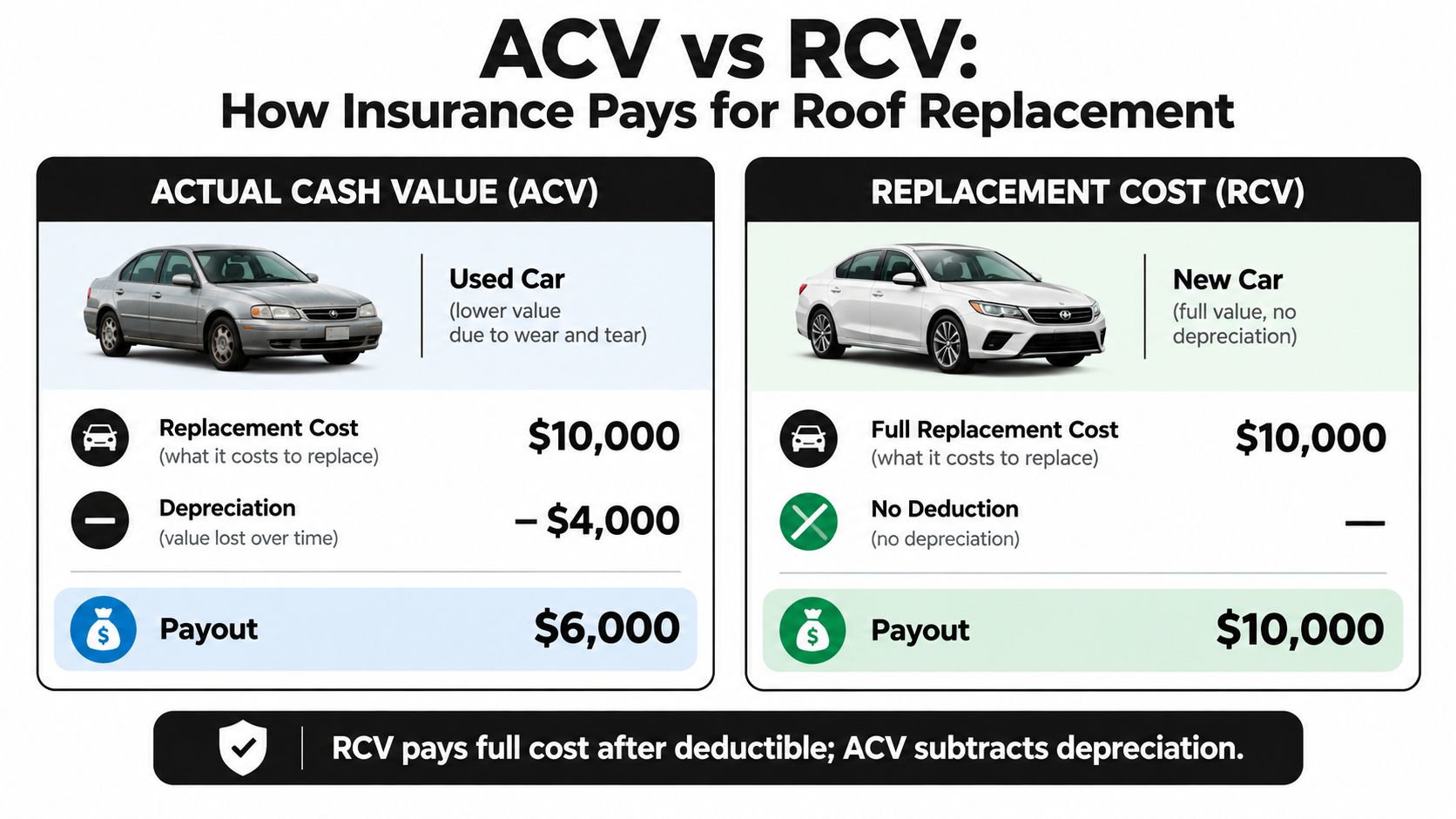
Actual Cash Value (ACV) is the roof's value at the time of loss after wear and age are factored in. Replacement Cost Value (RCV) is the cost to replace the roof today with materials of similar kind and quality. The NAIC explanation of ACV and replacement cost lays out that difference clearly.
A useful comparison is a totaled car: insurers usually pay the used value, not the price of a brand-new model. Roof math often works the same way.
Why the first check can be smaller than the total claim
This is the part many homeowners do not hear clearly enough. On many RCV policies, the insurer does not send the full replacement amount up front.
Instead, the payment often happens in two steps:
- The carrier calculates the full replacement amount for the roof.
- It subtracts depreciation and usually the deductible, then sends an initial ACV check.
- After the roof is replaced and the required paperwork is turned in, the carrier may release the withheld amount. That withheld amount is often called recoverable depreciation.
So the question is often not just, "What is my roof claim worth?" It is, "How much do I get now, and how much can I collect later?"
That cash-now versus cash-later split is what throws off budgeting.
A simple Kansas City-style payout example
Say your insurer agrees that replacing your storm-damaged roof will cost $20,000.
If the roof has $6,000 in depreciation and your deductible is $1,500, the first check on an RCV policy may look like this:
- RCV: $20,000
- Less depreciation withheld: $6,000
- Less deductible: $1,500
- Initial payment: $12,500
After the roof is completed and the insurer receives the final invoice or proof of completion, you may be able to recover the $6,000 withheld depreciation.
That means:
- Cash now: $12,500
- Cash later, if recoverable and properly documented: $6,000
- Your deductible remains your responsibility: $1,500
In that example, the total insurance contribution can reach $18,500, but only $12,500 may arrive at the start.
That is why two claim numbers can both be true at once. The total allowed amount can look solid on paper while the first payment still feels too small to a homeowner trying to schedule work.
How ACV-only and RCV policies change the result
With an ACV policy, the depreciation is usually not paid back later. The first check is often the main check, aside from any small adjustments.
With an RCV policy, the first check can still look disappointing, but more funds may be available after the roof is replaced and the claim file is updated.
So if two neighbors on the same block had similar hail damage, one may receive a much smaller final payout because their policy settles the roof at ACV instead of RCV.
What to look for in your paperwork
When homeowners review an estimate, they should look for a few specific lines:
- Replacement cost value
- Actual cash value
- Depreciation
- Deductible
- Recoverable depreciation, if listed
Those terms tell you whether you are looking at the full claim value or only the first phase of payment. If you want help reading those line items, this roof replacement depreciation guide gives a clearer breakdown of how insurers apply depreciation to a roof claim.
A good rule is simple: do not judge your claim by the first check alone. On many Kansas City roof claims, the first payment is only part of the story.
How Depreciation and Roof Age Shrink Your Insurance Check
If ACV and RCV are the big categories, depreciation is the lever that changes the actual dollars.
Why insurers depreciate roofs
A roof has a usable life. As it ages, insurers treat part of its value as already used up. That's why an older roof doesn't get valued the same way as a newer one under ACV.
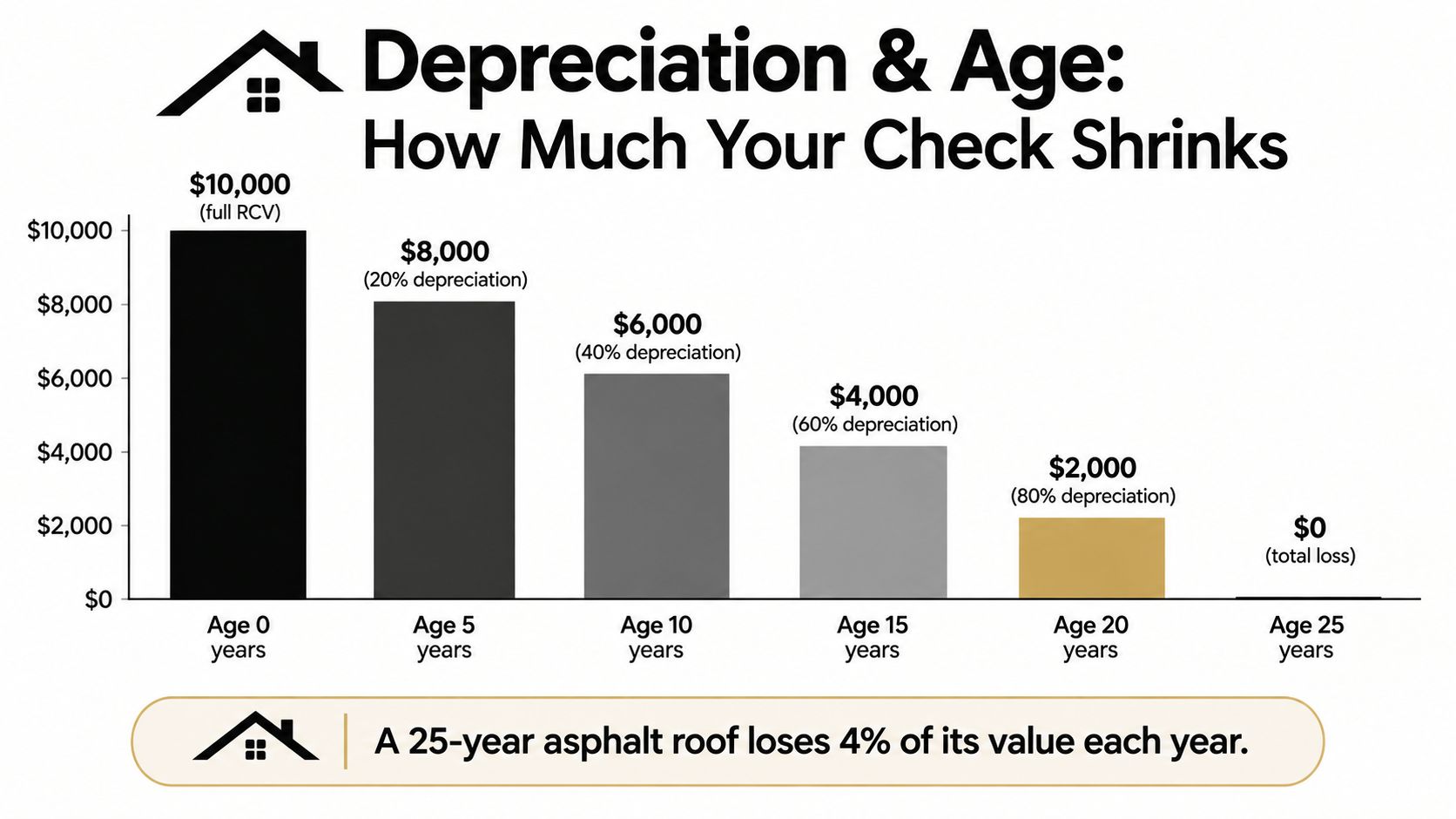
One insurer example says a 25-year composition shingle roof can depreciate by about 4% per year, so a 10-year-old roof could lose roughly 40% of its replacement cost before deductible under ACV settlement, according to Travelers' guide to understanding depreciation.
That one idea explains a lot of unpleasant claim math.
What age bands can look like
A legal analysis discussing roof claim structures cites a typical depreciation schedule with these payment bands: 100% for roofs 0 to 5 years old, 80% for 6 to 10 years, 60% for 11 to 15 years, 40% for 16 to 20 years, and 20% for 21+ years, as explained in this discussion of how policies limit roof claim payments.
That same analysis notes that many roof claims withhold about 20% to 45% as depreciation, and one calculator example shows a 15-year-old asphalt shingle roof may be 60% depreciated, leaving only 40 cents on the dollar under ACV.
For a lot of Kansas City homes, that's the shock. Hail may have created legitimate damage, but if the roof is already well into its life cycle, the insurer may not value it anywhere near today's full replacement cost under ACV terms.
A simple way to picture it
Think of depreciation like a battery you've already used most of the way. The roof may still be attached to the house, but part of its insurable value has already been consumed by time and weather.
That doesn't mean an older roof can't have a valid claim. It means the valuation method matters.
This short video helps visualize how roof claim value changes as the roof ages.
A quick self-check before the adjuster arrives
Use this as a rough thinking tool:
- If your roof is fairly new: depreciation may have a smaller effect.
- If it's around mid-life: expect a meaningful gap between replacement cost and first payment under ACV treatment.
- If it's older: the claim may leave a large share of the bill with you, especially after deductible.
The point isn't to out-argue the adjuster. It's to avoid being blindsided when the estimate arrives.
Typical Payout Ranges and Sample Calculations for Kansas City Homes
The numbers start to feel real. Kansas City homeowners usually don't need abstract insurance terms. They need to know what the check might look like on the kitchen table.
Start with the payout formula
For most roof claims, the working formula looks like this:
- Replacement cost
- minus depreciation if applicable
- minus deductible
- equals initial payment
If the policy is RCV and the depreciation is recoverable, the withheld amount may come later after the roof is replaced and documented.
The hard truth about older ACV roofs
State insurance regulators give a clean example that shows how steep the drop can be. On a roof that would cost $10,000 to replace, an ACV policy might pay only $4,500 for a 5-year-old roof, $3,000 for a 10-year-old roof, or nothing for a 20-year-old roof after a $4,000 deductible, according to Tennessee's consumer explanation of actual cash value and replacement coverage.
That's one of the clearest answers to the question, "How much does insurance pay for roof replacement?" Sometimes it pays a lot less than homeowners expect, even when the damage itself is covered.
Sample Kansas City Roof Insurance Payout Calculations
The table below uses only verified examples and simple claim math. The Kansas City part is the context, not a separate local pricing claim.
| Scenario | Replacement Cost | Depreciation Withheld | Deductible | Initial Check | Recoverable Amount |
|---|---|---|---|---|---|
| ACV example, 5-year-old roof | $10,000 | included in ACV valuation | $4,000 | $4,500 | $0 |
| ACV example, 10-year-old roof | $10,000 | included in ACV valuation | $4,000 | $3,000 | $0 |
| ACV example, 20-year-old roof | $10,000 | included in ACV valuation | $4,000 | $0 | $0 |
| RCV structure example, same roof cost before deductible | $10,000 | depends on first payment structure | deductible still applies | first check may be ACV-based | withheld depreciation may be released after proof of replacement |
What Kansas City homeowners should take from this
The local takeaway isn't a single average payout. It's that storm-prone markets create a false sense of certainty. Many homeowners hear "hail claim" and assume "new roof paid for." The actual result depends on the estimate, the deductible, the roof's age, and whether the withheld depreciation can be recovered.
The total claim number on paper and the cash available to you right now are often two different numbers.
That distinction matters when you're planning contractor deposits, scheduling work, or deciding whether to finance part of the project until final insurance funds arrive.
Questions to ask when you read the estimate
When the adjuster's paperwork lands in your inbox, don't just look at the bottom line. Look for these items:
- Coverage type: Does the roof show ACV only, or replacement cost with recoverable depreciation?
- Depreciation line: Is money being withheld now?
- Deductible amount: Has it already been subtracted from the check?
- Replacement requirements: What proof does the carrier require before releasing any remaining funds?
- Deadline language: Some policies require completion and documentation within set timeframes.
If those items aren't clear, ask for them in writing. Confusion at this stage is one of the main reasons people misjudge whether the insurance payout is fair, incomplete, or unfinished.
Navigating the Roof Insurance Claim Process and Timeline
A Kansas City homeowner gets an approval email for a roof claim, sees a large number on the estimate, and assumes the full amount is on the way. Then the first check arrives and it is lower than expected.
That moment causes a lot of confusion. The claim process is not just about how much the insurer agrees to pay on paper. It is also about when each part of that money is released. On many replacement cost claims, the insurer pays in stages, with cash now and cash later.
What the process usually looks like
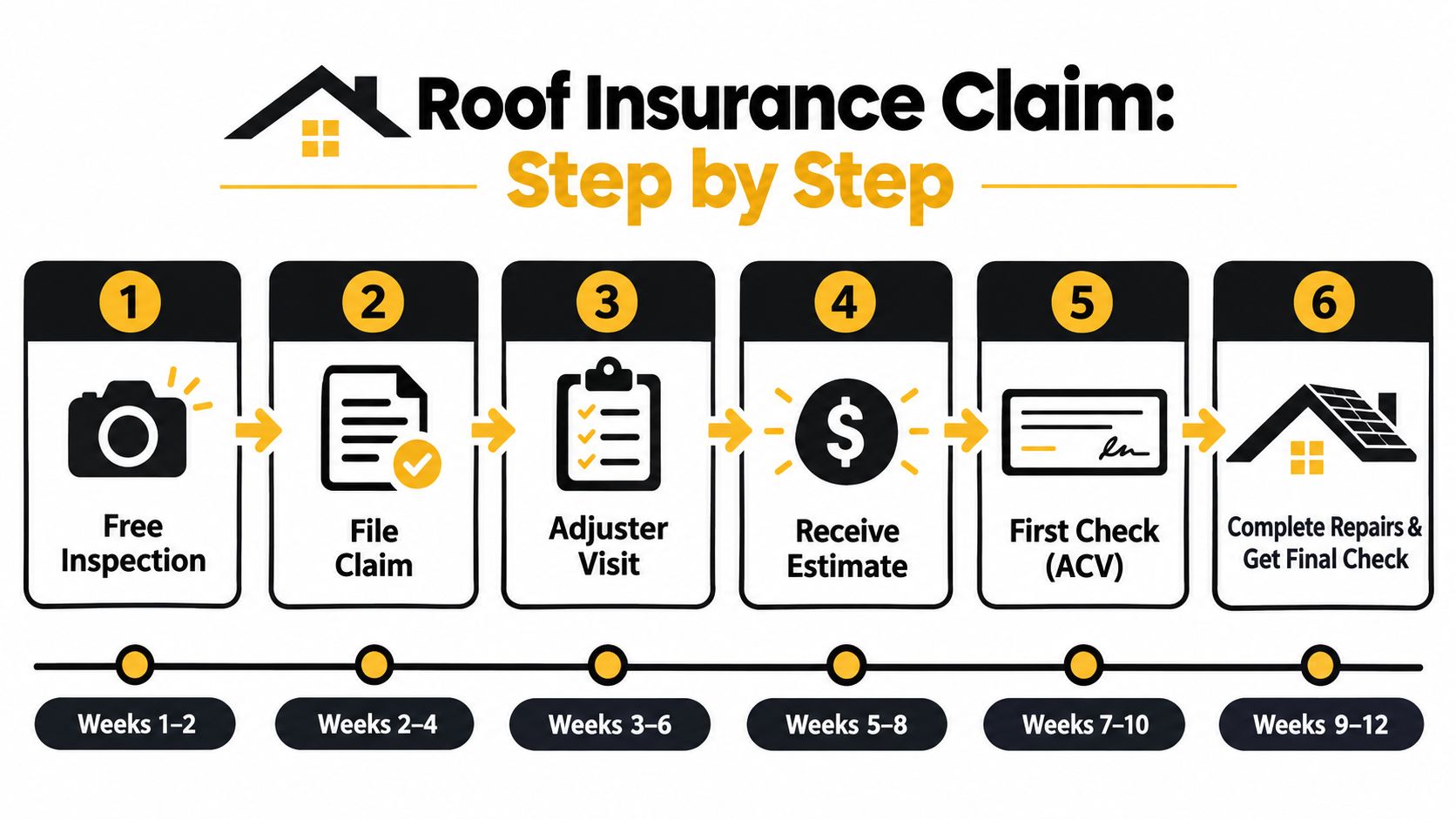
A roof claim usually follows the same general path, even if the timing varies by carrier and storm volume. The easiest way to read it is as a two-part payment process on many RCV policies. First, the insurer values the loss and sends the initial payment. Later, after the roof is replaced and the paperwork is turned in, the insurer may release the held-back amount.
The usual step-by-step path
Damage is documented.
Photos, notes, and inspection findings help show what was damaged and what likely caused it.The claim is opened.
The carrier assigns a claim number and begins its review.An adjuster or inspector reviews the roof.
The insurer decides what damage is covered and what items belong in the scope.The estimate is written.
This is the carrier's math sheet. It usually shows the replacement cost value, the deductible, and any depreciation being held back.The first check is sent.
This is the part many homeowners misunderstand. Even on a replacement cost policy, the first payment is often the amount available now after deductible and withheld depreciation. In plain English, the insurer is saying, "We agree on the full covered value, but part of that money is paid after the work is done."The roof is replaced.
Your contractor completes the work, and any added items discovered during tear-off may be submitted for review if they are covered.Final paperwork is submitted.
Invoices, proof of completion, photos, and any required forms go back to the carrier.The second payment may be released.
If the policy includes recoverable depreciation and the insurer accepts the documentation, the held-back amount is paid later.
A good way to picture it is a contractor draw schedule. One amount gets the job started. The remaining amount is released after the agreed work is complete. If you want a homeowner-friendly breakdown of each step, this roof insurance claims process guide explains the timeline in plain language.
Where delays usually happen
Delays usually come from paperwork gaps, not mystery.
A claim can slow down because the carrier is waiting on invoices, completion photos, or a supplement request for items that were not visible at the first inspection. Kansas City storm seasons can also create backlogs, especially after widespread hail events when adjusters and roofing crews are handling a high volume of files at once.
Timing rules matter too. On claims with recoverable depreciation, homeowners sometimes replace the roof but wait too long to send the final documents. That can postpone the second check or create a fight that could have been avoided with earlier follow-up.
A roof claim is not financially complete when the estimate is approved. It is complete when the insurer has accepted the final documents and released every covered payment owed under the policy.
What to keep in one folder
Keep these items together from day one:
- Storm photos and video
- Claim number and adjuster contact information
- Insurance estimate and any revised estimates
- Contractor scope, contract, and invoices
- Proof of completion
- Supplement approvals, if any
- Emails or letters about deadlines and required forms
That folder helps in a very practical way. If the first check feels short, you can quickly tell whether the difference is your deductible, withheld depreciation, or an item that still needs review.
Practical Ways to Maximize Your Legitimate Roof Replacement Payout
A Kansas City homeowner might hear, "Your roof claim was approved," then look at the first check and wonder why it feels short. In many valid claims, the biggest money gap is not whether the roof is covered. It is whether the homeowner understands what can be collected now, what can be collected later, and what paperwork releases the rest.
That is why the smartest way to maximize a legitimate payout is to treat the claim like a math problem with receipts.
The biggest money mistake is confusing the first check with the full payout
On many replacement cost claims, the insurer does not send the entire covered amount up front. The first payment often reflects actual cash value, minus the deductible. The held-back depreciation is paid later if the policy allows recovery and the homeowner completes the work within the claim rules.
A simple example helps. If the insurer values the covered roof replacement at $18,000, applies $5,000 in depreciation, and the deductible is $2,000, the first check may be about $11,000. The remaining $5,000 is often not lost. It is the cash-later portion, and it usually depends on finished work, invoices, and proof of completion.
That is the question many guides skip. Not only "How much will insurance pay?" but "How much arrives first, and what releases the second check?"
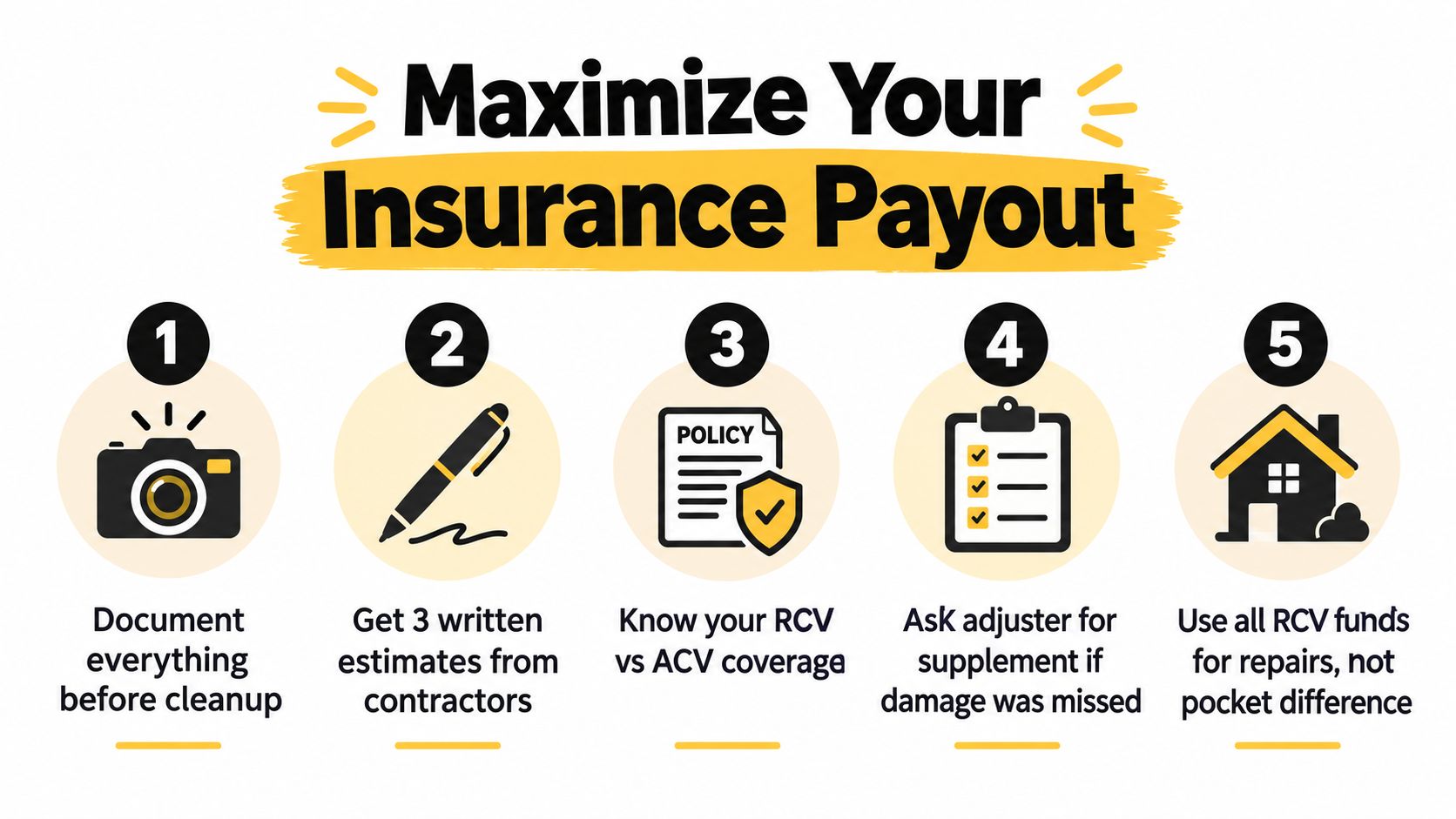
Five ways homeowners protect the payout they are owed
- Photograph the damage before temporary work changes the evidence. Clear photos of shingles, metal, gutters, and any interior leak signs make it easier to show the full scope of covered damage.
- Read the estimate like a worksheet. Look for the settlement type, the depreciation amount, and whether that depreciation is recoverable or non-recoverable.
- Compare line items, not just totals. A payout can come up short because ridge cap, starter, steep-charge items, code-related items, or accessory work were missed, not because the whole claim was denied.
- Submit support for missing items. If the roof has valid damage or required work that is absent from the estimate, ask for a supplement with photos, measurements, and scope details.
- Finish the paper trail after the roof is finished. Many homeowners complete the project but delay sending the final invoice or completion proof, which can delay or reduce the cash-later payment.
Accuracy raises the odds of full payment
Insurance math works a lot like a receipt at a hardware store. If an item is not listed, the cashier will not charge for it. Roof claims work the same way. If a covered item is missing from the scope, the insurer may not pay for it until someone documents why it belongs there.
That is one reason some homeowners choose a contractor that can help line up field conditions, estimate items, and completion documents. Two States Exteriors LLC is one example of a local company that works on roof replacements and insurance-related storm damage projects in the Kansas City area.
Stay inside the rules and still ask for every covered dollar
A legitimate payout comes from precision. Report the damage, review the estimate carefully, keep every invoice, and ask questions when the numbers do not make sense.
If the first check seems too low, break the gap into parts. Part of it may be your deductible. Part may be recoverable depreciation waiting on final documents. Part may be a missing scope item that needs support. Once you separate those pieces, the claim usually becomes much easier to understand and much easier to finish correctly.
How Two States Exteriors Helps You Secure Full Coverage and a Lasting Roof
A common Kansas City claim goes like this. A homeowner gets the first insurance check, looks at local roof prices, and assumes the carrier underpaid. Then the second part becomes clear. The first check may only be the cash-now portion, while the rest depends on final paperwork after the roof is finished.
That gap is where many claims slow down.
Two States Exteriors LLC helps homeowners work through that middle stage between approval and final payment. The company serves Kansas and Missouri and handles roof replacement, hail damage, wind damage, and exterior restoration work across the Kansas City metro. It is a GAF Certified, licensed, bonded, and insured contractor.
For an RCV claim, the goal is usually not just getting the first check. The goal is completing the roof correctly, matching the approved scope as closely as possible, and turning in the documents needed to collect eligible recoverable depreciation. That is the part many homeowners do not realize until cash-later money is still sitting with the carrier.
A contractor can help by keeping the claim organized and easier to follow. That often includes:
- Inspection photos and field notes that clearly show storm damage
- Scope review so the replacement work matches what the insurer approved
- Supplement support if covered items were left out of the estimate
- Project completion records such as invoices and proof of completion for final payment requests
The simplest way to view it is this. Insurance pays according to the documented scope and the policy terms. A finished roof only gets you all the way to the second check if the paperwork catches up with the work.
For homeowners asking how much does insurance pay for roof replacement, that makes question more practical. How much arrives now, how much arrives later, and what has to happen in between?
A strong outcome means the damage is documented clearly, the covered items are addressed, the roof is installed properly, and any eligible withheld depreciation is requested before deadlines are missed.
If your roof was damaged by hail or wind, Two States Exteriors LLC can inspect it, document the loss, and help you understand whether your first insurance check is the full story or only the first stage of payment. Schedule a no-obligation inspection and get clear guidance on the claim process before you commit to repairs.