
A $15,000 roof loss can leave you with an initial check of only $4,000 after depreciation and the deductible, according to the National Association of Insurance Commissioners' storm-rebuilding guidance. The urgent question after a storm isn't just whether your roof is covered. It's whether you can pay the contractor before any withheld insurance money arrives.
Before you authorize a tear-off, separate the insurer's first payment, your deductible, and any depreciation you may recover later. Then check whether your roof has the same settlement terms as the rest of your house.
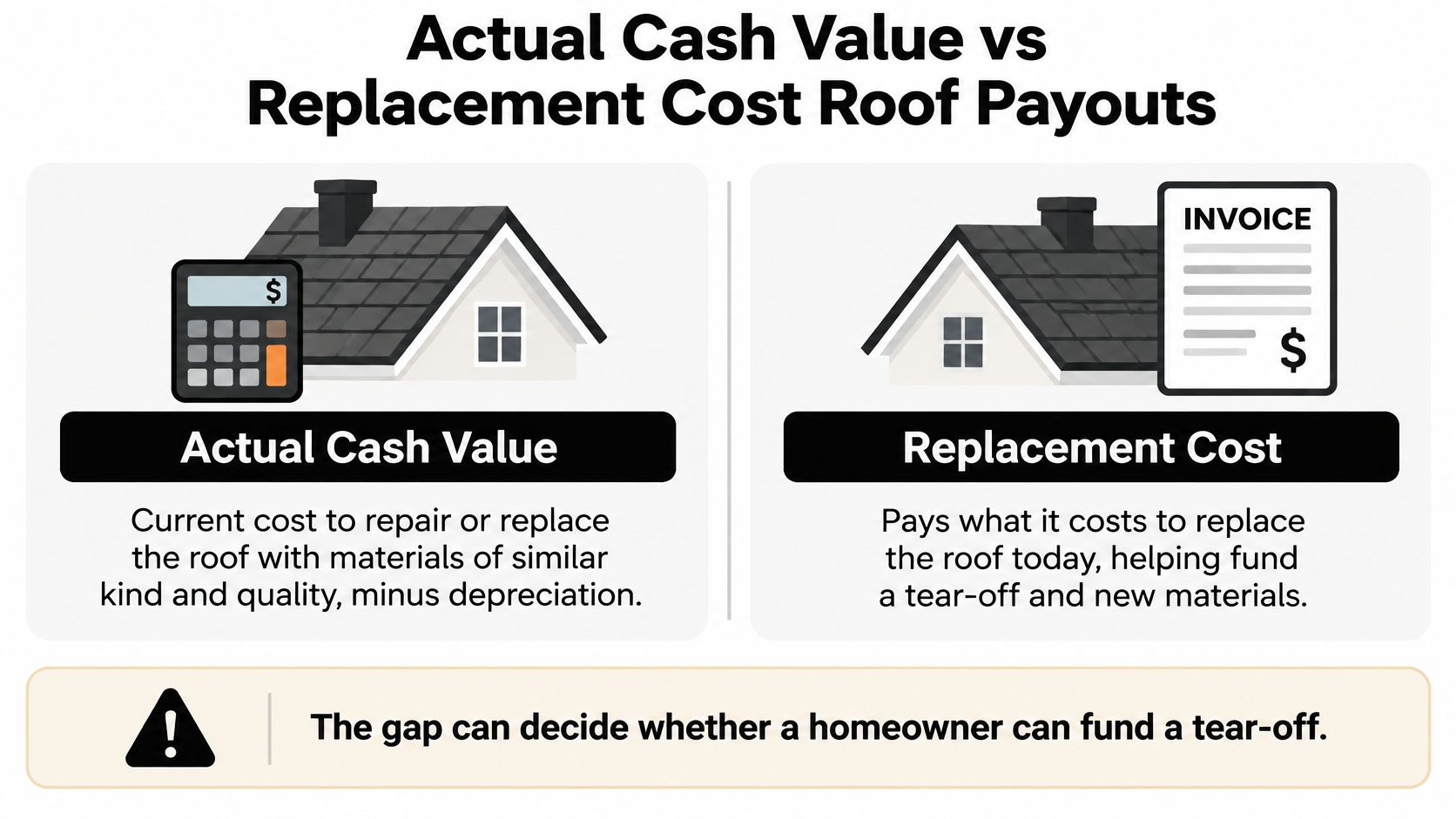
Actual Cash Value vs Replacement Cost Roof Payouts
Two roofs with the same repair estimate can produce very different first checks. Actual cash value (ACV) generally subtracts depreciation from the covered repair or replacement cost. Replacement cost value (RCV) may pay the recoverable depreciation after qualifying work is completed, subject to the policy's conditions.
Neither settlement type guarantees the full amount on a contractor's proposal. The deductible, coverage limits, exclusions, and any roof-specific terms can change what you receive.
Same roof, two settlement checks
These published examples from Tennessee's Department of Commerce and Insurance, the NAIC storm-rebuilding guidance linked earlier, and a Texas Department of Insurance example published in 2026 show how settlement terms affect payment.
| Example | Invoice | Deductible | Depreciation | ACV check | Replacement-cost check |
|---|---|---|---|---|---|
| Tennessee, roof about five years old | $11,000 | $1,000 | $2,500 | $6,500 as published | $10,000 |
| NAIC, 10-year-old roof | $15,000 | $1,000 | $10,000 | $4,000 | $14,000 after completed replacement |
| Texas 2026 example | $10,000 | $2,000 | $3,000 | $5,000 | $8,000 |
The RCV figure may be the eventual covered settlement, not the amount available before work begins. If a contractor requires payment before or during installation, that timing difference can create a cash gap.
Use the figures to frame questions about your own claim, not as a payment forecast. The examples use different assumptions, so they are not a universal schedule for how roof age determines a check.
What the check actually buys
With ACV, depreciation generally stays out of the settlement, leaving the homeowner to cover more of the replacement expense. With RCV, the insurer may release withheld depreciation after the qualifying work is completed and documented. The Duncan & Associates replacement cost guide explains why rebuilding cost differs from a property's value. Your policy determines how your roof claim is settled.
Before scheduling a tear-off, ask the insurer to separate the first payment from any later recoverable amount. Subtract the deductible from the covered settlement, then compare the money available at each stage with the contractor's payment schedule. That timeline makes the gap visible before work starts.
Before authorizing work: Ask for the initial payment and potential final settlement as separate amounts. An RCV estimate does not mean the full amount is available today.
How Insurers Calculate Depreciation on a Roof
The insurer first estimates the covered work, including damaged materials, quantities, labor, removal, and replacement with materials of similar kind and quality. That estimate is the starting amount for depreciation. It does not automatically include a more expensive roofing system.
A simple straight-line method assigns value based on the roof's expected remaining life. Insurers may use another method or account for the roof's condition as well as its age.
Follow the remaining-life calculation
In the Wisconsin Office of the Commissioner of Insurance consumer guide example, a roof with a $5,000 replacement cost, a 25-year expected useful life, and 15 years of age has $2,000 in actual cash value under the remaining-life method. The calculation uses 10 years remaining out of 25, or 40% of the replacement cost. The Wisconsin guide explains the method.
The table applies that same arithmetic to a hypothetical replacement amount. It shows how age affects the value before the deductible, not an insurer's promised depreciation schedule.
Straight-line value left on a 25-year roof
| Roof age | Life remaining | Share of replacement cost | ACV before deductible on $10,000 |
|---|---|---|---|
| New | 25 of 25 years | 100% | $10,000 |
| 5 years | 20 of 25 years | 80% | $8,000 |
| 10 years | 15 of 25 years | 60% | $6,000 |
| 15 years | 10 of 25 years | 40% | $4,000 |
| 20 years | 5 of 25 years | 20% | $2,000 |
| 25 years | 0 of 25 years | 0% | $0 |
The last row is the calculation's endpoint, not a prediction that every older roof receives no payment. The policy, depreciation method, and documented roof condition affect the actual claim.
ACV before the deductible is not the check amount. The deductible still reduces the payment, subject to how the insurer applies it to the covered claim.
Check the assumptions behind the deduction
Ask for the depreciation worksheet. A mistaken installation date or material classification can change the calculation before roof condition is considered.
Give the adjuster evidence to check those assumptions:
- Installation records: Provide the roofing invoice, permit record, warranty paperwork, or other reliable age documentation.
- Condition evidence: Share dated photographs, maintenance records, and repair invoices that show the roof before the storm.
- Material identification: Check that the estimate identifies the installed shingle, tile, or metal system accurately.
- Line-item treatment: Ask which components were depreciated and whether the worksheet separates recoverable from nonrecoverable depreciation.
The table's rate is only an illustration. Ask the insurer to explain the age and condition assumptions behind the actual deduction.
Keep underinsurance separate from depreciation
An inadequate dwelling limit can trigger a separate reduction under an insurance-to-value or coinsurance provision. That is different from depreciation, which reduces value based on age or condition.
Ask the insurer to show any underinsurance calculation in writing, including the required insurance amount, the limit carried, and the provision applied. The explanation should separate depreciation, the deductible, and any reduction tied to the policy limit.
Compare the insurer's line items with the roof's documented age, condition, materials, damaged components, and required work. That comparison can show which assumption needs clarification.
When the Roof Clause Overrides the Policy
A replacement-cost dwelling policy doesn't necessarily provide replacement-cost settlement for the roof. An endorsement can treat roof surfaces differently while leaving the rest of the home insured on replacement-cost terms.
The NAIC post-disaster claims guide warns that an ACV-only roof settlement can be as little as 20% of replacement cost when the roof's useful life is approximately 25 years. The actual percentage depends on the depreciation method and the roof's condition.
Read the pages that determine payment
Don't stop at a coverage summary or the name your agent uses for the policy. Read these documents together:
- Declarations page: Identify the dwelling limit, deductible, listed forms, and any separate wind or hail deductible.
- Roof endorsements: Search for roof, surfacing, roofing materials, payment schedule, and actual cash value. Look for roof-specific caps or exclusions.
- Loss-settlement provisions: Check the conditions for recovering depreciation and the deadline for submitting invoices or proof of completion.
A roof clause may change the settlement basis, restrict covered damage, or limit payment. A cosmetic-damage exclusion also deserves attention when the dispute concerns appearance rather than the roofing material's ability to function.
The roof endorsement, not the policy nickname, determines the roof's payment rule.
Separate roof coverage from related damage
A storm can produce several repair needs at once. Damage to roofing, wet insulation, stained ceilings, and emergency protection may require different estimate entries and coverage decisions.
Our guide to storm-damage insurance coverage can help you organize those questions before discussing the scope with the adjuster. Ask the insurer to identify the applicable provision for each disputed item rather than treating every storm-related expense as interchangeable.
The importance of reading the cause-of-loss language also appears in AMPM Restoration Services' guide to understanding Florida water damage coverage. That resource concerns Florida water damage, not Kansas or Missouri roof rules, but it offers useful context for separating the damaged property from the event that caused the damage.
Photograph or save the complete roof endorsement, including its form number. Then ask your agent in writing whether depreciation on this roof is recoverable and which policy provision supports the answer.
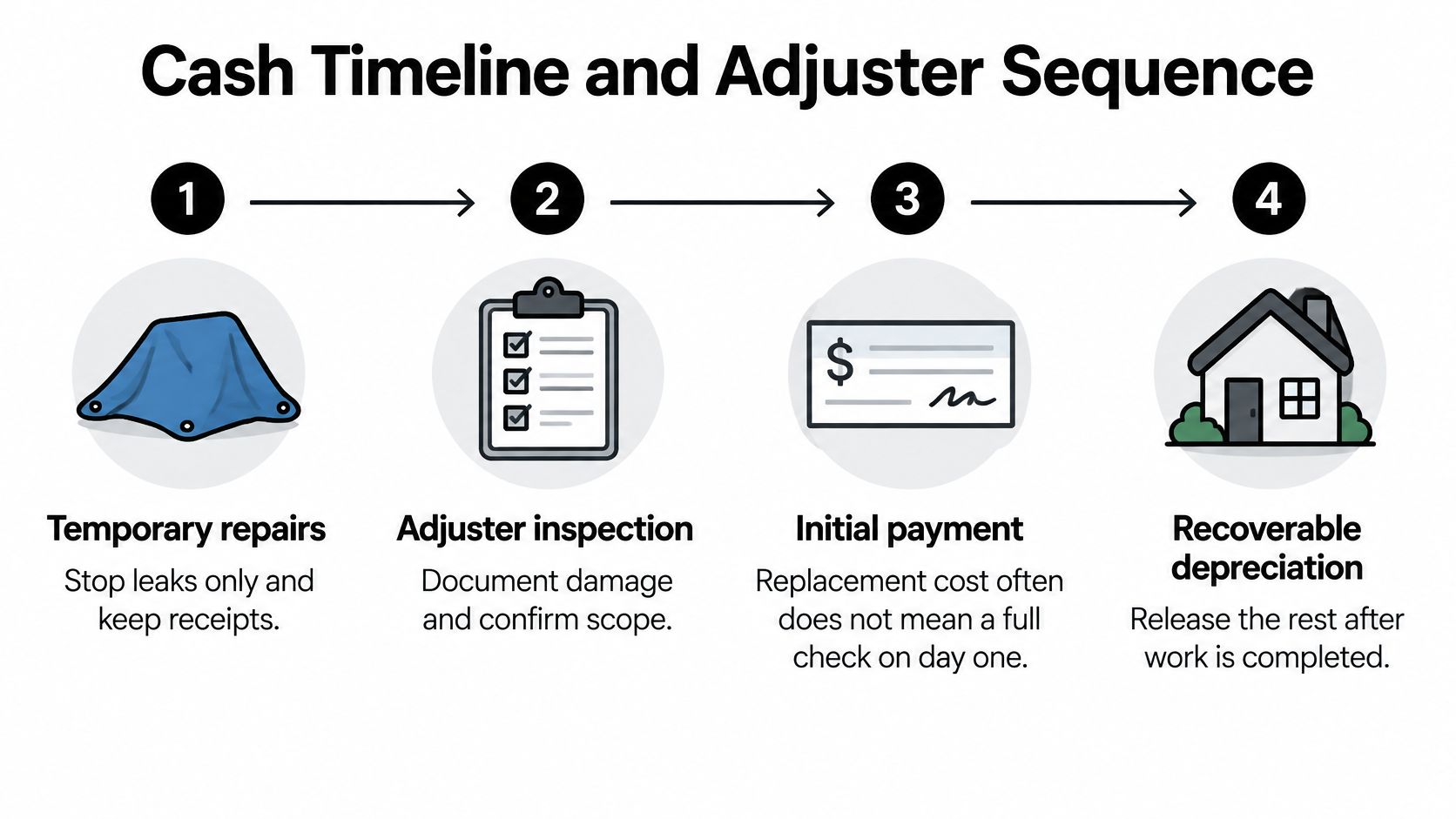
Cash Timeline and Adjuster Sequence
Plan the claim around payment milestones, not just the projected installation date. The contractor's work schedule and the insurer's payment schedule may not match.
This visual shows the broad sequence; the written claim documents determine what happens in your case.
Build a file at each milestone
Protect the home and retain receipts. Arrange safe temporary protection to stop active water entry. Photograph conditions before and after mitigation when possible, save receipts, and ask whether emergency dry-in will be estimated separately. Don't climb onto a damaged or wet roof yourself.
Get a written scope. Request an itemized proposal identifying the roofing material, damaged areas, tear-off, disposal, and any additional roof layers. The scope should distinguish known repairs from concealed conditions that can't be confirmed until removal. The document you need is a scope you can compare directly with the carrier's estimate.
Confirm the first payment. The NAIC personal-lines consumer guidance illustrates an initial $4,000 ACV payment on a $15,000 roof after $10,000 depreciation and a $1,000 deductible. The planning issue is the wait between that payment and any later release, not the amount printed at the top of the estimate.
Resolve the adjuster's scope. Bring roof-age records, damage photographs, the contractor's proposal, and the depreciation worksheet to the discussion. Compare drip edge, flashing, decking, and ventilation entries against the damage and proposed work. Ask separately about code upgrades, matching materials, and emergency protection; don't assume they're included or covered.
Document recoverable depreciation. Obtain written confirmation of whether depreciation is recoverable, what work qualifies, which documents are required, and when they're due. Ask how payment changes if the completed work costs less than the approved estimate. Keep the insurer's response with the claim correspondence.
Match available money to contractor payments. Write the cleared first payment, your deductible funds, and any temporary funding next to each contractor payment milestone. Identify who covers the unpaid amount while reimbursement is pending. Don't schedule tear-off until you understand that obligation.
Submit completion documents promptly. Send the final invoice, requested photographs, and proof of completion through the insurer's designated channel. Keep the submission confirmation and follow up on missing documents. A missed policy deadline may jeopardize recovery of withheld depreciation.
Keep construction decisions and coverage decisions distinct
Our roof insurance claims process guide helps homeowners organize the inspection, scope, and repair stages. We offer roof replacement and roof repair, including repairs needed for insurance claims.
The insurer decides coverage under the policy. A contractor can document damage and explain the construction work, but a proposal alone doesn't establish what the insurer owes.
For help organizing the payment conversation, Restore Heroes' claim payout guidance for homeowners provides another homeowner-focused resource. Keep every payment question tied to your actual estimate and policy rather than another homeowner's settlement.
Cash-flow checkpoint: A future reimbursement isn't money available for the contractor's next payment. Put both dates in writing before committing to the work.
For an additional visual explanation of claim payments, use the video below alongside your written estimate.
Hail and Wind Claims in Kansas and Missouri
Kansas City homeowners need a repair plan that reflects the roof in place, not a generic assumption that every storm requires replacement. The damage pattern, material condition, and feasibility of a durable repair affect the scope before the settlement method affects funding.
Missing shingles can be visible from the ground, but an inspection may identify other damage that isn't obvious from the driveway.
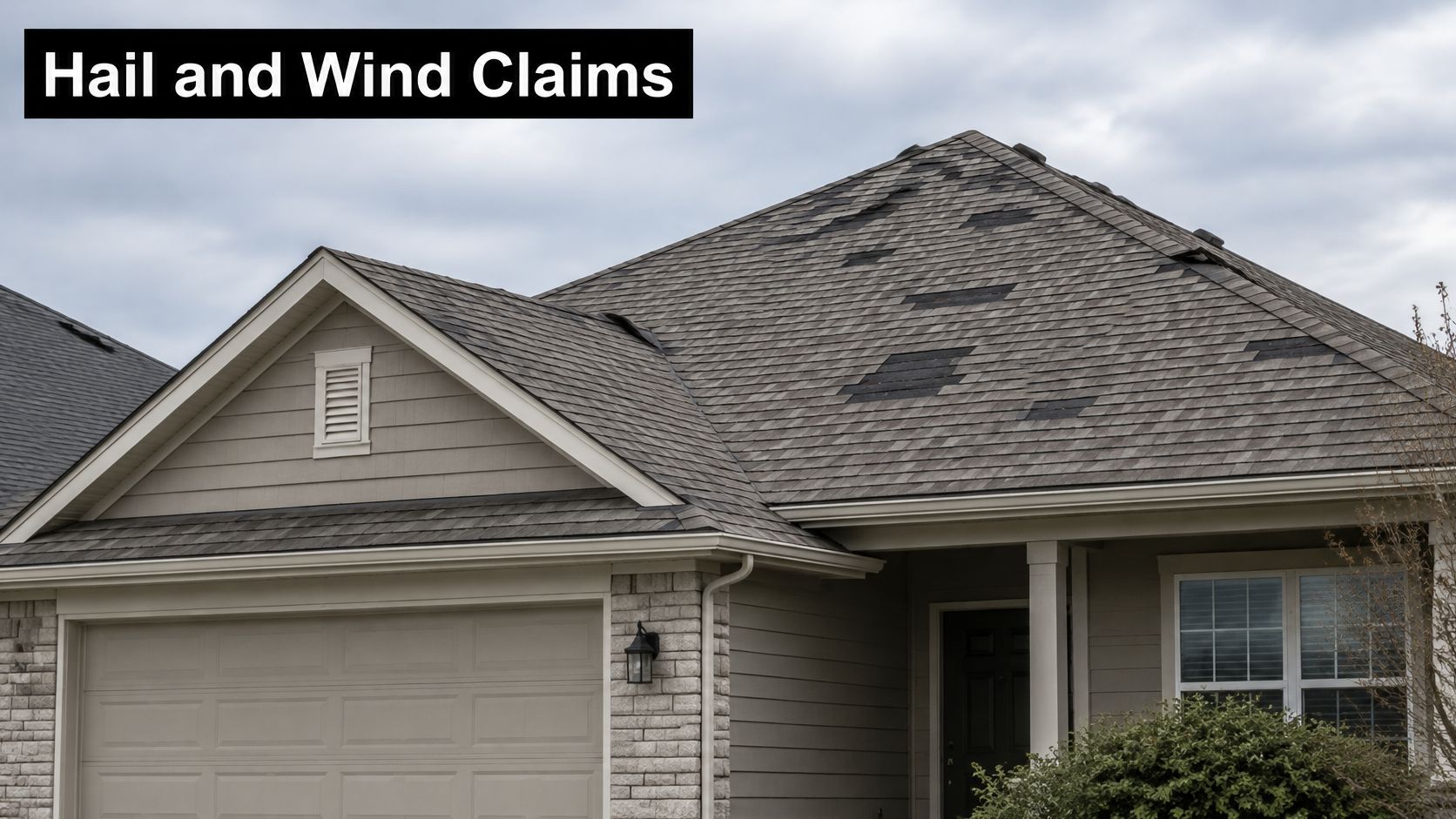
A newer architectural-shingle roof after wind
Say straight-line wind removes shingles from a relatively new roof. If compatible shingles remain available and adjacent materials can be repaired without creating additional damage, a targeted repair or partial-slope replacement may be appropriate.
The funding decision starts with the repair scope, not the price of replacing the entire roof. Ask for a proposal that identifies damaged areas, replacement materials, and how the repaired roof will shed water.
With less age-related depreciation, the settlement difference may be smaller. The deductible can still determine whether the available check meaningfully funds the work.
A mid-life asphalt roof after hail
A roof can have substantial storm damage while still carrying a significant depreciation deduction. The homeowner may receive an estimate approving replacement but lack enough immediately available cash to begin it.
Photographs should show hail impacts in place, not merely loose granules collected from a gutter. Have the inspector document affected slopes and related damage, and distinguish storm damage from ordinary wear.
The funding implication is a temporary or permanent shortfall, depending on the settlement terms. Resolve missing scope items before committing to a construction contract that assumes the carrier will add them later.
An older roof with limited remaining value
An older roof may need replacement after a covered storm even when its depreciated payment is far below the contractor's price. The practical choice may involve household reserves, financing, or a revised construction schedule, rather than waiting for a larger check.
Don't assume every leak means the whole roof qualifies for replacement. Document the roof damage, interior water entry, and any decking conditions visible during authorized work.
We offer roof insurance claims services for hail and storm damage. Our specialists conduct thorough inspections to identify damage or potential issues that could lead to costly repairs down the line.
For a storm-damage roof inspection, prepare a consistent evidence file:
- Roof photographs: Record missing, creased, cracked, or impacted materials in their original locations.
- Interior evidence: Photograph staining and active leaks, noting when you discovered them.
- Decking documentation: Have accessible or exposed damage photographed safely.
- Estimate comparison: Mark the specific carrier line items that don't match the documented work.
Raise disagreements as soon as they're identified. You don't need to wait for a payment to ask the adjuster to reconsider an incomplete scope.
Choose the Settlement That Fits This Roof
Replacement-cost roof coverage with recoverable depreciation generally fits homeowners who couldn't comfortably pay a substantial replacement shortfall. That's especially important when the installed roof has aged enough that a covered storm could leave a large depreciation deduction.
ACV can be a deliberate premium choice when the roof is newer and you have reserves earmarked for the uncovered expense. It shouldn't be a choice made solely because the annual premium looks lower.
Compare the obligation you would actually accept
Evaluate actual cash value vs replacement cost roof coverage using your installed roof, available savings, and written settlement terms. Ask whether you could afford both the permanent out-of-pocket amount and any temporary funding needed before reimbursement.
Before renewal, put these items together:
- Current roofing scope: Obtain a written description of likely replacement work, including removal and disposal.
- Applicable deductible: Identify the deductible that would apply to wind or hail, not just the general deductible.
- Roof settlement terms: Confirm whether a schedule, cap, or ACV endorsement changes the dwelling coverage.
- Available reserves: Decide how much you could pay without relying on money the insurer hasn't yet released.
If the dwelling has replacement-cost coverage but the roof doesn't, evaluate that endorsement as a financial obligation. Compare the likely roof payment with the price of the work you would need, rather than assuming the broader policy description protects you.
Make the next decision in writing
Ask your agent to confirm whether depreciation on the installed roof is recoverable and what conditions you must satisfy. File the answer with your roof records and review it when coverage changes.
Our website has an Instant Roof Quote option to help you begin planning. We're a GAF Certified Contractor, and qualified homeowners may receive a complimentary upgrade to Class 4 impact-resistant GAF Timberline UHDZ shingles with advanced algae protection.
Keep a material upgrade separate from the insurance settlement discussion. Eligibility for an installation offer doesn't change what your policy covers or remove your deductible.
The right choice is the settlement you understand and can fund. Before storm season, make sure the roof you own, the policy you carry, and the reserves you keep fit together.
Two States Exteriors LLC offers roof repair, replacement, and hail- and storm-damage insurance claims services to help you connect the documented roof damage with a practical construction plan. Visit Two States Exteriors LLC to request an inspection or explore the Instant Roof Quote option before scheduling work around an insurance payment.