You wake up after a hard Kansas City storm and find shingles scattered across the yard, dents in the gutters, and water staining the ceiling. The first question is usually, “Is my roof covered?” That's the wrong question to ask first.
The better question is, what does the policy pay for, under which settlement method, after which deductible, and within what deadline? Storm damage insurance coverage isn't a blank check. It's a contract filled with definitions, exclusions, limits, and conditions that can determine whether a damaged roof becomes a manageable repair or a large personal expense.
Filing a Storm Damage Claim: What the Insurer Actually Evaluates
The morning after a severe storm, a homeowner may see missing shingles, dented gutters, or a ceiling stain and call a roofer. That visible damage starts the investigation, not the payment decision. The insurer will examine the cause of loss, policy language, roof condition, deductible, and evidence supporting the claim.
A standard homeowners policy generally responds to sudden and accidental direct physical loss caused by covered perils such as wind and hail. The Insurance Information Institute's homeowners insurance data reports that property damage represented 97.3% of homeowners insurance claims in 2023, with wind and hail accounting for 42.5% of those property damage claims. It also reports that about 1 in 36 insured homes has a property damage claim related to wind or hail each year.
A 15-year-old roof may show damage from one storm, while the adjuster separates the estimate into wind damage, deferred maintenance, cosmetic damage, and excluded water intrusion. Each category can receive different treatment under the policy. Approval depends on how those details fit the contract, not just on whether a storm occurred.
The practical lesson: Insurance provides a potential source of benefits. It does not guarantee payment for every repair connected to the storm.
Policy traps often decide the result. A cosmetic exclusion may limit payment for damage that affects appearance but not function. An actual cash value settlement may reduce payment for depreciation. A strict reporting deadline can create another problem if the homeowner waits too long to notify the insurer or document conditions. Read those provisions before accepting an estimate or authorizing repairs.
Storm losses have also become more consequential for insurers. Verisk's analysis of convective-storm losses states that the U.S. exceeded $57 billion in insured losses from wind and thunderstorm events in 2023, including 18 thunderstorms with at least $1 billion in insured losses each. That pressure can affect pricing, deductibles, exclusions, and claim scrutiny.
Treat the claim as a formal financial process, not a casual repair request. Follow a documented storm damage insurance claim process that begins with safe documentation, policy review, and a qualified inspection before relying on the insurer's first estimate.
How Deductibles and Settlement Types Change Your Payout
Your payout usually depends on two policy mechanics that homeowners often overlook: the deductible structure and the loss-settlement method. A roof can have legitimate storm damage and still produce a smaller payment than expected because the deductible consumes much of the approved amount or the policy pays depreciated value.
Percentage deductibles create real out-of-pocket exposure
In hail-prone areas, insurers may use a separate wind and hail deductible tied to the dwelling coverage limit. AAA's severe-storm insurance guidance explains that this deductible is commonly calculated as a percentage rather than a flat dollar amount.
The math matters. If your dwelling limit is $200,000 and the wind and hail deductible is 1%, your deductible is $2,000. That amount comes out before the policy pays covered benefits. It isn't necessarily the same as the standard deductible printed elsewhere in your declarations.
Check the declarations page for separate entries such as:
- Standard deductible: The amount applied to covered losses under the ordinary policy terms.
- Wind and hail deductible: A separate amount or percentage that may apply specifically to storm losses.
- Dwelling limit: The coverage amount used to calculate a percentage deductible.
- Coverage cap: The maximum the policy will pay for the covered property and loss.
Don't estimate your likely payout from a contractor's price alone. Compare the repair scope with the applicable deductible and confirm which coverage limit applies.
RCV and ACV produce different settlement economics
The second major issue is whether the policy uses replacement cost value, or RCV, and actual cash value, or ACV. The Texas Department of Insurance explanation of RCV and ACV explains the difference clearly. RCV generally pays the cost to repair or replace with similar kind and quality without subtracting depreciation. ACV subtracts depreciation and pays only the item's depreciated value.
| Settlement Type | Initial Payout Calculation | Depreciation Handling | Homeowner Financial Risk |
|---|---|---|---|
| RCV | Approved replacement cost minus the deductible | Depreciation isn't deducted from the final replacement-cost benefit | The homeowner usually pays the deductible and may need to fund costs before withheld benefits are released |
| ACV | Approved replacement cost minus depreciation and the deductible | Depreciation is deducted based on age and condition | The homeowner carries a larger gap because the policy pays less than the cost of new materials |
Consider a roof replacement priced at $10,000 with a $4,000 deductible. Under an RCV policy, the initial payment would be $6,000, assuming the work is covered and the policy's payment process applies as described by the insurer. Under an ACV policy, depreciation is deducted as well, so the initial payment would be lower. The homeowner must cover the remaining cost through personal funds, financing, or a later recoverable amount if the policy permits it.
Ask the adjuster one direct question: Is this roof being settled on an RCV or ACV basis, and when will any withheld depreciation be paid? Get the answer in writing before signing a repair agreement.
Hidden Exclusions and the Flood Versus Wind Boundary
Many homeowners assume a storm creates one claim with one answer. It doesn't. The same weather event can produce several types of damage, and the policy may treat each cause differently.
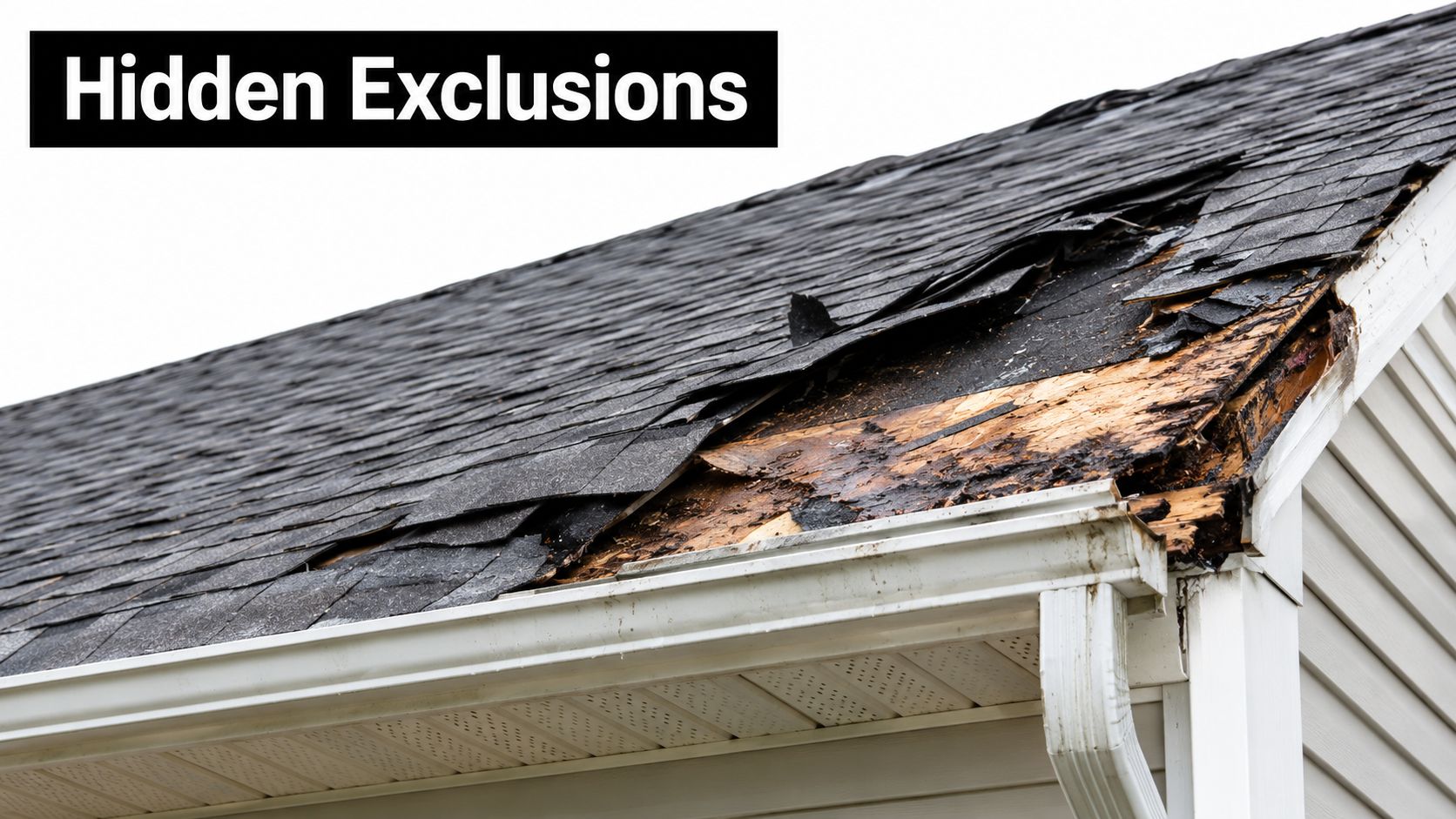
A wind gust that tears shingles from the roof can fall within standard storm damage insurance coverage. Hail that breaks a skylight may also qualify under the policy. But an insurer may dispute dents that affect appearance without affecting the roof's function. Cosmetic damage exclusions are increasingly important because they can remove coverage for appearance-only damage even when the homeowner can clearly see hail strikes.
That distinction is not cosmetic to your budget. If hail bruises the shingle mat, weakens the roof's protective surface, or creates a credible risk of failure, the issue may involve more than appearance. Your inspection report should identify the physical effect of the impact, not just count dents.
Wind damage and flood damage are different coverage questions
The flood boundary causes even more confusion. Standard homeowners policies generally cover wind and hail, but they usually exclude flood damage caused by storm rainfall, rising water, or storm surge. NerdWallet's guidance on homeowners insurance gaps explains that flood coverage often must be purchased separately.
That means a storm can damage the same room through two different paths:
- Roof breach: Wind damages the roof, rain enters through the opening, and the resulting direct physical damage may be evaluated under the homeowners policy.
- Rising or surge water: Water enters from the ground, drainage system, river, or coast, and the resulting damage may fall under flood coverage instead.
- Wind-driven wave or coastal flooding: The water source and policy wording become central to the coverage decision.
Don't assume a named hurricane, thunderstorm, or tornado automatically makes every loss an insured loss under one policy. California officials have warned that wind-driven wave damage, storm surge, and coastal flooding can be excluded from many standard homeowners policies, while National Flood Insurance Program policies can take 30 days to become effective, as described in the cited guidance.
Your job is to identify the entry point and document the sequence. Photograph broken roofing, damaged flashing, water stains, interior saturation, and standing water before cleanup changes the evidence. Then ask the insurer which policy and peril it believes applies.
Documenting the Damage and Meeting Strict Deadlines
A strong claim starts before the adjuster arrives. Once the property is safe, build a clear record that connects the storm to each damaged item and shows the steps you took to prevent further loss.
Some policies now impose reporting windows as tight as 180 days after the loss, according to recent insurance industry reporting on changing storm-claim terms. Don't assume your policy gives you plenty of time. Read the notice condition today, then report the loss promptly even if the full repair scope isn't known.
Follow a defensible sequence
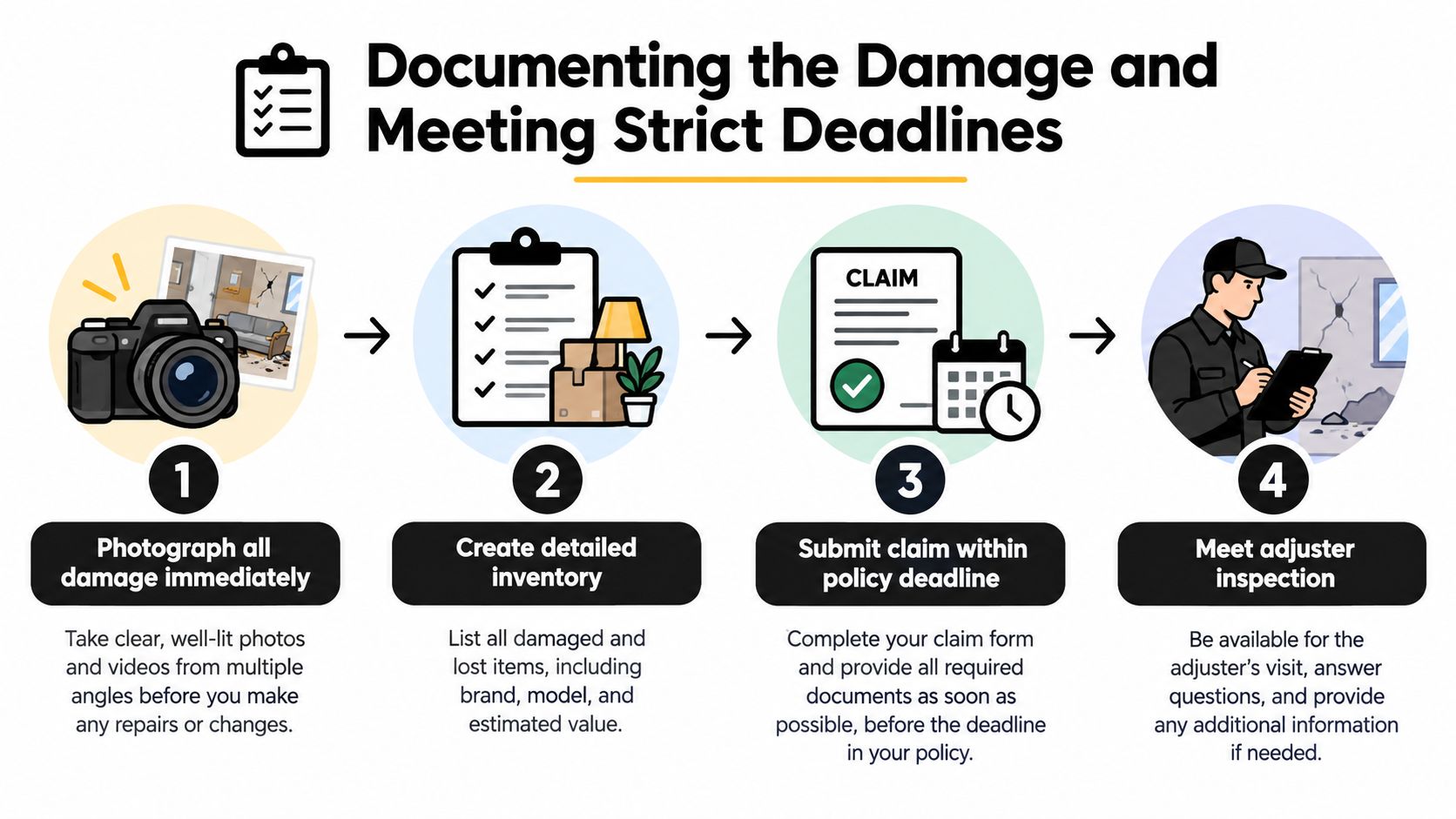
Photograph the property immediately. Take wide shots showing each elevation, then close-ups of shingles, flashing, vents, gutters, siding, windows, fences, and interior staining. Keep the original files and record when the images were taken.
Create an inventory. List damaged building components and personal property separately. Note the location, apparent cause, and current condition. A room-by-room list helps prevent small but legitimate items from disappearing from the claim.
Prevent additional damage safely. Use a qualified professional for emergency tarping or temporary repairs when necessary. Save invoices and receipts. Don't make permanent repairs before the insurer has a reasonable opportunity to inspect unless immediate safety or weather conditions require it.
Submit notice within the policy deadline. Provide the date of the storm, the observed damage, temporary measures, and your contact information. Ask for a claim number and written confirmation of the inspection appointment.
Attend the adjuster's inspection. Point out areas that aren't obvious from the ground, including roof slopes, attic staining, granular loss, bent metal, and collateral damage. A contractor's inspection can help identify conditions an adjuster may not see during a brief visit.
Temporary protection matters because insurers may question damage that worsened after the storm if the homeowner failed to act reasonably. Keep every receipt, photograph the temporary work, and describe why it was necessary.
Before the adjuster arrives, schedule a professional storm damage roof inspection with someone who can safely examine the roof and explain the findings in writing.
This video provides a visual overview of documenting damage for an insurance claim:
Choosing the Right Advocate for Your Claim
The insurer's adjuster works for the insurer. That doesn't make the adjuster dishonest, but it does mean the adjuster's assignment is to evaluate the loss under the company's procedures and policy interpretation. Homeowners should have someone focused on the technical completeness of the property damage.
A public adjuster represents the policyholder and negotiates the claim, usually for a fee or percentage arranged under a separate agreement. That can help when the loss is broad, disputed, or difficult to document. The tradeoff is that the public adjuster generally handles the claim negotiation, while the homeowner still needs to select and manage the contractor who performs the restoration.
A storm-experienced contractor brings a different advantage. The contractor can identify damaged roofing components, explain installation requirements, develop a repair scope, and participate in the inspection. A contractor doesn't replace the insurer's coverage decision, and shouldn't promise approval. The value is technical evidence and project continuity.

Choose representation based on the problem
Use this decision framework:
- Straightforward, limited damage: You may handle communication yourself if you understand the policy and can document the scope.
- Technical roof damage: Bring in a qualified roofing contractor who can inspect concealed or difficult-to-see areas and prepare a detailed scope.
- Coverage disputes or complex losses: Consider a public adjuster or insurance attorney after reviewing fees, authority, and contract terms.
- Full restoration needs: Favor a contractor who can coordinate roofing, siding, gutters, painting, emergency protection, and cleanup under one documented plan.
A GAF Certified contractor may also bring useful product and installation knowledge, but certification doesn't guarantee claim approval. Ask who will attend the inspection, what documentation you'll receive, whether the company is licensed, bonded, and insured, and how it handles supplements when hidden damage appears.
You can also review practical guidance on negotiating with an insurance adjuster. Keep the conversation factual. Ask the adjuster to identify the policy provision supporting a denial, exclusion, depreciation deduction, or omitted line item.
The Two States Exteriors End-to-End Claim Process
A storm restoration project has two separate tracks. The first is the insurance claim. The second is the physical construction. Problems arise when a homeowner treats them as one simple transaction and signs a repair agreement before understanding the scope, deductible, and payment schedule.
Two States Exteriors LLC is one Kansas City Metro Area option for coordinating those tracks. The company provides roof repair and replacement, gutters, siding, decks and patios, and interior and exterior painting, along with storm-damage claim support. Its process includes a free on-site inspection, project planning, emergency response, construction, and cleanup.

Keep the money and scope clear
The company's No Money Upfront policy is designed to avoid asking property owners to pay construction costs before insurance funds are released. That doesn't erase the policyholder's deductible or guarantee that an insurer will approve every requested item. It does create a clearer conversation about what the homeowner owes, when payment is due, and which work belongs in the approved scope.
A responsible contractor should explain:
- Inspection findings: What damage was observed and where.
- Repair scope: Which roofing and exterior components require work.
- Insurance coordination: What documents or photographs support the claim.
- Payment timing: What the insurer pays, what the homeowner owes, and when.
- Change orders: How concealed damage or approved supplements will be handled.
- Site protection: How the crew will protect landscaping, interiors, and surrounding property.
For commercial property managers, one point of contact can simplify communication across roof areas, gutters, siding, tenant concerns, and scheduling. For homeowners, the same coordination helps preserve curb appeal instead of leaving separate crews to solve connected exterior problems independently.
Two States Exteriors LLC states that it has served Kansas and Missouri since 1997 and operates as a licensed, bonded, and insured contractor with GAF Certified credentials. Verify current licensing, insurance, written scope, references, and contract terms before hiring any contractor. Those checks matter more than a storm-season promise made at the door.
Securing Your Property and Planning the Next Steps
Storm damage insurance coverage depends on more than whether the roof looks damaged. Policy deadlines, cosmetic exclusions, actual cash value settlements, and the quality of your documentation can determine whether the claim pays.
Protect people first. Keep everyone away from unstable roof sections, exposed wiring, broken glass, and loose exterior materials. Arrange temporary protection where needed, photograph the property before repairs begin, and keep receipts for reasonable emergency expenses.
Collect the documents that control the claim:
- Declarations page: Check dwelling limits, deductibles, endorsements, and policy dates.
- Full policy wording: Review wind, hail, cosmetic damage, water, roof settlement, and notice provisions.
- Storm record: Write down the date, approximate timing, and observed conditions.
- Damage file: Keep photographs, videos, inspection reports, inventories, estimates, claim correspondence, and receipts together.
- Inspection schedule: Arrange a qualified roof inspection before or alongside the insurer's inspection when possible.
A quick inspection is not a complete claim. Roof bruising, displaced materials, damaged flashing, and related interior or exterior losses may not be visible from the driveway. Give the adjuster access to every affected area, and organize your evidence so it connects each repair to the storm.
Severe convective storms remain a major source of insured losses. The Verisk loss analysis describes the scale of these events. As noted earlier, insurers may also apply shorter reporting deadlines, ACV roof settlements, and cosmetic exclusions. Read those terms before assuming coverage.
Before the adjuster arrives, prepare a one-page timeline listing the storm date, when you first saw damage, temporary measures taken, and every call or email with the insurer. Give the adjuster a copy at the inspection.
Two States Exteriors LLC offers free on-site storm inspections, roof and exterior restoration, and insurance-claim support for Kansas City Metro Area property owners. Visit Two States Exteriors LLC to request an inspection and discuss the next step for your damaged roof or property.