
You've found shingles in the yard after a storm, and now you're comparing roofing estimates. One proposal includes stripping everything off. Another offers to install new shingles over the old roof for less money. The cheaper option is tempting, but the useful question isn't just what you can leave in place. It's what you'd be covering up, and what you'll pay to remove later.
Overlay and Tear-Off Compared at a Glance
An overlay, also called a recover, installs new shingles over an existing shingle covering. A tear-off removes the old roofing down to the wood deck before crews install the replacement assembly.
Overlay vs tear-off across the decision factors
| Factor | Overlay (recover) | Tear-off and replace |
|---|---|---|
| Existing layers allowed | A sound single layer may qualify; adding a third isn't permitted | Existing layers removed to the deck |
| Typical cost per square foot | Lower initial cost because stripping and hauling are reduced | Higher initial cost because removal and disposal are included |
| Disposal volume | Little removal waste, apart from preparation and replaced details | Full shingle and underlayment removal waste |
| Deck inspection | Top surface remains concealed | Deck exposed for inspection, repair and documentation |
| Storm-claim documentation | Limited evidence of concealed conditions | Better access to photograph deck condition |
Municipal guidance such as Bloomington's reroofing handout permits a maximum of two total asphalt-shingle layers, making the existing layer count a practical starting point rather than a minor estimating detail.
What you're actually buying
With an overlay, you're buying a new weather-facing covering while retaining much of the existing assembly. That saves stripping labor, hauling and disposal. It doesn't buy the same access to the wood underneath.
With a tear-off, you're paying for removal and an opportunity to correct the substrate before covering it again. That opportunity matters if shingles look acceptable from the driveway but the attic shows staining, the roof surface sags, or flashing has been patched repeatedly.
Practical rule: An overlay is a conditional shortcut on a sound existing roof. A tear-off is the safer default when the deck's condition is uncertain.
Don't confuse less demolition with equivalent scope. An overlay estimate that retains old valley flashing isn't directly comparable to a tear-off estimate that replaces it. Likewise, a low replacement price may exclude deck repairs until crews uncover the wood.
At Two States Exteriors LLC, we offer re-roofing with either a complete tear-off or a recovery. The choice should follow an inspection, not a preference for whichever estimate looks smaller.
For a homeowner weighing roof tear off vs overlay, the most useful starting documents are the roof's installation history, attic photographs and a written description of what each contractor plans to retain. Those records help separate a legitimate recover candidate from a roof that looks recoverable from the ground.
When Building Codes Allow an Overlay
A third roof-covering layer isn't permitted under the cited IRC reroofing framework. The City of Plainview's residential reroofing requirements explain that an existing roof with two or more applications must be removed, as must roofing that's water-soaked or too deteriorated to provide an acceptable base.
That's a baseline, not permission for every property. Your municipality's adopted code, amendments and permit requirements control the project at your address. A Texas municipal handout explains the framework; it doesn't establish the requirements for a Kansas City-area house.
This checklist illustrates the distinction between an eligible base and a roof that needs removal.
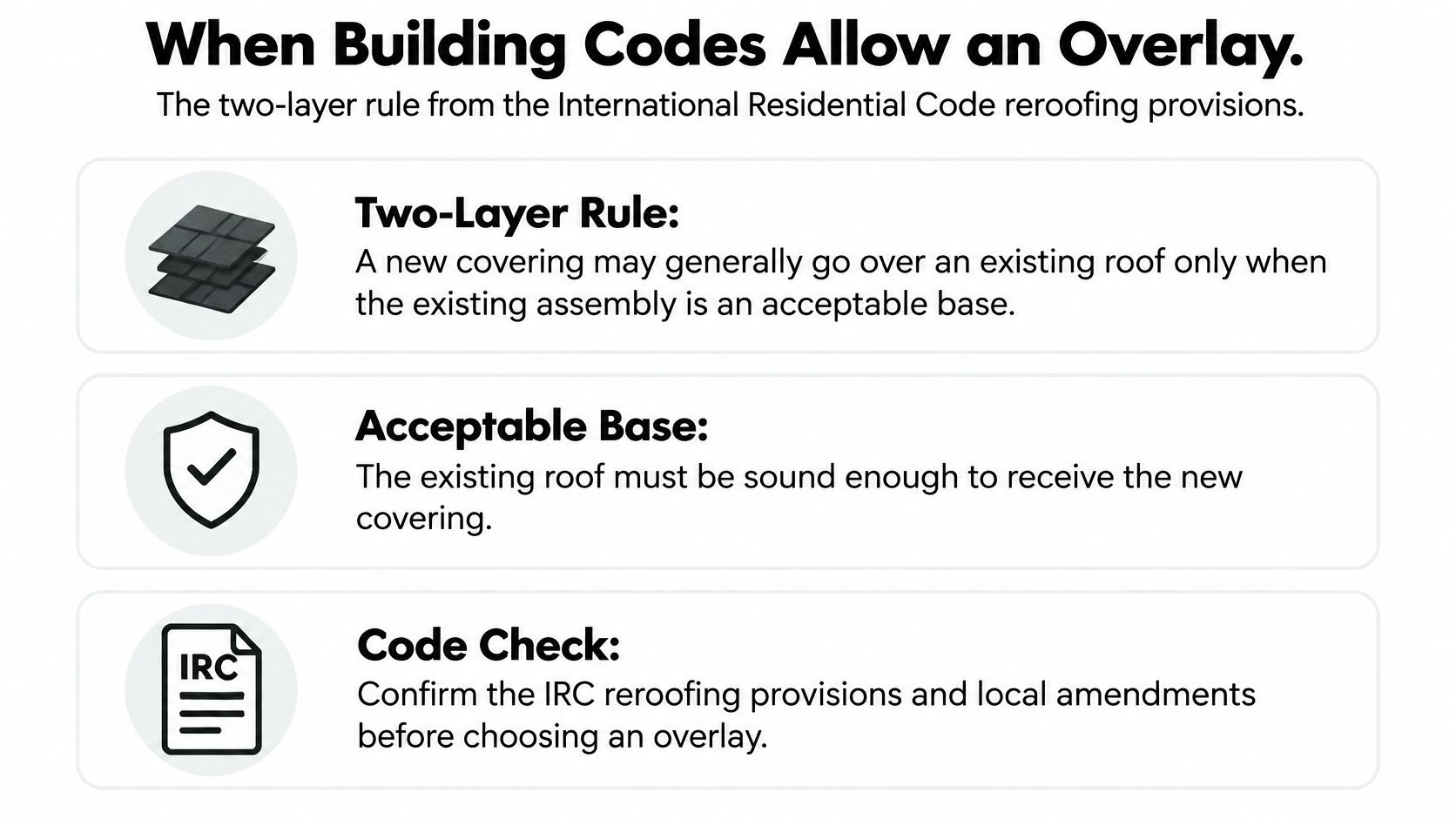
Check the roof before choosing the method
Confirm the layer count at an exposed edge. A roofer can inspect a cut edge near the rake, eave or penetration. Don't count starter strips as separate full-roof applications, and don't assume the visible top course tells the whole story. Leave climbing and lifting brittle shingles to someone using proper fall protection.
Inspect the deck from the attic where accessible. Use a strong flashlight to look for staining, darkened sheathing, sagging and daylight around penetrations. A qualified inspector can check suspect wood for softness without damaging sound panels. Walk only on supported framing or proper walkways, never ceiling drywall.
Identify the existing covering. Slate, clay, cement and asbestos-cement tile aren't ordinary asphalt recover candidates. If an older covering could contain asbestos, don't cut, drill or sample it yourself.
Contact the building department for the property's jurisdiction. Request the adopted reroofing provisions, local amendments and permit rules. In the Kansas City metro, confirm the applicable city or county requirements rather than relying on what was accepted across the state line.
Older houses need a closer look
A house can appear to have a straightforward shingle roof while retaining an older application underneath. Past invoices and home-inspection reports are useful, but they don't replace checking the actual assembly.
Permit scheduling also deserves attention before work begins. For an example of how inspection sequencing affects renovation planning, 9Builders' San José permit inspection timeline provides an out-of-market reference. Use your own building department's instructions for local scheduling and inspection requirements.
What Each Option Costs Per Square Foot and Per House
An overlay usually costs less upfront because it avoids stripping and disposing of the existing shingles. A 2026 K-Taku comparison puts overlay roofing at $3.50–$5.50 per square foot, compared with $5.00–$8.00 per square foot for tear-off and replacement. These are published comparison ranges, not a Kansas City quote.
Whole-project figures vary by roof size and scope. Peak and Valley Roofing, project ranges lists $3,000–$8,000 for an overlay and $8,000–$15,000 for tear-off and replacement. Home Improvement Nest, upfront difference reports overlays costing 15%–25% less upfront than tear-off. These figures describe different projects, so treat them as reference points rather than interchangeable bids.
Published overlay and tear-off cost figures, 2026
| Source and basis | Overlay | Tear-off and replacement |
|---|---|---|
| K-Taku, per square foot | $3.50–$5.50 | $5.00–$8.00 |
| Peak and Valley Roofing, project ranges | $3,000–$8,000 | $8,000–$15,000 |
| Home Improvement Nest, upfront difference | 15%–25% less | Comparison baseline |
The gap depends on roof pitch, access, building height, shingle choice, disposal charges and whether deck repairs are included. Compare the work, not just the total. An overlay that leaves existing flashing in place is not equivalent to a replacement that renews flashing, underlayment and ventilation details.
Put estimates on the same basis
- Use measured roof area. Ask for a roof measurement that accounts for slopes, additions, dormers and attached sections. The home's floor area is not the roof's surface area.
- Check the material allowance. Have the estimator show the allowance for cuts, valleys, hips and waste. Roof layout affects how much material the job requires.
- List exclusions. Confirm decking repair rates, flashing replacement, ventilation work, permit handling, disposal and property protection.
For additional budgeting context, see our roof replacement average cost guide. If you compare estimates from another market, ShamFix explains how to find local roofers and quotes. Its Ireland-focused pricing should not be applied to Kansas City.
The upfront difference is a real saving only when the existing roof is suitable for an overlay. If hidden defects or unsuitable conditions require removal later, the shortcut can shift costs rather than avoid them.
The Later Cost of Leaving Two Layers
An overlay postpones removal; it doesn't eliminate it. When the roof eventually needs stripping, crews must handle the retained covering along with the newer shingles. More material means more loading, hauling and disposal, even if the original overlay produced little demolition waste.
The end-of-life sequence is straightforward.
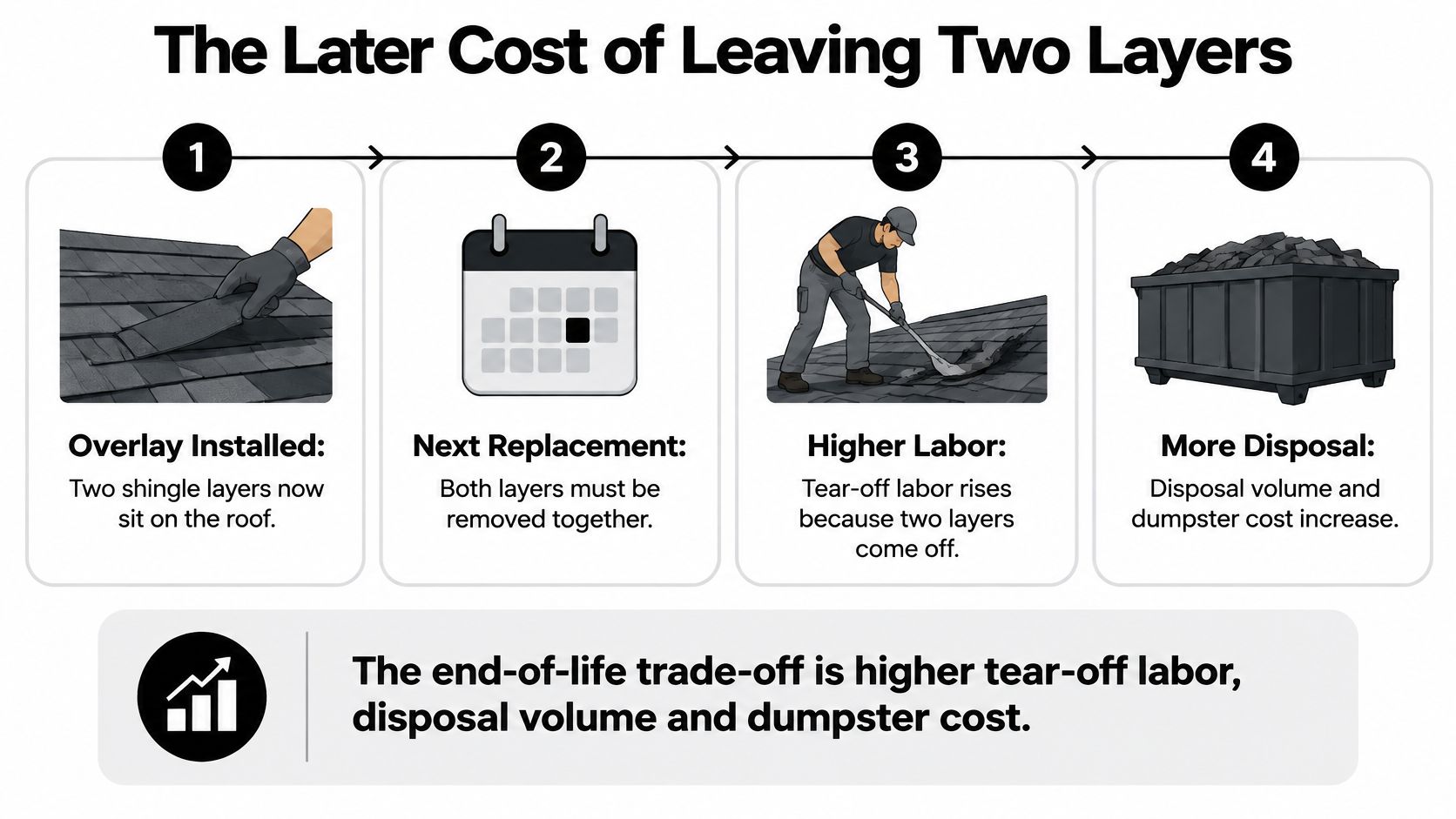
The EPA's asphalt-shingle waste document identifies shingles as a substantial construction-and-demolition waste stream and explains that they don't biodegrade in landfills. Recycling into uses such as paving materials is possible, but a theoretical recycling option isn't the same as an accessible local outlet accepting your project's shingles.
Compare equivalent ownership periods
Say you're choosing between an overlay now and a tear-off now. In the overlay scenario, your worksheet needs the current recover price, the eventual cost of removing the accumulated roofing, and an allowance for concealed repairs discovered then.
In the tear-off scenario, include today's replacement cost and the next replacement after that roof reaches the end of its useful service. Don't compare an overlay plus a future replacement against only today's tear-off, then call the difference a lifecycle result. Those totals purchase different periods of roof service.
The cheapest installation isn't necessarily the cheapest ownership path. Compare the same period, comparable materials and realistic repair assumptions.
Use current local quotes as the starting point, then test what happens if labor and disposal become more expensive or storm damage brings replacement forward. Holding future prices near today's levels can be a useful scenario, but it's an assumption, not a forecast.
This installation video offers additional visual context for discussing the work with an estimator.
Ask where the deferred cost lands
- Total ownership cost: What happens to the comparison if the overlay needs replacement earlier than hoped?
- Local disposal charges: Does the future removal allowance account for all retained material and applicable hauling charges?
- Recycling access: Is there an accepting shingle recycler within practical hauling distance, and what sorting or contamination restrictions apply?
Our guide to how often roof replacement is needed can help frame the timing discussion. Don't assign an overlay a guaranteed lifespan just to make the spreadsheet favor the lower bid.
How Each Option Holds Up and Installs
A roof's durability starts beneath the visible shingles. New shingles need secure fastening, a suitable surface and details that shed water. Putting them over an uneven or damp assembly doesn't correct those conditions.
The 2024 International Residential Code's roof-assembly provisions require an acceptable existing base and installation consistent with applicable manufacturer instructions. That makes substrate condition and product compatibility more useful than a blanket claim that every overlay lasts a certain number of years.
The installation details that matter
Added weight. Retaining the old covering adds load to the framing. On an older house with sagging rafters, altered framing or uncertain structural condition, get that concern evaluated before approving a recover.
Fastener engagement. The new nails must pass through the retained covering and achieve the manufacturer's required deck engagement. Nail length alone isn't enough if the underlying wood won't hold fasteners.
Flatness and sealing. Curled tabs, buckled shingles and irregular transitions can prevent the new covering from sitting correctly. Crews shouldn't treat severe unevenness as something the new shingles will flatten.
Flashing and edges. Ask exactly what happens at valleys, walls, chimneys, plumbing vents and eaves. An overlay doesn't automatically require keeping every old flashing, but replacing integrated details can be more difficult without removing surrounding roofing.
What a tear-off makes accessible
Removing the covering lets crews inspect panel joints, replace deteriorated sheathing and install new underlayment on an accessible deck. It also allows them to address eave protection, ventilation openings and flashing transitions without working around a retained shingle layer.
That access isn't a promise that every component will be renewed. The contract must identify what gets replaced, what can remain after inspection and how concealed repairs will be authorized.
A tear-off also creates a temporary weather-management responsibility. Ask how much roof the crew plans to open, how they'll achieve a dry-in, and what temporary protection they'll use if the forecast changes. An overlay reduces stripping-related exposure, but the crew still needs to protect openings and unfinished details.
Finish the comparison with the specific shingle's installation instructions and warranty documents. Don't accept “same warranty” without identifying whether that means material coverage, workmanship coverage or an enhanced roofing-system warranty.
Which Option Fits Your Roof Situation
Consider a ranch house with flat shingles, dry attic sheathing and a documented installation history. If inspection confirms that the existing assembly is suitable, a recover may be a reasonable way to control immediate expense.
Now consider a taller house where the roofer finds an older covering beneath the visible shingles. The owner's original preference for an overlay no longer decides the scope. The actual roof assembly does.
These houses may look similar from the street while requiring different work.
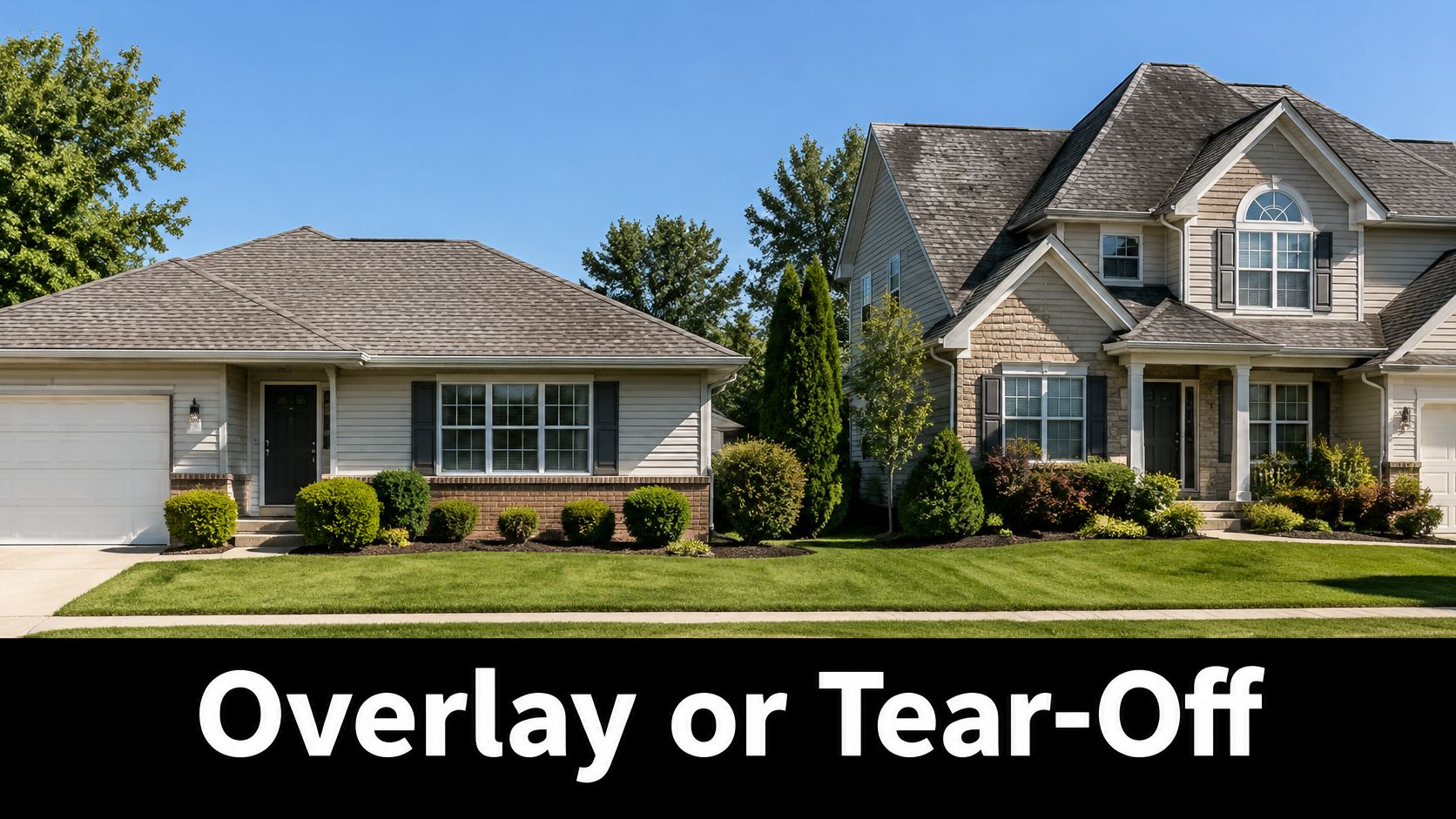
Which option usually fits each roof situation
| Situation | Usually fits | Why it decides it |
|---|---|---|
| Sound existing layer, dry deck, no storm damage | Overlay candidate | A suitable base can justify retaining the covering if local and product requirements allow |
| Roof already carrying the maximum permitted applications | Tear-off | Another recover isn't an available code-compliant option |
| Soft or water-damaged deck | Tear-off | The failed base needs access and repair |
| Slate, clay, cement or asbestos-cement tile | Tear-off or an approved material-specific replacement plan | These aren't ordinary asphalt recover substrates |
| Hail or storm damage on an insurance claim | Tear-off when replacement scope and inspection support it | Exposing the deck allows concealed conditions to be evaluated and documented |
| Roof near end of life, sale planned | Inspection-led decision | A sale deadline doesn't make an unsuitable assembly acceptable |
| Long ownership with a long planning horizon | Tear-off often fits better | Starting with an accessible, corrected base reduces inherited uncertainty |
The sale scenario deserves particular care. Installing a new surface doesn't answer a buyer's questions about past leaks, retained roofing or workmanship. Keep inspection photographs, permits, invoices and warranty documents regardless of which method you choose.
An overlay is decided by the retained layers and the suitability of the base. A tear-off scope is refined by what inspection and removal reveal.
Don't let ownership plans replace inspection
A short ownership horizon can make the smaller invoice attractive, but it doesn't change the roof's physical requirements. Conversely, long ownership doesn't automatically make every recover a bad choice.
I would favor a tear-off when the roof has unexplained leaks, uneven decking or extensive patched transitions. For a sound recover candidate, I would compare the documented initial saving with the accepted future removal obligation.
The right answer isn't “always overlay” or “always tear off.” It's an eligible, dry and stable roof, matched to a clear scope and an owner who understands what remains underneath.
Storm Claims, Insurance and Pre-Signing Checks
An overlay changes what can be inspected without removal. It can leave concealed deterioration undocumented, which becomes important if a later storm claim requires crews to distinguish new damage from pre-existing conditions.
A tear-off provides access for photographs and repairs before the replacement assembly covers the deck. That record can support a scope discussion, but better documentation doesn't guarantee insurance coverage.
A written roof inspection should connect visible damage to specific locations, materials and recommended work.
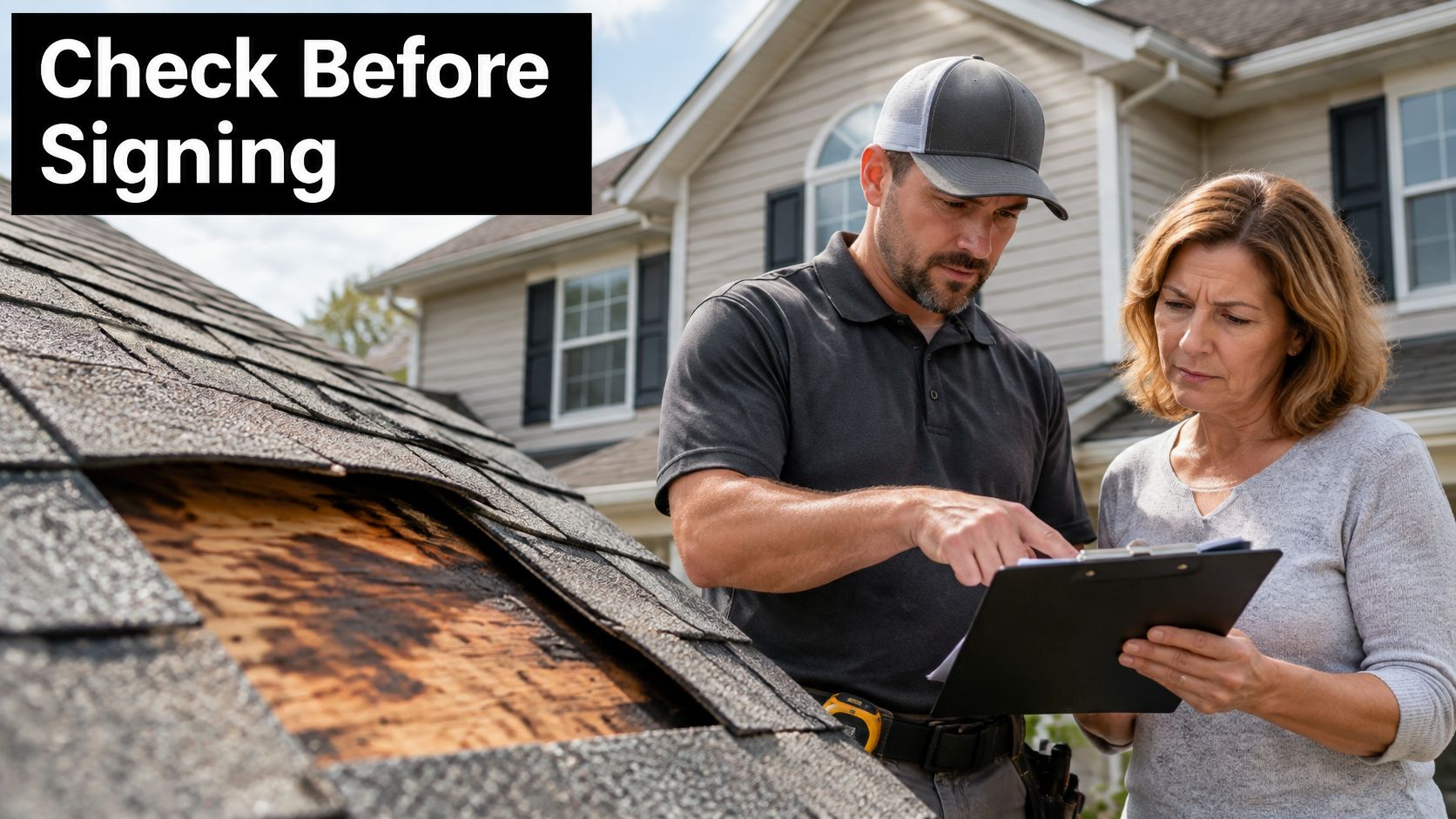
How a later claim can change the calculation
Say a recovered roof suffers hail damage during a later storm. During removal, crews discover wet, deteriorated decking beneath the retained covering. They now need to document the condition, determine the repair scope and request any appropriate supplement before covering the affected area.
That doesn't mean the insurer will pay for all the wood. Long-term leakage, deterioration and storm-caused damage may receive different treatment under the policy. The contractor can document what's present; the policy and claim determination govern payment.
The ReplaceCost overlay-versus-tear-off guide highlights why homeowners should check code requirements, insurance language and manufacturer conditions together. An installation can be physically possible without being the best fit for your future claim exposure.
Complete these checks before signing
Confirm the address-specific permit requirements. Obtain the adopted code, amendments and required inspection stages from the local building department. Make sure the proposal identifies who handles permits and how required inspections fit into the work.
Read the insurance settlement language. Ask your insurer how replacement-cost and actual-cash-value provisions apply to the roof, and whether a future covered replacement would include removing retained roofing. Also ask about depreciation, roof-specific endorsements, exclusions and ordinance-or-law coverage. Get answers tied to your policy, not a general reassurance.
Identify the exact manufacturer coverage. Obtain the shingle product name, installation instructions and proposed warranty. Ask whether recovering affects eligibility for enhanced coverage or other product-specific benefits. A contractor's workmanship promise isn't interchangeable with the manufacturer's coverage.
Request a written condition record. It should describe the existing assembly, accessible deck condition, leak evidence, flashing and ventilation. Where the deck can't be fully evaluated before removal, the estimate should say so and explain the process for approving concealed repairs.
If a fallen tree is part of the loss, Richmond Tree Experts GA's guide to filing a fallen tree insurance claim provides related claim-preparation context. Coordinate emergency protection and documentation without assuming that tree removal and roof restoration have identical coverage terms.
We provide roof repairs for customers who need them for insurance claims, and we perform annual or semiannual roof inspections. Our roof insurance claims process guide explains the roofing side of preparing and documenting a claim.
Policy wording controls, not the contractor's estimate. If inspection supports a recover and the code, policy and product requirements align, an overlay can fit. Otherwise, request a tear-off proposal using the same inspection notes, with clear allowances for concealed work.
We offer complete tear-offs, roof recoveries and repairs for storm-related insurance claims. Visit Two States Exteriors LLC to arrange an on-site inspection and discuss which approach fits your roof's condition, with the retained materials and potential repair costs made clear before you sign.