
Most Kansas City-area asphalt-shingle roofs need replacement between roughly years 12 and 20. Storm damage can move that date earlier for any roof, and premium materials last far longer.
You're in the driveway after a spring hail cell, staring at a roof the builder called a 30-year architectural. The tabs still lie flat. Then the gutters look like a sandbox. Granules, in year 14. That's when the warranty card stops acting like a calendar.
If you're sorting roof replacement how often for a house in this metro, the useful answer is a condition timeline, not a single national interval. Hail, wind, freeze-thaw, and wide daily temperature swings put more miles on asphalt than a mild-climate average assumes.
Why Roof Replacement Timing Is Not One Number
A 30-year label is a rating under gentle assumptions. It isn't a promise about a south slope in Overland Park after three hail seasons and a July attic that cooks the deck.
Weather does the miles. A shingle can look intact and still carry bruised mats, lifted tabs, and seal strips that never resealed after a wind event. Freeze-thaw then works those small openings. A rule copied from a national brochure was never written for that pattern.
The card and the roof disagree on purpose. Manufacturers rate products under controlled installation and climate. Your roof also inherits who nailed it, how the attic breathes, and whether anyone cleared the valleys. Two houses on the same block, same shingle, same year, can be a decade apart.
Age opens the file. Condition writes the verdict. A storm can reopen the file any year.
Use the material table as a budget window, then read the roof in front of you. The rest of this is how I place a Kansas City roof on that timeline: what shortens it, which symptoms mean tear-off, when to inspect a roof that still looks fine, and how three ordinary houses land on three different dates.
Roof Replacement Timelines by Material
Start with the material, then discount the label. Typical life in Kansas City conditions assumes ordinary exposure, working ventilation, and basic maintenance. Common rated lifespan is the manufacturer label under careful installation and a kinder climate. Plan replacement around is when I want quotes and a documented inspection, before the ceiling stains force the date.
| Roofing material | Typical life in Kansas City conditions | Common rated lifespan | Plan replacement around |
|---|---|---|---|
| Asphalt 3-tab shingles | 12-18 years | 20-25 years | years 12-16, sooner after major hail or wind |
| Architectural asphalt shingles | 15-22 years | 30-50 years | years 15-20, sooner with storm damage |
| Metal standing seam | 40-70 years | 40-50 years | inspect coatings and fasteners after year 30 |
| Wood shake | 20-30 years | 25-30 years | years 20-25 in humid, freeze-thaw climates |
| Concrete or clay tile | 50+ years | 50-100 years | underlayment and flashing often need work first |
| Natural slate | 75-150 years | 100+ years | check flashings and fasteners, not the slate itself |
| Synthetic slate or shake | 30-50 years | 40-50 years | follow manufacturer inspection milestones |
| EPDM or flat membrane | 25-40 years | 25-30 years | seams, flashing and drainage after year 20 |
How to read the Kansas City column
The gap between the rated column and the local column is the whole point. Architectural shingles are often sold on a 30- to 50-year label. On a Kansas City house with average sun, wind, and hail, I plan the conversation in years 15-20, and earlier if a storm has already marked the field. Three-tab moves sooner because the mat is thinner, and once granules go, the asphalt has little left to give.
The early decline is easy to miss. Asphalt shingles can lose useful wind resistance roughly 5-10 years before they look finished: seal strips harden, tab edges lift, and a moderate gust starts damage that a younger roof would have shrugged off. That is why an inspection around years 12-15 on architectural shingles, and earlier on 3-tab, is the replacement-planning tool. It turns a vague age into a budget window.
National averages look calmer than this table. A tabulation of the 2017, 2019, 2021, and 2023 American Housing Surveys, published by Benton Roofing, found a U.S. annual roof-replacement rate of 3.77%, which implies a replacement cycle of about 22-28 years. That blend mixes mild coasts, harsh interiors, metal, tile, and asphalt. It overstates what a conventional shingle roof endures here.
Flat roofs run on a different clock. A 2025 survey of 570 roofing professionals, reported by FacilitiesNet and citing the EPDM Roofing Association, found properly installed EPDM systems commonly provide 25-40 years or more, with recent field studies showing an average service life of 38 years. Seams, edge metal, and ponding still decide whether a roof reaches that average. I start seam and drainage checks after year 20, not at year 38.
What the last column is for
Plan replacement around is a budgeting window. Get the install year, photograph each slope, and price a tear-off while you still have a dry ceiling. A well-detailed metal roof can run long past year 40 if coatings and fasteners stay sound. Tile and slate usually outlast the underlayment and flashings beneath them, so the part that fails first is often the waterproofing you cannot see from the curb.
If hail has just moved your date up, the practical problem is getting the inspection booked while phones are jammed; some contractors use AI call answering for roofers so requests are logged while crews are still on ladders.
What Shortens or Extends a Roof's Life
A roof ages like a tire. Calendar age is the odometer reading nobody trusts by itself. Miles, road surface, heat, and whether anyone rotated the tires decide when the tread is gone. Four forces move the replacement date on a Kansas City house.
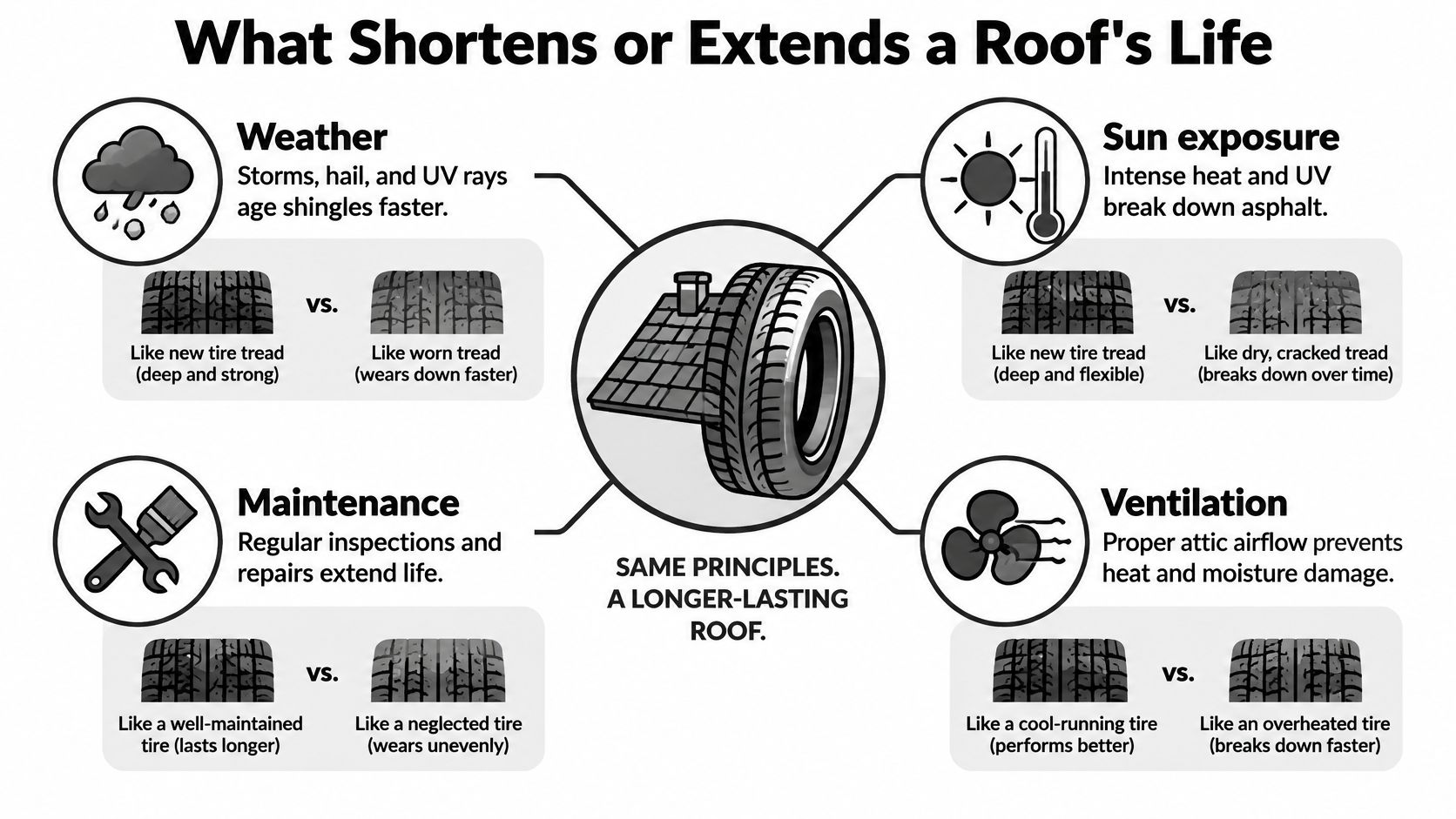
Weather exposure
Hail bruises the mat. Wind breaks the seal. Ultraviolet light bakes the asphalt. Freeze-thaw opens whatever those three started. A federal U.S. roofing survey, preserved in a National Institute of Standards and Technology publication on GovInfo, found reported asphalt-shingle life averaged 16 years in 26 states north of about the 40th parallel and 12 years in 21 states farther south. Climate was part of the gap, and the same research warned that shingle weight, exposure, construction, and maintenance still decide the ending. Kansas City sits in the weather that makes those averages diverge: hard freezes, wind, and hail.
Daily temperature swing shows up in newer county-level work too. An analysis of more than 2.8 billion AI-derived roof observations, covered by Professional Roofing, found counties with temperature fluctuations above 23°F averaged 9-year-old roofs, versus 11.1 years where fluctuations stayed below 20°F. That's a tire on a gravel road versus the same tire on smooth pavement. Same product, more flexing, earlier replacement.
Attic heat and ventilation
Shingles over a hot, closed attic age from the back. The U.S. Department of Energy's Building America insulation guidance reports that shingles over unvented attics run hotter and that homeowners may see about a 10% reduction in roof service life. Intake at the eaves and exhaust at the ridge have to balance. A box vent on a roof that never got soffit intake mostly spins warm air in a circle. When we replace a roof, the vent layout belongs in the same conversation as the shingle. A side-by-side of ridge vent vs box vent is the practical version of that choice.
Installation and upkeep
Flashing, underlayment, nail pattern, and deck condition decide whether a roof ever reaches the local column in the table. A perfect shingle on rotten decking is a short story. Maintenance is the unglamorous half: cleared gutters, trimmed limbs, moss and algae dealt with before they hold water, and a leak fixed before it soaks the sheathing.
Two identical roofs on the same street can need replacement a decade apart. Age is only the screening question.
I would not spend the replacement budget on a young roof with one bad valley flashing. I would spend it when weather, heat, and a sloppy install are all showing up on the same slopes.
Warning Signs and the Repair-Versus-Replace Call
A missing shingle after a thunderstorm is not automatically a replacement. Judge the roofing system: isolated damage on a young, well-sealed roof is a repair, while broad deterioration across several slopes points to replacement even if the calendar still looks generous.
Replacement means the old roof comes off. Recovery, or an overlay, puts a new layer over what is already there. An overlay only makes sense when the deck is sound, the underlayment is still doing its job, ventilation is balanced, and local rules allow one extra layer. Covering curled, soft, or repeatedly leaking material hides the problem and loads the new layer over a weak base.
| Warning sign | What it usually means | What to do next |
|---|---|---|
| Granules filling gutters and downspouts | Shingle surface is wearing toward the end of its life | Professional inspection; discuss replacement if loss is widespread |
| Curling, cupping, or brittle shingles | Heat and moisture aging; shingle losing flexibility | Replace when curling shows across many slopes; repair isolated spots |
| Missing, cracked, or lifted shingles | Wind uplift or storm damage | Repair a few; repeated loss on an aging roof points to replacement |
| Water stains on ceilings or attic decking | Failed flashing, underlayment, or a leak path | Trace the leak; recurring or multiple stains mean a replacement conversation |
| Sagging rooflines or soft decking | Trapped moisture weakening the deck | Urgent professional evaluation; usually full replacement |
| Cracked or rusted flashing at chimneys and vents | Seal failure at the roof's weakest points | Repair if isolated; weigh roof age before patching an old system |
| Dark streaks or moss | Algae growth and chronic moisture | Clean and improve drainage; trapped moisture shortens shingle life |
| Spikes in heating or cooling bills | Poor attic ventilation or insulation stressing the roof | Evaluate the attic; fix ventilation before it shortens shingle life |
Where the line sits
Replace when granule loss is widespread, curling shows on multiple slopes, leaks keep returning, underlayment is exposed, flashing has failed at several penetrations, or the deck sags or feels soft. Soft decking is urgent. Water is already in the structure, and another tube of sealant won't put strength back in the plywood.
Repair when a handful of shingles took a storm hit and the rest of the field is sealed, flexible, and granule-sound. Caulk and a few replacements are the right spend. A third patch on the same aging slope is usually money chasing a roof that is already declining.
Kansas City hail and heat make 20- and 30-year labels optimistic more often than brochures admit. I would rather see the decision driven by seal condition, leak history, deck firmness, and how many slopes are failing at once than by a birthday. That is the framework behind roof replacement vs repair: tear-off when the system is spent, recovery only when the base can carry it.
Two States Exteriors handles both tear-off and recovery, and the inspection decides which one the deck can support. Specialists check damage before it grows into a larger repair, and the team handles hail and storm insurance claims from documentation through the work. For qualified homeowners, a replacement can include a complimentary upgrade to Class 4 impact-resistant GAF Timberline UHDZ shingles with advanced algae protection.
Each spring, check the gutters for granules. After a hard rain, look at the attic deck with a flashlight. After hail, photograph every slope the same day. A label is a rating; condition is the clock.
When to Inspect a Roof That Still Looks Fine
Waiting for a stain on the ceiling is a bad habit. Wind resistance can slip years before a roof looks old.
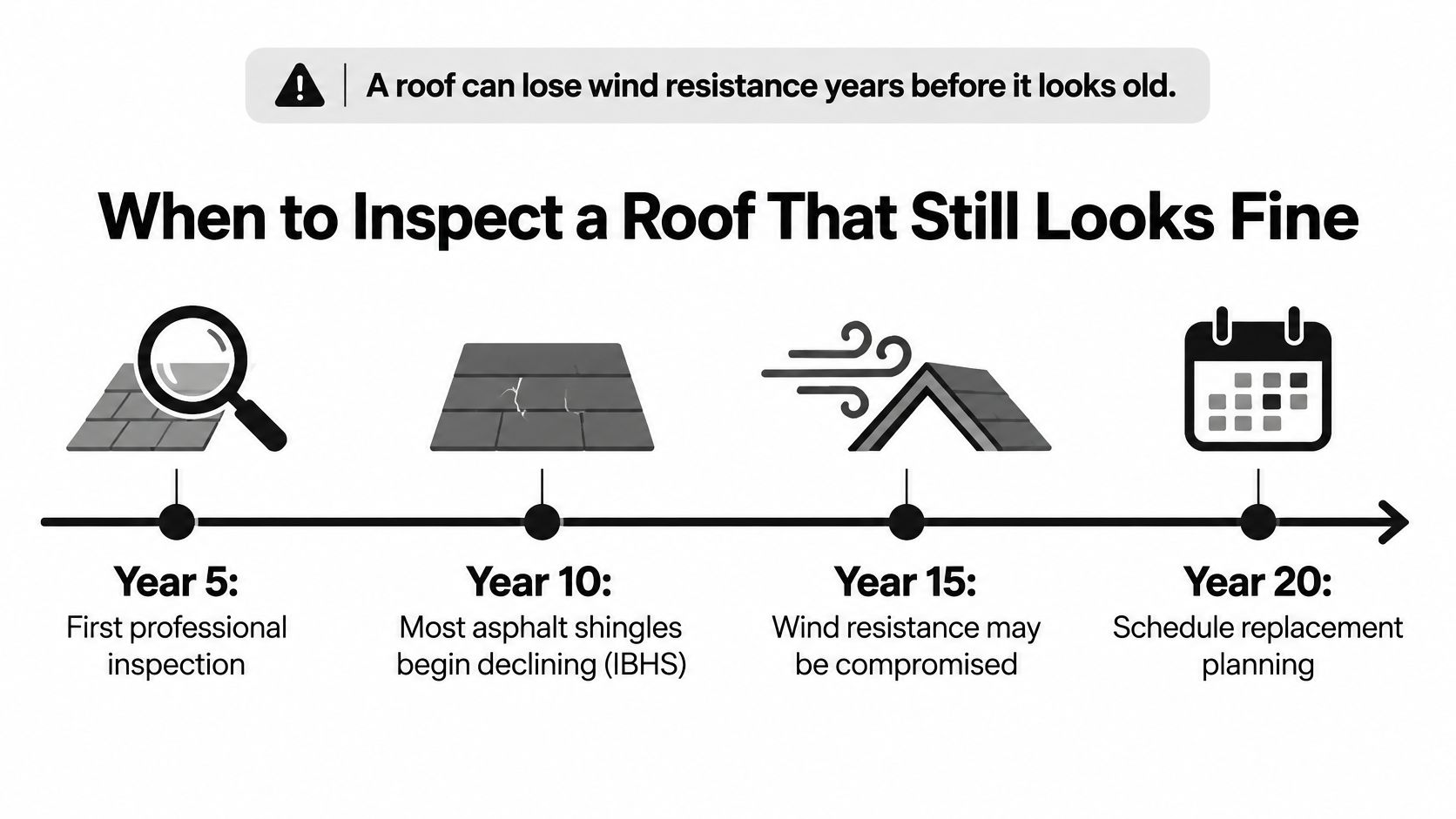
The Insurance Institute for Business & Home Safety tested asphalt shingles naturally weathered for five and ten years in several climate zones, including Ohio and Wisconsin. Its 10-year wind performance research found that wind resistance can improve in the first years after installation, then most products begin declining between five and ten years, with large differences by product and location. Ultraviolet light, extreme heat, freeze-thaw, wind uplift, and hail work on the adhesive, not just the surface you see from the yard. A roof that looks fine can already be losing seal-strip performance.
A schedule that matches the decline
Baseline around years five to eight. Have a roofer on the roof, not a glance from the driveway. Record shingle brand, install date, and photos of every slope, penetration, and flashing run.
Tighten the cadence as it ages. Move to annual or semiannual checks once the roof is past that first decade. We schedule inspections on that rhythm so small defects get caught before they become leaks.
Always after hail or serious wind. A roof only a few years old can still deserve a documented look. Don't wait for an interior drip to decide the storm mattered.
What to put in the file:
- Install facts: date, shingle type, and who installed it, from the permit, invoice, or wrapper stamp.
- Photos: each slope, valleys, chimney, vents, and any bruise or crease you can see in raking light.
- Seal and flashing: lifted corners, cracked sealant, and rust at metal.
- Attic: stains, damp insulation, and whether intake and exhaust move air.
- Claim timing: your insurer's deadlines. Storm photos lose value as weeks pass.
A practical walk-through for what adjusters expect is this guide to document roof damage for insurance claims. Pair it with a local look from someone who reads Midwest hail, not just a checklist. You can start with a residential roof inspection and keep the photos with your policy documents.
This short walk-through shows what a purposeful roof check covers, from the field to the attic.
An older asphalt roof already inside its planning years should be judged on remaining life, damage, and how it was installed. The inspection is the planning tool. The replacement date comes out of that file, not out of a round number on a brochure.
Three Kansas City Roofs, Three Different Timelines
Same metro, three houses, three answers. A National Institute of Standards and Technology analysis of 623 asphalt-shingle roofs damaged in Hurricane Laura in 2020 found damage severity rising notably around the eight-year mark. It did not set eight years as a universal replacement age. Many of those roofs appeared to stay sealed for the first four or five years, and age-related vulnerability mattered more once high wind showed up. That pattern is why I don't wait for a leak in a storm market.
Fourteen years, granules after hail
The calendar says mid-life architectural shingles. No ceiling stain. After the hailstorm, the downspouts are full of grit and a few tabs look bruised in low sun. I would inspect and photograph now, then talk with the insurer, rather than "waiting for year 20" because the roof isn't dripping yet. Remaining seal and mat condition decide repair versus replacement. The storm reopened the file.
Twenty-three years, curls and a second patch
Three-tab, curling on more than one slope, a ceiling stain after two rounds of patching. Calendar and symptoms agree. Another repair buys a season and leaves a tired deck, tired flashing, and tired underlayment in place. I would replace. Repeated patches on a system that's failing across the board are how small leaks become rafter repairs.
Seven years, hot attic, ice dams
The shingles look new from the street. The attic doesn't. It's hot, poorly vented, and the eaves have a history of ice dams. This isn't a tear-off. It's a ventilation correction and an inspection habit before year ten, because heat is already spending the service life the label promised. Fix the airflow, then watch the field. Don't strip a young roof to solve an attic problem.
Age opened each file. Condition decided it. Storms can reopen any of them next season, including a roof that isn't "old" yet.
Estimating Remaining Life and Budgeting the Replacement
A roof that still sheds water can already be inside its replacement window. Shingle seal strips lose wind resistance five to ten years before the field looks bad from the street, so the estimate starts from paperwork and condition rather than from drips on the ceiling.
- Get the install year. Check the permit, the contractor invoice, the roof-age field on your insurance paperwork, or the date stamp on a leftover shingle wrapper in the garage.
- Start from the material window, then shorten it. Subtract current age from the planning window for that material. Pull the date forward for hail history, a windward exposure, a hot or poorly vented attic, or years of skipped maintenance. A clean, shaded, well-vented roof can sit toward the long end of the same window.
- Match the math to the symptoms. Widespread granules, multi-slope curling, soft decking, or repeat leaks override a cheerful age calculation. A few replaced tabs on a sealed young roof do the opposite.
That arithmetic only pays off if you act before it does.
Budget while you still have a choice. The 2023 American Housing Survey, as published by Mark Studios from tabulations attributed to Harvard's Joint Center for Housing Studies, counted about 4.15 million U.S. homeowners reporting a roofing project, with average spending of $11,041. Treat that figure as the planning benchmark for the check you will eventually write. Written quotes gathered during the planning window, while the deck is still dry, let you compare tear-off scope, underlayment, and ventilation across bidders. The same roof bought at emergency pricing buys you whoever can tarp the house on a Friday.
This week, write down three dates: the install year, the last major hail or wind event, and the last time someone walked the roof. If any of those blanks scare you, that is the inspection.
Two States Exteriors LLC has served the Kansas City metro since 1997 with roof replacement, repair, and hail and storm claim support, including free on-site inspections and a no-money-upfront policy. If your roof is in its planning window, or a recent storm left you unsure whether to patch or tear off, an inspection can document the damage and put a real date on the roof. Visit Two States Exteriors LLC to request one.