
You hear water hitting the floor during a Kansas City storm, grab a bucket, and climb into the attic. The leak appears small, but the estimate later includes shingles, flashing, underlayment, and damaged decking. That gap between the visible problem and the actual repair is why a national average often gives homeowners the wrong expectation.
In the Kansas City metro, roof repair cost depends on where water entered, how long it has been present, which roof components failed, and whether wind or hail caused the damage. A few missing shingles may be straightforward. A leaking chimney, soft roof deck, or storm-damaged slope can require a much broader repair.
Understanding Roof Repair Expenses in Kansas City
A homeowner in Overland Park, Independence, or Lee's Summit may notice the same pattern after a severe storm. The shingles look disturbed, but the first interior symptom might be a brown ceiling mark several feet away from the actual entry point. Water can travel along underlayment, roof decking, framing, and insulation before it becomes visible indoors.
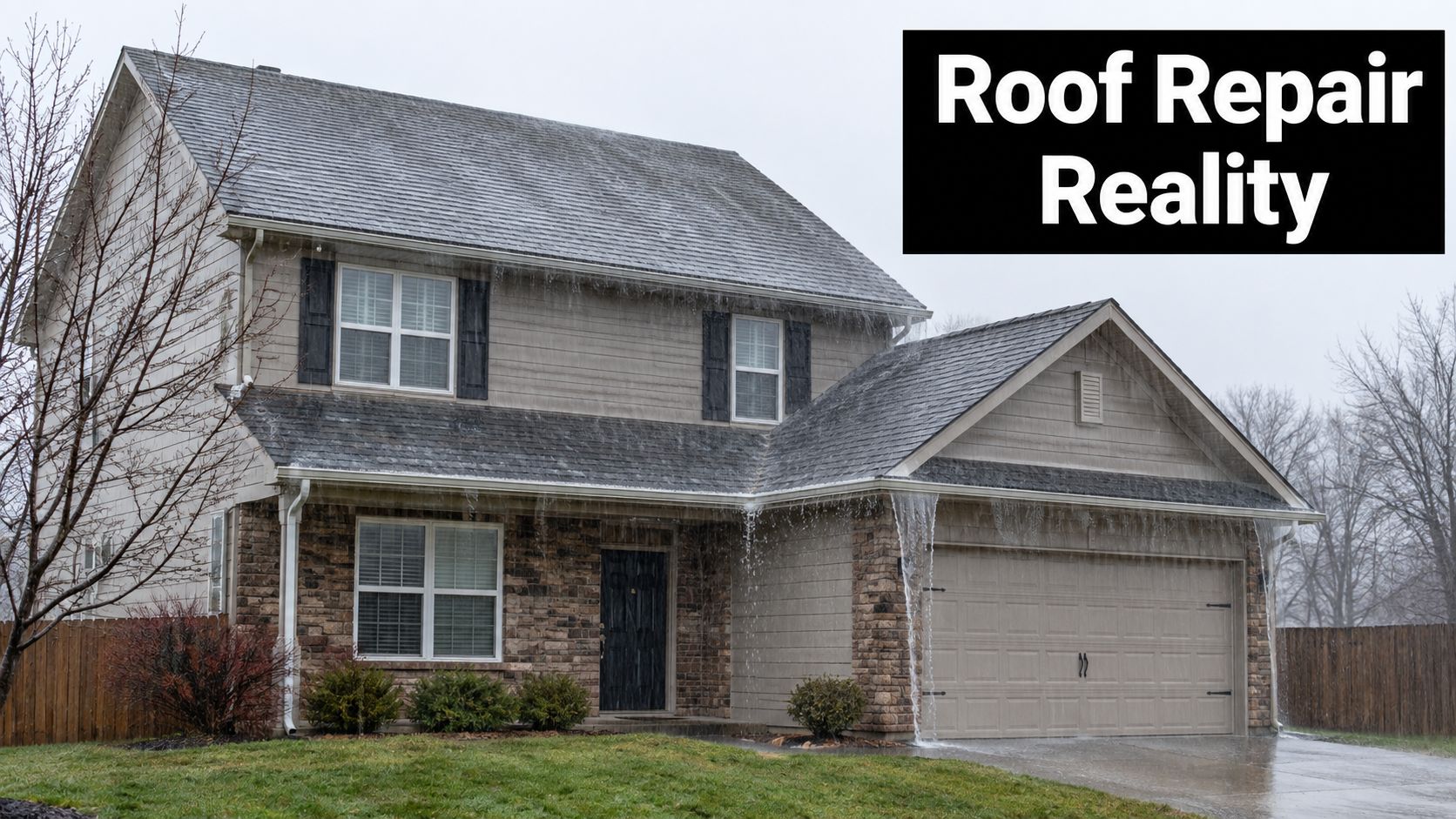
Kansas City roofs deal with more than ordinary rainfall. Strong thunderstorms, hail, wind-driven rain, freeze-thaw cycles, and winter ice can stress shingles and the components around chimneys, vents, valleys, and skylights. Ice dams can push water beneath shingles, while repeated wetting and drying can expose weaknesses in flashing or deteriorate the wood beneath the roof covering.
That's why two homes with similar-looking leaks can receive very different estimates. One may need a localized shingle repair. Another may require removal of the affected roofing, replacement of rotted decking, new flashing, and interior protection while the work is completed.
Why the first visible symptom can mislead you
A ceiling stain doesn't identify the repair scope by itself. The contractor has to trace the moisture path and determine whether the roof covering, flashing, underlayment, or deck allowed the water inside.
Practical rule: Pay for the cause to be corrected, not just the stain to be covered.
Roof age matters, but it shouldn't make the decision by itself. An older roof with one failed pipe boot may need a targeted repair, while a newer roof with widespread hail impact or structural damage may need more extensive work. The estimate should connect the recommended repair to observed conditions, photographs, and a defined scope.
Kansas City homeowners should also separate maintenance-related deterioration from sudden storm damage. That distinction affects both the repair approach and the possibility of an insurance claim. A contractor can document the condition, but your policy and carrier determine what's covered.
What Roof Repair Actually Costs in Kansas City
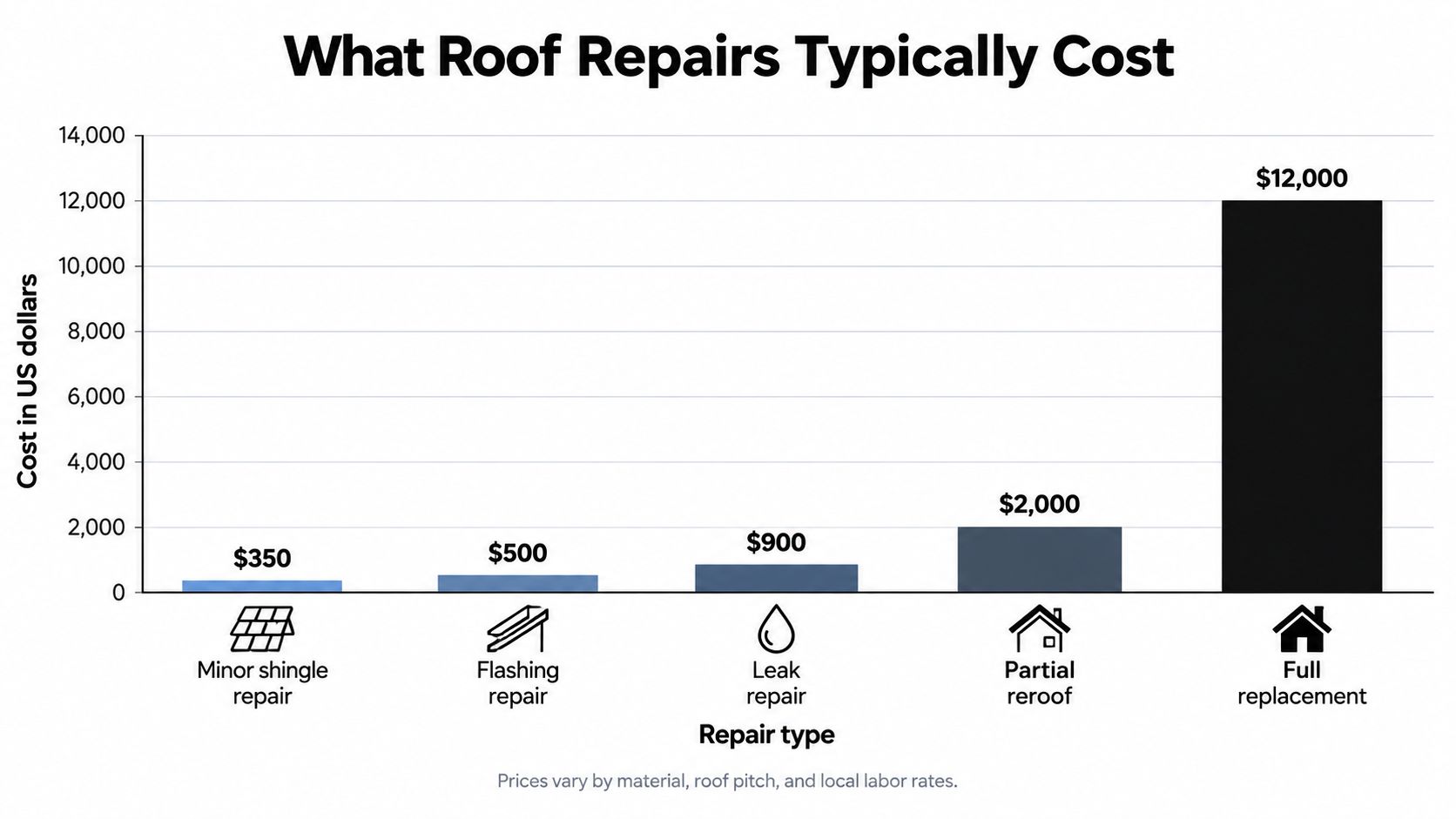
National pricing guides give a starting point, not a Kansas City quote. One 2026 roof repair pricing guide reports a U.S. average of about $1,150, with most repairs between $400 and $1,900. Minor work can start near $150, while major structural repairs can reach $8,000. The spread comes from damage extent, labor, and material complexity, and the national roof repair cost breakdown lays out those ranges.
That range matches what I see in the field. Replacing a few damaged shingles uses limited material and labor. Opening the roof to replace wet decking takes more demolition, carpentry, drying, and reinstallation. At that point, the contractor is repairing the roof system, not just the top layer.
Why market averages have moved upward
Replacement costs climbed 33% above the 2021 to 2024 four-year baseline, and repair bills have followed. Verisk reported average residential roof repair costs of $4,699 in 2025, while average replacement costs reached $17,631. Those figures appear in Verisk's 2025 roof-risk report.
These numbers are not a quote for every Kansas City home. They show how a headline average can understate a serious repair. Hidden moisture, decking damage, multiple roof slopes, access problems, and code-related work can push a job far beyond a basic service call.
| Damage level | What it often involves | Cost implication |
|---|---|---|
| Minor surface issue | A few shingles or a small isolated defect | Usually near the lower end of repair pricing |
| Localized leak | Shingles, flashing, pipe boot, or underlayment in one area | Moderate repair depending on access and materials |
| Hidden water damage | Wet insulation, deteriorated underlayment, or deck rot | Can move into the several-thousand-dollar range |
| Structural correction | Damaged decking or framing-related work | Requires broader labor and material scope |
| Storm or hail event | Multiple roof components or slopes | Often belongs to a separate, much higher cost tier |
The question that matters is not just, “What is the average roof repair cost?” Ask, “What conditions could make my repair larger once the roof is opened?”
How Estimates Are Calculated and What to Expect
A trustworthy estimate starts with diagnosis. A contractor who prices a roof from the driveway may identify obvious missing shingles, but that quick look won't establish whether water reached the deck or whether flashing failed beneath the visible surface.
The inspection process
A thorough roof assessment generally follows a practical sequence:
Start inside. The inspector checks ceiling stains, attic framing, insulation, ventilation, and visible moisture. This helps establish where water entered the living space, even though the entry point may be elsewhere.
Walk the roof when safe. The contractor examines shingle condition, exposed fasteners, granule loss, lifted tabs, punctures, valleys, ridges, and penetrations. Steep slopes, wet surfaces, and storm conditions may require an alternative inspection method.
Check transition points. Chimneys, wall intersections, skylights, vents, and valleys deserve close attention because they combine multiple waterproofing components. A roof field can look acceptable while one flashing assembly fails.
Look for concealed damage. Probing suspect decking or opening a limited area can reveal softness, rot, or water staining. The contractor should explain when exploratory work is needed and how it could affect the final scope.
Separate emergency work from permanent work. A temporary tarp or water-control measure may stop additional damage, but it isn't the same as repairing the roof assembly.
Write the scope clearly. The estimate should identify materials, affected areas, removal, replacement, ventilation or flashing work, cleanup, and conditions that could change the price.
What a useful estimate should show
A good estimate doesn't hide uncertainty. It distinguishes confirmed work from potential concealed conditions, explains whether the price covers one section or multiple slopes, and states how additional decking or related damage will be handled.
Ask whether the quote includes removal and disposal, flashing replacement, underlayment, fasteners, permits if required, and final cleanup. You should also ask whether the contractor expects to match existing materials and what happens if the original shingles are no longer available.
For a practical example of how roofing scope and pricing can be presented, review this roofing estimate example. The point isn't to copy another home's price. It's to compare whether your estimate communicates the same level of detail.
Avoid choosing solely by the lowest total. A low bid that excludes decking, flashing, disposal, or necessary tear-off may become more expensive after work begins. A higher estimate can be justified when it documents a larger or safer repair scope, but the contractor should be able to show you why.
Common Repair Scenarios and Price Ranges
A roof leak can start with one visible symptom and still point to very different work underneath. A few missing shingles, a failed chimney flashing, and soft decking all show up as "roof repair" to a homeowner, but the repair bill changes fast once the crew opens the area and sees what is damaged.
| Repair type | Description | Estimated cost range |
|---|---|---|
| Minor shingle repair | Replace a limited number of missing, torn, or damaged shingles | Lowest tier, driven more by shingle type and quantity than by labor hours |
| Localized flashing repair | Correct failed flashing around a chimney, wall, valley, or penetration | Moves up or down based on access, flashing design, and how much roofing must be removed |
| Leak repair with underlayment work | Open the affected area, replace compromised waterproofing, and restore shingles | Higher than a surface shingle repair because several layers are involved |
| Decking repair | Remove roofing, replace soft or rotted roof deck, and reinstall the roof covering | Can rise into the several-thousand-dollar range when the damaged area spreads |
| Partial roof repair after hail | Repair one slope or multiple components after impact damage | Pricing depends on how far the impact pattern runs and how many parts of the roof it reaches |
| Structural correction | Address framing or other load-bearing concerns discovered beneath the roof | Requires specialized evaluation and a scope broader than ordinary shingle work |
Within the $400 to $1,900 band noted earlier, the deciding factor is often access. A valley flashing repair that a crew can reach cleanly from a ladder usually stays closer to the low end. The same repair behind siding, masonry, or layers of adjacent roofing takes more labor and raises the price.
That is why two jobs that look similar from the ground can land in very different places on the estimate. A patch on the visible surface is one thing. A repair that requires opening up multiple layers, protecting nearby materials, and rebuilding the water path is another.
Comparing similar-looking leaks
A chimney leak may come from deteriorated counterflashing, step flashing, masonry joints, or the roof covering around the chimney. Replacing a few shingles will not fix a flashing failure. Tearing off an entire roof to solve one isolated flashing defect wastes money and still leaves the underlying problem in place.
A few missing shingles after wind can be a straightforward local repair if the surrounding shingles are still secure and the underlayment is intact. If wind lifted a larger section, exposed fasteners, or allowed water into the deck, the contractor has to price the layers below the shingles, not just the visible gap. The same logic applies after hail, where the full impact pattern should be documented before anyone narrows the scope. For that, homeowners can review roof repair after a hail storm.
Decking creates the biggest shift in scope. Once wood turns soft, the shingles above it no longer have a stable base. The crew may need to remove more roofing than the stain suggests so they can find solid edges, replace the damaged deck, and rebuild the roof correctly.
Hidden Costs and Unexpected Expenses
The estimate you receive before opening the roof is based on visible and reasonably inferable conditions. Roofing crews sometimes find additional damage only after removing shingles or flashing. That doesn't automatically mean the contractor underbid the work. It means the roof concealed part of the condition.
Deck rot is the most common scope expansion homeowners underestimate. A small leak can wet the decking repeatedly, allowing wood deterioration around a penetration or valley. The roofer may need to remove more material to locate solid edges, replace the affected deck, and restore the water-shedding layers.
Other additions can come from access and project logistics:
Permits: Recent consumer guidance cited in Verisk's roofing coverage says permits can add about $75 to $250, depending on the project and jurisdiction. Confirm local requirements before work starts. The related Verisk roofing risk discussion addresses the broader cost pressures affecting roof repairs.
Disposal: Tear-off materials, damaged decking, and wet insulation require handling and disposal. A quote that excludes debris removal may look cheaper until the final invoice.
Temporary protection: A tarp, emergency sealing, or temporary water diversion can prevent additional interior damage while the permanent repair is scheduled. It's useful emergency work, but it should be listed separately from the final repair.
Travel and access: Some estimates include travel or access surcharges, particularly when crews need special equipment, extended setup, or additional safety measures.
Material matching: Older shingles may no longer match precisely. A contractor may recommend repairing a defined area, replacing a complete slope, or discussing broader replacement if appearance and weathering differences matter.
Storm damage creates a different cost tier
Storm and hail repairs often affect more than the shingle surface. Independent market data places storm and hail roof repairs at about $12,300 on average, with a range from $2,632 to $22,127. Another 2026 estimate places hail damage repair around $4,250 on average, with minor spot repairs at $300 to $1,500 and multi-slope or flashing repairs at $3,000 to $9,000. These figures come from HomeAdvisor's storm and wind damage repair guide.
The spread is wide because “hail repair” can mean a few isolated replacements or a documented loss across several roof components. Ask the inspector to photograph each affected area and distinguish confirmed storm damage from age-related wear before you discuss the claim or final scope.
Strategies to Manage and Lower Your Roofing Costs
The cheapest roofing decision isn't always the smallest invoice. A low-cost patch that leaves wet decking or failed flashing in place can create another repair, interior damage, and a more difficult insurance conversation. The better approach is to control the scope without ignoring the cause.

Start with documentation. Photograph the exterior, attic, ceiling stain, gutters, and any visible debris or impact marks. Don't discard damaged shingles before the condition is documented, and don't authorize major permanent work before speaking with your insurance carrier when a sudden wind or hail event may be involved.
Repair or replacement requires judgment
A repair usually makes sense when the defect is isolated and the surrounding roof system remains sound. Replacement deserves consideration when damage extends across multiple areas, the deck is compromised broadly, or repeated repairs no longer restore reliable water protection.
Get estimates that use the same scope. One contractor may price a surface patch, while another includes flashing, underlayment, and decking. Comparing totals without comparing inclusions guarantees confusion.
A local contractor also understands the practical details of Kansas City work, including storm documentation, access, winter weather, and the differences between homes in Kansas and Missouri jurisdictions. Two States Exteriors LLC offers free on-site inspections, written project planning, storm-damage assessment, and insurance-claim coordination, along with roof repair and replacement services.
Financing can help when the repair is urgent and cash flow is limited, but read the terms before signing. Ask about total repayment, interest, fees, required deposits, and whether emergency work is separated from the permanent project. This roof replacement financing resource can help frame the questions you should ask.
A contractor explaining the inspection and claim process can prevent avoidable cost surprises. This short video offers another way to understand the decision process.
Don't wait for a ceiling stain to grow before arranging an inspection. In Kansas City, a prompt assessment can separate a contained repair from a roof assembly that has been absorbing water through repeated storms and freeze-thaw cycles.
Two States Exteriors LLC provides free on-site roof inspections, detailed repair and replacement estimates, and support with storm and hail insurance claims across the Kansas City metro. Visit Two States Exteriors LLC to request an evaluation before you approve work, especially if the estimate includes decking, structural repairs, or a full replacement.