Hail is a well-known spring risk in Missouri, and storm-driven roofing demand tends to rise during the months when severe weather is common.
Hiring a Missouri roofing company is a paperwork decision wrapped around a construction decision. Check who holds the license, whose insurance covers the installation, whether the work needs a Kansas City permit, how the crew will address decking and ventilation, and whose name appears on the claim file.
The costliest mistake is accepting a one-page bid that says “roof replacement” but says nothing about layers, underlayment, flashing, or permit triggers. A covering replacement may be permit-exempt and still fail code, a manufacturer's warranty, or an insurance file if the contractor skips those details. Review each document in order, from credentials to contract, before signing.
Why Missouri Weather Changes the Hire
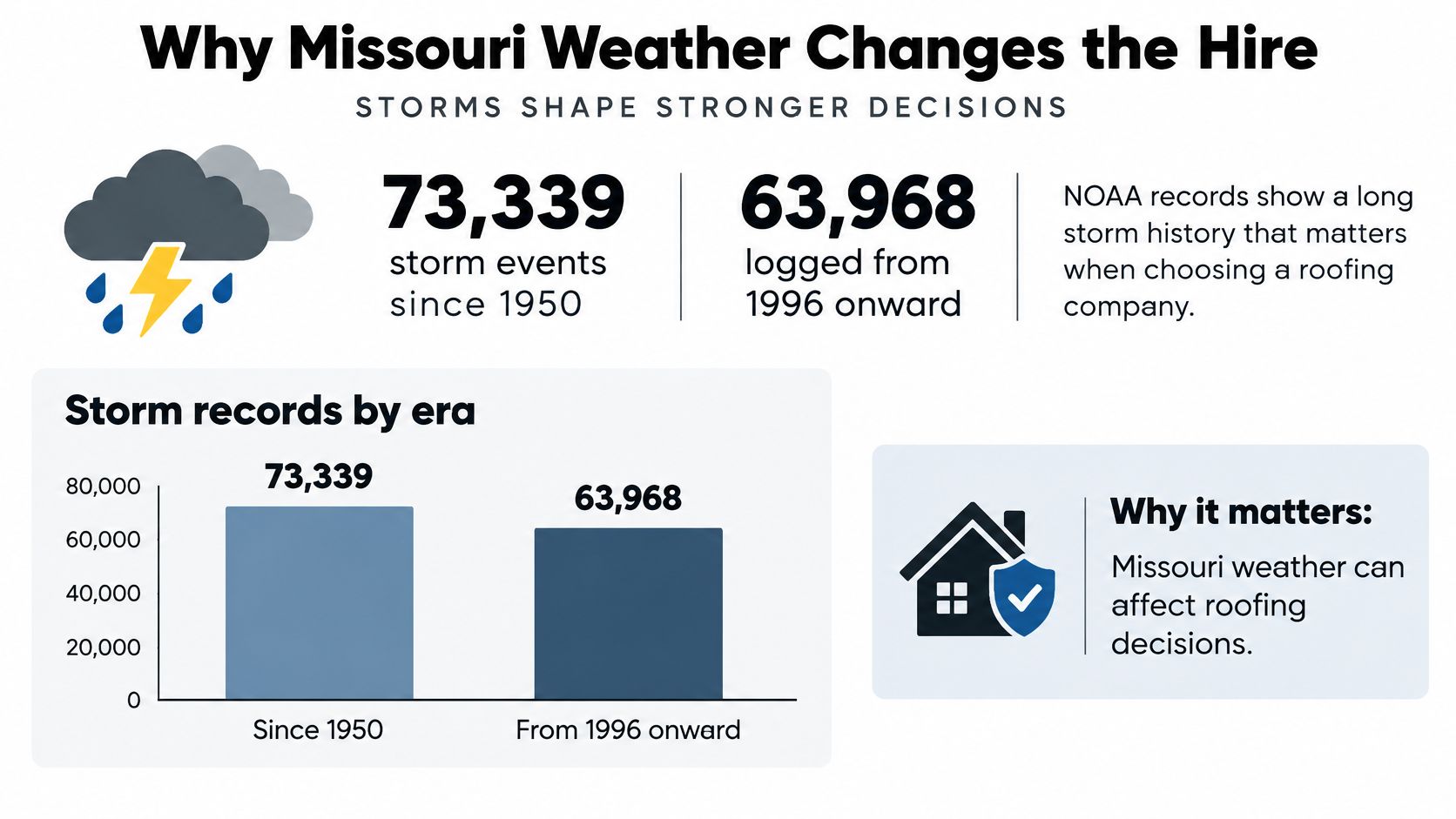
Start with the scale of the record. NOAA's Storm Events Database and Storm Prediction Center records, summarized in a historical state compilation, document 73,339 storm events in Missouri since 1950, and 63,968 of those were logged from 1996 onward, when recording coverage improved. The same record counts 20,443 hail reports, 20,293 severe-thunderstorm wind events, 10,821 flood or flash-flood events, and 2,707 tornadoes, with tornadoes tied to 429 recorded deaths. One storm also tends to hit several assemblies at once: a June 2022 multistate severe-weather disaster carried damaging hail, high winds, and more than two dozen tornadoes across Missouri and neighboring states.
The record condenses into a single picture.
Think of shingles as the shell of a raincoat. Missing tabs are the visible tear in the fabric. Soft decking, failed step flashing, a clogged gutter, dented siding, and moisture in the attic are the soaked lining underneath, and a contractor who quotes only the shell leaves you buying the job twice.
That's why you hire a Missouri roofing company to separate the stack, not just to sell shingles. The sequence runs credentials first, then Kansas City permit scope, then the site-visit questions, then claim evidence, then matching bid lines and warranties.
Before the first call, gather:
- Ground-level photos taken from the lawn with a date stamp, never from the ridge
- Ceiling and attic stain photos, which prove where water traveled
- The roof's approximate age plus receipts from any past repair
- The insurer claim number, if a claim is already open
Credentials a Missouri Roofing Company Must Prove
Print this table and work down it in one sitting before you discuss price. Every row ends with a document you keep in a folder.
| Credential | What it proves | Document to request | Red flag |
|---|---|---|---|
| Local contractor license | Legal authority to contract in that city or county | License number matching the company name | No number, or a number in another company's name |
| General liability insurance | Coverage for property damage during the job | Current certificate naming you as certificate holder | Expired dates or a personal auto policy |
| Workers compensation | Medical costs if a worker is hurt | Current workers-comp certificate | Cash helpers, or a claim that subs need no coverage |
| Surety bond | A financial backstop if the job is abandoned | Bond amount and surety name | A verbal promise with no bond document |
| GAF or other manufacturer certification | Crew training tied to a system warranty | Certificate or certification ID | A brand logo with no ID to verify |
| Permit responsibility | Someone accountable for code filings | Named person who submits and closes the permit | "We never pull permits" |
Reading the insurance rows
General liability and workers compensation are different protections, and homeowners routinely treat one certificate as covering both. Liability pays when a crew drops a bundle through your patio or cracks a neighbor's fence. Workers comp pays when a man falls off your roof. If an injured worker has no coverage behind him, the medical bill can travel toward your homeowner policy.
Read the dates on the certificate, not the logo at the top. A salesman's personal auto policy is not a roofing liability certificate, and a helper paid in cash usually means no workers-comp coverage exists. Both look identical at the kitchen table: a truck, a ladder, and a good story, but no certificate covering the install week.
Verifying a manufacturer certification
A decal on the door of a truck proves nothing, because the certification that matters carries an ID you can look up. Two States Exteriors LLC is a GAF Certified Contractor, and that's a checkable credential rather than a claim. The point of asking isn't to demand one specific brand. It's to confirm the crew training a system warranty is built on, since some shingle warranties depend on the installer being certified and the coverage is only as good as the registration filed after the job.
The entity check most homeowners skip
Look up the company's legal name in the Missouri Secretary of State business records. The name on the license, the name on the insurance certificate, and the name on the contract should match word for word. When a storm-chasing outfit trades under three names, that mismatch is where the warranty evaporates in year two.
Then ask the two questions no certificate answers: how many years has the company worked in this market, and can it supply two references from local jobs finished in the past year? The trade is growing fast. Missouri Economic Research and Information Center projections put 3,012 employed roofers in Missouri in 2024, reaching 3,408 by 2034, a 13.15% increase, and a growing trade means new companies form quickly, which is exactly why paperwork outranks the truck count.
Practical rule: Don't accept a start date until the insurance and workers-comp certificates carry dates that cover the entire install week, not just the afternoon you sign.
Kansas City Permit Paths by Roof Scope
Kansas City, Missouri, generally exempts reroofing on one- and two-family homes when the work replaces only light roof coverings and follows approved installation requirements, according to the city's Permits Division. The scope changes if the crew finds damaged sheathing or structural problems. Replacing a significant area of roof decking commonly triggers a building permit; confirm the exact threshold with the city's Permits Division. Rafter repairs or other structural work may also require plan review and contractor licensing.
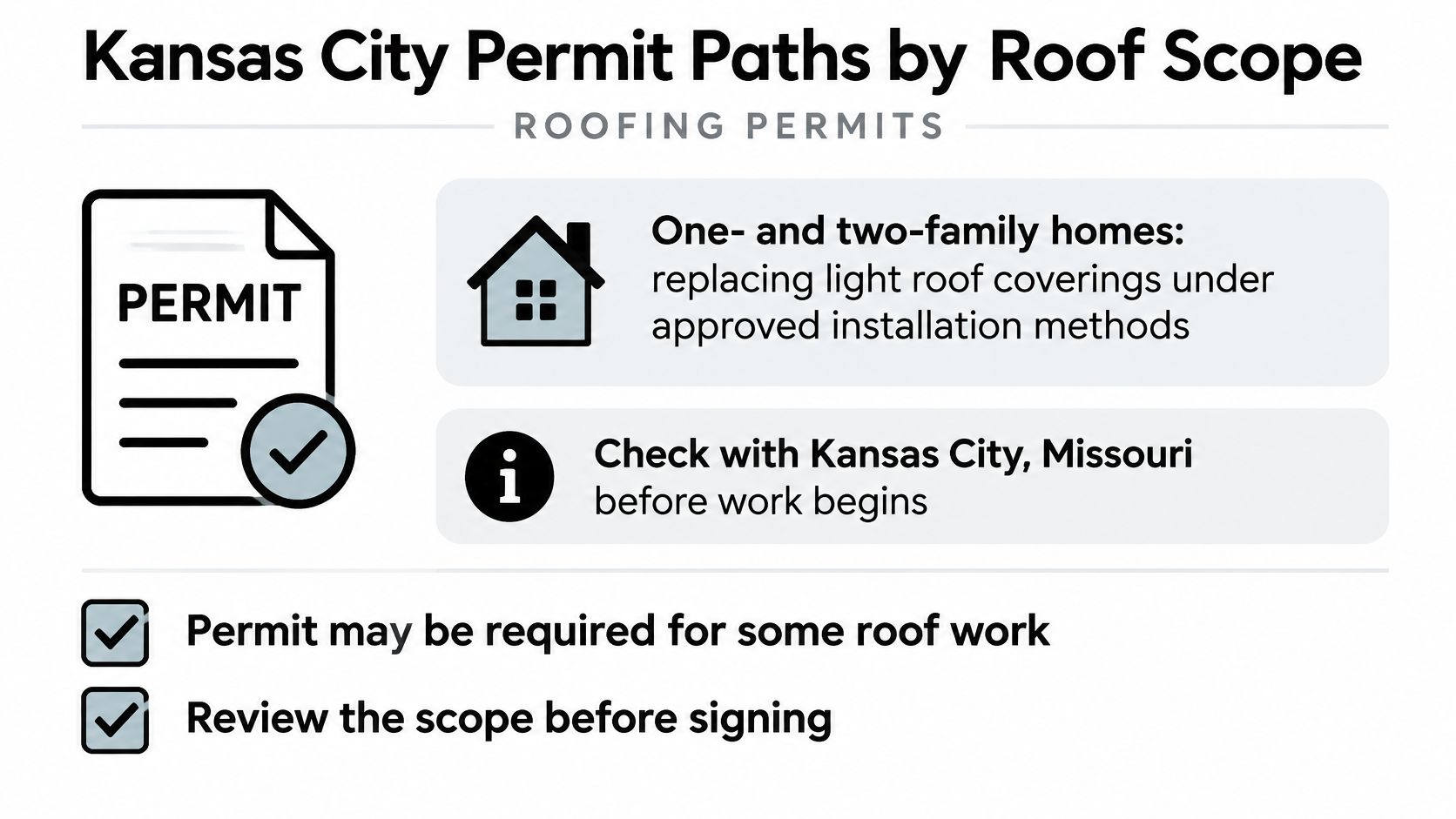
A permit exemption is not a code exemption. Even when a reroof does not require a permit, the work must still follow applicable zoning, development, and building requirements.
| Scope | Typical permit path | What still applies | Ask before signing |
|---|---|---|---|
| Light covering replacement only | Generally exempt | Zoning and building rules still apply | Who confirms the exemption in writing |
| Recover or second layer | May qualify as covering work if the deck stays | Manufacturer limits on extra layers | Is this a recover or a full tear-off |
| Significant decking replacement | A building permit may be required; confirm the trigger with the city | Requirements for the replacement deck | How is additional decking work priced |
| Rafter or structural repair | Plan review and licensing may apply | Structural work may need an engineered scope | Who handles drawings and the permit |
Two States Exteriors LLC offers re-roofing with either a complete tear-off or a recovery. Make sure the bid identifies which method is planned. A recovery leaves the existing roof in place, while a tear-off removes it; if the crew uncovers rotten boards, the scope may need to change.
Before material is ordered, clarify who applies for any required permit and closes it out, whether the quoted price includes permit fees, and how concealed rot would affect the price and schedule. Put those terms in writing. Treat commercial roofing and work outside the one- and two-family exemption as permit-likely, then confirm the requirements with the city.
Questions and Red Flags Before You Sign
The site visit belongs to you. You're running an interview, not receiving a presentation, so bring the lawn photo and the list, and note which questions get answered with a document and which get answered with enthusiasm.
A good inspection starts before anyone climbs a ladder.
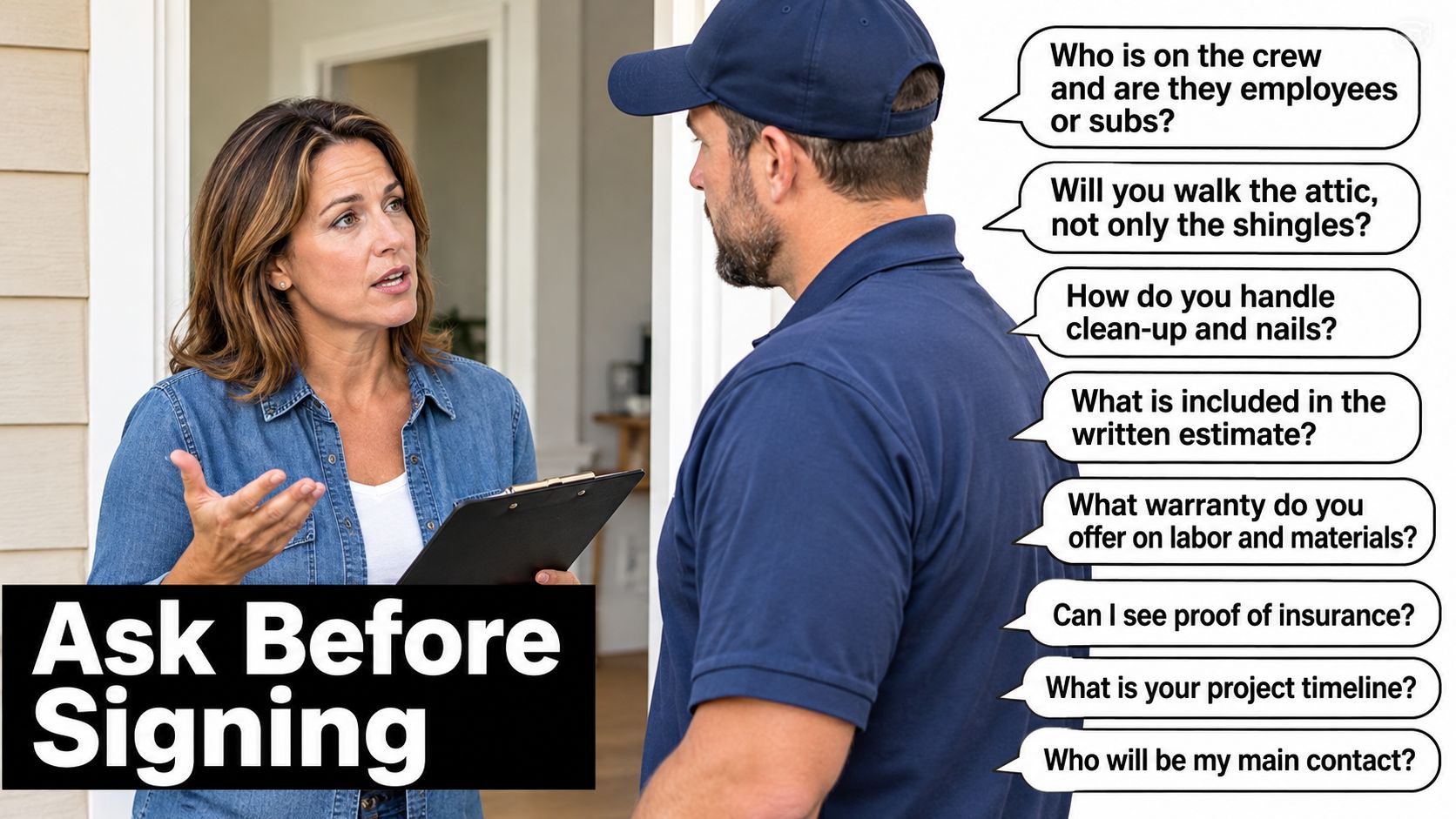
- "Who is on the crew, employees or subcontractors?" A shrug is a weak answer, because a sub's policy is separate and may not name your job.
- "Will you walk the attic, not just the shingles?" Watch for a driveway verdict with no attic access and no flashlight.
- "How do you separate hail bruises from age blisters?" If every mark means a full replacement, you're talking to a salesperson.
- "Who meets the adjuster?" A request to sign the claim over so the company can "handle everything" is a red flag, not a courtesy.
- "What's the daily cleanup standard?" "We tidy at the end" without a magnetic sweep over the lawn and driveway tells you what week two looks like.
- "Where do the bundles sit if a cold snap hits?" Overnight in the yard is the wrong answer for shingles that need to stay warm to seal.
- "How are change orders priced when decking is soft?" "We'll figure it out up there" invites an open-ended invoice. Ask for a price per sheet and a written approval step.
- "Which warranty is labor, which is material, and who registers it?" A single brochure with no registration process is a brochure, not a warranty.
Say a neighbor signs the day after an April hail event with a crew that knocked on the door while the gutters were still full of ice. The installation goes in fast. Months later, when the supplement for rotten decking is still unresolved, the crew's local number is disconnected and the office address is a mailbox.
Keep three written bids that name the same scope, the same layers, and the same decking allowance. Then price differences mean method, not missing work.
The pause signal: If anyone discourages you from reading the contract in full or from calling your insurer directly, end the visit. Both are rights you keep.
Document Hail Damage Before You File
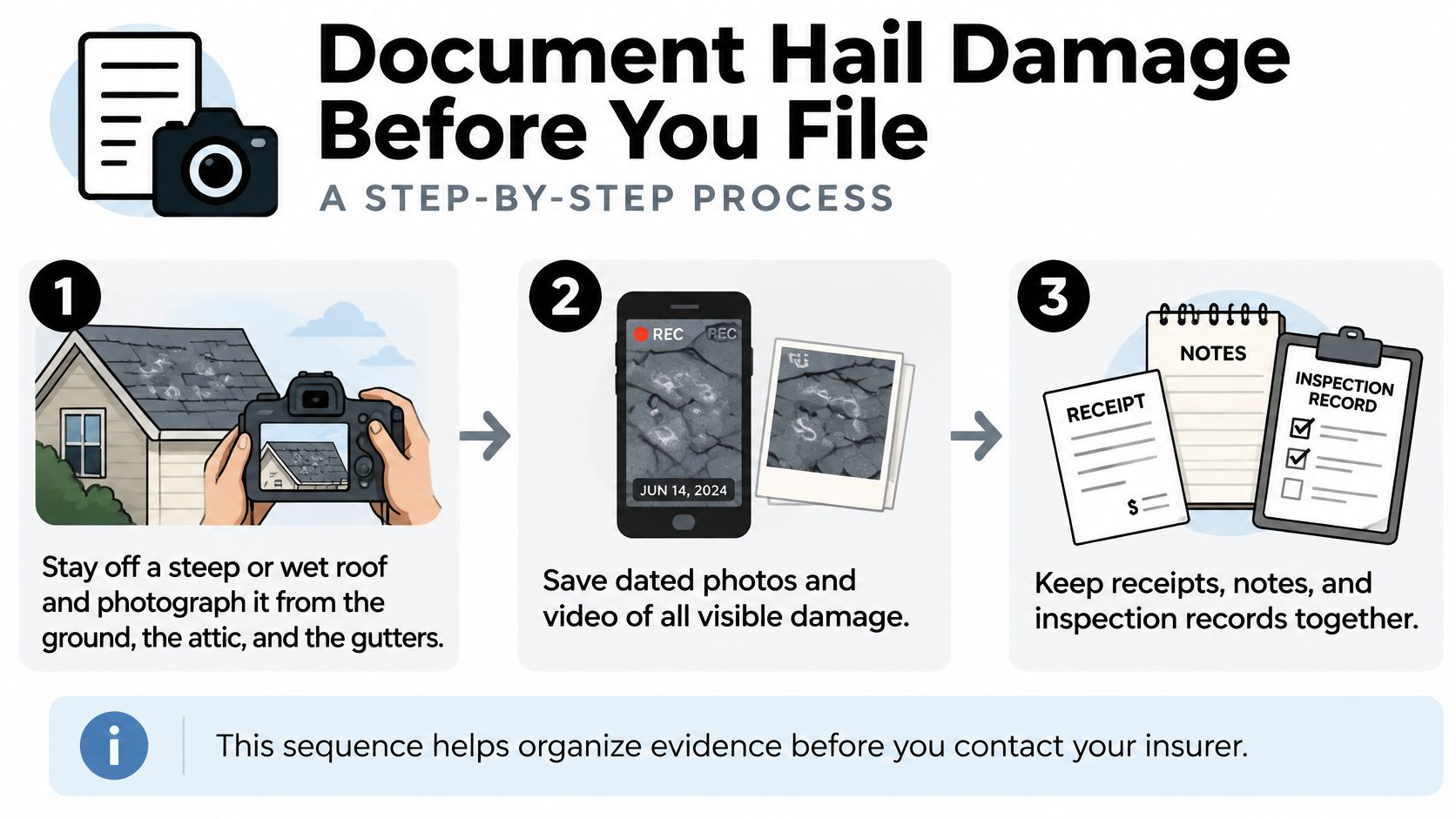
Build a neutral evidence file before you call anyone, so the claim rests on records rather than on a contractor's opinion. Seven steps, done in this order, keep the file useful whether or not you end up filing.
- Stay off a steep or wet roof. Photograph from the ground with a zoom, from the attic with a light, and at the gutters where downspouts meet the fascia.
- Save dated photos and video of displaced tabs, creases across a shingle, exposed fasteners, dented metal, and interior stains. Compare them against pictures of hail-damaged roofs so you're not guessing at what a bruise looks like.
- Record temporary mitigation such as a tarp, and keep the receipts for the tarp, the plywood, and the dumpster.
- Pull the storm record. The NOAA Storm Events Database entry for a 1.75-inch hail event in St. Louis County, Missouri, on May 19, 2025 shows how specific a report can be: date, county, hail size, nothing anecdotal.
- Weigh industry figures for what they are. Broader 2025 industry reporting placed Missouri among the leading hail states and reported a 10% year-over-year increase in State Farm hail claims in Missouri. Those numbers are insurer-specific, and they don't prove your roof was hit.
- Ask the insurer four questions before authorizing anything: the filing deadline, the deductible, how recoverable depreciation works, and the matching-material rules.
- Have the contractor mark functional damage separately from old wear and cosmetic dings, with locations noted per slope.
The file organizes the facts. It doesn't decide the outcome.
A storm report makes a claim plausible. It does not prove that every defect on the roof came from that one storm. Inspection evidence and maintenance history still set the scope.
Keep the photo file in the owner's name, whichever contractor you hire, and never sign away your claim rights to get a bid. A proposal that says only "replacement" can't be checked against a documented file of four creased tabs and twelve dented vents, which is precisely why the file comes first.
Compare Quotes Warranties and Ventilation
Two bids can land on the same total and buy different roofs. The gap hides in line items that sound identical over the phone.
| Line item | Why the price moves | Complete bid should name |
|---|---|---|
| Tear-off and disposal | Extra layers add weight and dump fees | Number of existing layers removed |
| Decking allowance | Hidden rot appears after tear-off | Price per sheet and who approves added sheets |
| Underlayment | Valleys and eaves need more than felt | Product and where ice-and-water shield goes |
| Flashing | Most leaks start at joints | Chimney, walls, and valleys replaced or reused |
| Ventilation | Blocked intake can void a shingle warranty | Soffit intake and ridge exhaust balance |
| Warranty registration | Labor and material are different promises | Years, who registers it, and transfer rules |
| Cleanup and overhead | Omitted fees show up later | Daily magnetic sweep and permit fee if any |
Where the low bid loses the warranty
Picture two quotes on the same ranch house. The first reuses the existing step flashing at the chimney, skips ice-and-water shield in the valleys, and prices the job at a figure that feels responsible. The second replaces flashing, names the underlayment product, and includes a decking allowance per sheet. The difference in price is the difference in materials and labor you can point to.
Cold weather changes the installation itself. The Missouri Department of Natural Resources lists thunderstorms, hail, damaging winds, tornadoes, and winter storms as recurring hazards capable of producing roof damage, and winter work adds its own rules. Asphalt shingles turn brittle in the cold, and the factory self-sealing strips may bond slowly or not at all. A careful crew stores bundles somewhere warm, carries up only what it will install that day, and hand-dabs quarter-size spots of adhesive under shingles in high-wind areas when normal sealing won't happen on schedule. Ask where the bundles sleep the night before a January install.
Ventilation decides whether the warranty survives the first summer. The National Roofing Contractors Association recommends placing approximately 50% of total ventilation area at or near the ridge, with the remainder at eaves or soffits. Check that soffit intake paths are unobstructed, ridge exhaust runs continuous where it belongs, and underlayment cuts don't cover the openings. Some shingle warranties condition coverage on minimum ventilation provisions, so a handsome ridge vent over blocked soffits can void the coverage the bid advertised. Compare any quote against these roof ventilation requirements before you accept it.
Award the job only when every bid uses the same layers, the same decking allowance, and a written ventilation note. Separate the manufacturer's material coverage from the contractor's workmanship term, and ask who files the registration and whether it transfers if you sell the house.
Book a Kansas City Metro Roof Inspection
Keep five items together before choosing a roofer: the contractor's license number, insurance and workers' compensation certificates, a written permit path for the planned work, dated roof photos, and at least two bids with matching line items. This makes it easier to compare what each contractor is proposing.
For a Kansas City Metro home or small commercial building, book an on-site inspection and get the written scope before agreeing to work. Confirm after-hours coverage before storm season. Two States Exteriors serves Kansas and Missouri, offers free on-site inspections, and operates 24/7 for roofing emergencies. Its Missouri line is (816) 845-7150, and its website offers an Instant Roof Quote.
Bring three questions to the appointment: Does the roof need a repair or replacement? Is there evidence to support an insurance claim? Do the gutters or siding show damage from the same storm? A call-handling service such as Dial Milo's roofing call handling can help roofing companies manage after-hours inquiries.
If you are still comparing bids, use the credential and line-item details already gathered. The guide to roof inspection contractors can help you prepare to book.
Keep the insurance claim in the property owner's name. Before tear-off begins, get the scope and any permit requirements in writing. A permit-exempt replacement can still create problems if the crew skips decking checks, ventilation details, or storm-damage documentation.
Two States Exteriors LLC provides roof replacement and repair, storm and hail damage claim assistance, and free on-site inspections. The company also offers a No Money Upfront policy and an Instant Roof Quote. Call the Missouri line at (816) 845-7150 or visit Two States Exteriors LLC to request an inspection.