
Hail just moved through your neighborhood, and two numbers are already on the kitchen table. The roofer's estimate is high. The insurer's first check is not. You're trying to figure out how to get money from an insurance claim when those figures don't match, and the mortgage company wants the roof closed before the next storm.
That gap is usually the deductible, depreciation, and money held until the work is done. It is not, by itself, a sign the carrier is refusing a covered loss. What decides the second payment is the file you build: dated photos, a line-item scope, and a written record of what the adjuster saw.
Where Your Insurance Check Really Comes From
Say hail bruised three slopes of architectural shingles. The contractor prices the job at $18,000. The first check lands near $11,000. That spread is ordinary on a replacement-cost policy, not automatic evidence of bad faith.
Average homeowners claim severity rose from $14,864 in 2020 to $20,062 in 2023, a 35% increase, according to the Insurance Information Institute. When claim dollars climb that fast, carriers price every square, linear foot, and code item instead of accepting a lump sum.
The replacement-cost clause is what decides whether the holdback is ever paid. Actual cash value is today's repair cost minus depreciation for age and wear. On many hail claims, the opening check is that cash value after your deductible. Recoverable depreciation stays with the carrier until the roof is finished and you send invoices plus completion photos.
If the dwelling is insured below the policy's required replacement-value threshold, the carrier can settle on a cash-value basis even though the hail itself is a covered peril. Read that clause before you treat the contractor total as money already owed. How roof replacement depreciation is applied to shingles, siding, and gutters is usually the largest piece of the missing amount.
What each line on the check does
| Component | What It Means | How It Affects Your Check |
|---|---|---|
| Replacement cost value (RCV) | Full cost to repair or replace at today's prices | Ceiling on what the policy pays when coverage applies |
| Depreciation | Reduction for age and wear on roofing, siding and gutters | Subtracted from RCV to reach actual cash value |
| Actual cash value (ACV) | RCV minus depreciation | Often the first check on ACV-based policies |
| Recoverable depreciation | Depreciation held back until repairs are finished | Paid after invoices and proof of completion are submitted |
| Deductible | Your share of the loss, often a flat amount or a percentage of insured value | Subtracted from the approved amount |
| Underinsurance penalty | Coverage below the policy's required replacement-value threshold | Can convert the settlement to an ACV basis |
On the payment letter and the depreciation worksheet, write down four figures: the approved amount, depreciation, the deductible, and the holdback. Those four, not the contractor's bid, are the budget you can realistically track.
How to File and Document a Hail Claim Step by Step
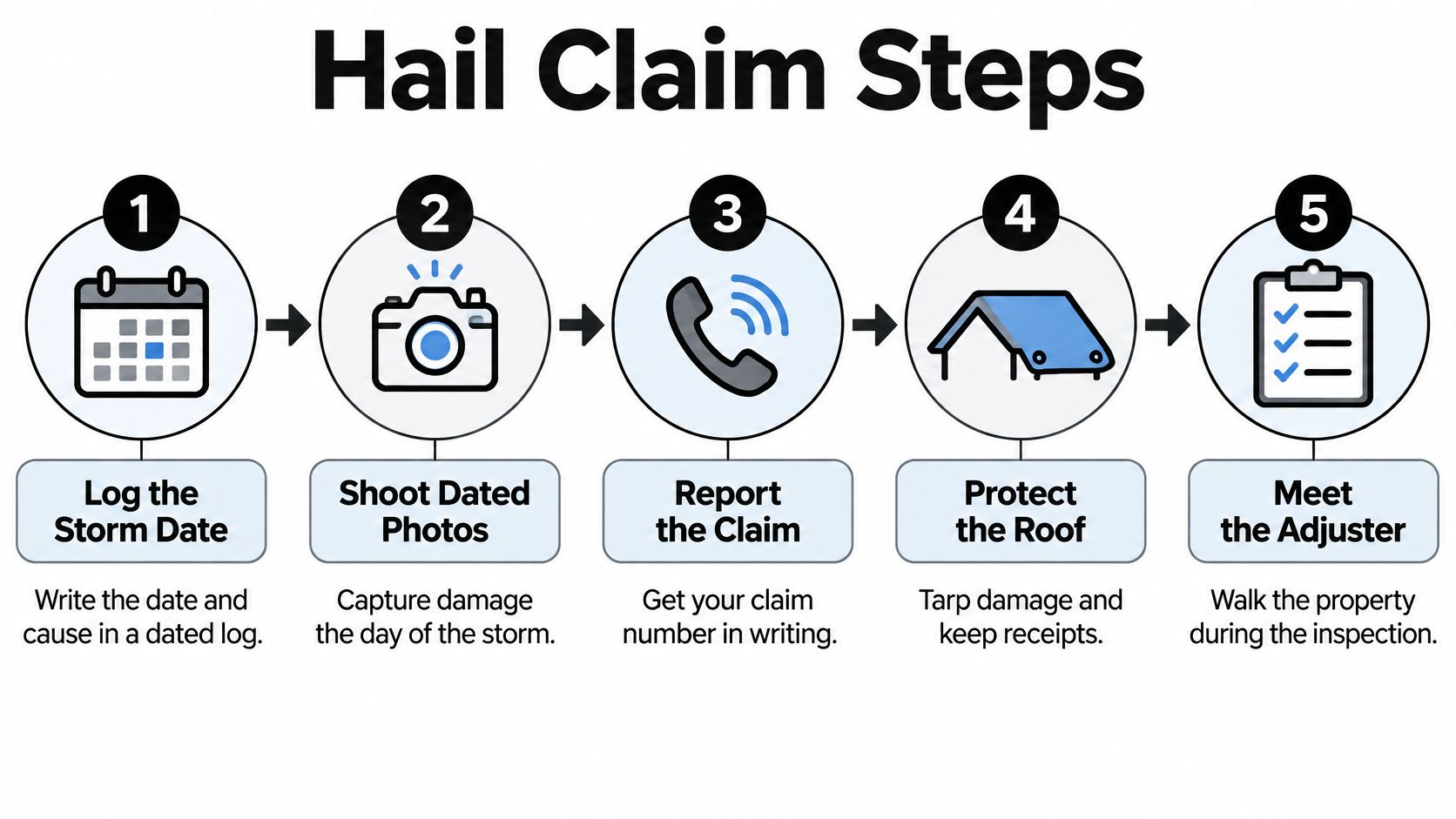
The claim file starts the day the storm hits. Waiting for the adjuster's callback to begin documenting puts you behind, and a clean sequence beats a stack of texts. Each step below adds to the paper trail that turns a low first check into a full second payment.
- Log the date and cause. Pull a weather report for your address and shoot photos that same day. Write the date, the hail size you observed, and which elevations took hits in a dated log. A memory from "sometime last week" is hard to match to a policy period.
- Read the policy before you sign anything. Compare covered perils, exclusions, the deductible, replacement-cost terms, ordinance-or-law coverage, and the deadlines for reporting the loss. Those clauses decide what the check can contain. Don't authorize a full tear-off just because a salesperson says the carrier "always pays for it."
- Notify the insurer in writing. Get a claim number back in writing. Tarp or board up openings so rain doesn't add a second loss, and keep creased shingles, torn flashing, and dented gutter sections for the inspection. Mitigation is required. Throwing the evidence in a dumpster is not.
- Photograph every elevation and any wet interior. Video the roof from the ground and from a safe ladder position. Keep tarp, board-up, and emergency-labor invoices with dates on them. A cash payment with no receipt rarely gets reimbursed.
- Get a written line-item estimate. It should show quantities, unit prices, labor, code-required work, depreciation, the deductible, and recoverable depreciation. A one-line "replace roof" bid gives the adjuster nothing to compare.
- Walk the inspection. Point out concealed damage, such as creased shingles under the ridge or soft decking at a valley. Ask for the adjuster's measurements before they leave. If you stay inside, those lines get missed.
- Reconcile the two scopes. Put the agreed lines in one column and the disputed lines in another, with the dollar difference on each. The first undisputed check usually covers only the agreed column, which is why it lands below the contractor's full estimate. Treat it as a starting balance and keep working the disputed lines.
Ask in writing whether that check is an advance, a partial payment, or a full settlement, and don't sign a release until the covered components are resolved. A signed release can close the file before the recoverable depreciation ever gets billed.
Deadlines belong in the same log. FEMA's NFIP claims guidance requires evidence substantiating the loss and generally a signed Proof of Loss within 60 days unless that deadline is waived, plus an appeal generally within 60 days of a denial. It treats itemized estimates and proof-of-loss paperwork as core support for payment. Your hail policy names its own reporting and filing dates, so copy them into the log the day you open it.
Watch a walk-through of the inspection conversation before the adjuster arrives. It shows what step six sounds like in practice.
Evidence and Estimate Details That Carry a Claim
An adjuster pays what you can show was storm-caused, dated, and priced. A strong opinion without those three things doesn't move the estimate.
| Evidence | What It Proves | Capture Tip |
|---|---|---|
| Pre-loss photos or listing photos | Condition before the storm | Use dated phone photos, past inspection reports or earlier listing images |
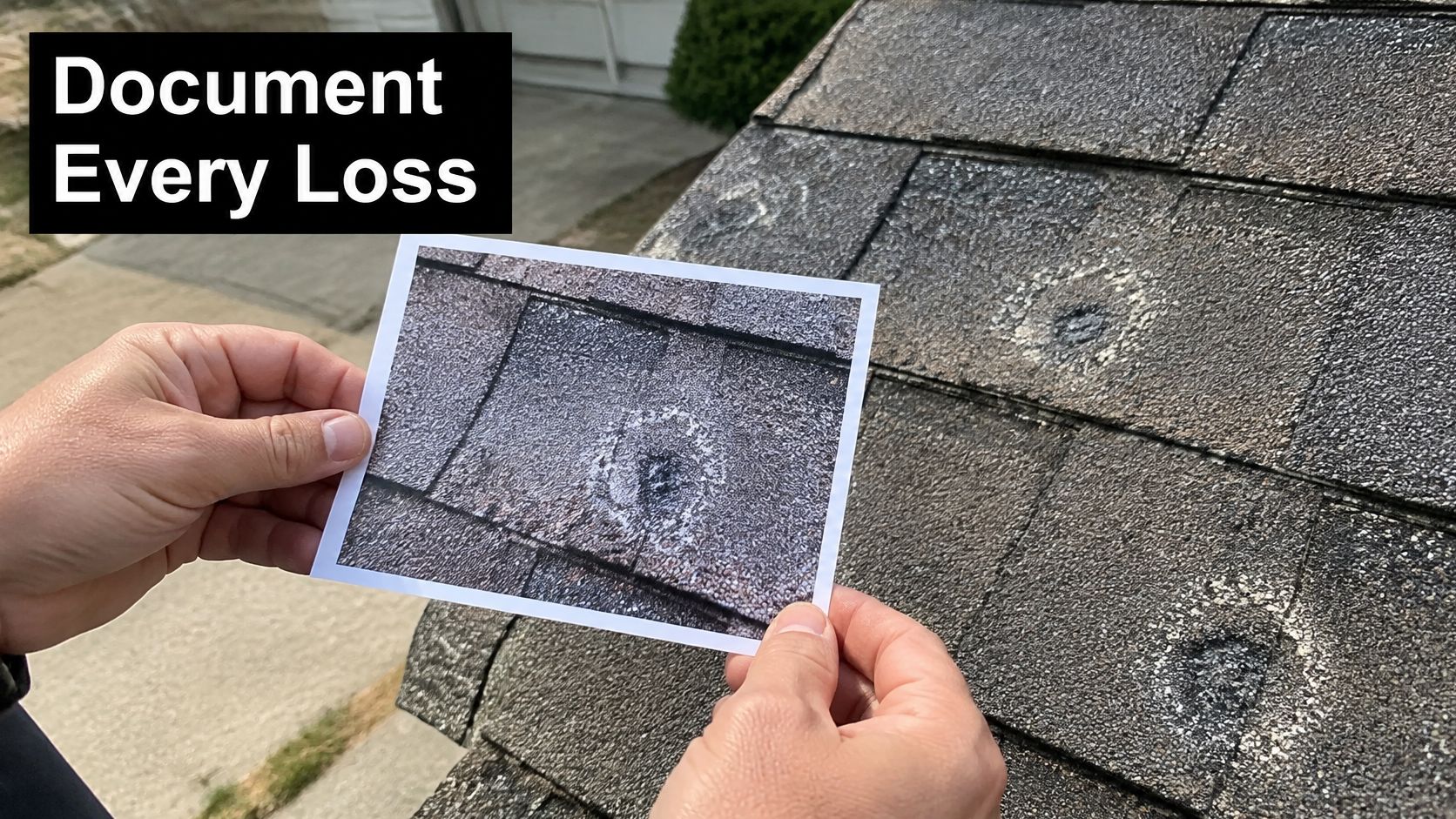
| Post-loss photos and video | Location, extent and cause of damage | Shoot each elevation with a ruler in frame and count hits per roof slope |
| Hail or weather report for the address | Date and approximate hail size at the property | Save the storm report and note the event date in your log |
| Temporary repair receipts | Reasonable mitigation costs | Keep tarp, board-up and labor invoices with dates |
| Line-item contractor estimate | Quantities, unit prices and code items | Ask for squares, linear feet and waste factor shown separately |
| Policy declarations page and endorsements | Insured status, limits and deductible | Save the current version and any replacement-cost endorsement |
Slope counts change the argument. Say the north slope shows about 60 dents in the test squares and the south slope shows none. A carrier that wants to repair "a few slopes" has to answer that split, and so does a contractor pushing a full replacement with no counts at all. Side-by-side hail damaged roof pictures make that pattern easier to see than a single wide shot of the front elevation.
Two habits keep the file usable. Leave the old materials in place until the adjuster has seen them. Label each photo with the address, the date, and the component, such as "north slope, lower course" or "rear gutter, downspout elbow."
A ruler in the frame beats a close-up that could be any roof in the county.
Handling the Adjuster and Disputed Line Items
Carriers often open with a narrow scope: only the slopes with obvious hits need repair, so a full replacement is off the table. A phone argument rarely moves that position. A written supplement does, because it forces each disputed item into a row the adjuster has to answer in writing. Map every line to a quantity, a price basis, a policy provision, a photo or measurement, and one requested action, such as "approve drip edge at the measured linear feet" or "issue a written denial citing the exclusion."
Send the supplement by email or the carrier's claim portal so the submission date sits on record, and ask for a coverage position plus a payment timeline on each disputed line. When the carrier still refuses to correct the scope, the Texas Department of Insurance outlines a complaint channel in which the insurer generally responds within 15 days or requests a 10-day extension, and the overall process averages 30–40 days. That complaint lands harder when the written supplement is already on file. If the carrier holds its position after that, the path for how to negotiate with an insurance adjuster beats retelling the story on another call.
Lines that get cut first
| Disputed Item | Carrier's Usual Position | Counter-Evidence |
|---|---|---|
| Full roof replacement | Only hail-hit slopes are damaged | Test-square counts per slope and an engineer or inspector report |
| Drip edge, starter strip and ridge cap | Not in the original scope | Manufacturer install requirements and local code citations |
| Gutters and downspouts | Cosmetic or not storm-related | Dated dent photos and the hail report for the address |
| Siding matching | Undamaged siding need not match | State matching rules and proof the product is unavailable |
| Code upgrades | Not covered unless a permit requires them | Building-department letter or permit requirement |
| Overhead and profit | Denied as not owed | Signed contract showing a general contractor coordinates multiple trades |
Overhead and profit shows how these rows work in practice. It belongs in the supplement when a general contractor coordinates several trades on the job, and the signed contract or work authorization in the file is what proves that role. A single trade nailing shingles with no other work has a weak claim to it. The same discipline applies across the whole table: leave out inflated quantities, unrelated interior stains, and code upgrades you can't tie to a permit or a manufacturer requirement. Padded lines give the desk adjuster a reason to reject the legitimate ones sitting next to them.
Delays, Appeals and Deadlines to Track
Slow payment is the complaint homeowners file most. A 2025 analysis citing the National Association of Insurance Commissioners' complaint database found delayed claim payments were the largest category, 22% of approximately 65,000 complaints filed with state insurance commissioners, as reported by the Consumer Federation of America. In the same analysis, California regulators reviewed 220 State Farm wildfire claims, and 27 claims in which payment was agreed were not paid within 30 days.
That gap between agreement and payment is where a large share of your claim money sits. The first check arrives reduced by the deductible and depreciation, and the holdback only releases if you close the file before the deadline the carrier sets. Miss the wrong date and the second payment disappears with it.
Clocks worth writing on the folder
| Stage | Typical Window | Action If Missed |
|---|---|---|
| Notice to insurer | Prompt, as the policy requires; often days after the loss | Confirm the notice in writing and keep the date |
| Insurer written response | The response clock in your state's complaint rules | Send a written status request and log the date |
| Complaint resolution | The average your state department publishes for closed files | File with the state insurance department |
| Payment after acceptance | The window your state and policy set; California has proposed legislation on these timelines | Confirm your state's rule and ask for interest in writing |
| Suit or appraisal deadline | Set by the policy and state law | Check now; a missed date can end the claim |
| Recoverable depreciation claim | The date printed on the carrier's payment letter | Ask the carrier for the deadline in writing |
California's SB 878 is a proposal rather than a rule you can enforce today. It would put timelines on written claim responses, decisions after proof of loss, and payment after acceptance, with interest for late payment. Your state may run different clocks, so confirm the deadlines in your own policy and state rules before relying on another state's bill.
Work the stall in this order.
- Request status in writing. Ask for the claim status and the missing-information list, and keep the reply.
- Cite the policy. Point to the loss-payment and proof-of-loss provisions, not a general complaint that "this is taking too long."
- Keep a dated log. Record every call, email, inspection, and estimate version.
- Ask for a written partial denial. You need the reasons, not a verbal "we're still reviewing."
- Use appraisal only for price. If the dispute is the dollar amount and the policy has an appraisal clause, invoke it. Appraisal doesn't rewrite coverage.
- Call the state department when the carrier misses an applicable deadline or stops answering.
The dated log does double duty: it proves the stall now, and it anchors the recoverable depreciation claim that collects your holdback later. A precise written record moves a stalled file faster than another informal call.
Public Adjusters, Contractors and Attorneys Compared
Outside help pays for itself when the dollar gap is large or the carrier has stopped responding. It costs you money when the loss is small and the scope is already clean.
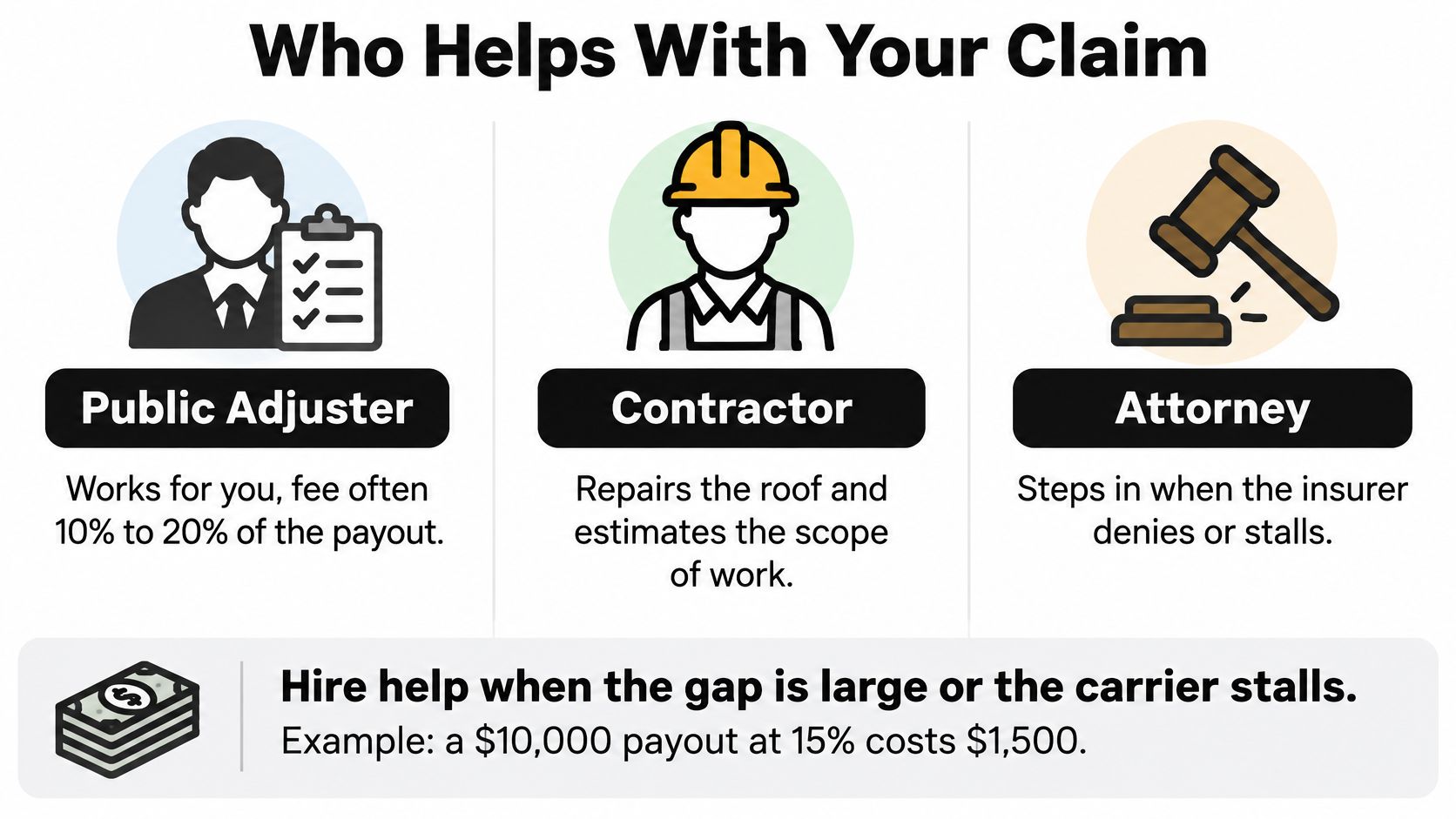
A public adjuster works for you, not the carrier, and commonly charges 10% to 20% of the claim. Some states cap that fee. Read whether the percentage hits the first check, the holdback, or both. On a small gutter claim, that cut can erase the gain.
A storm contractor can inspect, price the supplement, and stand on the roof with the adjuster. The risk is in the contract. Confirm it doesn't waive your deductible in a way your state forbids, and confirm it doesn't include an assignment of benefits that hands the claim to someone else. Two States Exteriors LLC is one Kansas City option that inspects storm damage and can meet the adjuster on site when you want the repair crew and the claim file in the same hands. Compare that offer with at least one other bid before you sign.
A construction-experienced attorney is the right call for a denial, a bad-faith dispute, or a suit deadline that's close. Contingency fees commonly run 33% to 40%. That's expensive on a clean supplement and reasonable when coverage itself is the fight.
An independent appraiser charges a flat or hourly fee. Use one when only the amount is disputed and the policy allows appraisal.
| Option | Works For | Typical Fee | Best When |
|---|---|---|---|
| Public adjuster | You | Commonly 10% to 20% of the claim | Large losses or a lowball offer from the carrier |
| Storm contractor handling the claim | You, under a signed contract | Often built into the job price; check deductible rules | Clear roof scope and you want one team on the claim |
| Construction-experienced attorney | You | Commonly 33% to 40% contingency | Denial, bad-faith or suit-deadline issues |
| Independent appraiser | You | Flat or hourly fee | Only the dollar amount is disputed and the policy has an appraisal clause |
A $4,000 gutter-and-fascia claim rarely justifies a 15% fee. A $40,000 roof dispute with omitted slopes often does. Match the fee to the dollars still in play, not to how frustrated the last phone call felt.
Confirm the Final Payment Before You Sign
Accepting the first check doesn't settle every covered item. Signing a broad release can. Endorse nothing until you know which of those two things the letter is asking you to do.
Ask the insurer, in writing, whether the check is an advance, a partial payment, or a full settlement. Request the depreciation worksheet. Confirm whether your policy pays actual cash value only or replacement cost after the work is done. Many policies separate those two, and recoverable depreciation is paid only after the work is completed and documented, as the NAIC homeowners insurance overview describes. The same regulator example from Indiana is blunt about underinsurance: coverage below 80% of current replacement value can result in settlement on an actual cash value basis rather than full replacement cost.
What has to be in the envelope
Say the holdback is $6,200. It typically comes off hold only after the roofer submits a final invoice, the permit closeout, and dated photos of the finished roof. Miss the completion deadline and that money can stay with the carrier. Miss a supplement window and the omitted drip edge or ridge cap can close with it.
- Keep the proof. Save every receipt, permit, final invoice, and completion photo in one folder.
- Name the three numbers. Approved amount, deductible, and holdback should match the payment letter before anyone signs a release.
- Lock the scope. If a contractor is running the job, get the final scope in writing this week, then compare it to the carrier's estimate line by line.
The first check is a starting payment. The second one is paperwork, finished work, and a deadline you can point to.
Two States Exteriors LLC inspects hail and storm damage at no charge, walks the roof with you during the adjuster's visit, and helps organize photos, receipts, and the repair scope so the claim file matches the work. If your first check falls short of the roof you need, start with a documented inspection instead of signing a release. Visit Two States Exteriors LLC to schedule that look at the property.