
The hail came through fast, the way it does here, and by the next morning the street has that after-storm quiet: a few ladders out, shingles in the grass, and a homeowner standing in the driveway looking at a row of small round dents along the front gutter.
The roof gets the worry. The gutter gets a shrug. That shrug is where people either spend money they didn't need to spend or skip a repair that slowly soaks the fascia for a year.
Sorting a cosmetic dent from a failing roof edge takes about ten minutes on the ground, and it starts with treating hail damage on gutters as a drainage and attachment question instead of a dent count. The marks matter less than what the water does after the next hard rain.
Signs of Hail Damage on Gutters
Start on the ground, both feet on the grass, phone in hand. Most of what decides a gutter's fate after hail is visible from a driveway, and the chart below sorts it faster than a ladder ever will.
| What you see | Likely meaning | Urgency |
|---|---|---|
| Shallow concave dents on the front face only | Direct impact that may still leave the channel open | Monitor if water still reaches the outlet |
| Dents clustered at a seam, outlet, or end cap | Narrowed or split path for runoff | Check flow before the next heavy rain |
| Cracked or missing sealant at an end cap | Impact or movement opened a corner leak | Photograph and plan a repair |
| Downspout bent or no longer plumb | Stone or wind struck the vertical run | Confirm it is still fastened at top and bottom |
| Hangers pulled away from the fascia | Fastener failure, often with wind as well as hail | Urgent if the trough is leaning out |
| Long sagging run with few impact dents | Wind load or loose fasteners more than hail alone | Don't label it hail without other marks |
| New stains on fascia or siding under one section | Overflow or water slipping behind the gutter | Functional failure; trace it to the dent or gap |
| Gutter lifted so the drip edge gaps open | Roof-edge attachment disturbed | Urgent; water can get under the roof edge |
A ladder is for people who already work at height safely, with a stabilizer and someone footing it. If that isn't you, the ground view plus photos will carry most of the decision, and the roof edge itself belongs to an inspector.
Reading the rows in order
Face dents are the ones everybody photographs. They're round, discrete, sometimes with bright metal showing where the impact broke the paint, and they usually mean the least. A dent that leaves the channel open and doesn't sit near a joint is a mark you watch.
Dents packed at a seam, an outlet, or an end cap carry more weight, because that's where the trough narrows and where water is already moving fastest. A pinch at the outlet backs up the entire run behind it, which is why a single crushed collar can matter more than twenty dents spread along the middle.
Pulled hangers and a leaning trough sit at the top of the list. Metal that has left the fascia is no longer catching water at the roof edge; it's redirecting it. The same goes for a gutter lifted enough to gap the drip edge, because that gap leads behind the roofing rather than toward the ground.
Photos that still mean something in three weeks
Set a coin or a small ruler against the dent before you shoot it, so the size reads without you in the frame. Get a wide shot of the whole run and a close shot of each impact cluster, and note which wall faced the storm that afternoon. Stains and drips are worth a photo after the next rain, since a wet mark tells an adjuster more than a dry dent.
Marks that look like hail and aren't
Ladder scars show up at the same height on every section, usually in a straight scrape, and they're the most common false alarm on a gutter face. Old corrosion looks chalky or pitted rather than round. Straight-line gaps at an end cap or a joint are expansion and thermal movement, not impact. If a mark has no matching strike on the fascia, soffit, downspout, or siding nearby, slow down before you call it storm damage.
Sorting rule: attachment and continuous flow outrank the dent count. A rough-looking gutter that holds its hangers and moves water to the outlet is doing its job.
Why Hail Makes a Gutter Stop Draining
After a storm, bruised shingles may draw attention while a dented gutter looks like a cosmetic problem. Yet a gutter can stay attached and still fail to carry water. The key is whether hail changed the channel's shape or its attachment enough to interrupt drainage.
A gutter catches runoff at the roof edge and directs it away from the fascia, siding, and foundation. The channel needs a clear path to the outlet, and its hangers need to hold that path in place. A small dent may do little; a sharp bend near an outlet or seam can narrow the route, much like a kink in a hose.
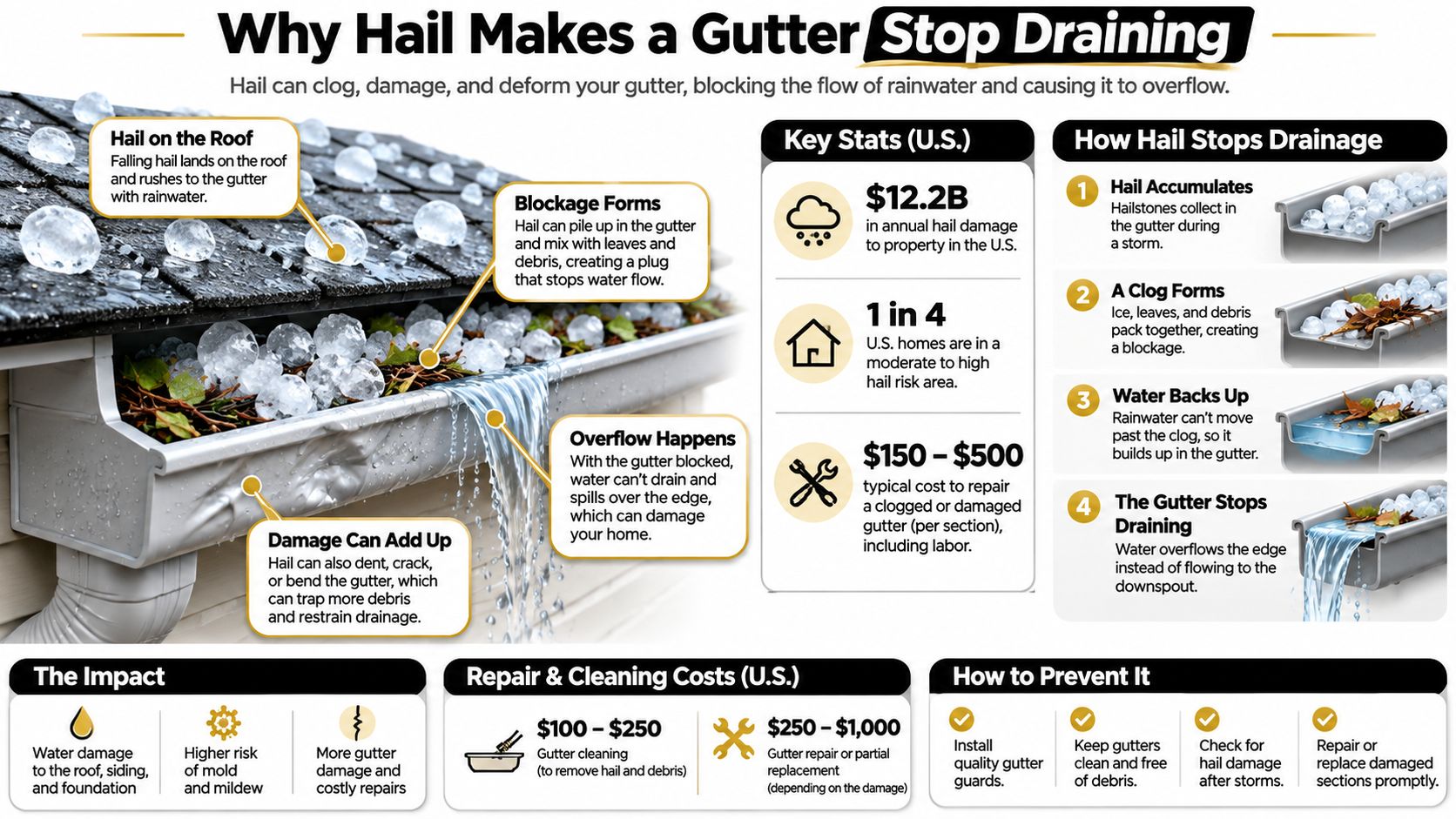
Hail damage is a recurring concern in storm-prone areas. Research published in Frontiers in Built Environment and summarized by InsideNoVa estimates that about 3,000 hailstorms occur in the United States each year, historically causing roughly $1 to $2 billion in annual damage. The same reporting cites an analysis of NOAA data showing that Kansas, Missouri, Oklahoma, Nebraska, Colorado, and Texas accounted for a substantial share of severe-hail events from 2023 through 2025.
Those figures describe hail activity and damage overall, not damage to a particular gutter. A local hail report can establish that a storm affected an area, but it does not prove that one gutter stopped draining. That requires evidence of a changed channel, a damaged connection, or a drainage problem.
What a controlled hailstorm showed
In a 2013 full-scale demonstration, the Insurance Institute for Business & Home Safety projected more than 9,000 laboratory ice spheres at a residential structure fitted with aluminum gutters and downspouts. Stones reached roughly 2 inches in diameter, and the concentrated test lasted about four minutes.
Researchers recorded dents in the aluminum gutters, along with damage to roofing, siding, windows, and other exterior components. The practical lesson is that a dent's location can matter more than its appearance. Deformation near a seam, outlet, or downspout connection can restrict the route water follows off the roof.
A flattened section of a drinking straw shows the same basic effect: the straw remains intact, but less air can pass through the narrowed point. In a gutter, runoff may slow at a pinch, back up along the run, and spill over the edge.
So, “the gutter is still on the house” does not settle whether it works. Check whether the trough remains aligned, water can reach the outlet, connections are intact, and fasteners still hold the run in place. A field of shallow dents alone does not justify replacement if the gutter continues to drain properly. Conversely, a single damaged outlet or connection may disrupt drainage even when the rest of the metal looks sound.
Hail Impact Versus Wind and Ice
After a storm, one gutter may show round dents while the run beside it hangs loose. Those marks point to different forces, but neither a dent count nor a local hail report proves that a particular gutter has failed. Check how the roof edge is attached and where water can travel.
The National Severe Storms Laboratory reports that typical severe-thunderstorm hail measures 1 to 1.75 inches and falls at approximately 25 to 40 mph. Strong horizontal winds can drive stones at an angle or nearly sideways. A stone striking sideways may hit the outward-facing bead, end caps, metal beside the fascia, or downspouts differently from one falling straight down.

Three patterns that look alike at twenty feet
Direct impact often leaves tight clusters of round dents, sometimes with bare metal at the center, on the side facing the storm. For example, a west-facing run with shallow craters along the outer lip and damage at a corner cap has marks consistent with impact. The pattern helps explain what may have happened, but it does not establish that the whole gutter needs replacement.
Wind loading may leave a long stretch separated from the fascia or sagging, with few round dents. Loose fasteners or wind pushing beneath the lip can shift a trough. A drooping run with a smooth face suggests an attachment problem that differs from concentrated hail marks.
Ice loading can distort metal after freezing weather, spreading seams or pushing the trough out of shape. Without fresh impact marks, a history of ice buildup may help explain the distortion. A bent gutter alone does not identify which force caused it.
At low-slope and commercial roof edges, wind can also lift a gutter and disturb nearby drip edge or flashing. If perimeter material starts to peel, the concern extends beyond the gutter.
Where the water goes after the strike
Hail often arrives with heavy rain, so a dent matters most when it changes the drainage path. Water may spill over a narrowed section, collect behind crushed metal or debris, or pass behind the fascia if the gutter has pulled away. A mark on the front face, by itself, does not prove that any of these failures occurred.
A blocked or damaged gutter, drain, or scupper can give water a path into the building during a storm. That is why the roof edge deserves attention alongside the roof: the gutter is part of the route that carries runoff away from the wall.
For a broader discussion of hail storms, see this hail damage myths debunked. Keep the distinction clear: a local report indicates hail occurred in an area, while the marks, attachment, and drainage at the home show whether a particular gutter was affected.
Field habit: Photograph dents with a scale reference, note which wall faced the storm, sight the gutter-to-fascia line, and check whether water reaches each outlet. Together, these observations help distinguish visible marks from a drainage or attachment problem.
When to Repair or Replace a Gutter
After a storm, a gutter covered in dents may still drain properly, while a run with only a few marks may have pulled away from the house. The number of dents is a poor guide on its own. Check whether water moves to the outlet and whether the gutter remains securely attached.
If the face is marked but the hangers are tight and water reaches the outlet, monitoring may be enough. If the gutter has shifted and water runs behind it, repair is more urgent. Replacing every dented section can cost more without fixing a drainage problem that comes from a loose hanger or a blocked outlet.
Three tests you can run without a roof climb
Watch the water. During steady rain, stand back from the corner and follow the gutter run. You can also run a hose at low volume near the high end for ten minutes. Water should reach the outlet without spilling over the lip or collecting in a low spot.
Sight the fascia line. Stand at one end and look along the gutter, as you would sight a fence post. A trough leaning away from the fascia, or a visible gap behind it, points to an attachment problem. Caulk will not secure a gutter that has pulled loose.
Look for staining. Dark streaks on the fascia or siding below a section can show that water is escaping behind the gutter rather than entering the downspout. Trace the leak to a dent, gap, or loose connection before deciding what needs work.
| Condition | Action | Why |
|---|---|---|
| Face dents only, hangers tight, water reaches the outlet | Keep and monitor | The gutter still carries runoff |
| One crushed outlet or a split seam | Repair that outlet or seam | A local pinch can back up a whole run |
| Open end cap or failed corner sealant | Reseal or replace the cap | Water escapes at the corner instead of reaching the downspout |
| Sound trough with pulled hangers | Rehang and refasten | The metal can still work if secured back in line |
| Several crushed runs or torn metal | Replace the damaged run | Collapsed aluminum will not spring back into shape |
| Gutter shifted and drip edge gapped | Replace or reset the run and inspect the roof edge | Water may enter beneath the roofing |
| Downspout crushed but the gutter is open | Replace the downspout | Runoff cannot drain if the exit is closed |
Why aluminum doesn't get a second chance
Dented aluminum does not return to its original shape on its own. Painting a crushed outlet leaves the channel pinched, so water can back up there again. A small seam gap may be sealed, but sealant cannot reshape metal folded over itself.
The repair choice depends on what failed. A sound trough may need only a local repair. If the fasteners failed but the metal held its shape, rehanging may solve the problem. A run that has lost its shape or shifted the roof edge may need replacement. Before comparing repair with replacement, review what gutter repair actually costs.
On a commercial or low-slope roof, a shifted gutter can signal trouble at the roof edge. The gutter may look like the only damaged part from the ground, but the edge flashing above it also needs attention. A replacement should be judged by hanger spacing and fastening, not just its color and length. Safeguard Roofing gutter services describes gutter work where those installation details matter. A properly attached run is less likely to repeat the same failure.
What Strengthens a Hail Damage Claim
After a storm, a gutter may show a few dents while still draining normally. Another run may have fewer marks but a pulled hanger or crushed outlet that sends water over the edge. For a claim, the useful question is what changed at the roof edge and whether the evidence connects that change to the storm.
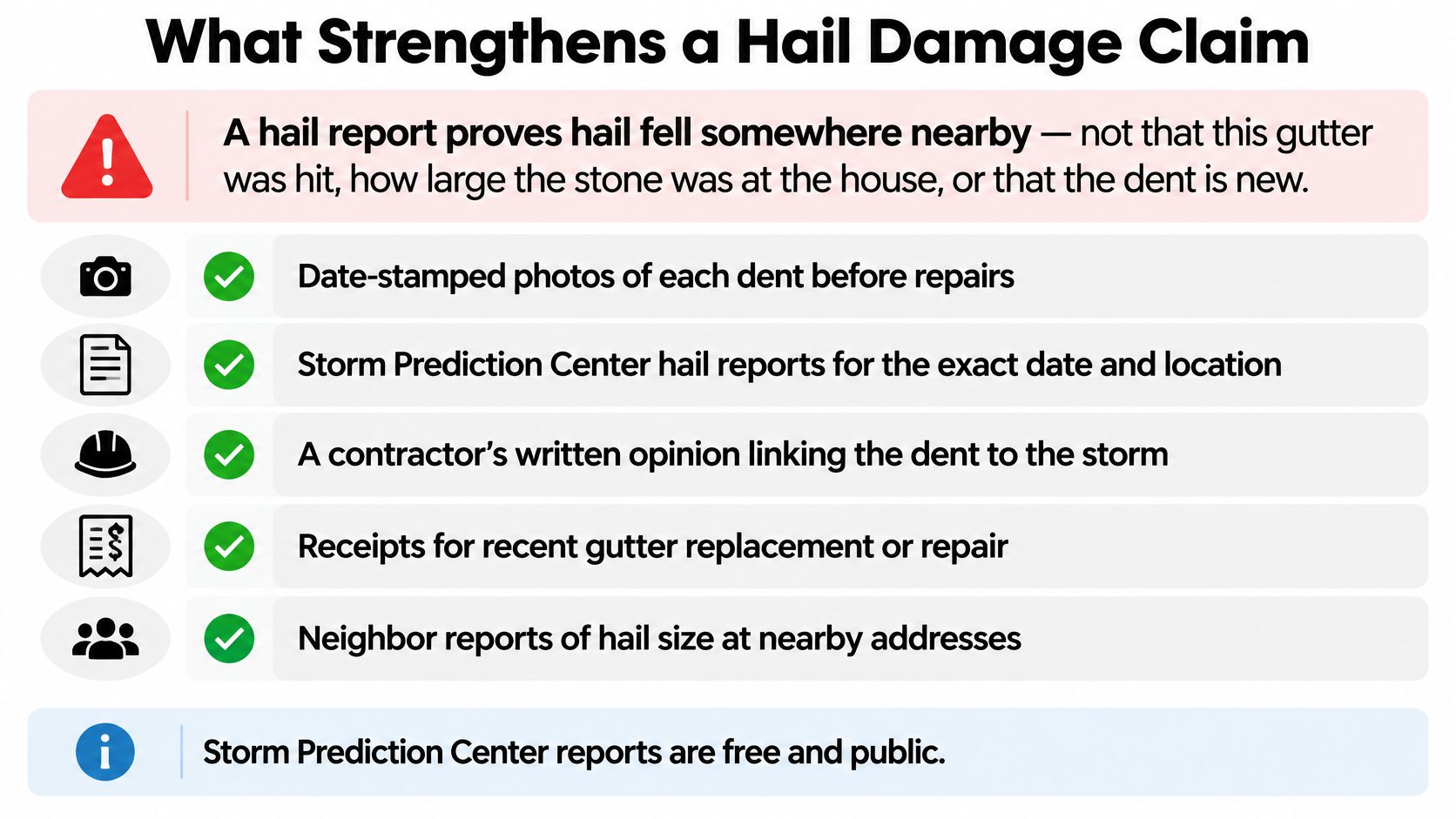
The Storm Prediction Center records hail reports at thresholds of 1 inch or greater and separately tracks significant hail above 2 inches. These reports describe hail in an area, not the exact stone size at your home, its direction of travel, or the age of a particular dent. A nearby report helps establish context, but it does not prove that one gutter failed.
The Insurance Information Institute reports thousands of hail events across the United States, with Kansas and Missouri among the states with the highest totals. That volume is a reason to document possible damage promptly, not proof that a particular gutter needs replacement or that a policy covers it.
The packet that helps an adjuster
Build a simple record before anyone alters the gutter. These details help distinguish a fresh impact or attachment failure from old wear:
- Storm date and size: Record when the hail fell and your best estimate of stone size. Note whether it fell straight down or was driven sideways.
- Ground-level photos with a scale: Include a coin or ruler, plus a wide view and close-up, before anyone touches the metal.
- Where the water went: Identify the section that spilled, any outlet that backed up, and stains noticed after rain.
- Attachment symptoms: Photograph a loose section, leaning trough, out-of-plumb downspout, or fasteners pulled from the fascia.
- Matching marks elsewhere: Check downspouts, fascia, soffits, windows, siding, and roofing on the same side of the house.
- Paperwork on recent work: Keep receipts for gutter repairs or replacement to help establish when older marks may have appeared.
Keep descriptions plain and specific. “Dents on the west elevation front face, roughly coin-sized, with matching marks on the downspout and fascia, first noticed the morning of the storm” gives an adjuster more to assess than a general description of how bad the damage looks.
Four questions the policy still has to answer
A claim still turns on four separate questions: Did a storm occur at the property? Did it cause this particular damage? Can the affected piece be repaired, or does it need replacement? Does the policy cover the damage, and what deductible applies? A local hail report can support the first question. It cannot establish the cause or extent of gutter damage by itself.
| Evidence | Supports storm damage | Points to other causes |
|---|---|---|
| Round dents with fresh bare metal at the impact point | Marks on the outward face with bright metal exposed | Scrapes at ladder height on every section |
| Matching marks on roofing, fascia, siding, or downspouts | Same wall and direction as the storm | Marks only on the gutter, none on other components |
| Torn sealant or cracked end cap | Fresh edges with no staining | Chalky old sealant with long-term staining |
| Hanger pulled with clean fastener holes | Fresh pull-out matching the wind direction | Rust, corroded fasteners, or loose old screws |
| Sag or lean along a long run | Shift that appeared after the storm date | Thermal movement, ordinary wear, or sag that predates the storm |
| Hail size near the house | Reliable size estimate for the address | Only a regional report that hail fell nearby |
A dent count alone is a poor guide. Corrosion, tired fasteners, thermal movement, ladder marks, and ordinary wear can resemble storm damage. For example, chalky sealant with brown staining beneath a split end cap suggests a leak may have started before the storm. A qualified inspector can assess unsafe roof access and examine the gutter attachment and roof edge together.
For the repair side of the process, this guide to hail damage repair and insurance claims explains how repair work relates to an adjuster's scope.
Book a Ground-Level Storm Inspection
Two paths come out of that chart, and neither one is "replace everything."
If you found shallow face marks, tight hangers, and water still reaching every outlet, keep the dated photos and recheck after the next hard rain. A cosmetic dent doesn't obligate you to spend money this week, and a documented baseline is worth more than an early replacement.
If an outlet is crushed, a run is leaning, stains have appeared under one section, or the drip edge has gapped open, get the gutter and the roof edge looked at together. Water that slips behind the metal doesn't announce itself. It shows up later as soft fascia, peeling paint, and a bigger bill.
Send the dated photos and one line about which side overflowed before the visit, so the crew knows which elevation to start on, and leave wet, steep, or high roofs to them. For Kansas City metro homeowners, Two States Exteriors LLC inspects hail and storm damage on gutters and roofs, and our specialists conduct thorough inspections to identify damage or potential issues that could lead to costly repairs down the line. We also handle roof insurance claims for hail and storm damage, and gutter installations, repairs, replacements, and protection when a run is past saving. If you'd rather start by finding hail damage repair near me, that's the request to make.
Request the storm inspection while the marks and the weather date are still fresh.
Hail damage on gutters is rarely about how the metal looks and almost always about whether it still moves water where it belongs. Two States Exteriors LLC inspects gutters and roof edges after every storm, documents what we find with dated photos for your claim, and repairs or replaces only the runs that have failed. Visit Two States Exteriors LLC to request a free on-site storm inspection before the next rain tests the repair you're still thinking about.