
After heavy rain, you notice water dripping from a gutter seam beside the porch. A tube of gutter repair sealant might stop it, but first check whether the joint has failed or the gutter is holding water because it's sagging. Those problems can leave the same puddle below, yet they need different repairs.
What Gutter Repair Sealant Is
Gutter repair sealant is a flexible, weather-resistant compound used to close seams, joints, end caps and small openings in a gutter system. A compatible product bonds to metal or vinyl while accommodating the gutter's movement.
Say water escapes beneath an end cap after a storm. If the cap fits tightly, the gutter drains properly and the surrounding material is sound, replacing the failed bead may solve the problem. If the cap has pulled away because the gutter corner is twisted, applying more sealant leaves that distortion untouched.
Think of sealant as a flexible bandage over a knee. It needs to move with the joint. A rigid patching compound behaves more like a plaster cast where movement is needed, resisting the bend until something cracks or separates.
Why flexibility matters
The move toward flexible sealing materials isn't new. A historical review published by Cambridge University Press traces the first commercial elastomeric sealants to polysulfide products in the early 1950s, with silicone, urethane and acrylic technologies reaching commercial markets later.
For a homeowner, the useful distinction is between a material that merely hardens over an opening and one that stays elastic while maintaining its bond. Hardness alone doesn't tell you whether a repair will hold.
Sealant also isn't an adhesive substitute for gutter hardware. It won't straighten a sagging section, secure loose hangers, reshape a distorted corner or restore rotten fascia.
Practical rule: Sealant is a repair component that works only when the gutter's slope, support and surrounding material are sound.
Where Gutter Sealant Works and Where It Fails
Sealant suits joints that move a little and carry little load. It fails as a repair strategy when the structure itself is wrong.
The location matters, but so does the material surrounding it. A small opening in firm gutter metal is a different job from a similar-looking opening surrounded by corrosion.
| Location or condition | Sealant suitable? | Why it works or fails |
|---|---|---|
| Seam between two gutter sections | Yes | A continuous bead bridges the joint and flexes with the metal. |
| End cap | Yes | Small seepage often stops with a careful bead applied to a clean, dry surface. |
| Downspout outlet joint | Yes, if surrounding metal is sound | Sealant holds only when the outlet and gutter floor are firm. |
| Small nail or screw hole | Yes, for minor cases | Sealant fills the opening, but thin metal may need a supporting patch. |
| Corrosion perforation | Limited | Sealant alone carries too much stress; a compatible metal patch supports it. |
| Sagging or loose section | No | Slope and hangers must be corrected before sealing. |
| Rot in fascia behind the gutter | No | The problem is structural and sits outside the gutter. |
Trace the first escape point
Observe the gutter during rainfall from the ground, or use a gentle hose flow in dry weather. Don't climb a ladder during a storm. Watch where water first escapes, not just where it finally drips, because water can travel along the underside.
Check whether water pools at the joint or backs up near the outlet. An end-cap drip beside a blocked downspout may become visible only when the water level rises. Clear the obstruction and retest before deciding the cap needs resealing.
Also follow the discharge beyond the downspout. Home Pro's Remodeling & Repairs offers East Texas drainage improvement ideas that provide context for thinking about where roof runoff goes after leaving the gutter, rather than treating the seam as the entire drainage system.
If the repair must change the gutter's shape or support, a tube is the wrong tool.
Choosing the Right Sealant Type for Your Gutters
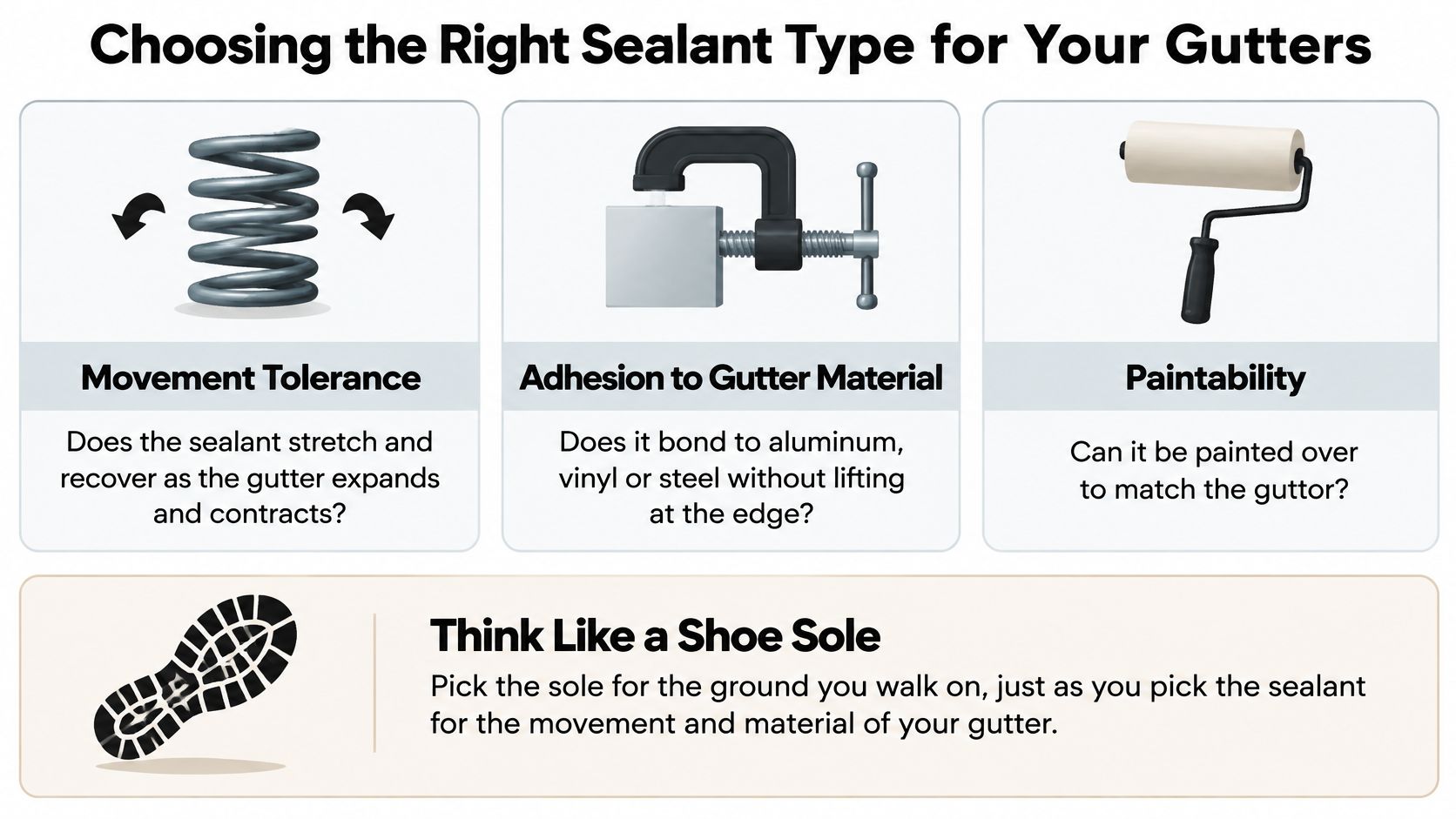
Choose by movement tolerance, adhesion to the gutter material and paintability, in that order. A paintable product isn't useful if it releases from the gutter, and strong initial grip doesn't guarantee flexibility after curing.
Choosing sealant is like choosing a shoe sole for a particular surface. Grip depends on what it touches. Aluminum, painted steel and vinyl don't automatically accept the same product.
Use these selection factors before comparing tubes.
Compare the practical trade-offs
| Type | Strengths | Limits | Best use |
|---|---|---|---|
| 100 percent silicone | Excellent weather and UV resistance; flexible under cycling | Usually not paintable; adhesion must be confirmed for the substrate | Seams and end caps on aluminum or vinyl when specifically approved |
| Polyurethane | Strong adhesion; paintable; good movement capacity | Can chalk or yellow unless rated for exposure; wet-service suitability needs checking | Metal seams where paint matching matters |
| Acrylic latex | Easy cleanup; paintable; lower odor | Limited movement; weak under constant wetting | Cosmetic touch-ups and small, non-moving gaps outside the water channel |
| Butyl sealant tape | Bonds without a liquid-curing stage; handles tight fits | Not for wide gaps; can be messy in heat | Temporary stop-gaps and small laps at fittings |
Silicone is a sensible candidate for exposed gutter joints when its substrate approvals match the job. Don't choose it where a painted finish is essential unless the manufacturer specifically permits painting.
Polyurethane can suit paint-matched metalwork, but the product must be intended for that exposure. Ordinary acrylic latex caulk is a poor substitute inside a gutter channel. Butyl tape needs close-fitting surfaces and firm pressure, not an unsupported opening.
Service classification matters more than the chemistry name alone. The OC San sheet-metal specification calls for classified elastomeric sealing materials, illustrating why compatibility and intended service belong in the selection decision.
For a specific example, the GE Gutter Silicone technical data sheet lists ASTM C920 Class 25, indicating tested capability for approximately 25% joint movement. That's evidence about a particular product, not a promise covering every silicone tube.
Joint layout matters too. This guide to how seamless gutters are installed explains the installation context behind the connections you're repairing.
Match the product to the moving joint and the actual contact surface. Treat paintability as a finishing requirement, not the main performance test.
Reading a Gutter Sealant Label Before You Buy
A gutter sealant label should give you checkable promises, not just a large waterproof claim. Read the technical sheet when the tube doesn't provide enough detail.
Start with the gutter material, then check the application conditions. A product can be suitable after curing yet unsuitable for installation on cold metal, damp surfaces or during approaching rain.
Your buying checklist
- Movement classification: Look for a recognized elastomeric sealant standard and a stated movement class, rather than a general claim of flexibility.
- Substrate approval: Confirm the actual contact surface, including painted aluminum, vinyl or galvanized steel. Metal approval doesn't automatically cover every coating.
- Outdoor exposure: Look for explicit weathering and ultraviolet-resistance information. Exterior use shouldn't be something you infer from the packaging picture.
- Paintability: Check whether painting is permitted and whether the manufacturer specifies a waiting period or compatible coating.
- Application temperature: Compare the permitted conditions with the gutter's surface temperature, not just the weather forecast.
- Water exposure and cure: Distinguish rain-ready time from full cure. These aren't necessarily interchangeable.
- Preparation requirements: Check for primer, cleaning-agent and old-sealant restrictions before buying supplies.
An impressive front label can hide an important limitation on the back. Take time to inspect the instructions before opening the cartridge.
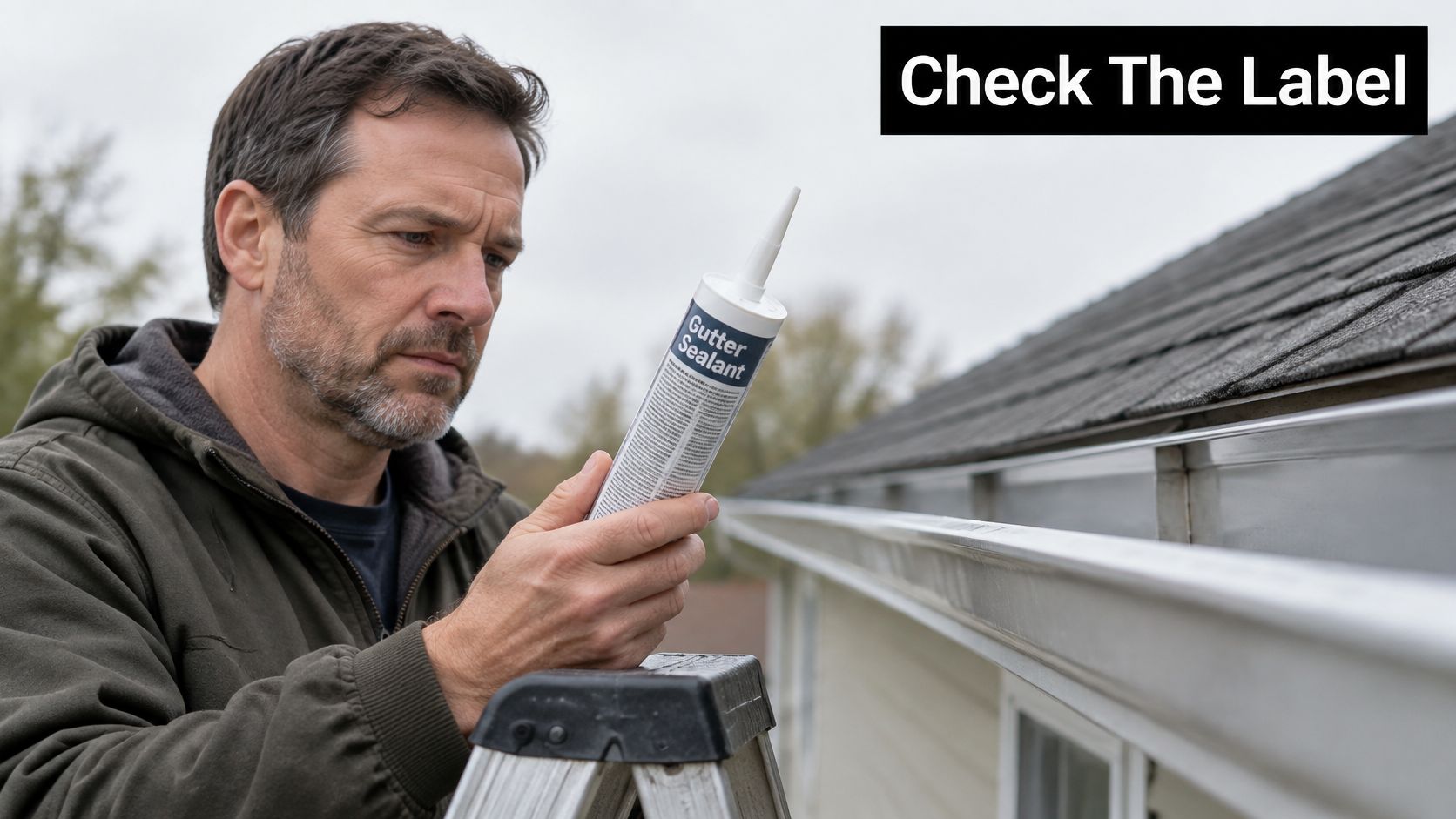
Suppose you're choosing between a tube with documented movement performance and metal approval, and another that says only all-purpose waterproof seal. For a gutter exposed to seasonal temperature changes, I'd choose the documented product, assuming its application requirements fit the job.
A waterproof claim doesn't tell you whether a bead will stay bonded while the joint moves.
Don't mistake a weathering test or warranty statement for a guaranteed repair lifespan. Installation conditions and the condition of the gutter still matter. Even a correctly specified product can release from contamination or trapped moisture.
How to Prep and Seal a Gutter Seam
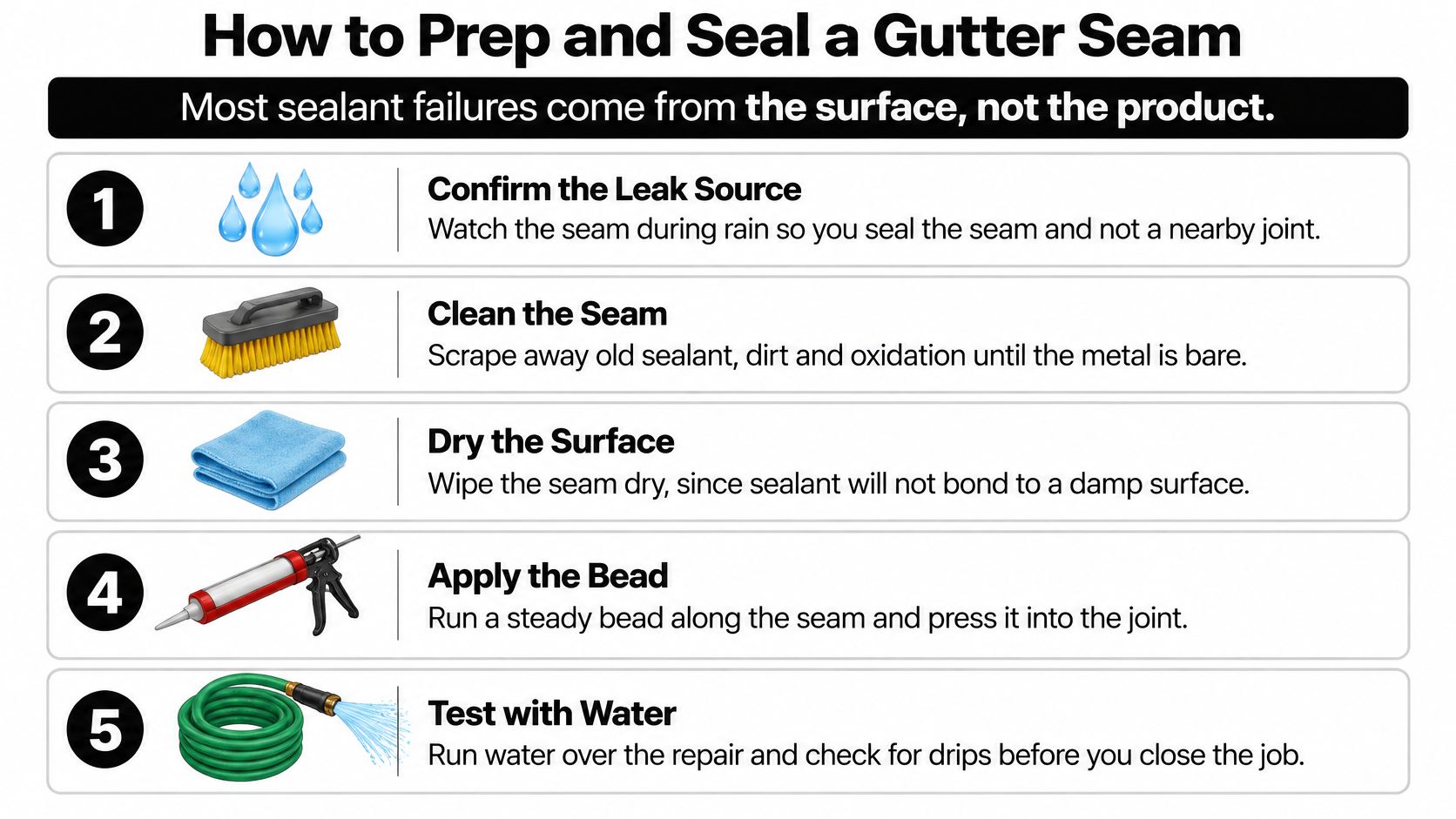
Start with the surface, not a thicker bead. Fresh sealant applied over loose residue is bonded to something that's already failing.
Before setting up, review how to clean gutters safely. Use stable ladder footing, gloves and eye protection, and leave inaccessible work to a professional.
This preparation sequence shows the essentials.
Prepare and apply the bead
- Confirm the source. Observe rainfall from the ground or introduce water gently with a hose. Mark the first escape point instead of sealing beneath the final drip.
- Let the gutter dry. Remove debris and standing water. Check tucked edges, where moisture can remain after the exposed floor looks dry.
- Remove failed sealant. Use a plastic scraper to avoid gouging the finish. Don't cover peeling material with a fresh layer.
- Clean the contact area. Remove oxidation, dirt and oils using a cleaning agent approved for both the gutter finish and sealant. A quick wipe over greasy residue isn't enough.
- Dry it again. Allow cleaning residue to evaporate. Don't trap solvent or moisture under the bead.
- Apply continuously. Run sealant along the joint so it contacts both mating surfaces without voids. Avoid leaving breaks where separate passes meet.
- Tool the bead. Use a suitable spatula or gloved finger if permitted by the manufacturer. Press the material into contact without thinning it into a transparent smear.
- Allow the specified cure. Keep water off the repair for the required interval. A surface skin doesn't necessarily mean the material beneath is ready.
The ASTM C920 standard covers elastomeric building sealants. For the repair itself, distinguish adhesive failure, where material releases from the surface, from cohesive failure, where the bead splits internally. Cleaning addresses the bond; suitable flexibility addresses movement.
A visual demonstration can help with the application technique.
After curing, hose-test the seam and confirm that water drains freely. If it still backs up or escapes elsewhere, Aastro Roofing Company's guidance on when to call a drainage pro offers context for recognizing a problem beyond the bead.
When to Reseal and When to Book a Pro
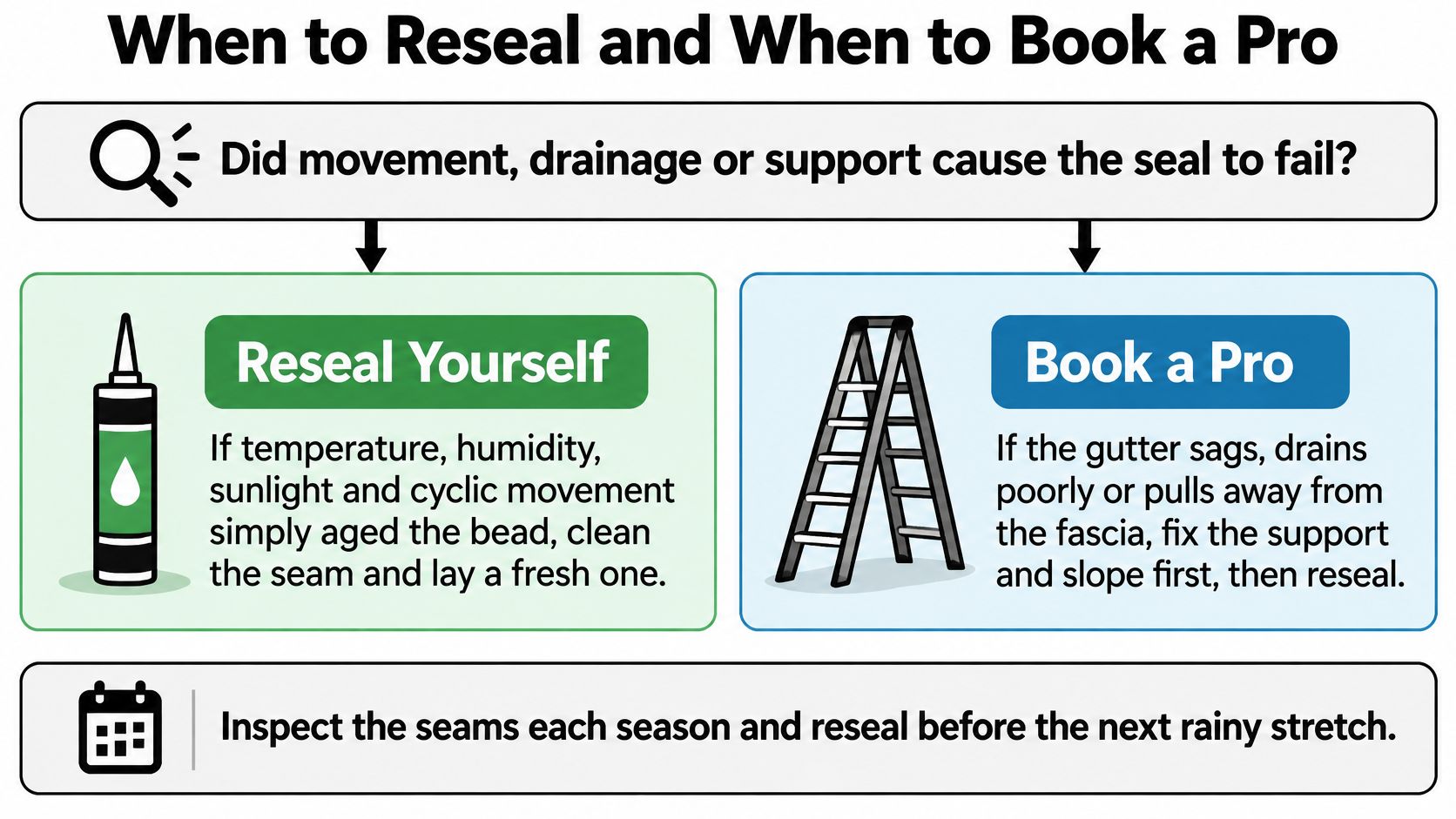
Did movement, drainage or support cause the seal to fail? That question is more useful than asking which tube is strongest.
A sealant durability study available through the USDA Forest Service identifies temperature, humidity, solar radiation and cyclic movement as interacting aging factors. Heat, moisture and repeated stress can contribute to embrittlement and premature failure.
For Kansas City homeowners, freeze-thaw exposure, summer heat and storm debris make a whole-gutter inspection worthwhile. A bead over a loose hanger or standing-water area may conceal the symptom without correcting the cause.
Sort the repair by condition
| Condition | Resealing may hold? | Call a professional? |
|---|---|---|
| One dry-weather drip at a seam | Yes, if residual water reveals an isolated failed joint | No, if safely accessible and otherwise sound |
| Gutter sags or pools water | No | Yes, to rehang and regrade |
| Several leaking seams at once | Unlikely | Yes, for inspection and repair |
| Reseal failed within one season | No, the cause is unresolved | Yes, for diagnosis |
| Corrosion holes or thin, brittle metal | No | Yes, to patch or replace the section |
| Fascia rot or damaged roof-edge flashing | No | Yes, for structural repair |
A dry-weather drip means retained water is still escaping, so check for ponding before treating it as an isolated seam problem. Likewise, repeated separation after resealing calls for diagnosis, not another layer over the same joint.
Use this decision guide to distinguish a bead replacement from work on the gutter itself.
Compare the scope, not just the price
In 2026, Modernize reported average gutter sealing costs of $220, with most projects ranging from $100 to $350. That's a general sealing benchmark, not a Kansas City quote or a price for fascia repair, rehanging or section replacement.
A DIY reseal can make sense when you already have safe access and the defect is localized. A professional visit becomes more useful when the work involves diagnosing pitch, replacing damaged connections or correcting roof-edge water entry. Compare those tasks using our gutter repair cost guide, rather than assuming every gutter repair is a sealing job.
Keep cleaning and repair estimates separate, too. Water Works Power Washing's overview of Dallas gutter cleaning costs provides an out-of-market comparison for cleaning work, not a local sealing estimate.
At Two States Exteriors LLC, we serve the Kansas City Metro Area for custom gutters. We also operate 24/7 for roofing repairs or installations, which matters when gutter trouble accompanies urgent roof damage.
Before calling, gather observations you can make safely:
- Leak location: Identify the seam, end cap, corner, outlet or rear gutter edge.
- Water behavior: Note pooling, overflow and weak downspout discharge.
- Visible support problems: Record loose hangers, separation or sagging.
- Repair history: Explain whether the same location leaked after an earlier reseal.
Don't climb to collect photographs or measurements you can't obtain safely. A clear description from the ground is enough to start the conversation.
Two States Exteriors LLC offers gutter repairs, replacements and new gutter installation, so the recommendation can address more than the visible drip. Visit Two States Exteriors LLC to request an inspection and find out whether your gutter needs resealing, support corrections or a replacement section.