
You chose a beautiful sage green for your Kansas City home. The color looked calm and balanced on the sample board, but after a season of hard sun, the south-facing wall began to fade and chalk while the shaded north side still looked freshly painted. The problem may not be the color alone. Exterior paint finishes control how light, moisture, dirt, and surface defects interact with the coating.
A two-story house in the Kansas City Metro Area takes repeated abuse from summer UV exposure, winter freeze-thaw movement, humidity, wind-driven rain, pollen, and hail repairs. A finish that looks attractive on a sample can exaggerate patching on siding, show lap marks along trim, or make a weathered wood surface look rougher than it did before painting. Use the exterior paint color guide alongside a surface audit, not as a substitute for one.
Why the Sheen on Your Kansas City Home Matters More Than the Color
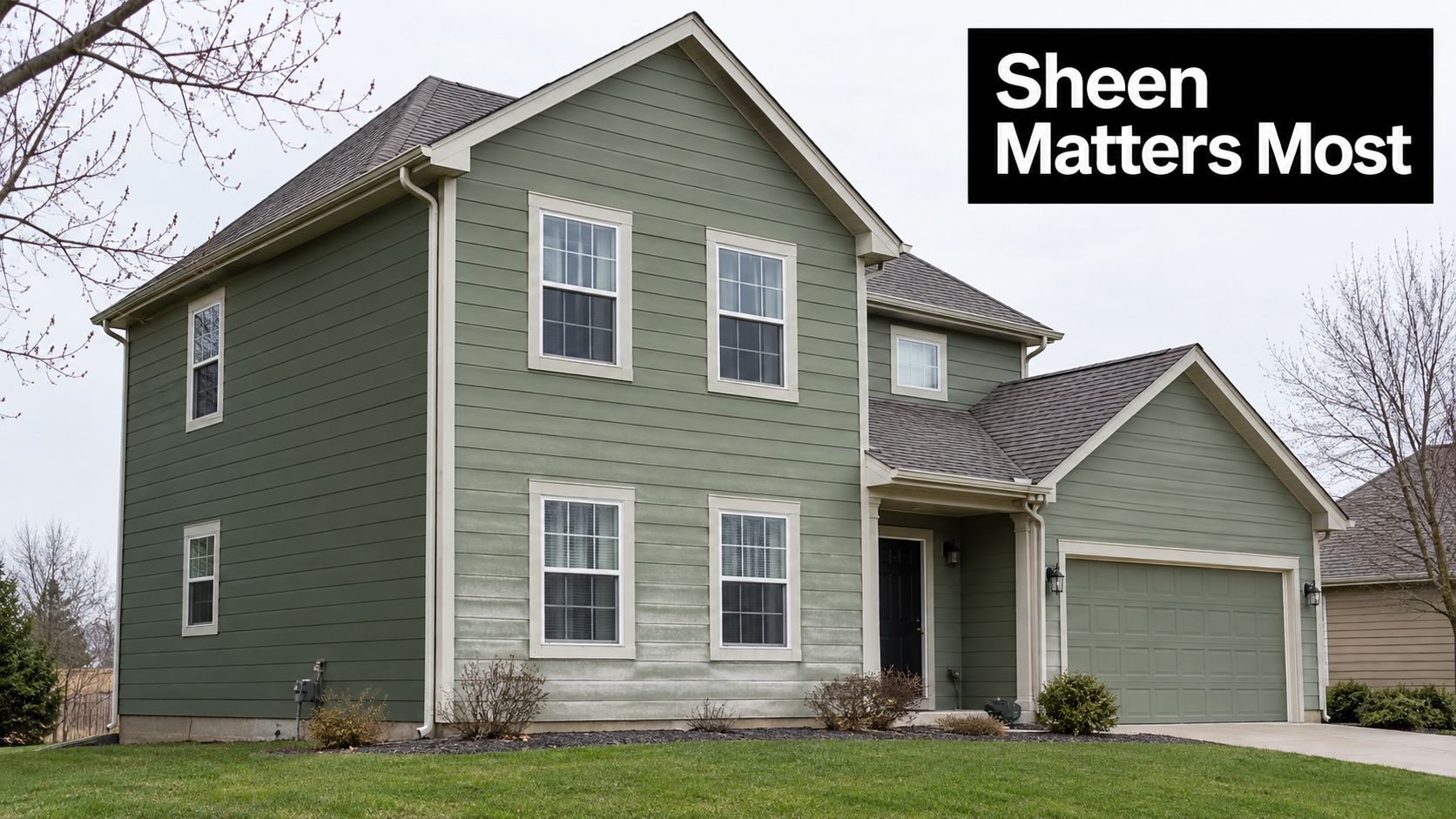
A Kansas City house can wear the same color two different ways. I see it on real jobs. One side gets hard afternoon sun and starts looking faded. Another stays damp longer, holds grime, and reads darker. If a few siding courses were replaced after hail, those repaired areas can throw back light differently even when the paint color matches.
That is why sheen deserves as much attention as color. A finish is part of the protection system, and it changes how the coating sheds water, shows repairs, handles washing, and ages on your specific exterior. Before settling on a sheen, it helps to pair your color choice with an exterior paint color guide for Kansas City homes and then compare that color against the actual siding, trim, and doors on the house.
This decision is not new. Historical research on Flemish façades found that, until the 19th century, most exteriors were rendered and or painted instead of left unfinished. Lime washes, distemper, oil paints, and imitation-stone finishes communicated architectural character while shielding brick, stone, and wood from weather, according to a documented façade study.
Start with the exposure audit
Kansas City homes usually have several coating conditions on one exterior, and each one pushes sheen in a different direction:
- South and west walls take stronger sun and tend to show fading, chalking, and uneven gloss first.
- North-facing walls dry slower and often hold mildew, pollen, and damp residue longer.
- Lower siding and porch areas catch rain splash, soil, salt, and runoff.
- Trim and doors deal with more handling, scrubbing, and day-to-day abrasion.
- Patched or replaced siding can telegraph every repair if the finish reflects too much light.
Higher sheen usually gives you a tighter, more washable film. It also makes defects easier to see. Dents, hail patches, sanding scratches, caulk lines, and wavy boards all stand out more as the surface gets shinier.
Low sheen hides those flaws better. The trade-off is maintenance. It can mark sooner, clean less easily, and ask more of the prep work underneath.
Practical rule: Choose sheen after inspecting the substrate, repair history, sun exposure, splash zones, and cleaning needs. Choose it on the house, not from a small color card.
The Exterior Sheen Spectrum from Flat to Gloss
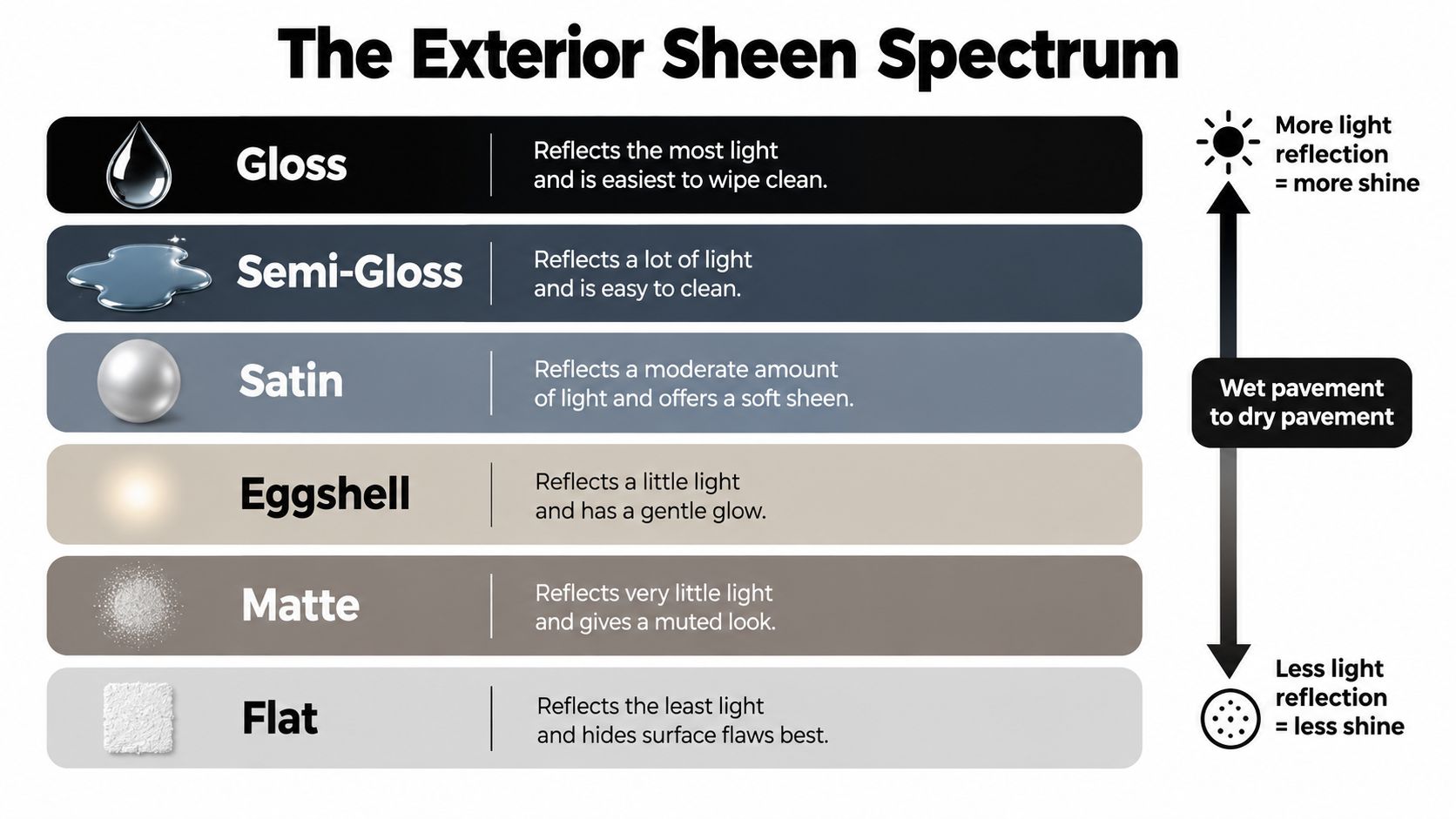
Think about a Kansas road after a storm. Freshly wet pavement throws back bright reflections from headlights and the sky. As the pavement dries, those reflections soften until the surface looks muted and almost chalky. Exterior paint finishes behave in a similar way. More sheen reflects more light, while lower sheen scatters light and conceals irregularities.
Read the scale from quiet to reflective
Flat has the least visible reflection. It gives siding or architectural details a dry, velvety appearance and hides minor surface variation well. The trade-off is lower cleanability and less forgiveness around standing moisture or repeated scrubbing.
Matte stays restrained but usually has a slightly more finished appearance than flat paint. It can soften weathered wood, patched surfaces, and façades where glare would be distracting. It still isn't the first choice for areas that need frequent washing.
Eggshell adds a gentle glow. It remains relatively discreet in direct sun while offering a more practical surface for occasional cleaning. On an exterior, it can work where the substrate is sound and the owner wants a little more resilience without a strong highlight.
Satin provides a noticeable but controlled reflection. It's often the useful middle ground for broad siding because it balances appearance, washability, and moisture resistance. Satin can still expose poor preparation, especially when sunlight strikes the wall at a low angle.
Semi-gloss looks distinctly brighter. Its harder film suits trim, doors, and other details that collect fingerprints, dirt, or splashback. The same reflectivity that makes it easy to clean also calls attention to dents and uneven repairs.
Gloss approaches a mirror-like effect. It's highly reflective and practical for select doors or carefully prepared architectural details, but it magnifies every surface defect and application mark. Gloss belongs on a deliberately smooth, well-prepared surface, not automatically on every exterior accent.
The label isn't perfectly standardized between manufacturers. One brand's satin may look closer to another brand's eggshell, so compare actual samples in morning sun, afternoon sun, and shade. The governing principle stays consistent: low sheen hides flaws, while higher sheen usually improves cleanability and light reflection.
Flat and Matte vs Eggshell vs Satin vs Semi-Gloss vs Gloss
Homeowners usually want one finish that does everything. Exterior surfaces rarely cooperate. A broad siding field needs a finish that doesn't turn every patched area into a highlight, while a front door benefits from a coating that tolerates handprints and washing.
| Finish | Look | Durability | Washability | Best Fit on a Kansas City Home |
|---|---|---|---|---|
| Flat | Soft and low-reflective | More vulnerable to marks and moisture | Limited | Low-glare façades and surfaces with visible irregularity |
| Matte | Velvety with minimal shine | Moderate, depending on the coating system | Limited to moderate | Weathered wood or carefully selected low-wear areas |
| Eggshell | Gentle glow | Moderate | Moderate | Sound siding where a subdued appearance matters |
| Satin | Controlled soft sheen | Good general resistance | Good | Broad siding, shutters, and selected porch surfaces |
| Semi-gloss | Bright and smooth | Strong for high-contact areas | Very good | Trim, fascia, doors, and railings |
| Gloss | Highly reflective | Strong when properly applied | Excellent | Smooth, prepared doors and architectural accents |
What the sunlight shows
Flat and matte finishes scatter light, so they're useful when the wall has old repairs, uneven boards, or a texture you'd rather not emphasize. Satin gives a cleaner visual read without becoming overly bright. Semi-gloss and gloss create stronger highlights, which can make a straight, well-prepared trim board look crisp but can also expose every sanding ridge.
Satin and semi-gloss are not interchangeable in every location. A siding wall with hail patches may look worse in semi-gloss because each patch catches the sun at a different angle. A door with a smooth surface may look better in semi-gloss because the reflection makes the feature feel intentional.
What weathering data can and can't tell you
Exterior coating performance involves more than the initial shine. In outdoor and accelerated-aging testing of reflective coatings, gloss-retention percentages gradually declined as the samples aged, with the rate depending on polymer binder type, while solar-reflectance values changed very little in the coating-aging research. In practical terms, a finish can lose visible gloss without losing the same amount of solar-reflecting ability.
That distinction matters when comparing products. Don't assume that a shinier starting appearance guarantees longer service, or that visible dulling means the coating has stopped protecting the substrate. Preparation, binder chemistry, application conditions, exposure, and maintenance all influence the result.
The useful question isn't “Which sheen lasts longest?” It's “Which coating system suits this substrate and still looks acceptable as it ages?”
Matching Each Finish to Siding, Trim, Doors, and More
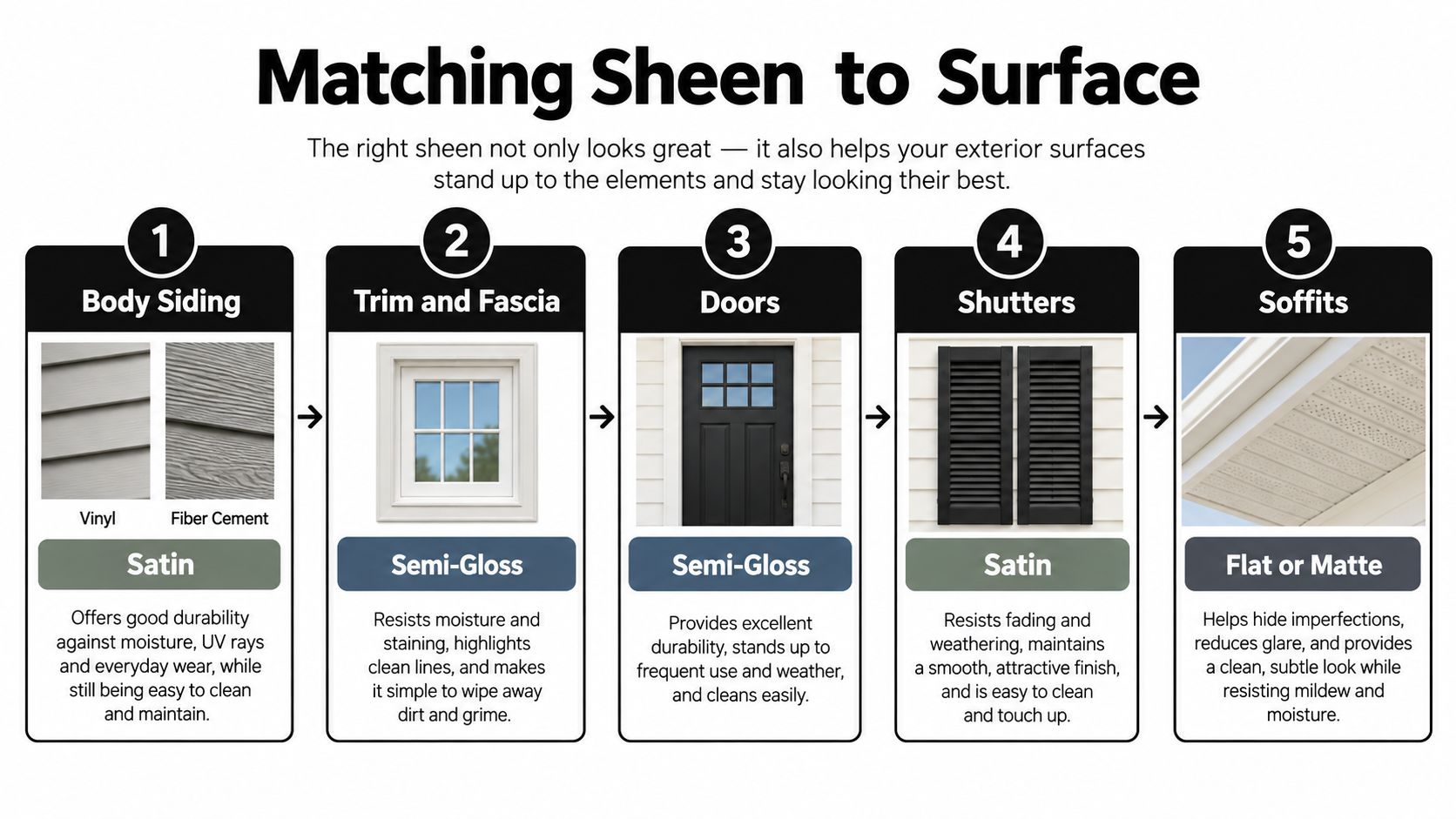
A Kansas City home needs a finish plan, not a single sheen applied everywhere. Walk the exterior clockwise and assign each surface according to its exposure, handling, repair history, and cleaning demands.
Body siding
Satin is often a practical starting point for vinyl, fiber cement, and sound wood siding because it offers a visible but restrained sheen. It handles ordinary dirt better than flat or matte paint while avoiding some of the glare associated with semi-gloss.
That recommendation changes when the siding is heavily weathered or repeatedly repaired. If patched sections, dents, or lap marks are prominent, eggshell or matte may produce a more uniform visual field. The lower reflection won't repair the substrate, but it can stop every irregularity from becoming a bright outline.
Color and sheen also matter on roofs and metal cladding. The U.S. Department of Energy defines solar reflectance as the fraction of sunlight a surface reflects and thermal emittance as its ability to release absorbed heat. Both are measured from 0 to 1, and higher values generally correspond with cooler surfaces according to the DOE cool-roof guidance. For heat reduction, ask for documented optical performance rather than assuming a visually pale color will perform as a reflective coating.
Trim and fascia
Semi-gloss usually fits trim because window casings, fascia, corner boards, and porch details collect dust, rain splash, and occasional contact. The brighter film is easier to wipe, but the painter must prepare joints, nail holes, and patched areas carefully. A poor repair will be more visible in semi-gloss than in satin.
Use a measured approach to painting exterior house trim. Clean edges matter, but so do dry substrates, compatible caulk, sound adhesion, and a consistent application method.
Doors and shutters
Front doors can take semi-gloss or gloss when the surface is smooth and the owner wants a strong architectural accent. Doors receive handprints and repeated cleaning, so the extra cleanability often earns its place. On a dented metal door or a door with uneven filler, satin may look more forgiving.
Shutters commonly work in satin. They need enough film strength for weather and occasional washing, but excessive gloss can make molded detail and surface waviness stand out.
Soffits, eaves, porches, and railings
Soffits and eaves often look better in flat or matte because they're viewed from below and can show overlap marks when the light hits across them. Their exposure still matters, especially where ventilation, moisture, or peeling indicates a substrate problem.
Porches and railings need a tougher system matched to the actual walking and contact pattern. Satin can balance appearance and cleanability on many vertical porch components, while semi-gloss may suit railings or trim that receive frequent handling and splashback. Coating-weathering programs commonly track gloss retention, color retention, and chalking through UV and condensation methods, and south-facing vertical exposures are particularly useful for evaluating those changes as described by the American Coatings Association material.
The Finish Selection Mistake Most Kansas City Homeowners Make
A homeowner stands in the paint aisle, sees low VOC and eco-friendly on the label, and assumes that tells them which finish will hold up best on their house. In Kansas City, that shortcut misses the actual job. Finish selection starts at the wall, not the can.

VOC labeling speaks to emissions during and shortly after application. It does not tell you how the coating will behave on fiber cement baking on a west wall, on older wood lap siding with patched edges, or on trim that stays damp near gutters and splash zones. Exterior performance comes from the full system, binder, pigments, film formation, surface prep, and the conditions the paint will face after it cures.
That matters because two products with similar environmental claims can age very differently once they hit real weather. One may keep its color and grip well on sound siding. Another may struggle on a chalky surface, around high-moisture joints, or where freeze-thaw movement keeps stressing the film. If I am looking at a Kansas City home, I want to know what the substrate is, where it has been repaired, which elevations get hard afternoon sun, and where water regularly splashes back before I choose a sheen.
Read the technical data sheet
Ask for the product data sheet and read it against the house itself, not in isolation. Look for:
- Application limits: Minimum and maximum temperatures, humidity restrictions, and rain or dew limitations.
- Recoat window: The time required before another coat can bond properly.
- Permeability: Whether the film allows moisture vapor to move through the assembly where appropriate.
- Mildew resistance: Product-specific resistance claims and the preparation required to support them.
- Weathering evidence: Gloss retention, color retention, chalking results, and exposure conditions.
- Warranty exclusions: Conditions involving ponding water, poor preparation, incompatible previous coatings, or application outside the stated limits.
The binder matters because visible sheen and actual film performance do not always fade at the same rate. A coating can lose some of its original look in service while still performing acceptably. That is why sheen should follow substrate condition and exposure, not marketing language on the front label.
A green label can inform the purchase, but it can't replace a substrate inspection or an application plan.
The practical lesson is straightforward. Paint within the manufacturer's weather limits, prepare the surface thoroughly, and select a coating system that matches the material.
Cleaning and Maintenance by Sheen Level
Maintenance starts with the surface audit. A shaded north wall with mildew risk may justify more cleanability than a sun-blasted south wall where glare and visible chalking are the bigger concerns. A low-sheen finish can preserve a calmer appearance on an imperfect façade, while a satin or semi-gloss surface may be easier to maintain near doors, walkways, and splash zones.
Match cleaning to the finish
Flat and matte finishes hide small flaws, but they're less forgiving when scrubbed aggressively. Pollen, storm soot, and organic residue can settle into their more subdued surface profile. Clean them gently and address contamination before it becomes embedded.
Eggshell and satin offer a middle path. They're generally easier to wash than flat or matte finishes while keeping reflections controlled. Satin is often practical for siding that needs periodic cleaning, but it still requires proper preparation because washing won't conceal sanding marks or uneven patches.
Semi-gloss and gloss tolerate wiping well, especially on doors, trim, and railings. Their weakness is visual honesty. Fingerprints, lap marks, hail dents, caulk defects, and touch-up differences can stand out clearly, so a cleanable finish doesn't excuse rushed preparation.
For product selection and maintenance planning, compare the best exterior paint brands by their technical documentation, substrate compatibility, and weathering information rather than relying only on sheen names.
A safer exterior washing routine
- Inspect first: Look for peeling, soft wood, open joints, mildew, and failed caulk before applying water.
- Use mild cleaning: Start with a soft brush, low-pressure water, and a mild detergent appropriate for painted surfaces.
- Work from the top down: Rinse thoroughly so loosened dirt doesn't dry on lower siding.
- Protect openings: Keep water away from vents, electrical components, window joints, and damaged areas.
- Avoid aggressive pressure: High pressure can drive water behind siding, scar wood, loosen coating, and turn a maintenance job into a repair.
- Let the surface dry: Don't repaint until the substrate meets the product's moisture and weather requirements.
Two States Exteriors LLC evaluates exterior surfaces and provides residential and commercial painting as part of broader exterior work, including siding and storm-damage restoration. For a home where sheen, repairs, exposure, and weather protection all need to be considered together, visit Two States Exteriors LLC to request an inspection and discuss a finish plan suited to the actual property.