You're probably standing in the exact same spot a lot of homeowners end up in. You search exterior house paint reviews, open three “best” lists, and somehow get three different winners. That's not because paint is mysterious, it's because most reviews mash together totally different failure modes and call the result a verdict.
A paint can look great on day one and still be the wrong choice for your siding, your climate, and your prep work. In Kansas City, that matters even more because a coating that survives July heat can still get exposed by winter weather, moisture, and repair patches later. The right way to read reviews is simple, but shoppers rarely get shown how to do it.
Why Most Exterior Paint Reviews Leave Homeowners Stuck
The problem starts with the way reviews are written. They sound definitive, but they usually reduce a complex coating job to a single ranking, then move on as if every house has the same siding, the same exposure, and the same prep quality.
Consumer Reports' exterior-paint testing is a good example of why a shallow rating can mislead. In its 2008 evaluation, it tested more than 40 exterior paints and stains and used accelerated outdoor exposure equivalent to about three to six years for some ratings. Its full results represented three years of testing, estimated to correspond to about nine years of real-world exterior exposure (Consumer Reports press release).
That's the level of seriousness you want from a review. Most consumer writeups don't get close. They lean on color, coverage, and how the can applies, while skipping the outcome that matters after the first season, then the second, then the third.
The question you should ask first
Practical rule: if a review can't tell you what was tested, how long it was tested, and what failed, it's not much help.
A useful review should tell you whether the product was judged on fading, chalking, cracking, peeling, dirt pickup, or adhesion. A weak review gives you adjectives like “durable” and “long-lasting” without showing the evidence behind them. That's why a star rating is a starting point, not an answer.
| Criterion | What it measures | Most consumer reviews |
|---|---|---|
| Product version | Whether the exact formula was tested | Often skipped |
| Exposure time | How long the coating was observed under weathering | Usually vague |
| Measured outcome | Fading, cracking, peeling, dirt pickup, adhesion | Replaced with opinion |
| Substrate fit | How it performs on the actual wall material | Rarely explained |
| Climate fit | Whether it suits the local weather stress | Usually ignored |
What matters in this guide
Read reviews like a contractor, not a shopper chasing stars. Split the product into separate questions: does it bond, does it keep color, does it stay clean, and does the film stay intact? If a review can't answer those, it doesn't deserve your confidence.
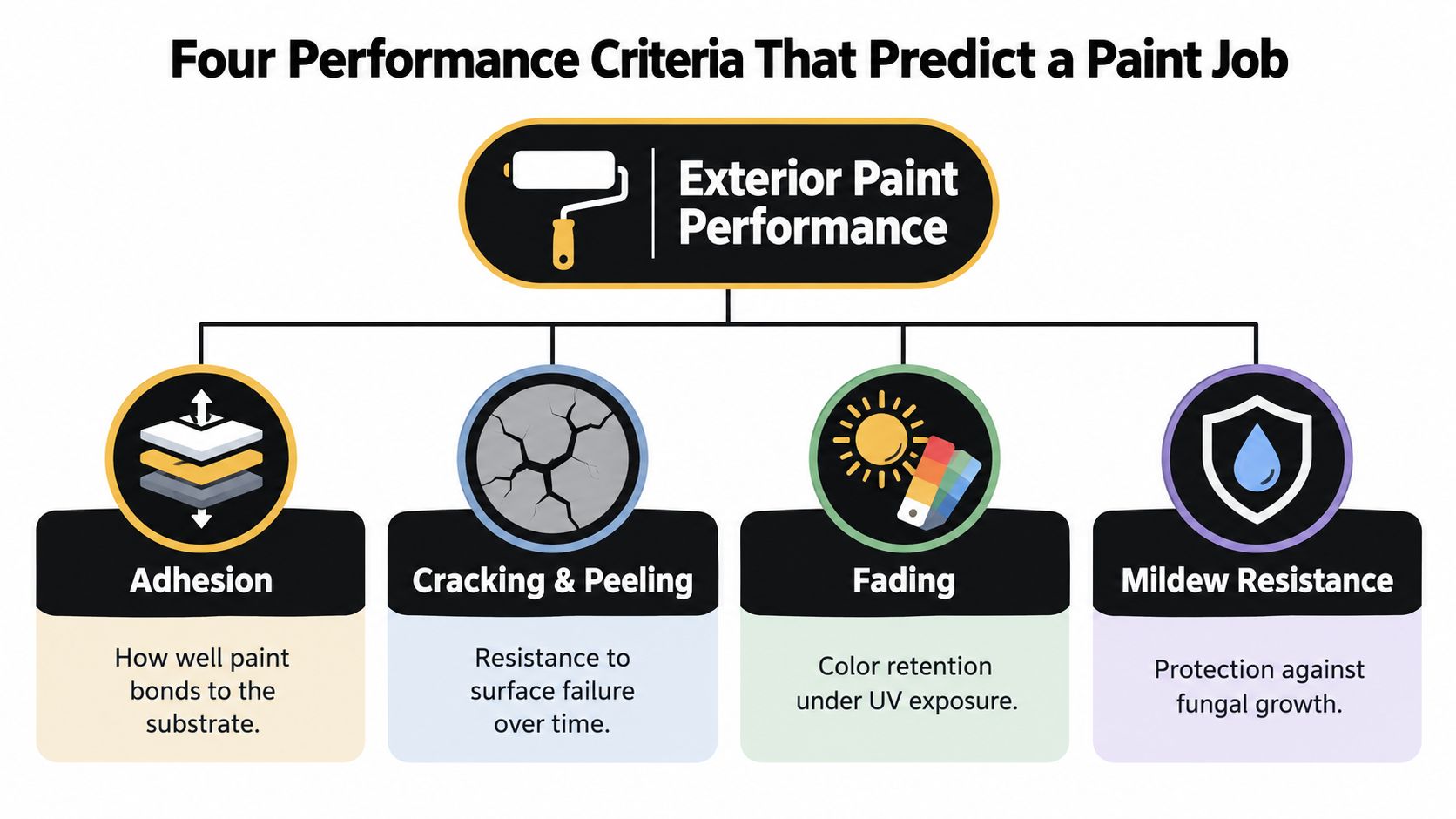
The Four Performance Criteria That Actually Predict a Paint Job
Adhesion is where the job starts
Paint that doesn't bond well is already losing. Adhesion tells you how firmly the coating grabs the substrate, and that matters more than the brochure language on the front of the can. The U.S. Forest Service western redcedar study showed how much surface condition changes that bond, with primer adhesion falling from about 255 lb/in² after four weeks of weathering to 125 lb/in² after 16 weeks (U.S. Forest Service study).
That's not a small difference. It's the difference between a coating system that has something solid to grab and one that's trying to stick to a tired, weathered surface. A review that ignores substrate condition is not really reviewing the paint job.
Color stability and film integrity are separate problems
Color retention tells you how a coating holds up under ultraviolet exposure. Film integrity tells you whether it cracks, blisters, or peels. Those are not the same thing, and a lot of reviews blur them together.
Consumer-facing ratings often hide that distinction. A paint can keep its color reasonably well and still lose the battle on dirt, adhesion, or surface failure. That's why the most useful exterior house paint reviews name the failure mode instead of hiding behind “premium” or “best overall.”
Dirt pickup can make a good coating look bad
ASTM's architectural-coatings work on dirt-pickup resistance showed why surface soiling matters. The committee studied seven commercial paints at seven U.S. locations over 36 months and found a preliminary correlation between accelerated testing and natural exposure, which makes dirt pickup a real review criterion, not a cosmetic complaint (ASTM dirt-pickup article).
A wall can still have an intact film and look tired because it's holding onto airborne grime. That's why you should never judge a coating only by how it looks right after application.
Read the result, not the slogan
A good review tells you what failed first. A bad one just tells you the finish looked nice on day one.
If a review scores paint without separating adhesion, color change, dirt pickup, and cracking or peeling, it's oversimplifying the job. Those four criteria are the backbone of any serious comparison.
Why Midwest Weather Breaks the Universal Best Paint List
January gives you one kind of failure. July gives you another. In Kansas City, the same house can see freeze-thaw stress in winter, heavy humidity in warm months, hard sun on the south and west sides, and patchwork repairs after hail. That is why a national “best exterior paint” ranking falls apart fast. It treats every wall like it lives in the same climate and ages the same way.
One wall doesn't behave like another
Walk around the house before you trust any review. The south and west elevations take the punishment first because they run hotter and see more direct sun. A shaded north wall usually stays damp longer, which changes what matters. A repaired section can be the weakest spot on the whole job if the old coating, the patch, the primer, and the topcoat are not working together.
That means one score for the whole product is not useful. You need to match the review to the wall.
The wall exposure should change your priority
| Wall exposure | Top failure risk | Criterion that matters most |
|---|---|---|
| South-facing wall | UV and thermal stress | Color stability |
| West-facing wall | Heat load and sun damage | Fading and film integrity |
| Shaded north wall | Mildew pressure and longer damp periods | Surface cleanliness and washability |
| Repair-heavy sections | Patch mismatch and bond issues | Adhesion |
Here is a common Kansas City example. A south-facing wall gets hail repairs, the patch compound flashes differently, and the crew spot-primes only the repairs. The finish may look fine at first. Then summer sun heats the wall, winter cold tightens it back up, and the patched areas start telegraphing through or losing bond before the rest of the elevation does. Homeowners blame the brand. The problem is exposure plus uneven substrate conditions.
Climate fit matters more than a "best overall" badge. Flexible acrylic paints are usually the safer call where siding and trim move through big temperature swings. Reviews that ignore freeze-thaw tolerance, moisture retention, and wall orientation are leaving out the conditions that decide service life.
Don't rank brands, rank risk
Start with the wall, not the label. Ask what that side of the house fights every season. Ask whether you are dealing with sun, trapped moisture, or patched areas from old repairs. Then read the review for that failure mode.
That is how a contractor reads paint reviews. Not by chasing one universal winner, but by choosing the coating that fits the exposure it has to survive.
The Preparation Lesson Reviews Rarely Teach
A lot of paint jobs fail before the first brush stroke. Kansas City homeowners see the peeling two winters later and blame the product, but the setup usually did the damage first.
Wood and siding do not wait politely for the painter. Sun, dew, and daily moisture swings start changing the surface right away. In the redcedar work from the U.S. Forest Service study, boards left exposed for 16 weeks before coating began cracking after about three years, while boards painted without prior weathering stayed in almost perfect condition after 17 years. Even one to two weeks of exposure shortened service life.
Preparation Is the Predictor Reviews Skip
That is the part homeowner reviews keep skipping. A five-star review that talks about smooth rollout, rich color, or nice coverage is only telling you how the paint looked on day one. It tells you very little about whether the surface was chalky, sun-baked, damp, dirty, or patched with mismatched materials before the coating went on.
Ask harder questions. Was loose paint removed. Were glossy areas dulled so primer could bite. Did bare wood, filler, and old paint all get treated as different surfaces instead of one big wall. Was the siding dry. Did the crew respect the cure window before dew, rain, or a cold night hit the film.
Contractor's rule: prep decides whether the coating gets a fair chance.
What to look for in a serious review
A useful review should tell you what sat under the paint, not just what color ended up on top.
- Substrate condition: What was painted, and how weathered or damaged was it?
- Surface prep: Were scraping, sanding, washing, and spot repairs described clearly?
- Primer system: Was primer used where it belonged, and was it matched to the material?
- Moisture control: Was the wall clean and dry before coating started?
- Cure and failure notes: Did the review mention rain, dew, cold snaps, peeling, cracking, or loss of bond?
If you want a homeowner-level standard to compare against a bid, use this prep guide. Good proposals read like a sequence of surface decisions. Bad ones read like a color choice with labor attached.
Color as a Performance Decision, Not Just a Curb Appeal Choice
Most homeowners treat color as style. That's a mistake. Color also changes heat gain, and heat gain changes comfort and cooling demand.
Lighter exterior colors reflect more solar energy, while darker colors absorb more. Research summarized by the Paint and Coatings Industry notes that cool exterior walls can produce annual HVAC savings in U.S. Climate Zones 1–4, and it also cites experiments where low-emissivity colorful paints showed about 21% lower cooling energy plus simulations showing a 7.4% annual reduction in total HVAC energy use for a typical U.S. mid-rise building (Paint and Coatings Industry heat-island article).
Don't overread the savings
Those results do not mean ordinary house paint will save you that much. They depend on coating technology, wall construction, insulation, orientation, and HVAC operation. That's the part most homeowner reviews skip because it complicates the sales pitch.
In plain English, a light color can help, but it's not magic. A dark west-facing wall is still going to take more heat than a pale one, and that matters on summer afternoons. If a review talks about color only as a design choice, it's missing half the story.
Ask the right color question
The right question isn't “What color looks best?” It's “What color makes sense for this wall, this sun exposure, and this home's comfort goals?”
Practical rule: if energy and comfort matter, compare the color's solar reflectance with the wall's exposure before you decide.
That doesn't mean every Kansas City home should chase the lightest possible finish. It means color should be chosen with the same seriousness as durability. If you're already paying for a repaint, you should at least ask whether the finish helps or hurts heat load.
A Practical Checklist for Vetting Any Paint Review or Contractor Quote
A good review should answer the same questions a serious contractor should answer. If it doesn't, keep moving.
Questions every review should answer
- Product line and version: Was the exact formula tested, or just the brand name?
- Test duration: Was it short-term appearance or long-term weathering?
- Substrate type: Was it tested on wood, fiber-cement, vinyl, aluminum, or previously painted siding?
- Climate context: Was the result from natural exposure or accelerated testing?
- Measured outcome: Did it track fading, chalking, cracking, peeling, adhesion, or dirt pickup?
Questions every contractor should answer
- Prep method: How will the siding be cleaned, sanded, and primed?
- Moisture condition: Was the surface checked for dryness before paint?
- Cure window: What weather window is needed before rain or heavy dew?
- Primer system: Which primer is being used and why?
- Warranty scope: What is covered, and what is excluded if the substrate fails?
Red flags that should stop the conversation
- “Best paint” without conditions: That usually means no climate judgment.
- Only one rating score: That hides trade-offs.
- No prep discussion: That's a shortcut, not a plan.
- No surface details: If they won't name the substrate, they don't know the risk.
| Ask about | Why it matters |
|---|---|
| Exact product version | Older reviews may not match current formulas |
| Testing duration | Long-term wear matters more than fresh appearance |
| Substrate and prep | Bonding depends on what the paint is covering |
| Climate and exposure | Sun, moisture, and movement change outcomes |
| Measured failure mode | You need to know whether it faded, cracked, peeled, or got dirty |
Take that list to your next estimate. If the answers are vague, the quote is weak.
When to Stop Researching and Call a Local Specialist
January exposes bad paint choices fast. A wall that looked fine in the first fall can start peeling, flashing, or holding grime after one hard Midwest winter. Once you have two or three coatings that match your siding, exposure, and budget, stop reading reviews and get eyes on the house.
Bring your shortlist. Point out the elevations that bake in afternoon sun, the sides that stay damp longer, and any trim or old paint that already shows failure. A local contractor should inspect the substrate, check where prep will be heavy, and explain how the paint system fits those conditions. That is what separates a useful recommendation from another generic star rating.
A crew with a long Kansas and Missouri track record, backed by GAF Certified standards, can connect prep, product choice, and warranty into one accountable plan.
If you want a straight answer on what will hold up on your house, talk to Two States Exteriors LLC. They have worked on Kansas and Missouri homes since 1997 and offer free on-site inspections with a No Money Upfront policy across exterior projects.