
You notice dark streaks on the roof while cleaning up after another Kansas City storm season. A few shingles look rough around the edges, and the contractor quote on your counter lists “composite architectural shingles,” a phrase that sounds familiar but leaves plenty unanswered. Are they upgraded asphalt shingles? Will they handle hail and wind? Does a “limited lifetime” warranty mean you'll never pay for another roof?
Those questions matter before you compare bids. A roof's appearance is visible from the street, but its real value depends on its layered construction, installation, weather ratings, ventilation, and warranty language. Midwest homes also face a demanding combination of hail, strong wind, moisture, and temperature changes, so the product label alone doesn't tell the whole story.
Introduction to Composite Architectural Shingles for Your Home
A roof can look substantial from the curb yet still depend on small installation details during a Kansas City storm. Composite architectural shingles address part of that concern by combining a dimensional profile with the familiar asphalt-shingle system used on many Midwest homes. Their construction centers on fiberglass-reinforced asphalt and mineral granules, rather than the organic-felt materials used in older asphalt products. The history and standards of asphalt shingles helps explain why current shingles differ from earlier flat designs.
Their layered appearance creates more shadow and texture than basic three-tab shingles. From the street, that profile can resemble wood shake, while avoiding the upkeep that natural wood requires. The laminated design can also support higher wind and fire performance classifications than entry-level flat shingles, when the roof deck, fasteners, sealing, and installation follow the manufacturer's requirements.
A rating belongs to the installed roof system, not just the package in the contractor's truck. Incorrect nail placement, poor adhesion, unsuitable ventilation, or an unrepaired deck can reduce storm performance. In the Midwest, that distinction matters after hail and high wind, when warranty language may address only specific defects or conditions.
This guide explains how composite architectural shingles are built, where their benefits and tradeoffs appear, and how they compare with three-tab and premium designer products. It also clarifies lifespan, cost, impact ratings, and warranty terms, including what “limited lifetime” and algae coverage generally do, and do not, promise. Use those details to compare contractor proposals and inspection findings after hail or wind damage.
What Composite Architectural Shingles Are and How They Are Built
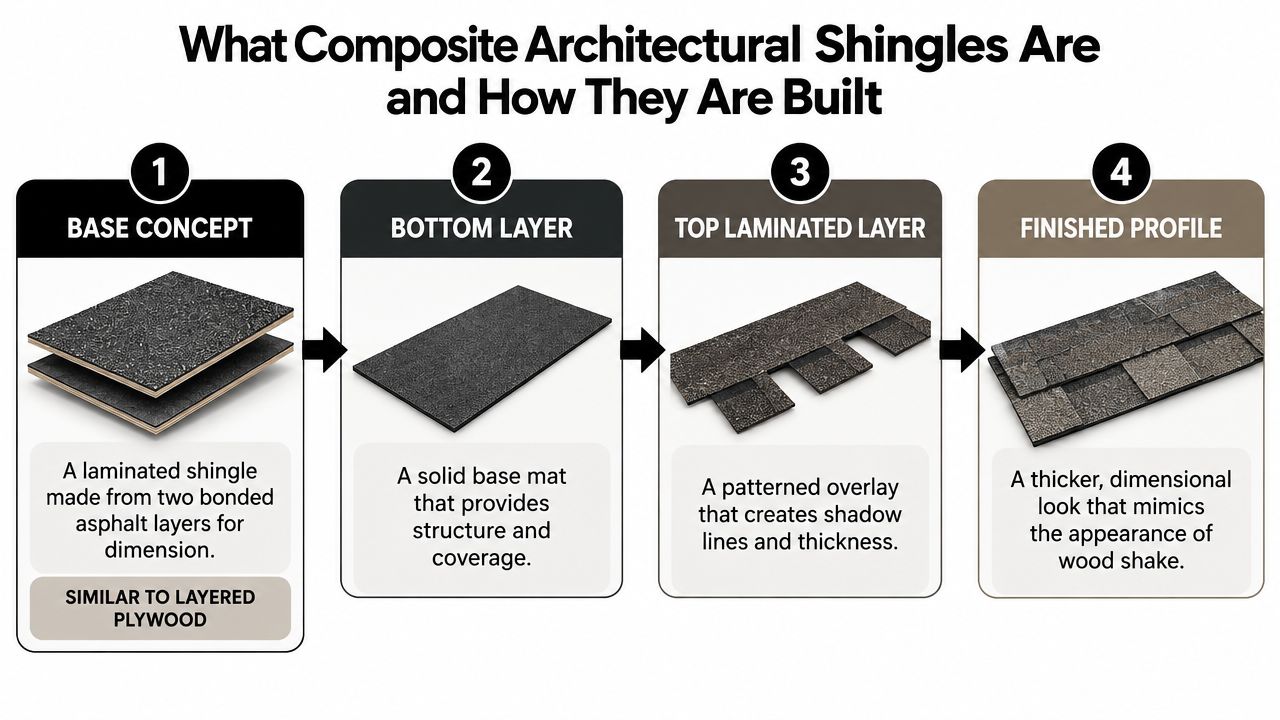
After a Kansas City hailstorm, a roof can look like a field of small, uneven tiles from the street. That depth comes from how architectural shingles are assembled. They use bonded layers to create more body, pattern, and structure than a single flat strip.
The base materials
The foundation is generally a fiberglass mat coated with asphalt. Fiberglass reinforces the shingle, while asphalt provides waterproofing and helps hold the layers together. Mineral granules are pressed into the exposed surface, adding color, texture, and protection from weathering.
Architectural shingles use a two-layer laminated design without the cutouts found on traditional three-tab shingles. The lower layer covers the roof field. A shaped upper layer is bonded over it, producing raised areas and shadow lines. That arrangement gives the roof a profile closer to wood shake than a flat strip shingle, without requiring wood-shake maintenance.
Fiberglass construction also marks a change from older organic-felt products. As noted earlier, industry standards distinguish modern asphalt shingles from those earlier materials. For homeowners, the practical point is simple: the mat, asphalt, overlay, granules, sealant, and fasteners work together as one shingle system.
What the standards test
Standards are testing requirements, not decorative labels. They examine characteristics such as mass, pliability, granule embedment, tearing resistance, nail pull-through resistance, fire resistance, and wind resistance. In plain terms, the tests ask whether the product has enough structure, flexibility, surface retention, fastening strength, and weather resistance for its listed classification.
A classification still does not make every roof perform identically. Manufacturers can use different asphalt formulations, fiberglass designs, granule blends, and sealant systems. Installation matters too, particularly after Midwest wind and hail. Nail placement, deck condition, sealing, and the manufacturer's instructions affect how the installed roof performs and how warranty coverage may apply.
For a plain-language explanation of the material, see this guide to what composite roofing means. The useful mental model is a reinforced base, bonded dimensional overlay, and protected granule surface create the thicker profile homeowners recognize as architectural roofing. When comparing estimates, review the product data and installation requirements, not only the shingle name.
Key Benefits and Tradeoffs to Understand Before You Buy
A Kansas City homeowner may want a roof that looks richer than basic three-tab shingles without moving to slate or another heavy material. Composite architectural shingles fit that middle ground. They add visual depth, use a familiar asphalt-roofing installation method, and can carry strong fire and wind classifications, depending on the product.
The dimensional profile is usually the first benefit people notice. A laminated overlay breaks up the repeated rectangular pattern of flat tabs, creating shadow lines and variation across the roof. That look can suit brick, stone, siding, and older Kansas City homes without requiring the structural changes that some heavier roofing materials demand.
Where the material earns its value
Fiberglass reinforcement gives these shingles more substance than an entry-level flat product. Product standards examine performance areas such as wind, fire, tearing, granule retention, and nail pull-through. Many products list Class A fire performance under ASTM E108 or UL 790, while wind ratings commonly reference ASTM D3161 and ASTM D7158. The rating belongs to the tested product and installation conditions, so a homeowner should read the manufacturer's data sheet rather than assume every architectural shingle performs alike.
Hail performance varies just as much. Some fiberglass architectural shingles carry UL 2218 Class 3 or Class 4 impact ratings. Polymer-modified asphalt can improve energy absorption and resistance to cracking during impact, as described in this architectural shingle technical fact sheet. An impact rating does not mean the roof cannot be damaged by a Kansas or Missouri hailstorm. It describes performance under a defined test.
The tradeoffs deserve equal attention:
- Higher initial investment: Materials and installation usually cost more than basic three-tab roofing.
- Roof structure matters: The contractor should confirm that the deck and supporting structure are sound before installing a heavier laminated product.
- Repairs can show: A replacement piece may stand out more when its pattern does not match weathered surrounding shingles.
- Maintenance still matters: Poor attic ventilation, trapped moisture, clogged valleys, and overlooked storm damage can shorten practical service life.
The core tradeoff: You are paying for a thicker, more dimensional roofing system. That value depends on a sound deck, correct installation, and timely maintenance.
A premium-looking roof is not automatically the right choice. Consider hail exposure, wind conditions, roof slope and geometry, appearance goals, and the contractor's installation process before signing an estimate. Warranty language also deserves a close read, especially because coverage for manufacturing defects is different from coverage for storm damage.
How Composite Architectural Shingles Compare to Other Shingle Types
A homeowner choosing among roofing products is usually balancing three things: appearance, storm performance, and budget. Composite architectural shingles sit between basic asphalt roofing and premium designer products, both visually and financially.
Three-tab shingles use a simpler, flatter pattern. They can make sense for a tight budget, a rental property, or a roof section where appearance matters less. Composite architectural shingles create more dimension and generally offer higher listed performance tiers. Designer premium shingles push the visual effect further, often imitating slate or shake with more elaborate patterns and specialized profiles.
The comparison below is a decision aid, not a substitute for reviewing a specific manufacturer's data sheet.
| Feature | Composite Architectural Shingles | 3-Tab Shingles | Designer Premium Shingles |
|---|---|---|---|
| Appearance | Dimensional, laminated, and often shake-like | Flat, regular, and repetitive | More elaborate, with premium slate or shake-inspired styling |
| Construction | Two bonded asphalt layers over reinforced shingle construction | Simpler single-profile design | Heavier or more specialized profile, depending on product |
| Wind performance | Commonly benchmarked at ASTM D3161 Class F and ASTM D7158 Class H | Product-specific and generally positioned as an entry-level option | Product-specific, often designed for premium performance |
| Fire performance | Many products carry Class A under ASTM E108 or UL 790 | Product-specific | Product-specific |
| Impact ratings | Some products carry UL 2218 Class 3 or Class 4 | Product-specific | Product-specific |
| Value position | Middle ground between basic and premium roofing | Lower upfront choice | Higher-end appearance and investment |
| Best fit | Homeowners wanting stronger visual depth and balanced performance | Budget-focused projects and simpler roof designs | Homes where premium appearance is the main priority |
Matching the roof to the home
A basic three-tab product may be adequate where the roof has limited exposure and the owner's primary goal is controlling initial cost. Composite architectural shingles make more sense when curb appeal and storm performance both matter. Designer products may fit a high-visibility home where the roof's visual character is central to the exterior design.
Kansas City homeowners should also consider repair visibility. A roof with multiple dormers, valleys, and intersecting slopes may make color and pattern matching more difficult after a localized storm repair. Before choosing, compare actual samples outdoors and ask how the contractor will handle discontinued or damaged shingles.
For more detail on terminology and product categories, see this explanation of architectural shingles versus composition shingles. The important distinction is that “composition” often describes the broader asphalt-shingle family, while “architectural” identifies the laminated, dimensional style within that family.
Lifespan Cost and Warranty Expectations Made Clear
Roofing warranties create confusion because one product can carry several different promises. A manufacturer may offer limited lifetime coverage for manufacturing defects, a separate algae warranty, and installation-related coverage from the contractor. Those protections don't mean the roof will remain visually perfect or that every future repair will be free.
Read the coverage by category
Start by separating the warranty into four questions:
- What defect is covered? Manufacturing coverage generally addresses problems with the product itself, not every form of storm damage or installation error.
- How does coverage change over time? Limited lifetime language can become prorated, leaving the owner with less material reimbursement as the roof ages.
- Does labor count? A material warranty may not cover tear-off, disposal, installation, or interior repairs.
- What excludes coverage? Poor ventilation, improper fastening, severe weather, algae appearance, maintenance issues, and unauthorized installation can affect a claim.
The phrase “lifetime” needs especially careful reading. One major architectural line pairs lifetime-limited manufacturing coverage with an algae warranty lasting 10 years, while a premium variant extends algae coverage to 25 years, according to the IKO Cambridge product information. Atlas also varies algae protection by climate zone, with 10 years in temperate zones and 5 years in tropical zones, as described in the same verified warranty discussion.
That distinction matters in humid Midwestern conditions. Black streaking may affect curb appeal long before the roof has reached the end of its functional service. An algae warranty may cover the product's resistance to algae growth under defined conditions, but it may not pay for cleaning, color preference, or every stain a homeowner notices.
Price depends on the roof, not just the shingle
The final estimate reflects material selection, roof pitch, access, tear-off requirements, flashing, ventilation work, deck repairs, disposal, and labor. A simple, accessible roof and a steep roof with multiple valleys won't carry the same installation demands, even if both use the same shingle.
Ask the contractor to separate product cost, removal, repairs, ventilation, flashing, and labor. That breakdown makes competing bids easier to compare and exposes low estimates that omit necessary work.
Warranty rule: Treat “limited lifetime” as a promise with conditions, not as a guarantee of a free, trouble-free roof forever.
Performance in Hail Wind and Midwest Weather
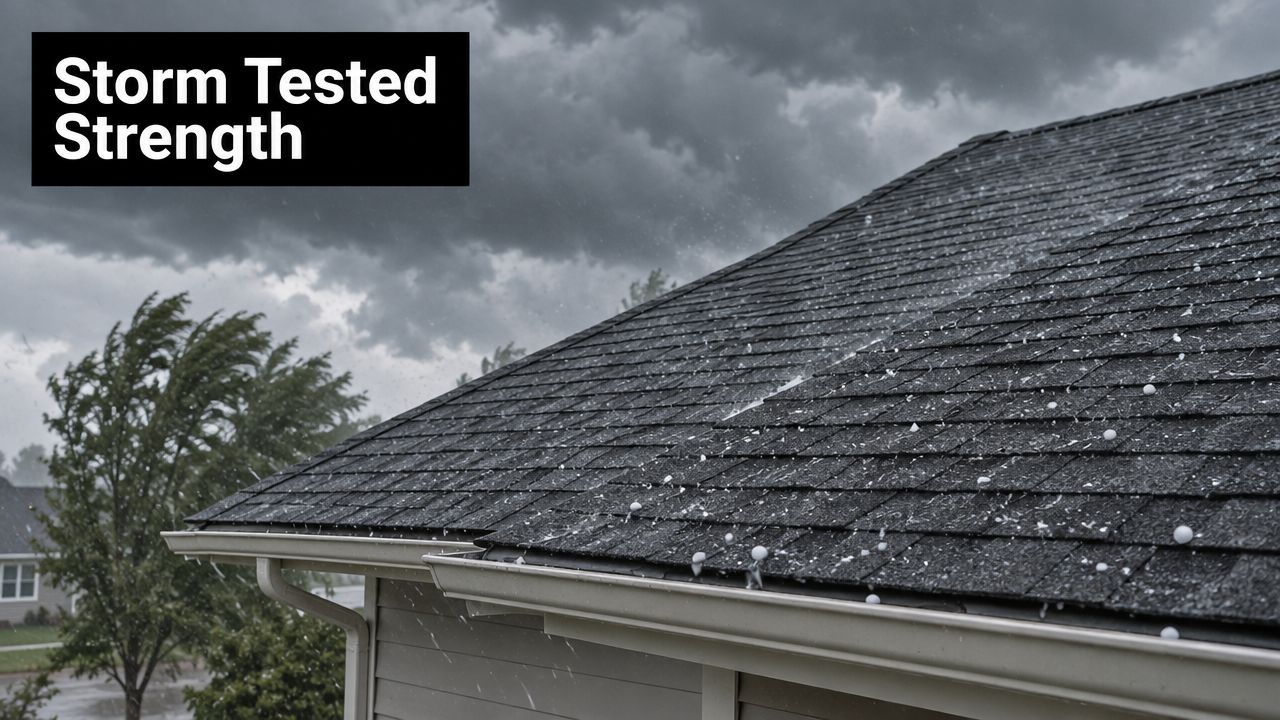
Kansas City roofs take punishment from several directions. Hail can bruise the shingle surface, wind can lift vulnerable edges, and repeated wet-to-dry or warm-to-cold cycles can expose weak installation details. Composite architectural shingles are often selected for this environment because their construction supports higher listed wind and fire classifications, while some products add impact ratings.
What the wind classes mean
Composite architectural shingles typically benchmark at ASTM D3161 Class F and ASTM D7158 Class H, classifications used for higher wind-resistance tiers. Manufacturer literature commonly equates ASTM D7158 Class H with 110 to 130 mph wind resistance, as summarized in this architectural shingles market analysis.
Those labels describe tested product performance under defined conditions. They don't guarantee that every installed roof will behave the same way. Nail placement, nail depth, sealant strength, roof geometry, shingle stiffness, deck adhesion, and installation temperature all affect uplift resistance. A shingle can carry an impressive class listing while a poorly fastened roof remains vulnerable at eaves, rakes, hips, or ridges.
Hail ratings require the same caution. UL 2218 Class 3 or Class 4 can indicate stronger tested impact resistance, but a severe storm can still damage a rated roof. A qualified inspection should look for bruising, exposed mat, displaced granules, creased shingles, damaged vents, and collateral damage to gutters or siding.
For homeowners reviewing storm options, hail-resistant shingles for Kansas City homes can help frame the product conversation around impact ratings rather than vague “hail proof” language.
A short visual explanation can help you recognize why the rating and installation details have to be evaluated together:
What to ask after a storm
Don't approve a replacement based only on a door-to-door inspection or a sales label. Ask for close-up photographs, the product's impact and wind documentation, and a written explanation of any decking or ventilation work. If you're filing an insurance claim, keep the contractor's findings separate from assumptions about what the policy will cover.
Choosing and Installing Composite Architectural Shingles With Confidence
The best product on paper can fail to deliver if the contractor rushes the preparation. Start with the roof system, not the color brochure. A careful inspection should address the deck, flashing, valleys, pipe penetrations, eaves, ridge, attic ventilation, and visible storm damage before anyone discusses final shingle selection.
Use the estimate as an inspection tool
Ask each contractor to answer these questions in writing:
- Product identification: What exact manufacturer and line will be installed?
- Wind and impact documentation: Which ASTM or UL classifications apply to this product?
- Fastening plan: Where will nails go, and how will the crew handle high-wind areas?
- Underlayment and flashing: What materials will protect vulnerable transitions and penetrations?
- Ventilation: Will the existing intake and exhaust arrangement be inspected or changed?
- Deck condition: What happens if crews find rotten or delaminated sheathing?
- Cleanup: How will the crew handle magnetic nail collection, landscaping protection, and final debris removal?
- Warranty responsibility: Which coverage comes from the manufacturer, and which comes from the installer?
A contractor should also explain how the roof's geometry affects installation. Complex slopes, valleys, dormers, and wall intersections require careful layout and flashing work. Those details may not be visible from the driveway, but they often determine whether water and wind stay outside the assembly.
Inspect the finished roof
After installation, walk the property with the project manager. Look for straight shingle courses, secure flashings, sealed penetrations, clean valleys, properly finished ridge areas, and debris-free gutters and landscaping. Keep the product documentation, photographs, permit records if applicable, and contractor warranty together.
Basic maintenance remains useful. Clear debris that traps moisture, keep gutters flowing, watch for displaced or cracked shingles after major storms, and arrange professional inspections when hail or high wind passes through the area.
For a Kansas City homeowner who started with dark streaks or storm concerns, the decision becomes much clearer once the quote answers these practical questions. You're not merely choosing a roof color. You're choosing a layered system and the installation process that makes its ratings meaningful.
Two States Exteriors LLC provides roof inspections, repair, and replacement services for Kansas City Metro properties, including storm and hail damage evaluation and insurance-claim support. Visit Two States Exteriors LLC to request an inspection and discuss whether composite architectural shingles fit your home, budget, and Midwest weather exposure.