
$4,699 was the average U.S. residential roof repair claim in 2025, according to the Insurance Journal report citing Verisk's U.S. Roof Report. That figure belongs to the insurance side of the market: documented damage, multiple components, and an estimate built for review.
A routine out-of-pocket fix lives on a different ledger. Minor leak and flashing work can stay comparatively modest because the scope is contained, while hail damage around Kansas City and Missouri often pulls shingles, underlayment, flashing, vents, gutters, and decking into the same scope. Budget from the wrong column and the first supplement feels like a surprise even though the job changed category.
Use the claim number when storm damage is widespread or an insurer estimate is already in play. Use the smaller consumer range only when the problem is isolated and the repair still makes sense against replacement cost. If the roof is older, the damage crosses several assemblies, or the repair approaches a meaningful share of replacement, I would price both paths before authorizing work.
Typical Roof Repair Costs by Job Size
The number most readers search for is straightforward. The Angi guide to roof repair costs puts an average roof-repair project at approximately $1,158 in the U.S. market, with a broad range of about $150 to $8,000 depending on damage severity, roof geometry, material, and access. That range is wide because a repair can mean resealing one pipe boot or rebuilding a valley, replacing underlayment, and correcting flashing across several planes.
Use the table to locate your job before you compare quotes. A single fix and a size-based repair are priced differently, and the claims average belongs in its own row because it measures something else.
| Job type | Typical cost | Basis |
|---|---|---|
| Minor leak or flashing repair | $360-$1,550 | Single fix |
| Average repair, all job sizes | $1,158 (range $150-$8,000) | Project average |
| Per 100 square feet | $350-$1,200 | Size benchmark |
| Per 1,000 square feet | $3,500-$12,000 | Size benchmark |
| 2025 residential claims average (Verisk) | $4,699 | Insurer estimate, not final payout |
Why a Small Repair Still Costs Real Money
Homeowners often expect a handful of shingles to produce a handful-of-shingles price. It doesn't work that way. Mobilization, fall protection, diagnostic labor, setup, and minimum service charges are largely fixed costs, so the price doesn't scale in a straight line with the number of damaged shingles. A crew still has to drive out, set ladders or anchors, trace where water is entering, open the area carefully, and restore the laps so the patch sheds water instead of trapping it.
Roof shape adds time too. Mansard or butterfly designs need more layout, detailing, and water-shedding transitions than a simple gable, so the same damaged area takes longer to make weather-tight. If you're comparing your situation with other published ranges, Rooftop Solutions' repair cost guide is a useful second reference for how repair scopes get broken down before a total is quoted.
How to Use These Figures in Kansas City
Don't budget from a per-square-foot figure alone. Ask for a written scope that separates diagnostic work, tear-out, replacement materials, flashing or underlayment, ventilation corrections, cleanup, and any emergency premium. That breakdown tells you whether a low bid costs less or leaves out work the other contractor included.
Low-slope systems need the same treatment, since seams, drains, and membrane patches are scoped differently from shingle work. If your home or building has that roof type, our guide to flat roof repair cost in the Kansas City area walks through how those estimates are built. Find the row in the table closest to your job, then test it against the drivers that move a price up or down.
A national average tells you the size of a typical repair bill. It doesn't tell you what your roof needs, and it won't predict a storm claim.
What Drives the Price of a Roof Repair
Material sets the baseline before anyone climbs a ladder. The Angi guide to metal roof repair costs lists benchmark repair averages of approximately $975 for asphalt shingles, $1,700 for metal, $1,800 for slate, $1,000 for tile, and $400 for flat, foam, or single-ply systems. Those figures reflect how much skilled handling each system demands, not just what the replacement pieces cost at a supply house.
The hierarchy below shows how those material benchmarks stack up against each other.
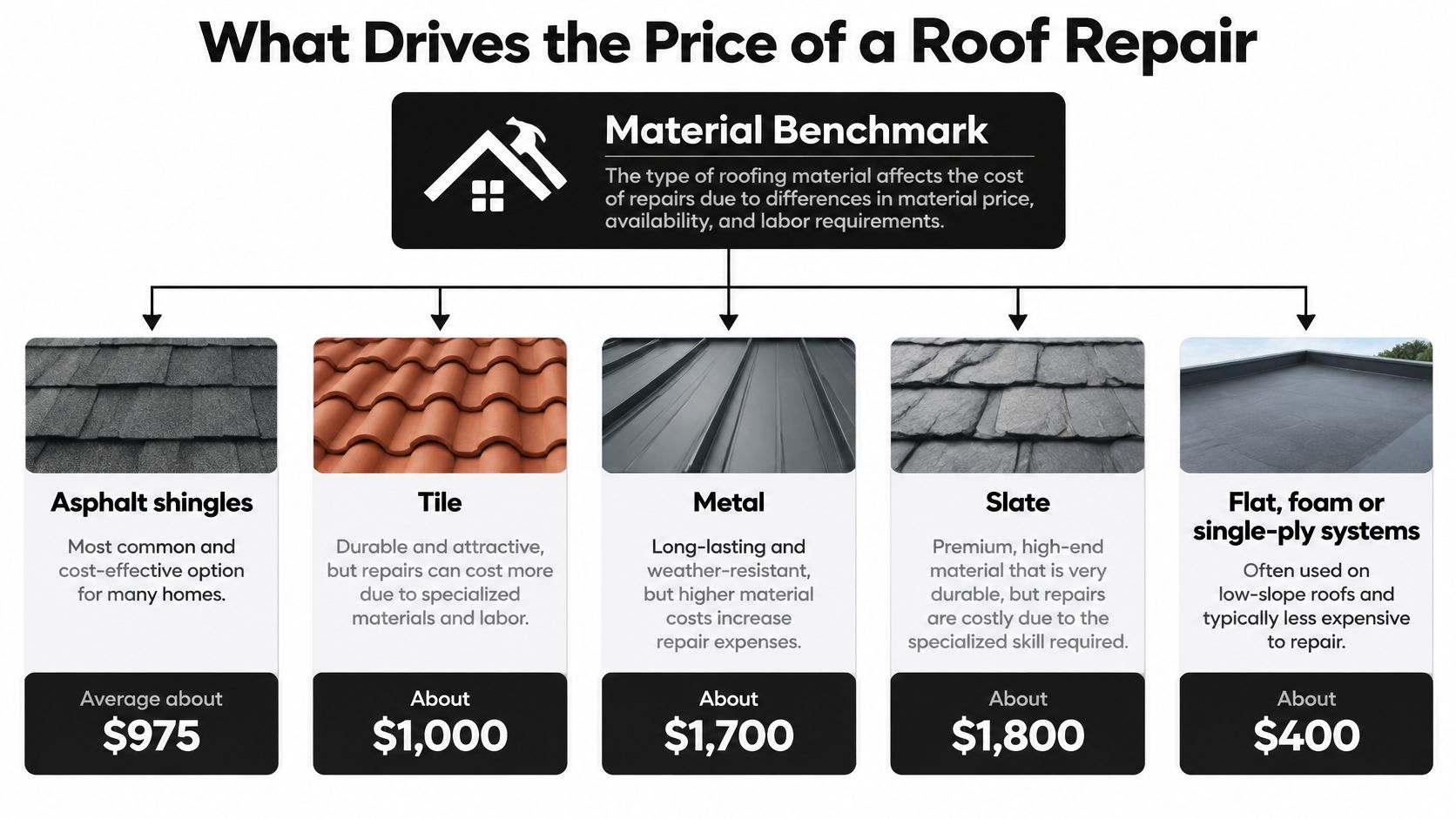
| Roofing material | Average repair cost |
|---|---|
| Asphalt shingles | $975 |
| Tile | $1,000 |
| Metal | $1,700 |
| Slate | $1,800 |
| Flat, foam or single-ply | $400 |
Metal shows the specification effect clearly. A standing seam panel, a through-fastened panel, and a stone-coated steel section don't come apart or go back together the same way, and the wrong fastener or sealant can create the next leak. Two metal roofs with identical square footage can carry very different repair totals once the panel profile and fastening method are priced in, which is why per-square-foot figures are a weak budgeting tool on these systems.
The short video below shows the kind of on-roof inspection and repair work that sits behind those line items.
The Drivers Ranked by Impact
Labor comes first. On a leak repair, most of the bill is the hours spent tracing water migration, which rarely runs straight down from the stain on your ceiling, removing surrounding material without breaking sound pieces, integrating new flashing or underlayment, and restoring weather-tight laps. That diagnostic and detailing time is the repair. The materials for a small leak often cost less than getting a qualified crew on the roof.
Extent of damage is next. Storm or hail damage may affect flashings, penetrations, underlayment, and decking, not merely visible shingles, so a proper inspection documents each affected assembly separately. A quote that says "repair leak" with one lump sum hides whether the step flashing, ice and water shield, or vent boot is included. In a hail-exposed market like Kansas City, that distinction matters, because storm damage tends to spread across more assemblies than a wear-and-tear leak.
- Roof pitch and access: Steep or two-story roofs need fall protection, roof jacks, and slower material handling, which stretches labor hours.
- Roof geometry: Valleys, dormers, dead valleys, and roof-to-wall transitions each add layout and flashing work.
- Hidden decking or water damage: Rot found after tear-off has to be cut out and replaced before new material goes down, or fasteners won't hold.
I'd compare quotes on assembly, not total. If one estimate lists shingles, underlayment, step flashing, counterflashing, and decking as separate lines and the other lists a single number, the detailed one is easier to verify and easier to hold a contractor to if the scope changes once the roof is opened.
Kansas City Hail Exposure and Insurance Claims
A national average roof repair cost misleads in a hail market. The Prequalify Roof repair cost guide notes that consumer cost guides commonly present roughly $531 to $1,150 for a typical repair, while Verisk data puts the U.S. average residential roof-repair cost at $4,699 in 2025, up 25% from the 2021 to 2024 average, with replacement averaging $17,631. The two figures measure different jobs. One tracks routine maintenance a homeowner schedules. The other tracks storm-driven, documented damage that an insurer prices line by line.
That gap matters more every year. Even as claim volume softened in 2025, average repair severity kept climbing, so fewer claims did not translate into cheaper repairs. For a Kansas City homeowner, budgeting a hail repair off a low headline average is the fastest way to be surprised by a legitimate estimate.
How Exposed Kansas Roofs Are
The exposure here isn't hypothetical. The Verisk analysis of factors influencing roof risk in 2025 reports that Kansas had 51.8% of roofs impacted in the cited multi-year analysis, and that 16 U.S. states had severe hail impacts affecting at least 20% of roofs in 2025, compared with 12 states in 2024. Hail represented 33% of catastrophe-designated roofing claims in 2025, and total residential and commercial hail-damage repair and replacement costs reached $22.5 billion.
Severity, not just frequency, is driving the money. Material costs climbed faster than roofer labor in 2025, so a claim priced months after a storm can cost more to complete than the first estimate assumed. Timing alone can move the number. That is one reason a dated, photographed, line-item scope protects you better than any online average.
Why Two Identical Leaks Get Different Estimates
Say two neighboring homes both show a brown ring on a bedroom ceiling after a storm. One has a cracked vent boot on a walkable slope. The other has bruised shingles across three facets, torn step flashing at a sidewall, wet underlayment, and soft decking at the eave. The visible symptom matches. The repair doesn't.
Roof age, slope, accessibility, underlayment condition, decking, code requirements, interior damage, and material matching all move the final amount. Material matching is its own problem on older roofs. If the original shingle color or profile is discontinued, a repair that looks patched may be the only option short of replacing a full slope, and that question belongs in the estimate, not after the work starts.
Practical rule: Photograph hail damage from the ground and in the attic before anyone repairs it. Dated photos are evidence, and evidence is what a claim runs on.
Who Pays and What Changes the Check
Insurers draw a line between maintenance wear, which is commonly excluded, and sudden storm damage, which may be covered. Granule loss from age, worn sealant, and a leak that developed slowly over seasons usually land on the homeowner. Hail fractures, wind-lifted shingles, and impact damage from a specific storm event are the kind of loss a policy is built for.
Several terms determine how much of a covered repair you receive:
- Deductible: The amount you absorb before coverage applies, which can exceed the cost of a small repair on its own.
- Actual cash value versus replacement cost: One pays the depreciated value of the damaged material, the other pays toward replacing it, often in stages.
- Depreciation: The portion withheld based on age and condition, sometimes recoverable after work is completed and documented.
- Supplemental estimates: Additional documented scope submitted when concealed decking damage, code upgrades, ventilation, gutters, siding, or interior water damage wasn't in the first scope.
Don't treat an insurer's initial scope as the complete repair scope. Adjusters write what they can see and verify on the day they visit, and concealed damage found at tear-off needs separate documentation. Reporting deadlines vary by policy, so check yours early rather than after the next storm blurs which event caused what.
We handle roof repairs for customers filing insurance claims, including hail damage and storm damage claims. If you want the sequence laid out step by step, our overview of the storm damage insurance claim process covers documentation through final payment. Keep dated records, request a written line-item estimate, and compare it against the insurer's scope before you accept the first number.
Repair or Replace Using the 25 to 33 Percent Rule
Every repair quote should be measured against a replacement quote. Without that second number, you can't tell whether you're buying years of service or postponing a bill you'll pay anyway. The repair-to-replacement ratio gives you that comparison in one division.
The Verisk newsroom summary of the U.S. Roof Report placed the average U.S. residential roof-repair estimate at $4,699 in 2025 and average residential roof-replacement costs at $17,631 in 2025, meaning the average repair estimate equaled approximately 26.6% of replacement cost. Verisk cautions that its figures represent claims estimates produced through the Xactimate estimating system, not necessarily the final amount paid by insurers, and that the dataset covers only a subset of the total U.S. market. Even with that caution, the ratio is the useful part.
| Repair as share of replacement | What it usually signals | Next step |
|---|---|---|
| Under 25% | Spot repair is usually sensible | Repair and monitor |
| 25% to 33% | Gray zone | Inspect remaining roof life and repeat repairs |
| Over 33% | Replacement is often better value | Get a full replacement bid |
A Worked Example
Take a hypothetical repair quoted at $4,000 on a roof that would cost $15,000 to replace. That repair sits near 27% of replacement, squarely in the gray zone. The ratio alone doesn't decide it. It tells you to gather more evidence before signing either contract.
That evidence comes from four questions. How old is the roof, and how much service life is realistically left in the field of the shingles? Has this same area been repaired before? Are leaks showing up in more than one place, which suggests a system failing rather than a single component? Is the damage concentrated in one spot, or spread across multiple slopes the way hail leaves it?
The same report identified severe hail, hail at least 1 inch in diameter, as the dominant weather-related roof threat across much of the country, which matters for Midwest properties that take repeated storm seasons on the same roof surface. A roof can survive one event with a repair and still be a poor candidate for the third.
If you're weighing the two paths, our comparison of roof replacement versus repair lays out the condition checks that tip the decision. I'd add one plain rule on top of the math. If repairs keep coming back in different places, the pattern matters more than the ratio, because you're no longer fixing damage. You're maintaining a roof that's wearing out.
Budgeting for a Repair Without Surprises
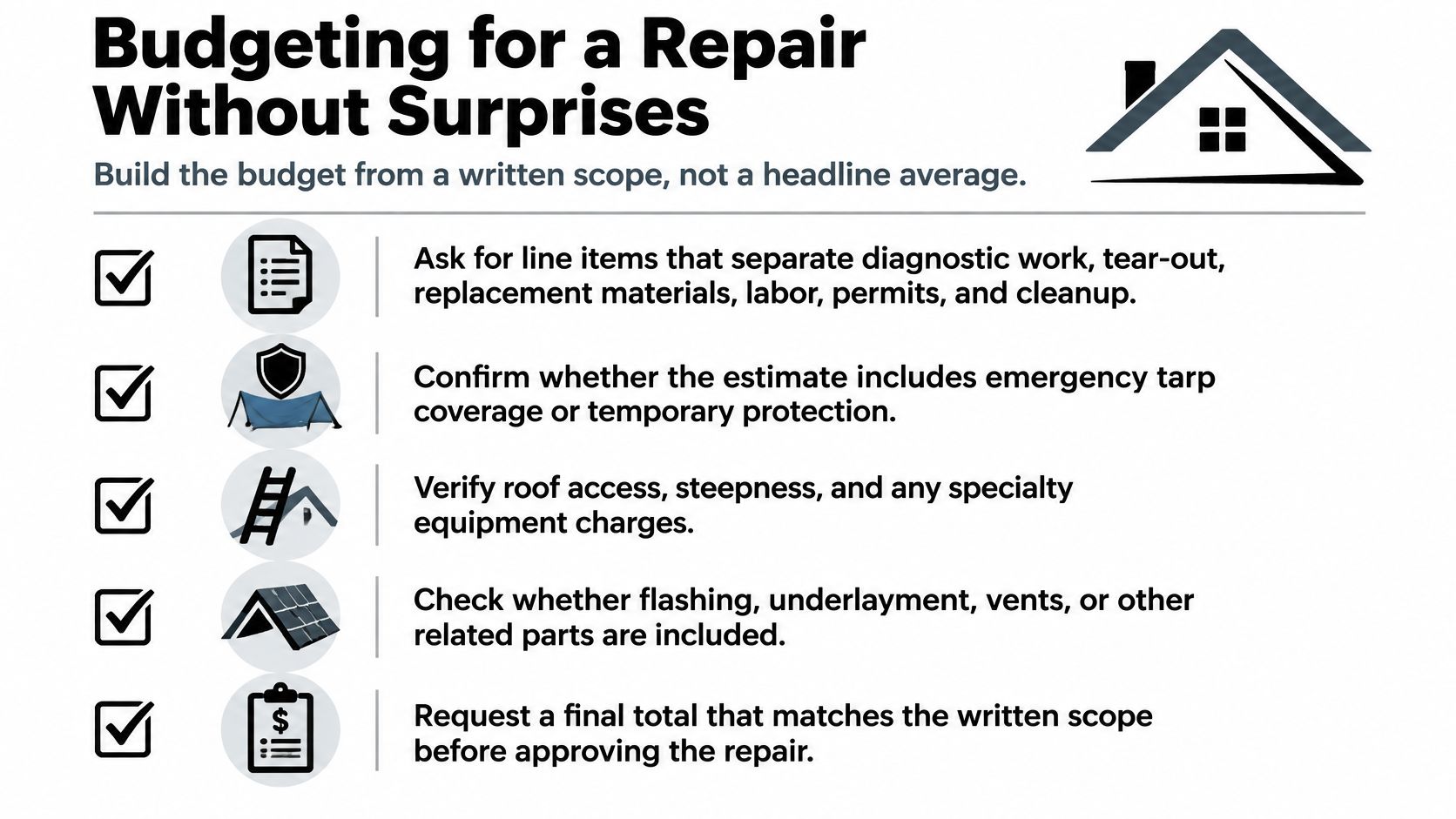
Build the budget from a written scope, not a headline average. A headline tells you what strangers paid for different roofs. A scope tells you what your money buys on yours, and it's the only document you can compare across contractors.
The checklist below turns that scope into a budget you can plan around.
The Pre-Approval Checklist
- Ask for line items: Diagnostic work, tear-out, replacement materials, flashing or underlayment, ventilation corrections, cleanup, and any emergency premium should each appear separately, so a missing item is visible before work starts.
- Confirm the labor and material split: Leak repairs are labor-heavy, so a quote that's mostly materials with thin labor usually means the diagnostic and detailing time isn't really in there.
- Price the concealed damage question: Ask whether rotted decking found after tear-off is included, priced per sheet, or handled as a change order, and get that answer in writing.
- Check code upgrades: Ventilation corrections, drip edge, and underlayment requirements can be triggered by the repair itself, and they shouldn't arrive as a surprise invoice.
- Set aside contingency money: Once a roof is opened, small repairs can grow, so hold back a reserve rather than approving a budget with no slack.
- Compare quotes on scope, not total: Two bids with the same total can describe different jobs, and the cheaper-looking one often excludes flashing or cleanup.
- Keep dated photos and invoices: If an insurance claim follows, or the repair fails under warranty, your paper trail is what settles the argument.
Approve the scope, not the number. A total you can't trace to line items is a guess with a dollar sign.
A budget built this way changes the conversation with every contractor you call. Instead of asking who is cheapest, you're asking who has included the work, and that question filters out most of the surprises that make repairs feel unpredictable.
Confirm Your Repair Budget Before You Sign
You have two clear paths, and the roof in front of you determines which one fits. If the problem is a single flashing or sealant failure and the rest of the roof is sound, schedule the repair and compare quotes on the same written scope. If the repair lands in the gray zone, or hail has hit several slopes, book a full inspection before you commit to either option.
We perform annual or semiannual roof inspections, and we operate 24/7 to handle roofing repairs or installations promptly, so an active leak doesn't have to wait for business hours. Our free estimate form asks customers what roofing service they need, which keeps the first conversation focused on the actual problem rather than a generic sales pitch.
The Five Step Decision
- Write both numbers down: Place the repair estimate and the replacement bid side by side on one page.
- Divide repair by replacement: That single calculation gives you your ratio.
- Compare against the thresholds: Under the lower threshold suggests repair, the middle band needs inspection evidence, and above the upper threshold points toward replacement.
- Audit the scope: Confirm the estimate lists every affected assembly, including flashing, underlayment, and decking, plus anything explicitly excluded.
- Sign only when both tests pass: The scope is complete and the total fits the threshold. If either fails, request the replacement bid before deciding.
Ask whoever inspects your roof to document each affected assembly with photos, not just the worst spot. A photo set that shows sound areas alongside damaged ones strengthens a repair recommendation, because it proves the rest of the system is worth keeping.
The final test is simple. A repair is a reasonable spend when the written estimate lists every affected assembly and the total stays within the threshold for a roof with real service life left. If you can't say both of those things about the quote in your hand, you're not ready to sign it.
If your roof is leaking now or a hail claim is sitting open, Two States Exteriors LLC can inspect the damage, document each affected assembly with photos, and give you a written line-item estimate you can measure against a replacement bid. Reach out for a free estimate and we'll tell you plainly whether a repair still makes financial sense for your roof, or whether you'd be spending money on a system that's ready to be replaced.