Asphalt shingles are cheaper to install, but steel can become the lower-cost roof over a long ownership period. The actual answer depends on how long you plan to stay in the house.
The popular advice is simple: take the lowest roofing bid and move on. That works if your only goal is spending less today. It can be poor advice for a Kansas City homeowner who expects to keep the property through several storm seasons, hail claims, and another replacement cycle.
A steel roof asks for more money at installation. In return, a properly specified system may avoid a future tear-off and replacement. Asphalt shingles usually win the day-one price contest, while steel can win the ownership-cost contest. Your break-even point depends on the roof system, installation quality, storm exposure, financing, maintenance, and the number of years you'll own the home.
Why the Cheaper Roof Question Has Two Answers
The lowest roofing estimate answers only one question: what you pay the contractor today. It leaves out future tear-off, disposal, flashing, underlayment, maintenance, and storm repairs. That difference separates first cost from life-cycle cost, the total expense of installing, maintaining, repairing, and replacing the roof while you own the property.
For a Kansas City homeowner, ask “Which roof costs less during my ownership period?” A seller who plans to move soon may not recover steel's higher installation price. An owner staying for decades may avoid one or more asphalt replacements and finish with the lower total bill.
The break-even year matters
The break-even year is when steel's higher initial price is offset by avoided replacement and repair costs. The break-even year moves with roof complexity, product grade, local labor, maintenance, hail damage, and how long the owner keeps the property.
One comparison places the potential metal life-cycle advantage around years 18–22, but roof type, storm exposure, and ownership period can change that result, as explained in this roofing cost comparison. Use that range for planning, not as a guarantee.
Kansas City properties face hail, strong wind, summer heat, winter freeze-thaw cycles, and insurance decisions before a roof reaches its expected service life. A low bid can lose its advantage after repeated repairs or an early replacement. A steel system can also perform poorly if the product, fasteners, flashing, or installation does not match the home and local weather.
Practical rule: Compare the cost of keeping the house, not only the cost of putting the roof on it.
Resale changes the calculation
A short-term owner may not capture the full value of a long-lasting steel system. Buyers often appreciate a newer roof, yet the sale price may not reimburse every dollar of the premium. Inspection results, remaining service life, installation records, appearance, and Kansas City buyer expectations all influence the outcome.
The honest answer has two parts. Shingles are cheaper to buy. Steel can be cheaper to own. Choose based on your ownership timeline, storm exposure, and break-even estimate, not on a contractor's preferred material.
Steel Roofing and Asphalt Shingles at a Glance
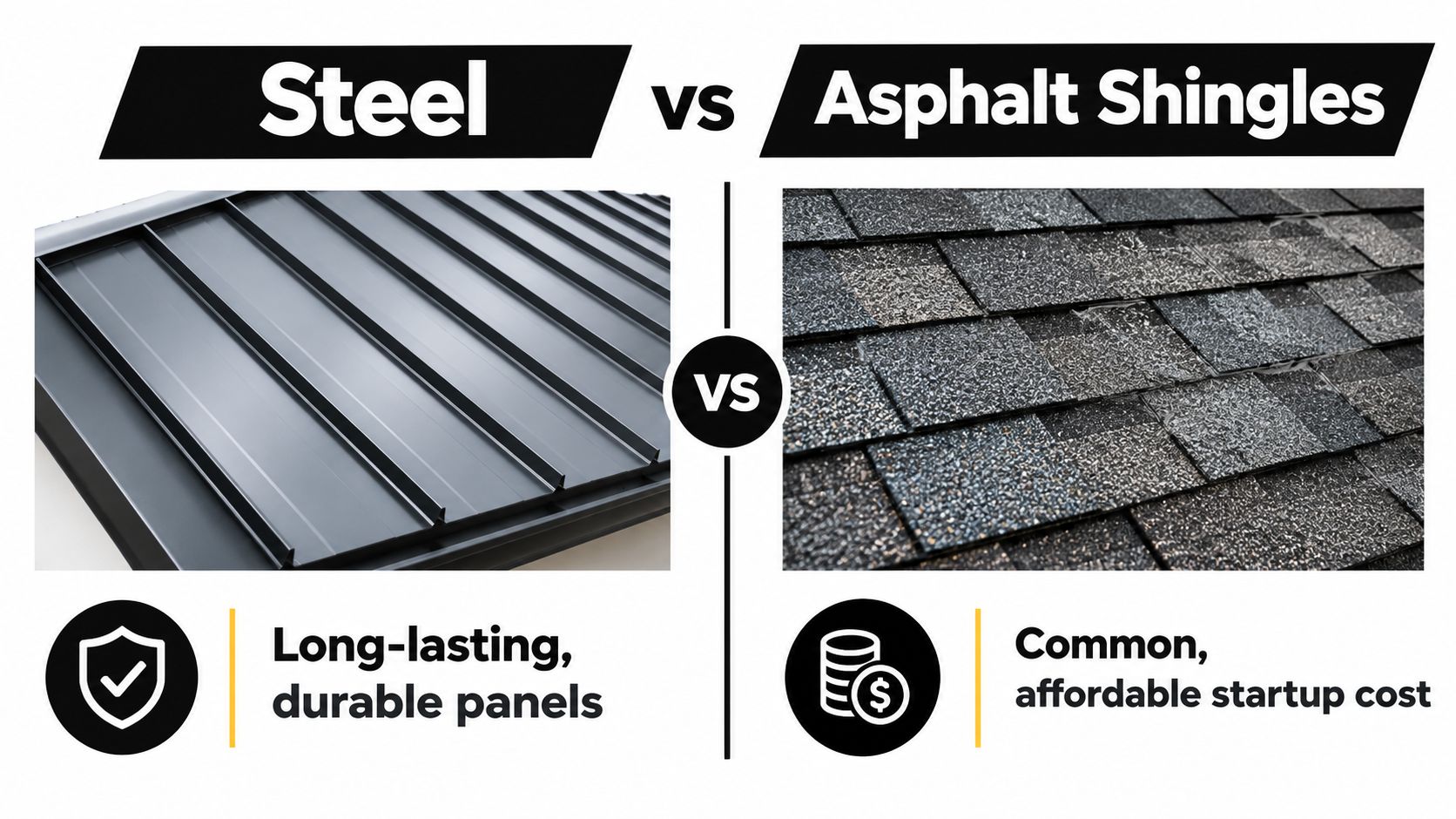
Steel roofing usually arrives as formed panels. Those panels may use exposed fasteners or concealed fasteners, as with a standing-seam system. The finished roof can look modern and sharply defined, or it can mimic familiar residential profiles depending on the product selected.
Asphalt roofing uses layered shingles installed over underlayment and roof decking. Architectural shingles have a dimensional appearance, while simpler shingle products use a flatter profile. Shingles remain familiar to most local crews, which can make repairs and replacement easier to source.
The details that drive the dollars
A material label doesn't tell you enough. Two steel bids can differ sharply because one uses exposed fasteners and the other uses a concealed-fastener standing-seam system. Asphalt bids can also vary because of shingle grade, tear-off requirements, ventilation work, flashing replacement, and deck repairs.
| Factor | Steel roofing | Asphalt shingles |
|---|---|---|
| Installation cost | Usually higher | Usually lower |
| Replacement pattern | Longer service interval when properly specified | More frequent replacement is common |
| Repair familiarity | Requires a crew comfortable with the selected panel system | Familiar to most roofing crews |
| Storm evaluation | Review panel, coating, fastener, wind, and impact specifications | Review shingle impact and wind classifications |
| Thermal performance | Depends on coating, color, insulation, and ventilation | Depends on product reflectance and the roof assembly |
| Weight and attachment | System-specific, with attachment details critical | Generally lighter and widely understood |
Kansas City homeowners should also distinguish appearance from performance. A reflective steel coating may help with summer heat, but a dark panel over a poorly insulated attic won't automatically outperform a lighter reflective shingle. Similarly, a premium-looking panel won't compensate for weak flashing or careless fastener placement.
If you're comparing panel styles, review the practical differences among corrugated metal roof types before accepting a generic “metal roof” allowance in a proposal. The profile, attachment method, coating, and installer experience all affect the cost equation.
Upfront Installed Cost per Square Foot
Steel roofs are usually more expensive on the first invoice. Asphalt shingles generally run about $5–$9 per square foot installed, while metal roofing runs roughly $8–$25 per square foot. For a Kansas City homeowner, use those figures only to frame the conversation. Your roof's shape, access, stories, valleys, dormers, tear-off, decking, flashing, ventilation, underlayment, and disposal will determine the actual bid. A simple ranch roof will not price like a steep, cut-up roof with damaged decking and multiple penetrations.
Get the scope in writing before comparing materials. A low shingle allowance may exclude deck repairs or ventilation work, while a metal proposal may include upgraded underlayment, trim, and flashing. Use this metal and asphalt roofing cost comparison to frame the material difference, then make both contractors price the same work.
A documented life-cycle example
One neutral analysis examined a 30,725-square-foot project. It priced asphalt shingles at $4.00 per square foot, or $122,902 for one installation. Metal roofing cost $7.75 per square foot, or $238,122, making the steel installation about 94% more expensive upfront, a difference of $115,220. Those figures show why asphalt usually wins the initial price test.
The ownership math changed after replacement. The model included two asphalt installations and one metal installation. Total asphalt life-cycle cost reached $344,876, compared with $238,122 for metal. Steel finished $106,754 lower, about 31% below the asphalt option, because the model avoided a second replacement. The analysis credited no energy savings, so replacement avoidance produced the difference. Review the neutral project life-cycle analysis for its assumptions.
That result is useful, not universal. A homeowner selling soon, financing a large project, or dealing with storm damage before the expected service period may never reach the break-even point. Poor installation, corrosion, and structural repairs can also erase the advantage. Kansas City hail and wind exposure make the system specification and contractor's installation quality part of the price equation.
A working comparison
| Material | Installed Cost per Sq Ft | Expected Service Life | Replacements in 60 Years |
|---|---|---|---|
| Asphalt shingles | Roughly $5–$9 | About 15–30 years | May require multiple installations |
| Steel roofing | Roughly $8–$25 | Roughly 40–70 years | May require one installation |
Treat these service-life ranges as planning figures, not a warranty. Product grade, coating, storm exposure, attic conditions, and workmanship all affect how long the roof performs.
Ask both contractors to identify tear-off, deck repairs, underlayment, ventilation, flashing, disposal, coating, fasteners, maintenance assumptions, and expected replacement timing. Without the same scope, the cheaper bid may only be cheaper because it leaves work out.
Annualized Cost and the Replacement Cycle Math
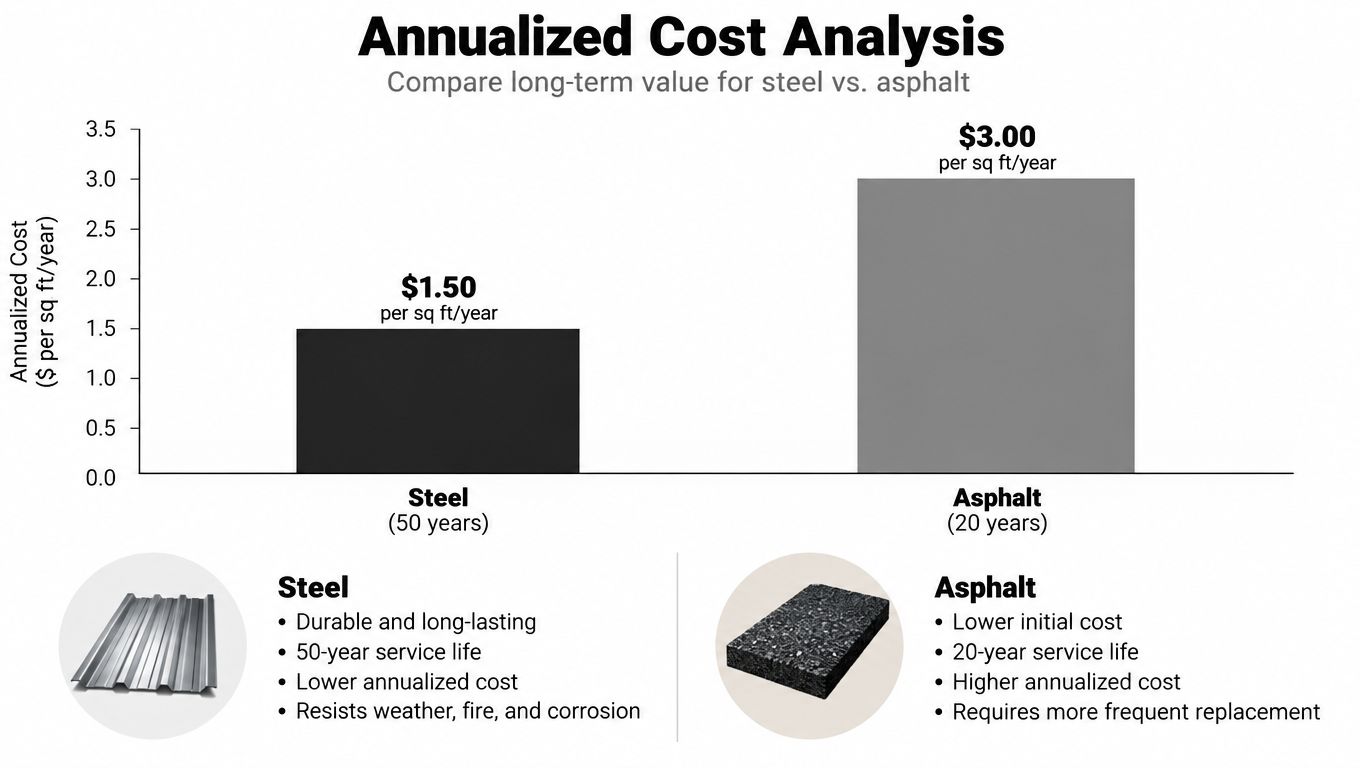
Sticker price favors shingles because the first check is smaller. Annualized cost asks a harder question: how much does the roof cost for each year it serves the building?
Industry life-expectancy data summarized by the Metal Construction Association and attributed to BOMA International reports expected life-cycle costs of about $0.30 per square foot per year for metal, compared with $0.37 per square foot per year for asphalt, making metal's annualized figure roughly 19% lower. Those figures are presented in the life-cycle assessment guidance from the Metal Construction Association.
Replacement creates the reversal
On a 60-year building life, a 20-year asphalt roof could require three installations. A 50-year steel roof could require one, before repairs, maintenance, disposal, financing, or storm damage enter the equation. Each asphalt replacement means another crew, another tear-off, another disposal charge, and another opportunity for labor and material costs to change.
That doesn't make steel automatically cheaper for every homeowner. If you sell before the replacement cycle matters, your personal calculation may favor asphalt. If you stay long enough to pay for another shingle roof, steel's higher first cost has more time to earn back its premium.
The cheapest roof at closing isn't necessarily the cheapest roof during ownership.
The annualized figures also explain why a contractor should state the assumed service life instead of using a vague phrase such as “built to last.” A steel system's value depends on the panel, coating, fasteners, flashing, installation, and maintenance. Asphalt's result depends on shingle grade, ventilation, installation quality, storm exposure, and the timing of the next replacement.
This is a financial model, not a guarantee. A life-cycle comparison should include present value, maintenance, repair, replacement, salvage, and sensitivity testing for early failure. For a house exposed to repeated hail, the timing of claims can matter more than a clean service-life estimate.
The ownership question remains decisive. A short-term owner may pay steel's premium and leave before the modeled advantage appears. A long-term owner may pay once and avoid a future asphalt replacement. The roof doesn't become cheaper because it is steel. It becomes potentially cheaper when its longer service interval fits the owner's timeline.
Durability, Weather, and Midwest Storm Performance
Kansas City roofs don't live in a spreadsheet. They face hail, wind, hot summers, winter weather, and repeated expansion and contraction. A roof that looks inexpensive on installation day can become expensive if the system suffers damage, loses its warranty protection, or needs detailed repairs after each major storm.
Steel's durability advantage depends on the complete assembly. Panel thickness, coating, fastener placement, underlayment, flashing, ventilation, and deck condition all matter. Poor details can erase the benefit of a longer-lasting panel.
Hail and wind require specifications
Don't accept “metal is hailproof” or “shingles are weak” as a technical answer. Ask for written wind uplift and impact classifications for the exact product. Thin panels may show cosmetic dents, while other systems may perform differently. Asphalt products also vary, and a homeowner should compare the specific shingle's tested ratings rather than the material category.
The same rule applies to wind. A strong panel attached through weak or incorrectly placed fasteners remains a weak roof system. Flashings around chimneys, walls, skylights, vents, and valleys deserve the same scrutiny as the field panels or shingles.
In storm country, the roof's tested assembly matters more than the word printed on the brochure.
Energy performance is conditional
Reflective roofing can reduce solar heat gain, but the coating and roof assembly control the result. Weathered ENERGY STAR-qualified cool-roof products can have solar reflectance around 0.5, compared with about 0.05 for a traditional dark roof, and qualifying reflective roofs may run up to 60°F cooler in summer. Those figures describe qualifying reflective products generally, not every steel roof, as explained in this cool-roof comparison.
A dark steel roof over an under-insulated, poorly ventilated attic isn't automatically more efficient than a light-colored reflective shingle. Roof orientation, insulation, attic ventilation, HVAC efficiency, coating, and local climate determine the actual result.
For a Kansas City estimate, request the proposed coating's tested reflectance and emittance data. Then ask the contractor to identify the insulation and ventilation work included in the scope. If the bid promises energy savings without documenting the roof assembly, leave those savings out of your payback calculation.
Insurance, Maintenance, and Resale Impact
Insurance can change the ownership equation, but never treat a discount as guaranteed payback. A carrier may review impact resistance, wind performance, product documentation, deductibles, exclusions, and underwriting rules. Another carrier may rate the same roof differently, especially after a Kansas City hail claim.
Get written confirmation before you count insurance savings. Ask whether the carrier recognizes the exact product and tested rating, then confirm how the policy handles replacement after hail damage. Check whether the roof's age, repair history, and deductible affect the claim.

Maintenance still belongs in the bid
Steel can reduce replacement work, but it still needs inspection and upkeep. Require the proposal to address fasteners, washers, sealants, flashing, coating wear, and corrosion protection. Exposed-fastener systems may need closer attention than concealed-fastener designs because fastener condition directly affects the assembly.
Asphalt upkeep usually involves granule loss, lifted or damaged shingles, flashing, sealant, and storm repairs. After major wind or hail, either roof deserves an inspection. Compare the expected frequency and cost of those tasks instead of accepting the claim that one material needs no attention.
Put hidden-condition costs in writing before work starts. Damaged decking or inadequate ventilation can raise the bill for either roof, and leaving those problems unresolved can shorten service life.
Resale rewards documentation, not slogans
A newer steel roof can appeal to buyers who want fewer near-term roofing decisions. The strongest resale case comes from a roof with clear maintenance records, permits, product details, and a transferable warranty where applicable. Buyers still judge the roof's visible condition, remaining service life, and storm history, so do not assume they will repay the full premium.
For a Kansas City home, keep the warranty, permit records, inspection reports, and repair invoices together for the closing file. Documentation gives an appraiser and buyer something concrete to evaluate, while an unsupported claim about durability carries little weight.
If you choose asphalt in a hail-exposed neighborhood, compare impact ratings and product specifications instead of automatically choosing the lowest-cost shingle. A contractor can explain whether hail-resistant shingles suit your roof design and insurance requirements. That choice may improve the claim profile, but confirm the carrier's response in writing before including any savings in your break-even calculation.
Which Roof Is Actually Cheaper for Your Situation
The recommendation is clearer when you match the roof to the owner.
Selling within a short window: Choose asphalt when your main objective is the lowest installation price and you don't expect to own the house long enough for steel's replacement avoidance to matter. Still, don't install the cheapest possible system if it creates inspection problems or leaves obvious storm damage unresolved.
Staying for decades: Give steel serious consideration if you expect to remain in the home through a future shingle replacement cycle. Request a system-specific proposal that identifies the panel type, coating, fasteners, flashing, underlayment, ventilation, maintenance expectations, and warranty terms. Compare the quote using the same roof area and scope as the asphalt proposal.
Owning in a repeated-storm area: Start with documentation. Get tested impact and wind classifications, a written insurance response, deductible assumptions, and a realistic repair plan. Hail frequency can change the calculation, but don't add an insurance discount or energy savings unless the carrier and roof specifications confirm them.
Use this checklist before signing:
- Same scope: Confirm roof area, tear-off, decking, underlayment, ventilation, flashing, and disposal.
- Same timeline: Ask each contractor to state expected service life and replacement timing.
- Storm specifications: Request written wind uplift and impact classifications for the exact product.
- Thermal documentation: Review tested reflectance and emittance data for the proposed coating or shingle.
- Ownership math: Compare the cost through your expected time in the property, including financing and maintenance.
- Insurance confirmation: Obtain a written quote before treating any discount as part of the payback.
- Resale records: Keep the contract, product details, permits, warranty documents, and inspection information.
My kitchen-table answer is simple. Choose shingles when today's price controls the decision. Choose steel when you plan to own the home long enough to benefit from fewer replacement cycles and you've verified the system details. For a Kansas City property with serious hail exposure, the cheapest material is less important than the roof that performs, remains insurable, and fits your ownership horizon.
Two States Exteriors LLC provides roof inspections, repair and replacement estimates, storm-damage support, and material comparisons for Kansas City homeowners. Visit Two States Exteriors LLC to request an on-site evaluation and compare steel and asphalt options using the same scope, storm assumptions, and ownership timeline.