Most homeowners pay roughly $800 to $1,500 per square for exposed-fastener metal roofing and $1,200 to $2,500 per square for standing seam in 2026, before tear-off, structural repairs, permits or complex flashing. A square here means 100 square feet of roof surface, so the per-square figure is a planning number, not a quote.
Here's how far apart planning and reality can sit. A national benchmark for a 3,000-square-foot standing-seam replacement with full tear-off averaged $51,865, or about $1,729 per roofing square, according to the metal roof cost survey. That figure includes removing and disposing of the old roof. The survey ranges above mostly don't.
So metal roof prices per square are best read as a starting bracket. What decides where your project lands inside that bracket is scope: the system, the metal, the gauge, the finish, and how much cutting and detailing your roof geometry demands. The way to keep two bids honest is to force them onto the same measured square count and the same scope list before you compare a dollar figure.
What Metal Roofing Costs Per Square in 2026
A roofing square is 100 square feet of roof surface, not 100 square feet of floor area. Everything downstream, from the panel order to the crew hours, is priced against that unit. Treat the per-square figure as a planning metric: it brackets your project before anyone steps on a ladder, and it only becomes a quote once scope is attached to it.
Installed metal roof prices per square by system type (2026)
| System | Installed per square | Per square foot | Typical use |
|---|---|---|---|
| Exposed-fastener / corrugated panels | $800-$1,500 | $8-$15 | Barns, sheds, budget homes, simple roofs |
| Standing-seam panels (steel) | $1,200-$2,500 | $12-$25 | Primary residential roofs, clean modern look |
| Standing-seam, premium metal (aluminum, zinc, copper) | $2,500-$3,900 | $25-$39 | Coastal, high-end, long-life roofs |
| Metal shingles / stamped panels | $1,000-$1,800 | $10-$18 | Homes that want a shingle look with metal life |
| Full replacement benchmark (3,000 sq ft, standing seam, tear-off) | $1,729 | $17.29 | Real-world all-in project average |
The order in that table isn't random. Exposed-fastener panels get screwed straight through the ribs, so a crew covers a simple roof quickly. Standing seam is roll-formed to length and held with concealed clips, which takes more fabrication time and more precise labor. Published 2025 cost surveys put installed exposed-fastener metal at about $800 to $1,500 per square, standing seam at $1,200 to $2,500, and metal shingles at $1,000 to $1,800, per the metal roof cost survey.
Those are installation ranges. They typically exclude the work that turns a panel price into a roof:
- Tear-off and disposal. Removing the old roof and hauling it off is its own line item, and it's never free.
- Deck repairs. Soft sheathing around chimneys and valleys shows up after removal, not during the estimate.
- Permits. Required in most jurisdictions for a full replacement.
- Complex flashing and steep pitch. Valleys, dormers and slopes above a walkable pitch slow a crew down.
Watch what happens when those exclusions get added back in. The same cost survey benchmarked a full standing-seam replacement, 3,000 square feet with complete tear-off, at $51,865, or about $17.29 per square foot and $1,729 per square. That all-in figure sits comfortably inside the standing-seam range, but it includes removal and disposal work that the bare installation ranges leave out. For a 20-square roof, the survey ranges imply roughly $16,000 to $50,000 before extras, depending on panel system, metal type, roof design, labor market and removal requirements.
That spread is the point. A per-square number only means something when you know what scope it carries. Low bids can hide missing scope: a quote built on installation-only pricing looks thousands cheaper than one that includes tear-off, deck repair allowance and permitting, right up until the change orders arrive.
The habit that keeps bids honest: ask every bidder to quote on measured squares, with the same scope written out. A material-only number should never be mistaken for a complete replacement price.
Count Your Roof Squares Before You Compare Prices
Start with roof surface, not living area. A sloped roof always has more surface than its footprint, and the gap grows with pitch. Skip this step and every per-square price you collect is built on a number nobody verified.
Here's the sequence I'd walk through on site:
- Measure the footprint of each roof section. Include the house, the attached garage and any covered porch that shares the roof plane.
- Apply a pitch factor to each slope. Steeper sections carry more surface than their footprint suggests, so each plane gets its own multiplier.
- Divide total roof surface by 100. Two thousand square feet of roof surface is 20 squares.
- Ask about waste. Purchased squares exceed measured squares because of cuts at valleys, ridges, rakes and penetrations. Find out how much each bidder adds and whether it's already in the price.
- List the detail work separately. Dormers, skylights, chimneys and valleys drive cutting and detail labor, and they belong in the conversation before pricing starts.
A roof measured at 18 squares gets priced on 18 squares, not on the 1,800 square feet of living space underneath it. At $1,200 to $2,500 per square for standing seam, that roof implies $21,600 to $45,000 before extras.
The conversion from floor area to roof area trips up more homeowners than any other step in the process, so it's worth checking the arithmetic yourself using this guide to converting square feet to roofing squares.
Make the measured square count the first line of every bid. Two contractors quoting the same roof at different square counts aren't quoting the same job, no matter how close the per-square rates look.
The Metal and Finish Decisions That Move the Price
A $900-per-square metal roofing bid and a $2,400-per-square bid can both be honest. The gap usually sits in substrate, gauge, panel profile and coating, not in one contractor charging more. Installed standing-seam estimates span about $8 to $39 per square foot, or $800 to $3,900 per roofing square, with metal type, panel width, gauge, roof complexity and installation conditions all moving the number, per This Old House's standing-seam cost guide.
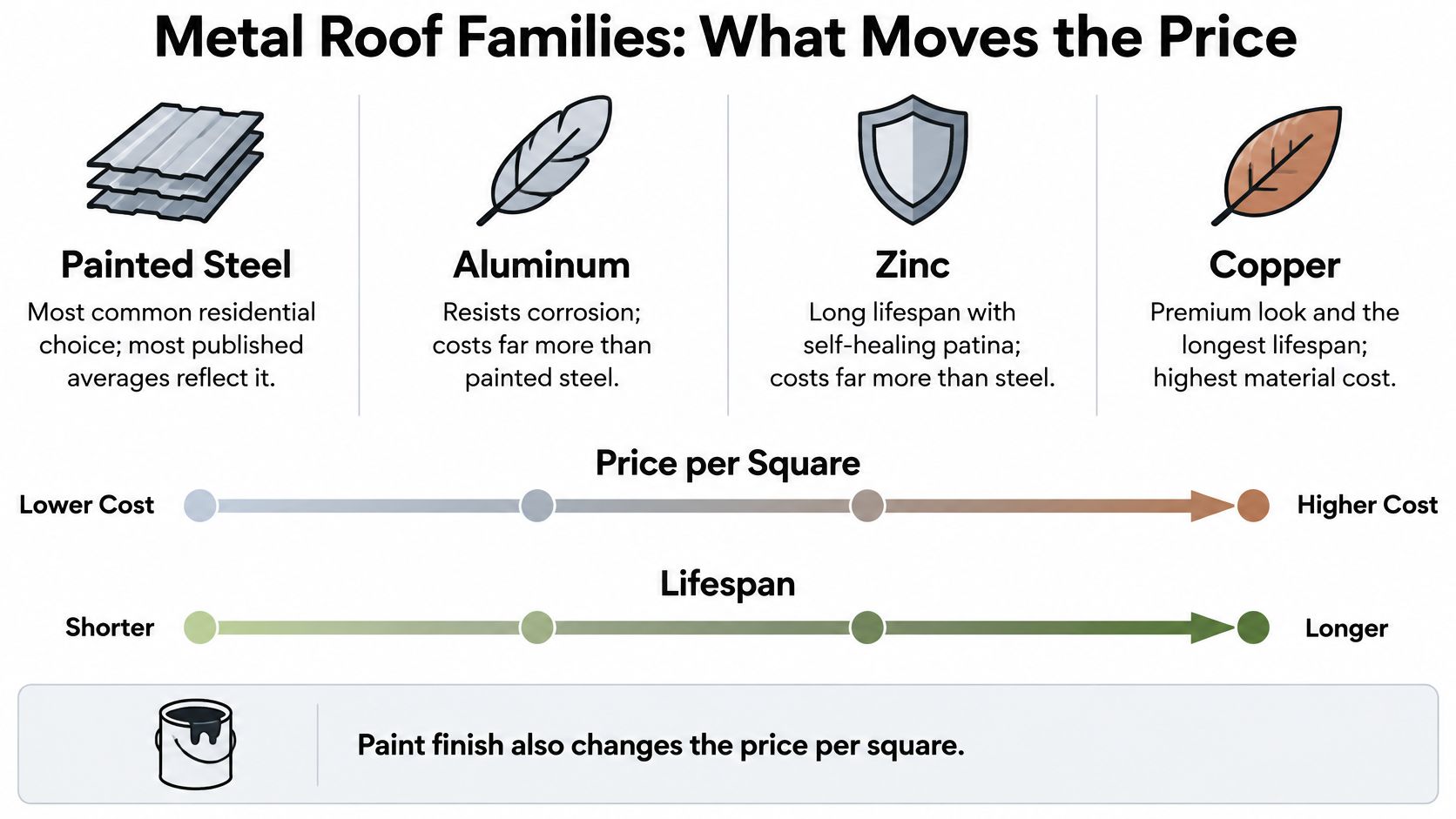
Steel is the common baseline for metal roofing estimates. Material pricing shows where the categories sit: painted steel standing-seam material runs about $4.59 to $8.55 per square foot, while copper material alone runs about $12.24 to $26.60 per square foot. Aluminum and zinc usually land above painted steel and below copper, while the exact quote depends on coil availability, profile, finish and how much custom trimming the roof needs.
Metal types and what they cost per square
| Metal | Material cost per sq ft | Expected service life | Best for |
|---|---|---|---|
| Steel (painted) | $4.59-$8.55 | 30-50 years | Most homes, best value |
| Aluminum | $8.56-$12.23 typical range | 40-60 years | Coastal or salt exposure, lighter panels |
| Zinc | $8.56-$12.23 typical range | 50-75 years | Premium look, self-healing patina |
| Copper | $12.24-$26.60 | Longest of the four | High-end historic and architectural roofs |
Gauge is the first number to read
Steel roofing runs from about 22 to 29 gauge, and a higher number means thinner steel. 24 to 26 gauge is the common range for a primary roof. 29 gauge is the lighter-duty, lower-cost option, and it appears more often on sheds or budget outbuildings than on a house someone plans to keep.
Gauge affects more than price. Thinner panels dent more easily, move more under foot traffic and give less margin around fasteners and cut edges. On a roof with valleys, dormers or multiple penetrations, that difference matters because the installer handles each panel more than once before it locks into place.
The coating decides how long the color holds
Two panels with identical gauge and different paint are not the same roof. Metallic coatings, galvanized zinc or Galvalume, protect the steel substrate from corrosion. Paint systems, SMP or PVDF, control color retention, chalking and weathering. A heavier panel with a strong coating costs more per square and earns it back over decades. A thin panel with a weak finish saves money at signing and spends it later on fading, fastener movement and denting, which matters in a hail-prone metro like Kansas City.
Service life follows the same hierarchy, with results depending on coating, climate, detailing and maintenance. A long warranty on a poorly detailed roof will not correct bad flashing, trapped water or an underlayment choice that does not match the assembly. Keep the metal, finish and detail work on the same line of comparison.
If you're still deciding between profiles, this breakdown of types of metal roofing covers how standing seam, corrugated panels and stamped shingles differ in appearance and installation before you commit to a bid comparison.
What a 20 Square Roof Really Costs Line by Line
Take a roof measured at 20 squares, which is 2,000 square feet of roof surface (one square equals 100 square feet, or roughly 9.3 square meters), and price it end to end instead of stopping at the panel rate.
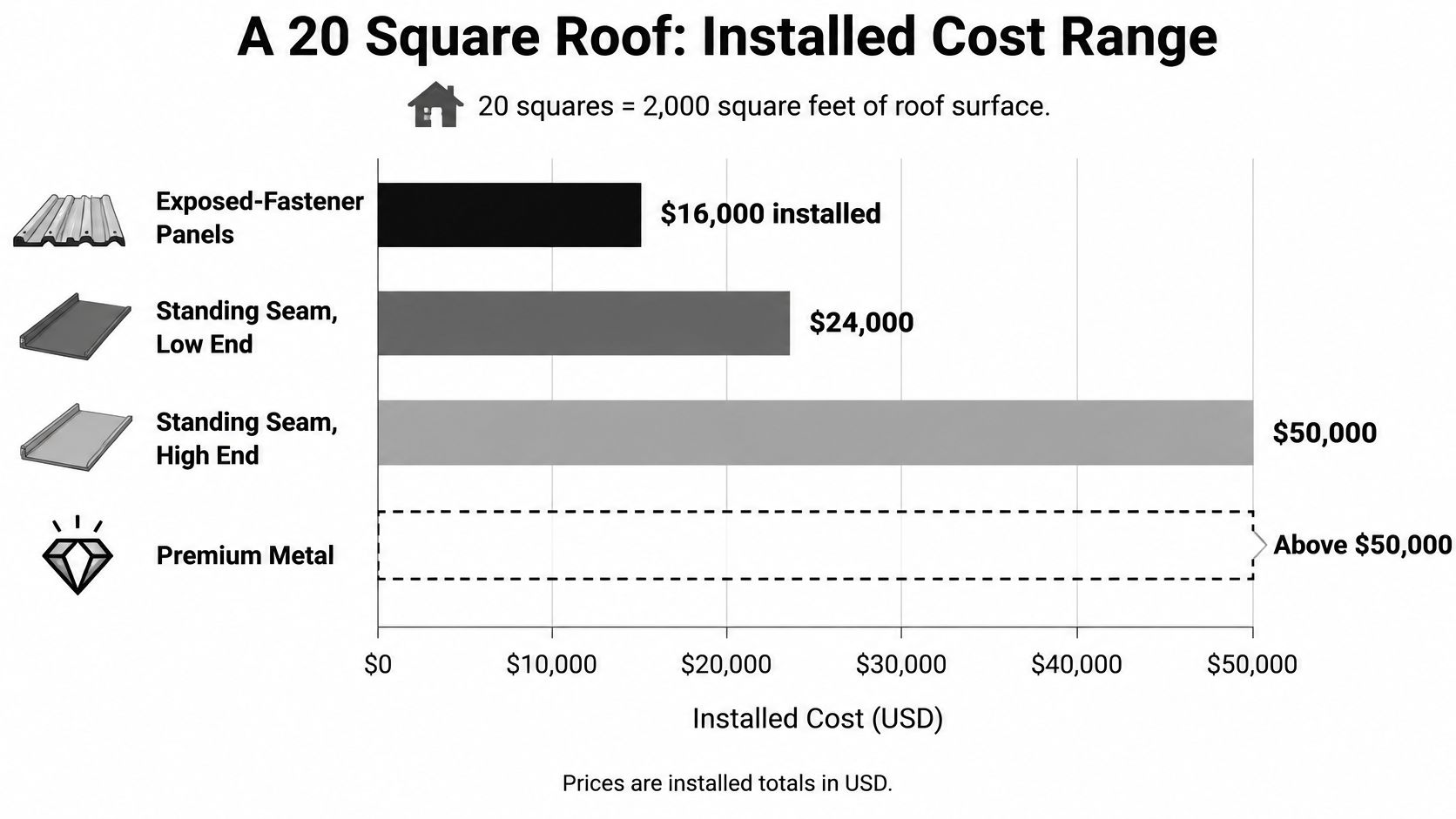
At the survey ranges, exposed-fastener panels land near $16,000 installed, standing seam runs roughly $24,000 to $50,000, and premium metal climbs above that. Those totals cover the panel system, not the whole bill.
Labor alone is reported at approximately $2.95 to $10.93 per square foot, which on 20 squares is nearly $5,900 to $21,860 before panels, trim, underlayment, removal, flashing, access equipment and disposal, per roof.wiki's steel roofing reference. Standing-seam panels get formed, lifted and clipped rather than screwed down, which is why the labor share runs high on that system.
Then come the line items that ride on top of the panel price. Here's an illustrative budget for a straightforward 20-square standing-seam job with a full tear-off:
Line-item budget for a 20-square standing-seam roof
| Component | Low estimate | High estimate |
|---|---|---|
| Standing-seam panels and trim (20 squares) | $24,000 | $50,000 |
| Tear-off and disposal of old roof | $2,000 | Set by roof layers and disposal volume |
| Underlayment and ice-and-water shield | $1,200 | $3,000 |
| Flashings, ridge, drip edge and ventilation | $1,500 | Priced by how many details the roof carries |
| Decking repair around penetrations | $500 | $2,500 |
| Permits and access equipment | $500 | $2,000 |
| Project total before contingency | Sum of the rows above | Sum of the rows above, each at the top of its range |
For a walkthrough of how that scope translates into a finished roof, this installation video covers the panel handling and seaming stages.
Geometry multiplies the rate. Dormers, valleys, skylights and multiple penetrations add cutting and detail time, so a cut-up roof prices higher per square than a simple gable of the same measured area. Removal is a choice too: a full tear-off can reveal substrate damage, while recovery over the old roof saves money only where code allows it and where the existing deck is sound. Waste is the quiet one, since purchased squares exceed measured squares once trim and cuts are counted.
Lower published figures usually reflect narrower scope. One 2026 estimate set puts exposed-fastener metal at roughly $650 to $1,000 per square and standing seam at $1,000 to $1,500, while material-only numbers run far lower, per The Roofing Brief's cost-per-square breakdown. The gap between that set and the ranges above is scope, not regional luck.
After hail, the arithmetic gets more complicated. An insurance estimate may price replacement components separately from code-required upgrades and hidden substrate damage, so the claim scope and an out-of-pocket bid can describe the same roof with different numbers. Read the total, not the panel rate. The lowest panel price is not automatically the lowest project price, because detailing and complexity regularly outweigh the metal selected.
How to Compare Metal Roof Bids Line by Line
Every bid should be quoted on the same scope before anyone talks about value. Ask each contractor to state the measured squares and the measurement method, the panel system and gauge, the metal substrate and paint system, the underlayment, ventilation, flashing, tear-off and disposal, permits, warranty terms, and how storm damage gets priced.
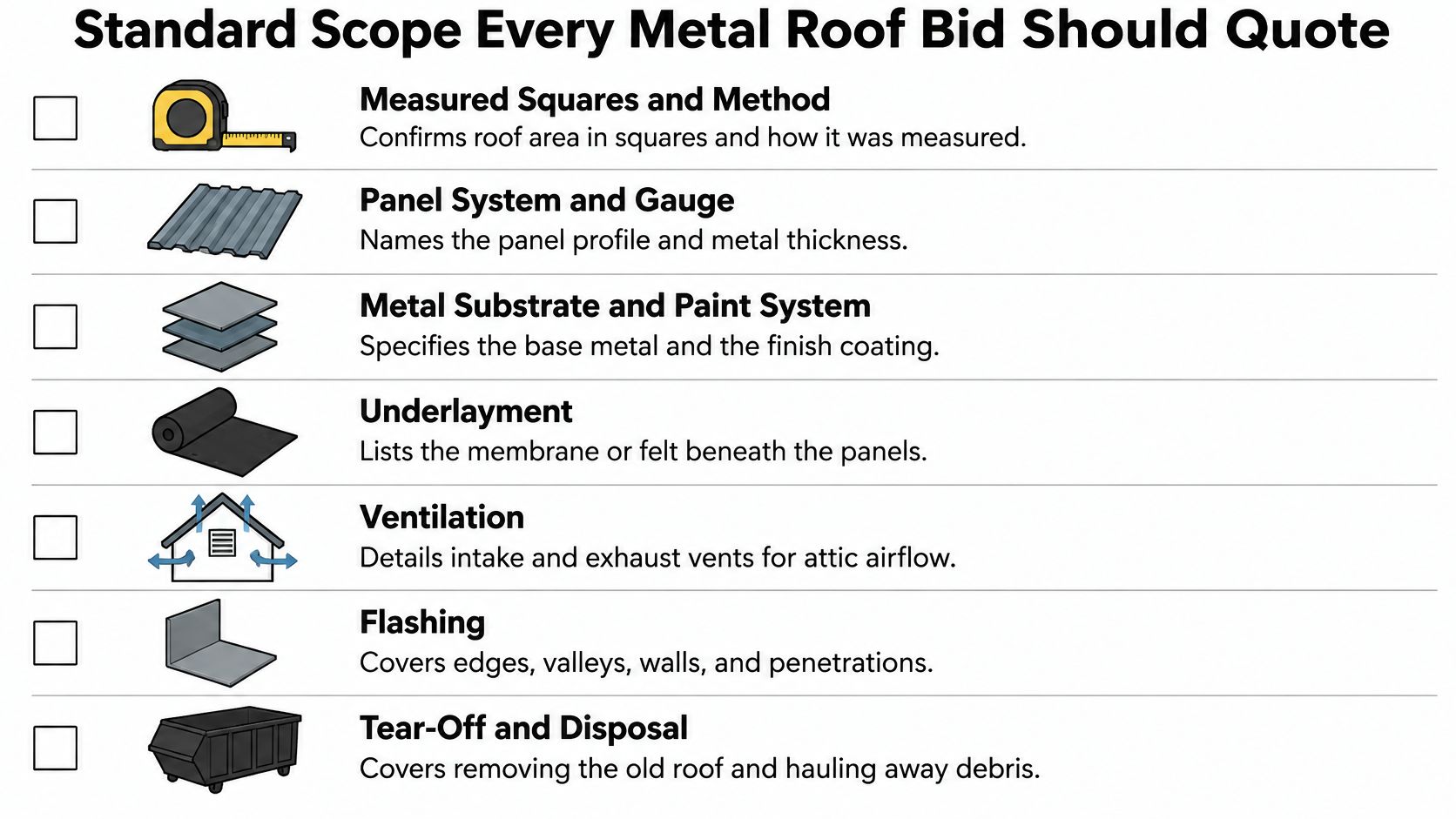
A per-square figure means nothing until you know what sits inside it. Two bids can differ by thousands of dollars and include exactly the same work.
Bid comparison checklist for metal roof quotes
| Scope item | What to look for | Why it changes the price |
|---|---|---|
| Measured squares | Stated square count and measurement method | Different measurements change the total |
| Panel system and gauge | Gauge and panel type as specified in the metal section | Thinner metal costs less but dents and fades |
| Metal and coating | Steel, aluminum, zinc or copper; SMP or PVDF | Substrate and finish drive both price and life |
| Underlayment and ventilation | Brand, type, ridge and soffit venting | Skimping here shortens roof life |
| Flashing and trim | How valleys, chimneys and skylights are detailed | Complex detailing is the big labor variable |
| Tear-off and disposal | Full tear-off or recovery; dumpster included | Removal is a real line item, not free |
| Permits and warranty | Permit cost and workmanship warranty length | Unpermitted work can jeopardize coverage |
| Storm damage and deck repair | How hidden damage is priced | Insurance and out-of-pocket scopes differ |
What the paperwork should document
Gauge and coating do the heaviest lifting on both price and performance. Steel roofing commonly uses gauges from approximately 22 to 29, with a higher number indicating thinner steel; 24 to 26 gauge is identified as a common primary-roof range, while 29 gauge is typically positioned as a lighter-duty, lower-cost option, per a technical price-per-square reference for steel sheet roofing. Metallic coatings such as galvanized zinc or Galvalume protect the substrate, while paint systems such as SMP or PVDF control color retention, chalking and weathering.
That creates a direct cause and effect. Heavier panels, concealed fastening, higher coating performance and formed accessories require more material, specialized fabrication or installation labor, which raises dollars per square. Choosing a thinner panel or weaker finish purely to cut the purchase price increases denting, fastener movement, fading and maintenance exposure in hail- and weather-prone regions.
Put a bid at the bottom of the standing-seam range next to one near the middle and the pattern shows up fast. The cheaper quote often leaves out tear-off, flashing detail and disposal, while the higher one includes them. Itemize both on the same scope and the gap usually closes to something explainable.
Ask for the documentation that makes per-square prices comparable: base-metal thickness, metallic-coating designation, paint system, fastener type, clip spacing, approved substrate, and wind or hail test reports. In the Kansas City metro, also ask how an insurance claim estimate maps onto that same scope. A written roofing estimate example shows what that level of detail looks like on paper.
Book an On Site Quote for Your Square Count
Settle two things before you call anyone: your measured square count and the system you want quoted. Deciding between standing seam and exposed fastener first means every bidder prices the same product instead of three different roofs.
Then collect at least two itemized written bids against the checklist above, and ask each contractor how tear-off, decking repair, storm damage and warranty get handled. Keep every quote in writing so the line items can be compared later without relying on memory.
The decision rule: the right roof isn't the lowest per-square bid. It's the best-specified bid at a fair price for the metal that fits your exposure and your budget.
For a Kansas City-area homeowner, a free on-site inspection is the fastest way to confirm squares, settle the metal and gauge, and price any hail or storm damage. Two States Exteriors LLC handles metal, tile and concrete roofing, and the free estimate form asks which roofing service you need so the visit arrives with the right scope. The company also manages roof insurance claims for hail and storm damage, which keeps the claim scope and the construction scope aligned.
One practical note on timing: after a storm, the contractor who answers the phone books the inspection. A roofing call answering service keeps after-hours calls out of voicemail during hail season, when schedules fill within days.
Two States Exteriors LLC has served the Kansas City metro since 1997, installing metal roofing alongside tile, concrete and stone-coated steel, with free on-site inspections and a No Money Upfront policy. If you have a square count and a system in mind, the team can price a full tear-off or a recovery against the same scope your other bids use, and handle hail or storm claims end to end if damage is part of the picture. Visit Two States Exteriors LLC to schedule your free estimate and get a written, line-item quote for your roof.