
The average U.S. residential roof replacement cost reached $17,631 in 2025. Your share of that bill is the replacement price minus the insurer's first payment, and that first payment is fixed by two things: your deductible and, on an actual cash value policy, the depreciation subtracted from the roof before any money moves.
That $17,631 figure comes from Verisk's U.S. Roof Report, summarized in this collection of roofing industry statistics, and it describes a gross job price. It says what a contractor charges, not what a carrier releases. On the same house those two numbers can sit $15,000 apart, and the gap is where most claim disputes start.
The gap also has a timeline. An insurer doesn't necessarily hand over the settlement in one check. Under replacement cost coverage it can pay the depreciated amount first and hold back the rest until the work is finished and the paperwork is filed by the policy deadline. That means a homeowner with a valid, approved claim can still need five figures of cash in the middle of the project.
What this article does: it separates the job price from your share, then maps when each dollar actually arrives, so you can plan the cash instead of discovering the shortfall at the contract signing.
What a Roof Replacement Really Costs Before Insurance
Start with the invoice, not the claim. Average U.S. residential roof repair costs reached $4,699 in 2025, according to Verisk's U.S. Roof Report, and a full replacement runs several times that. The replacement total is the gross price of the job: tear-off, underlayment, shingles, flashing, ventilation, disposal, permits and labor.
Insurance touches only the part of that price above your deductible, and on an actual cash value policy it touches less still, because depreciation comes off before the first check is cut. Nothing about the shingles changes between those outcomes. The same roof, the same storm and the same contractor can produce an insurer payment anywhere from a few thousand dollars to nearly the full invoice.
The table below runs four versions of one job, with the deductible and depreciation assumed as labeled.
| Scenario | Replacement cost | Deductible | Your share at first |
|---|---|---|---|
| Full RCV replacement, flat $1,000 deductible | $17,631 | $1,000 | $1,000 |
| Full RCV replacement, 2% wind or hail deductible on $300,000 dwelling | $17,631 | $6,000 | $6,000 |
| ACV on 20-year-old roof, 25-year assumed life, $1,000 deductible | $17,631 | $1,000 | $15,105 |
| Repair only, $1,000 deductible | $4,699 | $1,000 | $1,000 |
How to read the split
Answer two questions before you look at any row: what kind of deductible is on your policy, and how old is the roof. Those answers pick your line.
A homeowner with a flat $1,000 deductible and full replacement cost coverage sits in row one and owes $1,000 when the work is done, provided the approved scope matches the actual job. A neighbor with a 2% wind and hail deductible on a $300,000 dwelling owes $6,000 before the carrier contributes anything, six times more for an identical roof.
Row three is where claims hurt. On a 20-year-old roof with a 25-year expected life, depreciation removes roughly $14,105 from a $17,631 replacement, leaving an initial payment near $2,526 after the deductible. The homeowner funds about $15,105 of the job while waiting for a final payment that arrives only after completion and documentation.
The number to budget: the first check isn't the job price minus the deductible. It's the depreciated value minus the deductible, and the difference sits in your bank account until the claim closes.
Small jobs flip the math. A $4,699 repair with a $1,000 deductible leaves only the portion above the deductible as covered work. Filing for a few hundred dollars above the deductible puts a claim on your record for a payment that barely covers a day of labor.
Material choice moves the gross number before insurance enters the picture. If you're weighing a flat-roof system against shingles, what drives your rubber roof quote breaks down the membrane, labor and tear-off variables that set the price an adjuster later compares against.
Which Roof Damage Insurance Covers
An aging roof is not an insured loss. A storm-damaged roof is. That distinction decides whether a replacement is payable at all, and it has nothing to do with how badly the roof needs replacing.
Missouri's Department of Insurance explains that windstorm and hail are commonly covered perils, while wear and tear and roof depreciation are not, and that an insurer may authorize replacement of only the roof portion directly damaged by the covered peril rather than the entire roof (Missouri homeowners insurance FAQs). So a contractor's finding that a roof is old, curled and broadly worn does not by itself establish a covered claim.
Documented storm evidence does. Creases where wind bent shingle tabs, hail punctures through the mat, lifted or missing shingles, dented metal vents and gutters, and water entry traced to a storm date all support the scope.
What evidence actually supports a claim
- Photograph immediately. Shoot the roof from the ground, the gutters and downspouts, and every interior ceiling stain. Date the images.
- Stop further damage. Tarping or a temporary patch is expected of you, and the cost is commonly treated as part of the storm claim. Keep the receipt.
- Preserve the evidence. Don't let anyone permanently alter damaged sections before the adjuster inspects, unless safety requires it.
- Ask for the policy provisions that add cost. Matching requirements, ordinance-or-law coverage and code-upgrade coverage are what pay for items local rules demand beyond a like-kind swap.
Kansas guidance adds a practical point: insurers may require repair estimates and an adjuster's inspection, so a line-item scope and a clean paper trail matter when your contractor's number and the carrier's number disagree.
Practical rule: the argument you win is about causation, not condition. Tie every damaged section to a dated storm event, and let the wear pattern stay out of the conversation.
Our team handles roof insurance claims for hail and storm damage, and a homeowners insurance roof inspection before you call the carrier tells you whether the damage justifies a claim at all.
How Your Deductible Sets Your Share
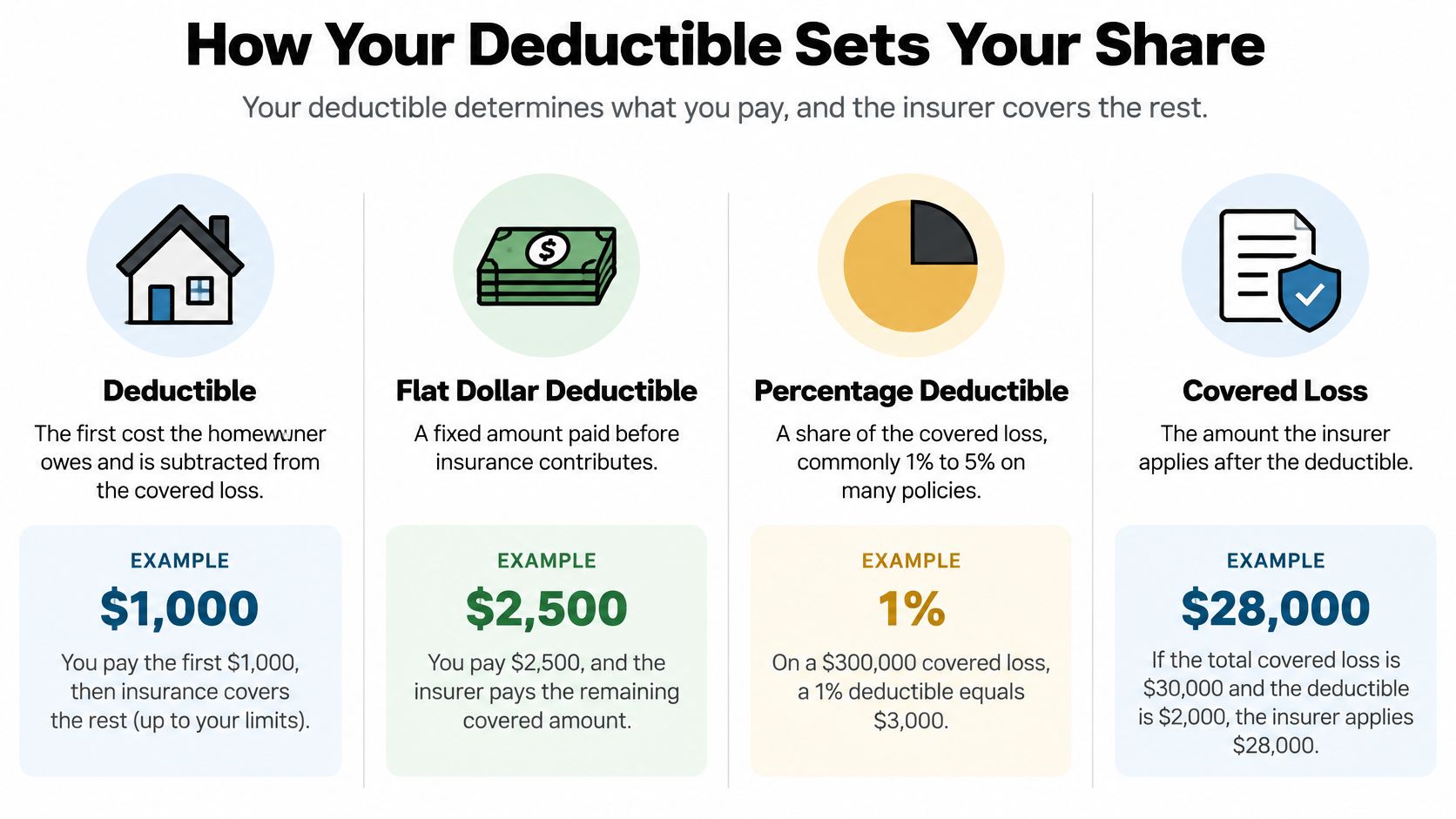
The deductible is the one figure you pay in every version of the story. It's subtracted from the covered loss, which makes it the first cost on the job and the last one you can negotiate.
The National Association of Insurance Commissioners notes that percentage deductibles commonly range from 1% to 5% of the dwelling coverage limit, and that the applicable deductible can vary by peril, including separate wind or hail deductibles. On a home insured for $300,000, a 2% wind or hail deductible requires the homeowner to contribute $6,000 before insurance funds apply. A $1,000 flat deductible produces a much smaller out-of-pocket amount for the same loss.
That difference matters most after a storm, because the peril that damaged your roof is often the peril carrying the higher deductible. A fire claim and a hail claim on the same policy can carry two different numbers.
Find your deductible in four steps
- Open the declarations page, not the marketing summary. It's the page with your limits and forms listed.
- Find the wind and hail deductible line. It may sit apart from the all-perils deductible.
- Note whether it's a percentage and which limit it multiplies, usually Coverage A dwelling.
- Multiply. On a $300,000 limit, 1% is $3,000 and 5% is $15,000.
Run that multiplication before you file. A deductible that lands close to the expected net payout means the claim buys you very little, and you want to know that before an adjuster visit goes on your loss history.
How RCV and ACV Change What Insurance Pays First
Replacement cost value pays to rebuild the roof with materials of similar kind and quality without subtracting depreciation. Actual cash value deducts depreciation for age, condition and expected service life, and then the deductible comes off. The NAIC's breakdown of replacement cost versus actual cash value sets out both methods, and the arithmetic is blunt.
Take a $15,000 covered roof loss with a $1,000 deductible. Under RCV the settlement is roughly $14,000 before policy limits or other adjustments. Under ACV, a $10,000 depreciation deduction drops the initial payment to about $4,000. Same loss, same deductible, a $10,000 difference created entirely by the settlement clause.
| Settlement type | First payment basis | Depreciation | Final payment | Watch for |
|---|---|---|---|---|
| Replacement cost value (RCV) | Cost of similar kind and quality materials | Not deducted once work is complete | Full covered cost less deductible, subject to policy conditions | Insurer may pay ACV first |
| Actual cash value (ACV) | Replacement cost less depreciation | Deducted by roof age, condition and expected life | Depreciated amount only | Depreciation may never be recovered |
| Roof-specific ACV endorsement | Depreciated value of the roof | Applied to the roof only, even on an RCV home policy | Roof capped at ACV | Check declarations page and endorsements |
| Recoverable depreciation under RCV | Initial ACV payment | Withheld until repairs are completed | Balance released by the policy deadline | Late or incomplete documentation can reduce the balance |
The endorsement that caps the roof, not the house
A home can be insured at replacement cost and still carry a roof-specific ACV endorsement. Read the declarations page and the endorsements, not the coverage summary, and confirm which settlement method applies to the roof itself.
Where the holdback lands
Even a clean RCV policy can pay the depreciated amount first and release recoverable depreciation after the work is complete, subject to policy conditions and deadlines. The label on your policy is not a promise of an upfront full payment. The payment procedure is a separate clause, and it decides when the money shows up.
How to Check the Insurance Estimate Against the Real Scope
The carrier's estimate is a starting scope, not a final price. Treat it as a document to be compared line by line, the same way you'd compare two contractor bids.

Costs have moved fast enough that older pricing underperforms. Verisk's 2025 roofing analysis reported that average U.S. residential roof replacement costs reached $17,631 in 2025 while repair costs averaged $4,699, with replacement costs 33% higher than the prior four-year average and repair costs 25% higher. An estimate built on last year's unit prices can be technically replacement cost coverage and still leave a gap.
Line items that go missing
Watch for roof squares and waste factor, underlayment, ice and water shield, flashing at walls and chimneys, ridge and soffit ventilation, drip edge, disposal fees, permits, code-required components and matching materials. Each one is a real cost and each one can be absent from a scope.
How to challenge a low scope
- Request the carrier's written line-item estimate. You're entitled to the document the adjuster worked from.
- Get an independent, measurement-based estimate from a contractor who walks and measures the roof, not one priced from a satellite image alone.
- Mark each mismatch by line item, quantity against quantity.
- Attach photos and code references for hidden or required work, such as decking found soft after tear-off.
- Submit a supplement request with that evidence rather than absorbing the difference.
- Ask the adjuster to put each exclusion in writing, citing the policy language that removes it.
Here's a walkthrough of the comparison in practice:
Separate legitimate exclusions from omitted work. A policy that excludes code upgrades is a coverage limit. A scope that forgot the drip edge is a mistake, and mistakes get corrected through a supplement. A line-by-line roofing estimate example shows what the corrected version should look like.
A low deductible doesn't guarantee a low out-of-pocket cost when the scope or the policy limit leaves a gap. We provide a free estimate, requested by filling out the form on the website or by calling, so you have a measured number to compare against the carrier's.
Build Your Cash Plan and Confirm Before You Sign
With a verified scope and a known settlement type, the remaining question is cash flow. Maryland's insurance regulator warns that even an RCV policy may initially pay only ACV, and that policy language can impose roof-specific ACV limits (Maryland Insurance Administration). That is why approved claims still stall on a homeowner's bank balance. The headline replacement price matters, but the timing of each payment determines what you must cover first.
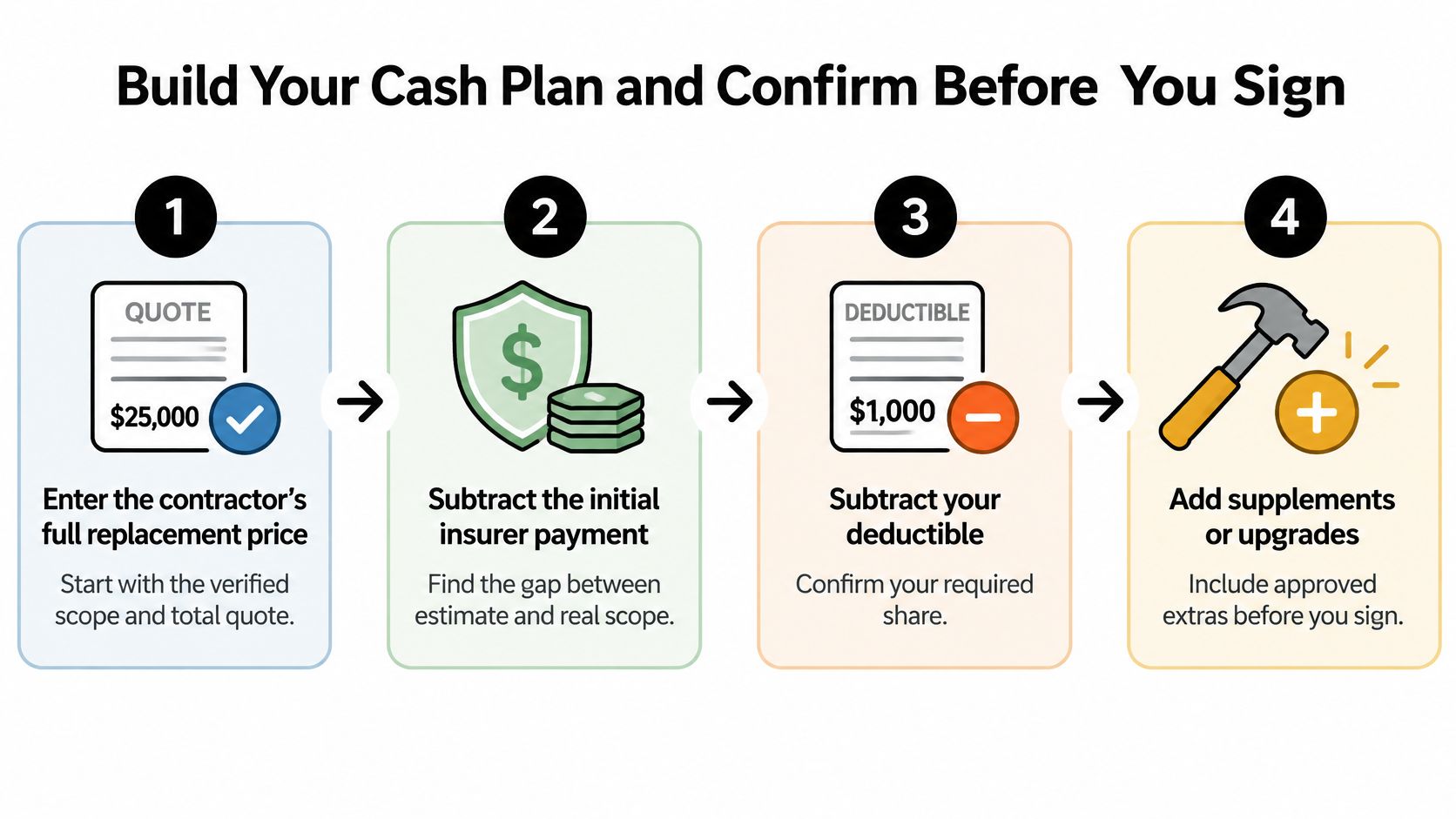
The worksheet
- Enter the contractor's full replacement price. Use the measured scope, not the carrier's draft.
- Subtract the initial insurer payment. This gap is the amount left after the first payment, so it already reflects your deductible as well as any covered scope limits.
- Add excluded code and scope items the policy doesn't pay for, like ordinance-or-law upgrades.
- Enter the withheld depreciation and the claim deadline. Note the date the documentation has to be filed.
- Total the cash you need before the final payment arrives, then decide how you'll cover it.
The withheld depreciation line is the one people forget. Maryland's regulator illustrates how a 20-year-old roof under ACV coverage could receive as little as 20% of replacement cost when a 25-year useful life is assumed. On a replacement cost policy the withheld balance is recoverable, but it's recoverable later, not at signing.
That creates a two-stage cash problem. First, you need enough available funds to start the job while the insurer's first payment is in place. Second, you need a plan for any recoverable depreciation that arrives only after proof of completion. A low deductible does not remove that timing problem. It only reduces one part of the final share.
Confirm these four things before you sign
- Settlement type and any roof-specific endorsement, read off the declarations page.
- The wind or hail deductible in dollars, not as a percentage.
- Two numbers side by side: the insurer's written estimate and an independent measured estimate.
- The adjuster's inspection, scheduled before any permanent repair begins.
The fourth item deserves attention because it affects payment sequence. If the adjuster has not inspected the damage before permanent repairs begin, the carrier may have less documentation for the claim file. That can delay the first payment or complicate the release of withheld depreciation. The contract should match the insurance timeline as closely as the scope matches the roof.
If the gap has to be financed, compare the terms carefully before committing. This NextStopLoans guide to borrowing choices explains how each structure prices the same amount of money differently, which matters when you're covering a holdback for a few months. Our roof replacement financing overview covers how homeowners typically sequence a claim payment against a contractor invoice.
A good outcome isn't a bigger check. It's a known deductible, a known holdback, a deadline on the calendar and a scope that matches the roof on your house. Two States Exteriors LLC provides roof repairs for insurance claims involving hail damage and storm damage, and the website has an Instant Roof Quote option if you want a starting number today.
Two States Exteriors LLC helps Kansas City area homeowners work through this sequence with a free estimate, a measured roof estimate, and claim documentation for the adjuster's review. Bring your declarations page and the insurer's written estimate, and we'll show you where your share starts and when each payment lands. Visit Two States Exteriors LLC to schedule the inspection.