
A standard asphalt ridge cap replacement typically runs $250–$750. Tile or metal caps run $500–$1,500.
Those two bands are why two bids for the same ridge can sit hundreds of dollars apart. The cap itself is a short course of material. What changes the bill is how long the crew is on the roof, how they get there, whether the vent under the cap is still sound, and whether the fasteners match the product. A lump-sum number hides all of that. An itemized one shows it.
Ridge Cap Replacement Cost at a Glance
Start with the job, not a price per foot. A Profindr cost guide places complete asphalt ridge cap replacement at roughly $250–$750, tile or metal replacement at $500–$1,500, and a damaged ridge vent at another $200–$700.
| Job Type | Typical Cost Range | What It Includes |
|---|---|---|
| Standard asphalt ridge cap replacement | $250–$750 | Caps, removal, installation and cleanup |
| Tile or metal ridge cap replacement | $500–$1,500 | Specialized caps and different installation handling |
| Ridge vent replacement added to the job | $200–$700 | Vent removal and new vent section |
| Small 12-foot asphalt ridge example | $280–$520 | Two hours of labor, materials and minimal disposal |
| Ridge cap alone, average-sized home | $500–$1,200 | Labor typically $300–$800 |
Cap material is the small line. Angi puts asphalt ridge-cap materials at about $1.20–$4 per linear foot, while labor is approximately 60%–80% of the project price. On a short ridge you still pay for access, tear-off, sealing, cleanup, and fall protection. Length is one variable. The crew's time is the larger one.
Puetz Construction reported in 2025 that ridge cap replacement alone typically costs $500–$1,200 for an average-sized home, with labor generally $300–$800. That split matches what I look for on a bid. If labor is a thin slice of a very low total, the scope is probably missing removal, disposal, or a vent check.
What these bands leave out
These are national consumer benchmarks. Kansas City Metro pricing can sit higher or lower because of local wages, storm demand, roof design, and permit or disposal fees. A simple gable after a quiet season is not the same job as a steep hip roof the week after a hail event.
Practical rule: Measure the ridge in linear feet, then match that length to the closest row before you collect quotes.
A 20-foot asphalt ridge with an intact vent belongs near the small-job end. An average home with tile or metal caps, or with a vent that has to come out, belongs in a higher row. Write the footage down. You can't compare two estimates until both contractors priced the same length.
Material Prices Per Linear Foot Compared
A flat rate for every roof will mislead you, because the cap product changes the material line before anyone talks about labor.
| Cap Type | Price per Linear Foot | What the Price Covers |
|---|---|---|
| Standard asphalt | $1.50–$3.00 | Cap material only |
| Premium asphalt | $3–$5 | Cap material only |
| Metal | $4–$8 | Cap material only |
| Clay tile | $5–$10 | Cap material only |
| Standard shingle project, all-in average | $6.50 (range $3.50–$10) | Labor and materials combined |
Neutral cost estimates put standard asphalt ridge cap around $1.50–$3.00 per linear foot, premium asphalt around $3–$5, metal around $4–$8, and clay tile around $5–$10, and those figures are cap material only. Design Transition Studio reported in 2026 that ridge cap replacement averages $6.50 per linear foot, with a stated range of $3.50–$10 per linear foot for standard shingle projects. That second set is labor and materials together.
Why the two views don't match
A supplier price is a stack of caps. An installed price pays someone to pull the old course, haul it, fasten the new course, and seal the end. The all-in average can be several times the material band, and it still may not include a vent, steep-roof staging, or deck repair. Treat a per-foot figure from a material counter as a shopping number, not a quote.
The cap also has to match the field. We install asphalt shingles, concrete tile, stone-coated steel, and synthetic slate, and the ridge product should be the one made for that system and for the roof's pitch. A field shingle cut into thirds and bent over the peak is the old shortcut. It cracks at the fold sooner, and it can knock a manufacturer system warranty out of play. If you're weighing shingle against tile or metal for a larger project, a roofing material comparison is the right place to lock the field product before you price caps.
Multiply ridge length by the cap-type price, then ask each contractor whether their per-foot figure is material only or the full install. If one bid is $4 a foot and another is $9, they may not be pricing the same thing.
How Roof Size, Pitch and Access Change the Price
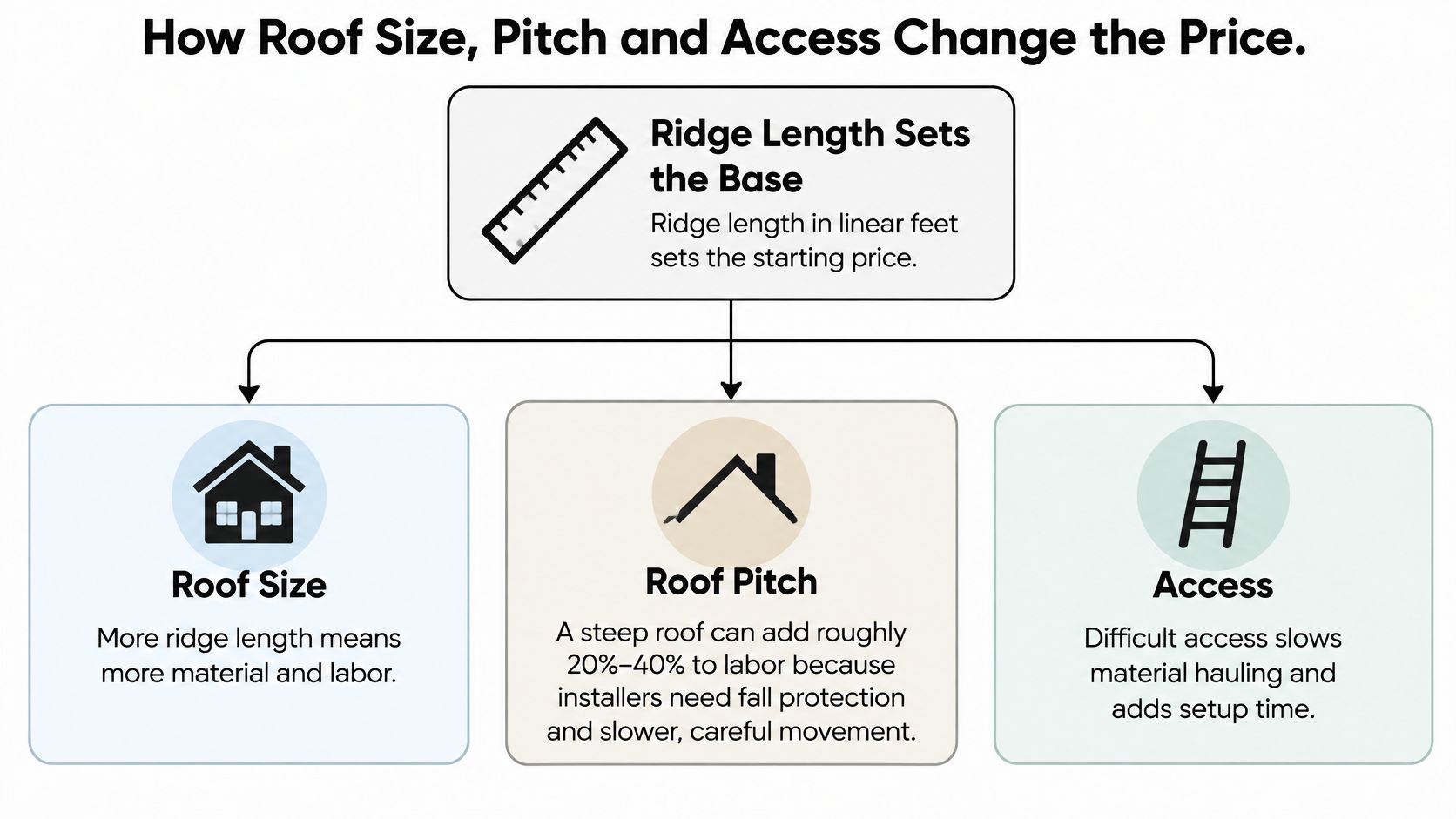
Ridge length sets the base. Site conditions move the final number, and a steep slope is the first place labor jumps.
| Factor | Effect on Cost | Typical Example |
|---|---|---|
| Roof pitch (steep slope) | Adds roughly 20%–40% to labor | Harnesses, roof jacks, extra staging and slower installation |
| Ridge length | Scales material and labor per linear foot | 12 ft asphalt example at $280–$520 with two hours of labor |
| Access and staging | Adds equipment and setup time | Two-story home or obstructed access needs extra staging and ladder time |
| Disposal of old caps | Adds a separate charge | Removal and hauling of old caps and debris |
| Hidden deck or fastener repair | Adds unplanned cost once caps come off | Replacing backed-out nails or soft decking under the ridge |
A steep roof can add roughly 20%–40% to labor because installers need harnesses, roof jacks, extra staging, and a slower pace. That is not a padding line. Fall protection and careful movement take real time, and a crew that skips them is not giving you a deal.
Length doesn't multiply in a straight line
Design Transition Studio reported in 2026 that a 12-foot ridge cap replacement example totals $280–$520, including two hours of labor, materials, and minimal disposal. A 60-foot ridge is not five times that figure. Setup, ladder time, and a disposal run happen once. Extra footage adds caps and fastening time. It doesn't add a second mobilization.
Difficult access works the same way. A one-story gable with a clear yard is a short setup. A two-story home with a fenced side yard, a steep driveway, or landscaping tight to the wall needs more staging and slower hauling. Disposal of old caps and debris is its own charge, even when the pile looks small.
Clay tile and metal caps cost more per foot than asphalt and take different handling, so the same footage lands in a higher band. Hidden deck or fastener repair is the line nobody can price from the driveway. Backed-out nails and soft wood show up after the caps come off.
A hip roof or a house with several ridges usually costs more than one straight ridge, because the crew reaches more than one area and each hip has its own starter and end detail.
You can check three things from the ground before anyone climbs. Look at the pitch, count the stories, and see whether a ridge vent is visible along the peak.
When a Cap Repair Becomes a Roof System Repair
A ridge cap is a small part of the roof. Water doesn't stop at the cap. It follows whatever failed underneath, and a stain on a ceiling can sit well away from the peak because water travels along the deck before it drips.
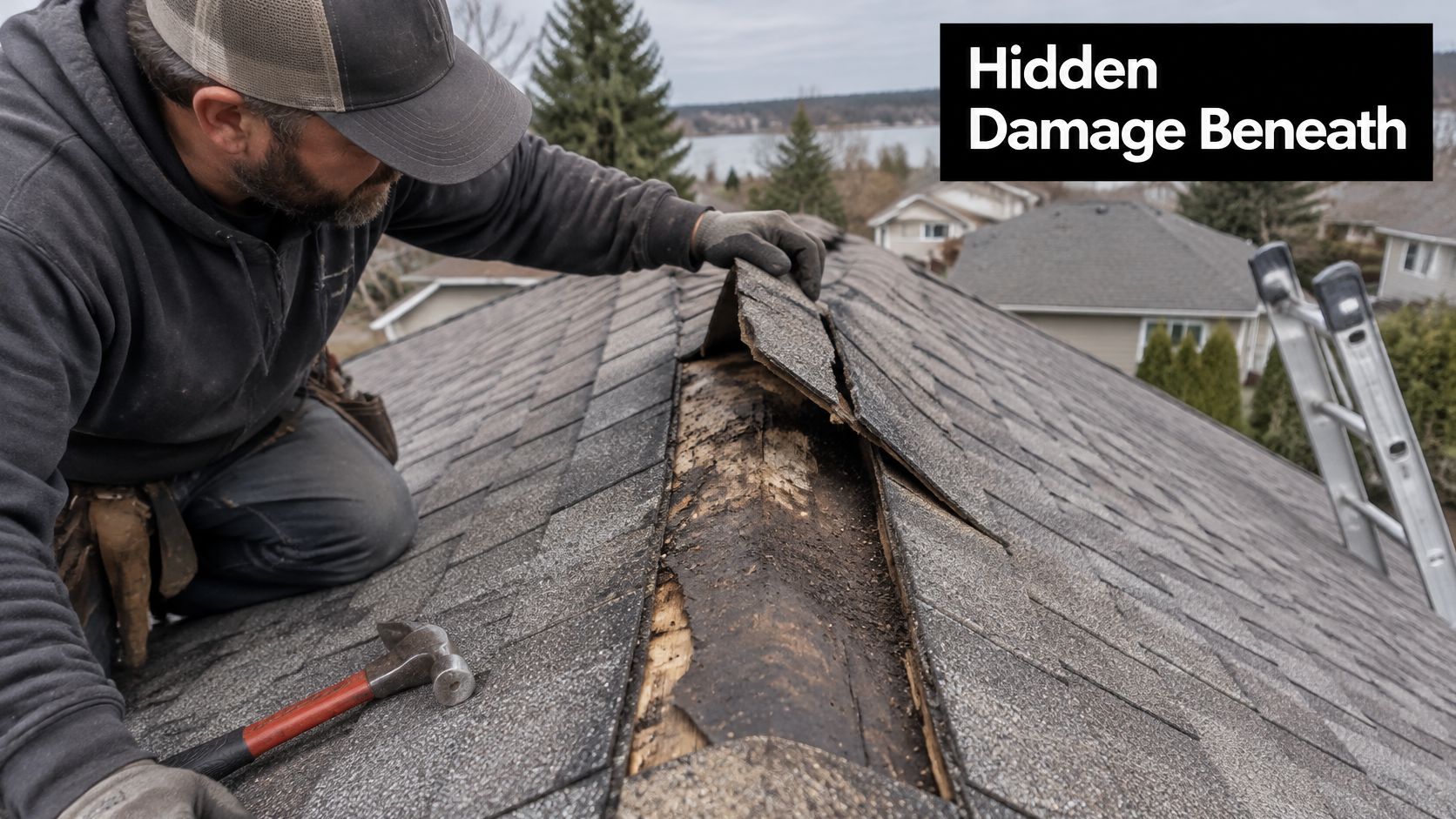
A small-looking ridge job turns into a broader repair for a short list of reasons, and they stack.
- Damaged or missing caps. Cracks along the fold, lifted edges, or a gap where the vent shows are the obvious start. Replacing only the broken pieces is reasonable when the neighbors are still sealed and flat.
- Exposed or backed-out fasteners. A nail head sitting proud of the cap is an open path for water, and short nails that never reached the deck let the course work loose in wind.
- Failed sealant. Aged or skipped sealant lets wind get under the lap. In cold weather, caps that were never hand-sealed can stay loose for months.
- Missing or worn underlayment. Once the cap is off, a bare or brittle underlayment means the next rain isn't waiting on a new shingle. That repair belongs in the same visit.
- A deteriorated ridge vent. Crushed, brittle, or unfiltered vent pulls the cap line out of plane and can let wind-driven rain into the attic.
- Poor original installation. Field-cut 3-tab pieces, nails in the sealant strip, or laps facing the prevailing wind fail earlier than a matched hip-and-ridge product.
Localized repair or the full run
A localized repair covers the damaged stretch and the caps you have to unseal to get there. Replacing every cap along a ridge or hip makes more sense when most of the course is cracked, the pieces are cut 3-tab, or the color and exposure no longer match. Chasing one or two caps after every storm costs more over a couple of seasons than doing the run once.
If the field shingles are failing with the ridge, a cap-only repair won't hold. We re-roof with a complete tear-off or a recovery, and the right path depends on how many layers are already down and what the deck looks like. The Roofing Brief describes total projects ranging from $500 to $4,200 once disposal, access equipment, permits, roof pitch, and material type are included. That upper end is a system repair, not a bundle of caps.
The vent sits under the cap on many Kansas City roofs. It is airflow. The cap is the shingle course. You can need one without the other, but a damaged or inadequate vent is its own cost, in the $200–$700 add-on range when it has to be replaced. Home Repair Calc reported in 2026 that asphalt ridge cap replacement generally costs $8–$20 or more per linear foot, while ridge caps installed over a ridge vent cost $15–$35 or more per linear foot. Those are full project prices, with labor and vent work in the number, which is why they look nothing like a material-counter rate.
Three questions sort a vague bid from a real one. Does the quote include a vent check? Is the vent sized for the attic, with intake at the eaves to match? Is vent replacement its own line, or buried in "misc"? Skipping a bad vent shortens the life of the new caps, because the course is nailed through a product that is already crushed or letting weather in.
Don't shop this decision off a nationwide average. Shop it off the scope. If the quote doesn't say what happens when the deck is soft, you don't have a price yet. You have a guess.
What a Correct Ridge Cap Installation Includes
A cheap cap job and a durable one can use the same shingle. The difference is the fastening.
A manufacturer-approved specification, recorded in a Miami-Dade product approval, calls for three details that are easy to check on a work order.
- Two corrosion-resistant roofing nails per cap. One nail, or a staple, is not the pattern these products are tested to.
- Placement at about 6 7/8 inches from the exposed end and 1/2 inch from the edge. Nails in the sealant strip, or too close to the butt, miss the zone that holds the cap in wind.
- Nails driven flush. Overdriven nails cut the mat. Underdriven nails sit proud and leak.
Deviating from those details creates wind-uplift and water-entry paths, especially on storm-exposed ridges, and it can invalidate the product-system requirements a warranty depends on. On a vented ridge the nail also has to be long enough to reach solid deck through the vent baffle. Short nails are the detail most often gotten wrong.
On a 60-linear-foot ridge, asphalt cap material alone might run roughly $72–$240 before labor, disposal, or other charges. The spread between a low bid and a careful one usually sits in that labor detail, not in the bundle of caps.
Ask each contractor three things, and get the answers in writing before you approve the estimate. How will the caps be fastened, including nail count, location, and length? Does the specified cap match the roof pitch and the existing shingle or tile line, including a high-profile cap where the slope calls for it? Does the quote treat this as a roof-system repair, with an intact vent, sound underlayment, and solid decking, or as a shingle swap? I would not sign a bid that can't answer the fastening method and the warranty terms that hinge on it.
Insurance Claims for Hail and Storm Ridge Damage
Say a spring storm lifts a run of caps on a Lenexa or Independence roof. From the sidewalk the line looks a little uneven. In the attic, daylight or wet insulation may already sit under the peak. Hail and wind crack, bruise, and displace ridge caps, and that damage is harder to judge from the ground than a missing field shingle.
Document it before anyone "cleans it up."
- Photos of each damaged section with a measuring tape in the frame, so length isn't a guess later.
- Ridge length in linear feet, counted for every ridge and hip, not just the worst spot.
- The storm date, plus any leak notes inside the house, including stains that aren't directly under the peak.
- Roof age, because an adjuster weighs the loss against how the roof was already wearing.
Cosmetic marks and functional damage are not the same thing. Insurers usually look for loss that changes how the roof keeps water out. A scuffed cap that still lies flat and sealed is a different conversation from cracked folds, missing pieces, or exposed nails. An adjuster will also ask whether the ridge is part of a broader storm loss across the slopes, and a ridge-only bill doesn't automatically become a full-roof claim.
We handle roof repairs prepared for insurance claims, and we support hail and storm damage claims. That doesn't mean the policy pays the whole invoice. Compare a typical asphalt ridge repair, in the $250–$750 band, with your deductible before you file. A small ridge repair can cost less than opening a claim, and a claim you don't need can still affect how the carrier looks at the next one. Ask the adjuster whether the contractor's estimate is written on a replacement-cost basis, not a depreciated patch.
Request the itemized estimate before the adjuster visit so both sides work from the same scope. Our notes on a roof hail damage insurance claim walk through what to gather. Don't promise yourself a payout. Do show the damage clearly enough that the scope isn't negotiated from memory.
Confirm an Itemized Ridge Cap Estimate Before You Sign
Collect at least two itemized estimates and compare them line by line before you approve work. A single lump-sum number makes that comparison impossible. One contractor may have priced a cap swap. The other may have priced a vent, a disposal run, and harness time.
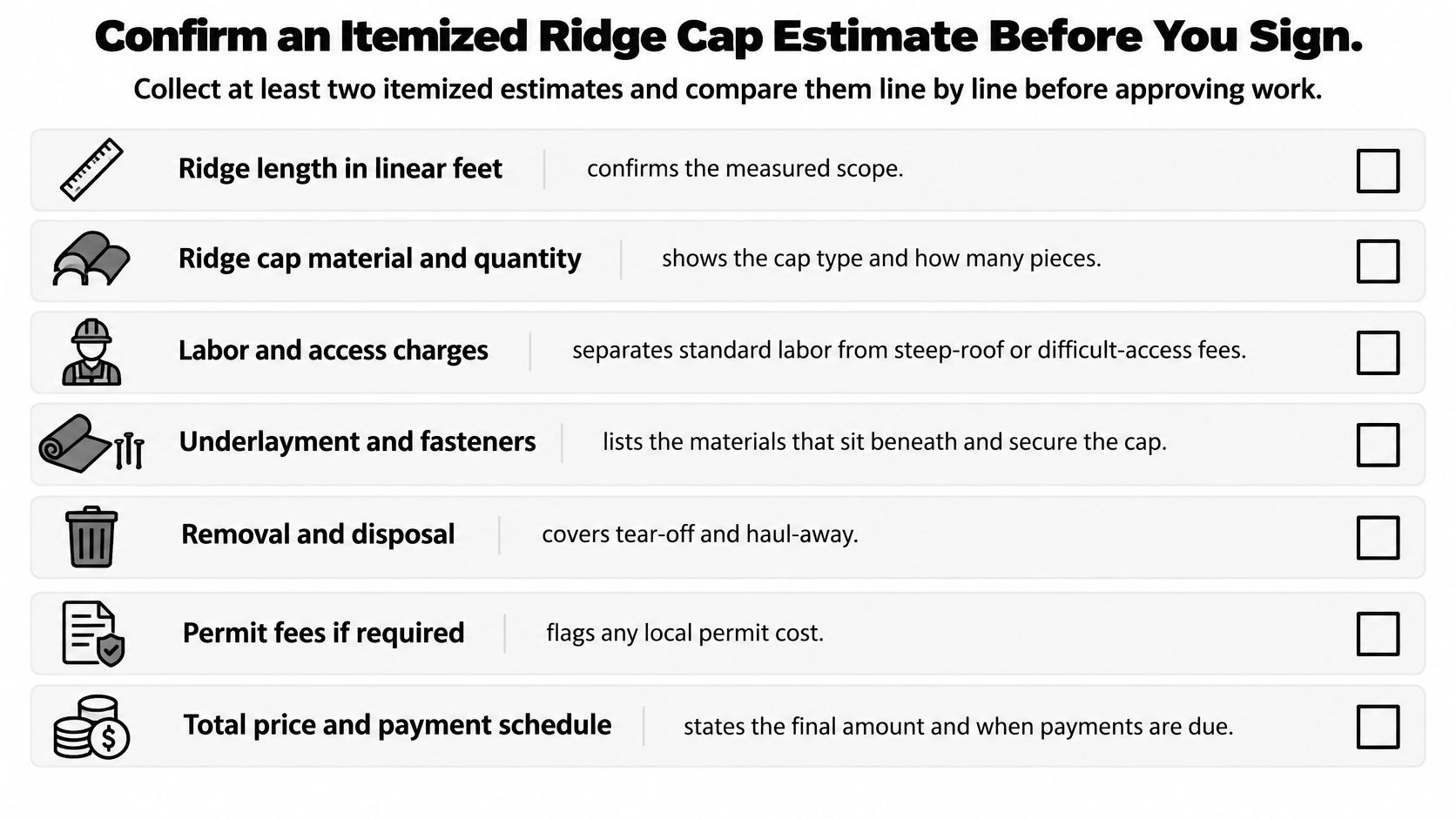
Each estimate should show nine things.
- Ridge length in linear feet, measured, not guessed from the street.
- Cap type and material, named to the shingle or tile line and the pitch.
- Removal of the old caps, including how neighboring sealed caps will be freed.
- Disposal, as its own amount.
- Access and safety equipment, with steep-roof or two-story staging called out.
- Ridge vent condition, and vent replacement if the baffle is crushed or missing.
- Underlayment or decking repairs, with a unit price for soft wood found after tear-off.
- Code-related upgrades, if the local permit or ventilation rule requires them.
- Warranty scope, including what fastening the manufacturer requires.
If you want a format to line those rows up, JobsiteStack's copyable roofing estimate line items are a useful checklist next to the bids. A worked roofing estimate example shows how a real scope reads when labor, material, and extras aren't mashed into one figure.
You can start with the Instant Roof Quote on our site for a baseline, then use the on-site look to confirm pitch, access, and the vent. Annual or semiannual inspections catch curling, cracked folds, and exposed nails before a storm turns a cap course into deck repair.
The cheapest quote isn't automatically the right one. The right estimate names the damage, the fix, and the materials, and it matches the roof you already have.
Two States Exteriors LLC measures the ridge, checks the vent and deck, and prices cap work as a roof-system repair for homes and businesses across the Kansas City Metro. If your quotes don't agree, bring them to a free on-site inspection and we'll show you which lines are real. Visit Two States Exteriors LLC to request an estimate or start an Instant Roof Quote.