
Treat the national average as an anchor, not a forecast. CoreLogic data cited by Policygenius puts the typical hail claim near $9,000, and Verisk's Xactimate pricing, reported by Carrier Management, pegs 2025 benchmarks at $4,699 for a repair and $17,631 for a replacement.
Your own number follows a formula: insurer-approved estimate, minus your deductible, then reduced by ACV depreciation or held back until you finish the job under RCV. Two homeowners on the same block can see identical scopes and different checks.
What Will Insurance Pay for Your Hail-Damaged Roof?
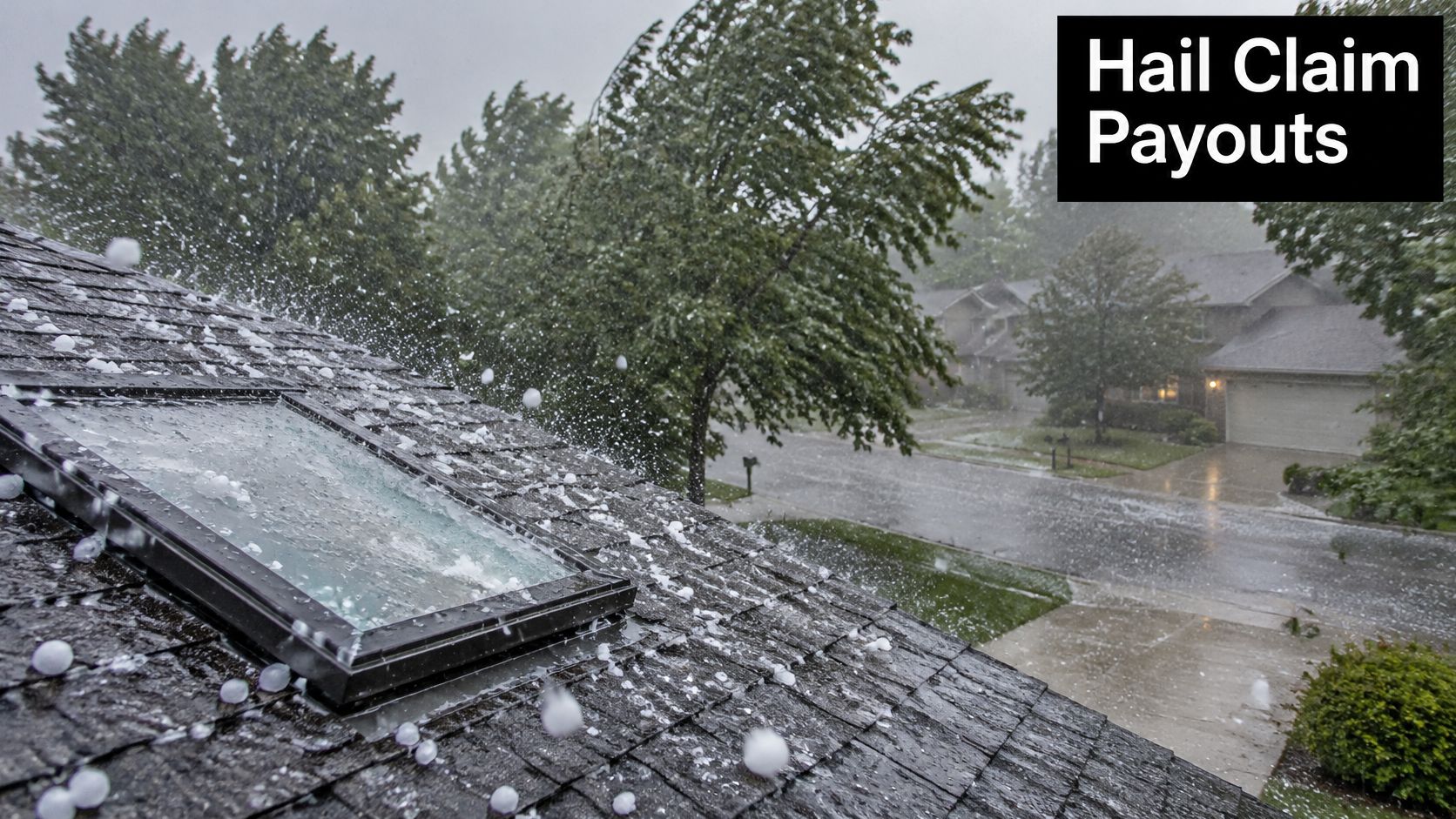
Say a June evening in the Kansas City metro ends with hail hammering your shingles and skylights. A week later, a contractor recommends replacement, but the adjuster's estimate leaves you wondering who's supposed to pay the difference.
The storm is only the beginning of the coverage question.
Your neighbor's settlement won't settle that question. Their roof might have different materials, a different deductible, or replacement-cost coverage that your policy doesn't provide.
Insurance pays for the covered scope under your policy, not for a contractor's recommendation. A replacement can be the sensible construction decision without every part of it qualifying for reimbursement.
Start with the right comparison: Compare the contractor's scope with the adjuster's scope before comparing either document with the check.
Separate the problem into three questions: What did hail damage? What work will restore it? What portion does your policy reimburse? Once those answers are written down, you can place your roof in a realistic settlement range and decide whether the next step is a repair, a replacement estimate, or a request for additional inspection.
Average Hail Claim Payouts and Roof Cost Benchmarks
These benchmarks measure different things. One tracks insured losses nationally, one tracks construction estimates, one tracks what homeowners report spending. None of them is your expected check.
| Benchmark | Amount | What it covers | Source basis |
|---|---|---|---|
| Average U.S. hail claim, past decade | About $9,000 | Covered hail losses, potentially including partial roof repairs, siding, and interior water damage | CoreLogic data cited by Policygenius |
| Average hail-related claim benchmark | $13,511 | Roof plus siding, gutters, windows, and other covered components | Insurance Information Institute figure attributed by Insurance.com |
| Average roof repair cost, 2025 | $4,699 | Residential roof-repair estimates, not paid settlements | Verisk Xactimate estimates |
| Average roof replacement cost, 2025 | $17,631 | Residential roof-replacement estimates, not paid settlements | Verisk Xactimate estimates |
| Homeowner-reported storm roof damage | $5,001-$15,000 for 31% of respondents reporting severe-weather roof damage | Self-reported damage costs, not insurer payments | Insurify's 2026 survey |
Read the measure before using the amount
The historical hail-claim average answers a broad question about insured property losses over a decade. It doesn't tell you what replacing your roof costs today, and it doesn't isolate the roofing portion of a claim. The $13,511 benchmark carries the same limitation. When a settlement includes gutters, siding, window screens, and interior repairs, the homeowner can't treat the whole amount as a roofing budget. Those other components still need funding.
The Xactimate figures run the other direction. They price construction, not coverage. A $17,631 replacement estimate describes what a contractor charges for tear-off, roof covering, accessories, and disposal. It says nothing about your deductible, your depreciation, or whether the insurer approved every line. The Insurify range is self-reported, so a respondent quoting $5,001 to $15,000 may be mixing a contractor's bid with an insurance check in the same number.
Repair costs, replacement estimates, and claim payments aren't interchangeable. A repair estimate describes construction work. A paid claim reflects coverage decisions and the homeowner's share of the expense.
Choose the closest comparison
For a contained loss, compare your contractor's proposal with repair work, not a nationwide replacement average. For widespread damage, look at a complete replacement scope that identifies tear-off, roof covering, accessories, disposal, and any covered additional work.
Our guide to hail damage roof repair costs separates the construction budget from the insurance reimbursement. That distinction beats deciding whether your quote looks high or low against a blended national claim figure.
For broader housing context, Statlyst's housing stats for journalists is a useful companion resource. Keep broad housing information separate from the measurements and policy provisions that determine an individual roof settlement.
A national average is a reason to investigate the scope, not a reason to accept or reject a check.
Match the row that resembles your situation, then identify what it leaves out. A homeowner-reported damage bill might include expenses insurance excluded, while a replacement estimate might still be waiting for supplemental approval. The figure that predicts your check is the approved estimate minus your deductible, adjusted for depreciation.
How Insurers Calculate Your Hail Damage Payout
Your settlement generally equals the approved covered estimate minus the deductible, adjusted for depreciation under the roof's valuation terms. The MrTask hail-repair cost guide describes this settlement model and the distinction between actual cash value and replacement-cost reimbursement.
The approved estimate is the starting point. It isn't necessarily the contractor's bid, and it isn't necessarily the insurer's first estimate if additional covered work is later approved.
Find the deductible that actually applies
A flat deductible is a stated dollar amount. A percentage wind/hail deductible uses the policy's specified insured-value basis, not the size of the repair bill.
Using the dwelling-limit example behind the hail-related claim benchmark, the calculation is:
- Find the base: Use the dwelling coverage limit identified by the policy.
- Apply the percentage: Multiply that limit by the wind/hail deductible percentage.
- Subtract the result: Deduct that dollar amount from the covered loss before considering other adjustments.
Don't substitute your mortgage balance, purchase price, or county assessment. Read the deductible wording and ask the insurer to confirm the calculation in writing if the basis isn't clear.
Separate permanent depreciation from temporary holdback
Actual cash value, or ACV, pays the roof's depreciated value. Replacement cost value, or RCV, can reimburse eligible replacement costs, but the insurer may initially withhold recoverable depreciation until you complete the work.
The used-car comparison helps: ACV values the used item you had, while replacement-cost coverage addresses the cost of replacing it with an equivalent new item. RCV isn't a blank check for upgraded materials or unrelated improvements.
ACV vs RCV roof coverage at a glance
| Feature | Actual Cash Value (ACV) | Replacement Cost Value (RCV) |
|---|---|---|
| Payout basis | Depreciated value of the existing roof | Eligible cost of equivalent new materials and labor |
| First check | Reflects depreciation and deductible | Often ACV-sized, with recoverable depreciation withheld |
| Withheld depreciation | Generally not recoverable under ACV-only terms | May be released after completion and required documentation |
| Effect of roof age | Age and wear affect depreciated value | Endorsements and eligibility conditions still matter |
| Premium cost | Compare the actual quoted policy | Compare the actual quoted policy |
| Best fit | Homeowners prepared to fund the depreciation gap | Homeowners seeking replacement-cost protection, subject to policy terms |
Don't choose ACV merely because the roof is old. That's when the unreimbursed depreciation can be especially difficult to fund.
Our explanation of roof replacement depreciation can help you separate a recoverable holdback from a permanent reduction. Ask the carrier to label both clearly on its estimate.
Cash-flow check: Before signing a construction contract, know what insurance will pay now, what it may pay later, and what you must fund yourself.
A low initial check doesn't automatically mean the claim was underpaid. It might reflect the deductible, recoverable depreciation, excluded work, or a scope disagreement. Get a written explanation for each reduction rather than treating them all as the same problem.
Factors That Push Your Hail Payout Up or Down
The roof, the damage, and the policy each affect the result. A large construction estimate doesn't necessarily produce a large net check.
Verisk's roofing risk assessment reports roughly 60% higher loss costs for roofs in moderate-to-poor condition than roofs in good-to-excellent condition. That finding describes loss severity, not a promise that an insurer pays more for a neglected roof.
What moves a hail damage roof payout
| Factor | Effect on the payout | Why it matters |
|---|---|---|
| Roof size and pitch | Larger or steeper roofs increase the construction estimate | More material, access equipment, and labor |
| Roofing material | Premium materials can increase replacement scope | Equivalent replacement must account for the existing roof system |
| Damage severity | Widespread functional damage can support broader replacement | Repair feasibility matters, not just visible impact marks |
| Roof age and condition | Can reduce the net reimbursement | Depreciation and pre-existing deterioration require separate treatment |
| Coverage valuation | Determines depreciation treatment | Recoverable holdback differs from permanent ACV depreciation |
| Deductible type | Changes the homeowner's share | A percentage deductible can substantially reduce a smaller claim |
| Local labor prices | Affect estimated construction costs | Kansas City-area pricing should match the work and location |
| Code upgrades | Can increase scope when covered | Required construction work and insurance coverage are separate questions |
Distinguish storm damage from roof condition
A shingle's fractured mat, exposed substrate, or damaged flashing needs a specific explanation. Scattered marks don't establish that every slope requires replacement, while an absence of indoor leaks doesn't prove the covering remains sound.
Ask the inspector to distinguish sudden impact damage from aging, installation problems, and deterioration. That separation supports a defensible repair-versus-replacement decision without attributing every existing defect to the storm.
Three Hail Claim Scenarios and Their Payouts
Current construction costs explain why a historic claim average can be a poor replacement budget. Carrier Management's report on Verisk's Xactimate estimates places average U.S. residential roof replacement at $17,631 in 2025 and roof repair at $4,699, while explicitly distinguishing estimates from paid claims.
The examples below are hypothetical applications of the settlement mechanics, not quoted Kansas City prices or predicted offers. They show why the policy can matter as much as the amount of damage.
A newer roof with replacement-cost coverage
A homeowner has widespread functional damage to an architectural-shingle roof. The carrier approves replacement, and the homeowner completes the covered work under the policy's replacement-cost conditions.
The payment sequence looks like this:
- Approved scope: The carrier accepts the eligible replacement work.
- Initial payment: The carrier subtracts the deductible and any recoverable depreciation.
- Completion payment: The homeowner submits the required completion evidence, and the carrier evaluates release of the holdback.
- Final homeowner share: The deductible remains, along with upgrades or other expenses the policy doesn't cover.
The practical issue is timing. Even with adequate RCV coverage, the homeowner needs a contract and payment arrangement that account for the difference between the initial check and eventual reimbursement.
An older roof with actual-cash-value coverage
Another homeowner needs similar replacement work, but the roof is insured on an ACV basis. The insurer calculates depreciation before subtracting the deductible.
The arithmetic is:
Approved replacement estimate − nonrecoverable depreciation − deductible = insurer payment.
Completing the roof doesn't turn nonrecoverable depreciation into recoverable money. The owner must plan for both the deductible and the depreciation gap, plus any excluded work.
A supplement can correct missing covered scope or unsupported quantities. It generally can't rewrite an ACV policy into replacement-cost coverage. That's why an estimate disagreement and a coverage limitation need different responses.
A localized repair with a substantial deductible
A third homeowner has damage confined to a repairable area and associated gutter work. The contractor writes a localized scope instead of recommending an unnecessary full replacement.
Here the calculation is:
Approved covered repair cost − applicable deductible = potential payment, before other adjustments.
If the covered amount doesn't exceed the deductible, there may be no insurer payment. The repair still needs attention, but filing a claim doesn't make the expense disappear.
This homeowner should compare the likely covered repair scope with the actual wind/hail deductible before expecting a check. A percentage deductible can absorb a modest loss even when the damage is real.
The same storm can produce very different settlements on the same street without any of those settlements being inherently wrong.
The useful question isn't which neighbor received more. It's whether the insurer identified your covered damage accurately and applied your policy correctly.
Hail Claim Myths That Cost Homeowners Money
It hailed, so approval is automatic. A documented storm establishes an opportunity for damage, not proof of every claimed defect. The inspection must connect the condition of your roof to the event and separate it from pre-existing problems.
These common assumptions are worth checking against the written policy.
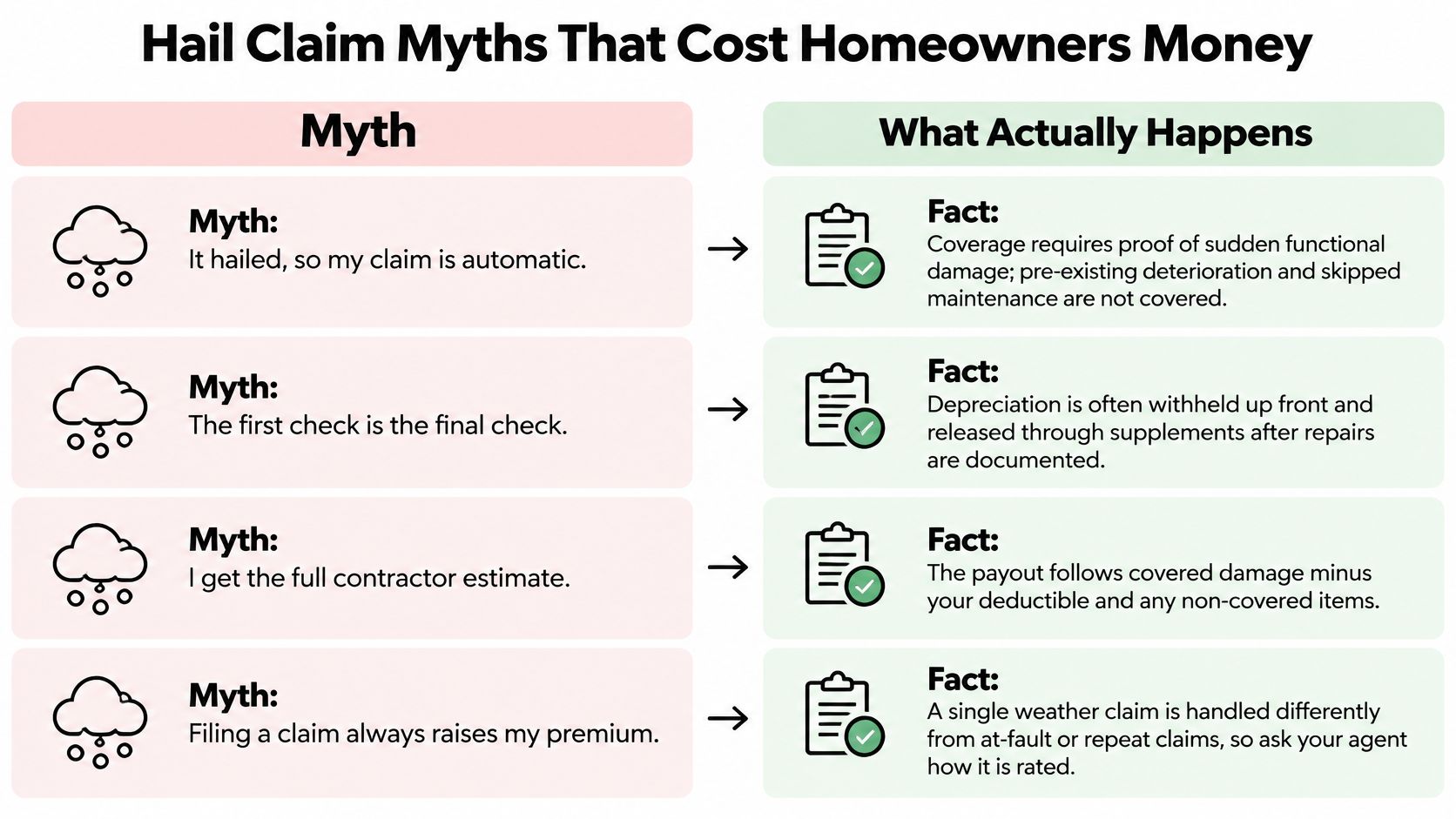
Dents aren't a complete replacement argument
Every dent means a new roof. Cosmetic marks and functional damage aren't interchangeable, and cosmetic coverage depends on policy language. An inspector should explain whether an impact impaired the component, not merely circle every visible mark.
A costly hail season means a bigger personal settlement. Leader's Edge reports that Verisk recorded 835,058 homeowner hail claims in 2025 and estimated $22.5 billion in residential and commercial structural hail losses. Those totals describe industry exposure, not an individual homeowner's entitlement.
The contractor's estimate is what insurance owes. A bid proposes construction work; a coverage determination identifies what the policy reimburses. Resolve discrepancies with measurements, photographs, supported pricing, and a supplement rather than assuming either document is automatically complete.
The practical test is whether the claimed damage can be tied to the storm and whether the proposed work addresses a covered loss. Don't assume anything about renewal pricing from a generic claim graphic; ask your agent how your particular carrier and policy handle weather claims.
How to Document and Support Your Hail Damage Claim
Build a file that lets someone understand the damage without standing on your roof. Clear photographs and itemized scope help far more than a long argument about whether an estimate feels low.
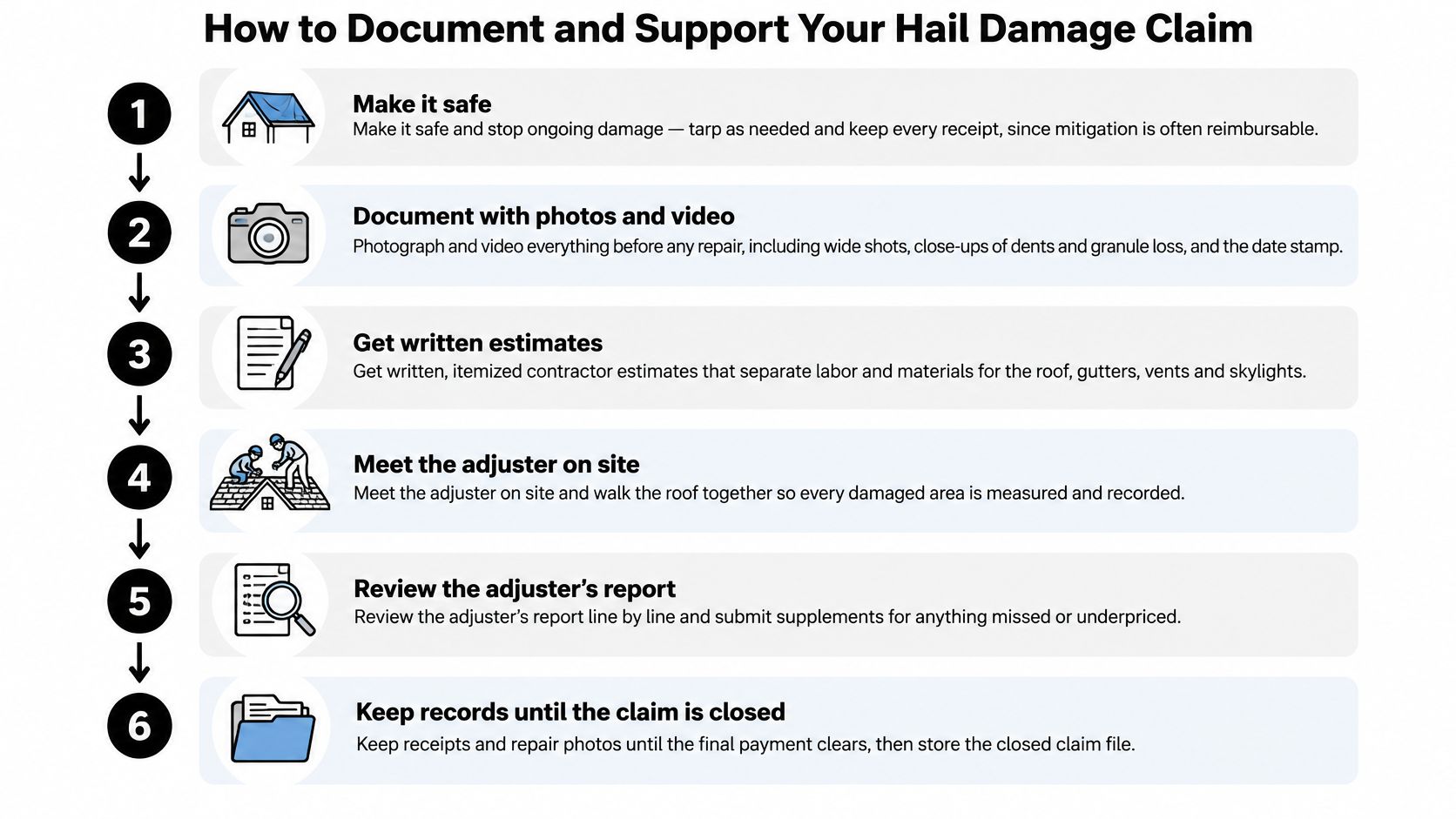
Use this visual checklist as an overview, then preserve the supporting records for each stage.
Capture the loss before permanent repairs
Make the property safe. Arrange temporary protection for active openings and move belongings away from leaks without entering unsafe areas. Keep mitigation invoices and receipts, and ask the carrier how those expenses are handled.
Photograph the full property. Have a qualified inspector capture each roof plane, ridge, hip, flashing detail, gutter, and downspout. Add ground-level photos of siding, windows, garage doors, the air-conditioning condenser, and any interior staining, preserving original files and capture dates.
Record the storm information. Write down when the hail occurred and save available weather-service or local-news reports for the property's area. These records support the timeline, but they don't substitute for evidence of damage at the house.
Get a written construction scope. Request an itemized estimate covering the roof covering, underlayment, flashing, ventilation, debris removal, and any necessary code-related work. Separate damaged components from optional upgrades so the adjuster can evaluate each item.
Report the claim promptly. Follow the policy's notice requirements and submit the photographs, storm timeline, and inspection report. Ask for written confirmation of applicable claim and repair-completion deadlines rather than relying on a general online timeline.
Keep the estimate and payment record aligned
Coordinate the inspection. Arrange for your contractor to be available when the adjuster visits, if practical. Let qualified professionals handle roof access and identify the locations shown in the inspection photographs.
Compare both estimates line by line. Check measurements, affected slopes, material descriptions, accessories, labor operations, and disposal. Use the declarations page and endorsements to distinguish a missing construction item from a coverage restriction.
Request explanations and submit supported supplements. Ask why each disputed amount was depreciated, withheld, or excluded. A supplement should identify the exact missing work and include photographs, measurements, invoices, or applicable code documentation.
Document completion for recoverable amounts. Submit the final invoice, completion photos, and any other evidence the insurer requests. Confirm what remains outstanding instead of assuming the contractor's completion automatically triggers payment.
Keep the complete claim file. Save emails, letters, estimates, revised approvals, receipts, and payment records in one folder. Reconcile the final insurance payments with the contract and your own contributions before treating the claim as closed.
This video provides additional context for the roof-claim process.
Get Your Roof Inspected Before You File
The average insurance payout for hail damage roof claims is a planning reference, not a personal settlement forecast. A useful forecast starts with your roof's actual damage, an itemized construction scope, and the policy terms that determine your share.
Before accepting an estimate or committing to replacement, make these decisions:
- Confirm the settlement terms. Locate the roof's ACV or RCV provisions, deductible, and relevant endorsements. If the declarations page doesn't answer the question, request written clarification from the insurer.
- Classify the work. Determine whether the property needs a localized repair, broader replacement, or a mixed exterior repair project. Don't let a neighborhood sales pitch substitute for an inspection.
- Compare documented scopes. Identify the specific differences between the contractor's proposal and the adjuster's estimate. Resolve quantities and covered operations before focusing on the bottom-line gap.
Kansas City metro homeowners can use an independent inspection as a comparison step, not as a commitment to replace the roof. We offer hail damage roof inspections and roof insurance claims services for storm-related damage.
You don't need a promised payout before getting informed. You need a clear account of what happened to the roof and what work is justified. The strongest settlement preparation begins before the adjuster climbs the ladder.
Two States Exteriors LLC offers roof repair, replacement, and insurance-claim services for hail and storm damage. Visit Two States Exteriors LLC to request a free estimate, or call (913)-238-6562 to discuss your damaged roof and the scope you need to compare with the insurer's estimate.