
Ask a question after the next hailstorm and notice how fast the answer arrives: "Is my roof totaled?" The people answering fastest usually have a ladder in the truck and a contract pad on the seat. What almost nobody asks first is whether the shingle lost any of its actual function, because that question takes a closer look than a driveway glance allows.
Two very different failures hide inside the phrase damaged roof shingles, and they carry very different price tags. One is surface wear: granules knocked loose, a few bare patches, sun-faded asphalt. The other is structural: a fractured fiberglass mat, a puncture, a tear that lets water past the shingle for good.
A shingle is a thin asphalt mat wrapped in mineral granules. The mat keeps water out. The granules shield the asphalt underneath from ultraviolet light. Hail can hurt either layer, and the two injuries look nothing alike up close, which is why a mark you spot from the driveway tells you almost nothing on its own.
Spot the Damage Types on Your Roof
Seven patterns cover most of what you'll find, and most can be spotted without climbing anything.
| Damage type | Typical cause | What you see | Urgency |
|---|---|---|---|
| Cracked or torn tabs | Wind, age, thermal stress | Split tabs or lifted corners | Schedule repair |
| Missing shingles | High wind or uplift | Bare patches and exposed felt | Repair soon |
| Hail bruising | Hail at or above about 1 inch | Soft spots and fractured mat | Inspect now |
| Granule loss | Aging, hail, foot traffic | Bare spots and granules in gutters | Assess mat condition |
| Curling or clawing | Age and poor ventilation | Edges curl upward | Plan replacement if widespread |
| Blistering | Trapped moisture or gases | Raised blisters on the surface | Monitor; inspect if cracked |
| Algae streaks | Humidity and shade | Dark streaks on the surface | Cosmetic unless widespread |
Cracked or torn tabs show as splits across a single tab or corners lifting off the adhesive strip, most often on the slopes that catch wind. A split tab still sheds water until a hard, sideways rain finds it. Missing shingles leave felt or deck showing, and that's the one pattern that doesn't wait, because the underlayment is now your only roof.
Hail bruising is the pattern that fools people. A stone at or above about 1 inch can soften a spot the size of a thumbprint while the surface still looks whole, so walk the gutters, downspouts, and soft metal around vents first looking for matching dents, then compare your own photos with this collection of roof hail damage photos. Granule loss reads as bare, dark, or shiny patches, plus grit collecting at the bottom of a downspout.
Curling and clawing lift the edges upward and usually point to age or a poorly vented attic. Blistering raises small bumps that pop and leave craters. Algae streaks are dark stains running down a slope; they're cosmetic unless they cover most of the roof.
A weekend check takes twenty minutes and gives you a record:
- Photograph each slope from the ground, one wide shot and one zoomed shot, and name the file by date.
- Note which slope faces the storm, since that's the plane an adjuster will examine hardest.
- Match what you saw against the table rows, and write down anything you can't place.
How Hail and Storms Create Shingle Damage
Hail is one of the most significant weather-related causes of damaged roof shingles in the United States, and the federal definition of a severe thunderstorm gives you a threshold to work from. NOAA's severe storm explainer defines a severe thunderstorm as one producing hail at least 1 inch in diameter, wind gusts of at least 58 mph, or a tornado.
| Hail diameter | Familiar object | Likely effect on asphalt shingles |
|---|---|---|
| 1 inch | Quarter | NOAA severe-storm threshold; bruising possible, rupture risk rises on weaker shingles |
| 1.25 inch | Half dollar | Can rupture mid-life shingles; mat fractures likely |
Hail rarely leaves the obvious broken shingles people expect. It leaves small, widely dispersed impact points, so a roof can hold its appearance while its weather resistance drops. That's why a driveway inspection after a quarter-inch-to-golf-ball storm so often ends in a shrug and a false sense of safety.
Wind works differently and more visibly. Gusts at or above that 58 mph mark catch the exposed edge of a tab, pop the seal strip, and peel shingles back from rakes, ridges, and the windward corners. Once a seal breaks, the next gust gets a grip it didn't have before.
Direction matters more than most homeowners realize. Slopes facing the storm take the bulk of the impacts, and the opposite plane may look untouched, which is why a full inspection maps each roof plane separately instead of sampling the easiest one to reach. Season matters too. NOAA identifies spring as a period when severe storms frequently affect many Central and Southeast states, and Kansas City sits squarely in that corridor, making hail assessment a recurring maintenance issue rather than a once-a-decade event.
Age offers no protection. A FEMA case study from Ponca City, Oklahoma documents a National Weather Service average of four hailstorms a year in that area, with at least one producing hail an inch or larger. After two severe hailstorms, roughly half the homes in the featured neighborhood had roof damage estimated at $2,500 to $4,000 per property, and several of those roofs were relatively new and still under warranty.
When a storm crosses that inch or 58 mph line, the next move is an inspection, not a ladder.
Cosmetic Marks Versus Functional Damage
Take two shingles from the same slope. Both lost a patch of granules the size of a business card in the last storm. One has a sound mat underneath and will shed water for years. The other has a hairline fracture across the mat, and every freeze and thaw from here on widens it.
That is the whole distinction. Functional damage means a puncture, tear, or fracture in the mat beneath the surface, the kind inspectors call a bruise. Missing granules alone do not qualify, and a technical white paper on hail degradation in residential asphalt shingles makes the case plainly: granules come off for reasons that have nothing to do with hail, including normal aging, foot traffic, handling during installation, blistering, manufacturing variation, and tree limbs rubbing across a slope.
Granules work like the tread on a tire. Surface wear is cosmetic right up until the cords show.
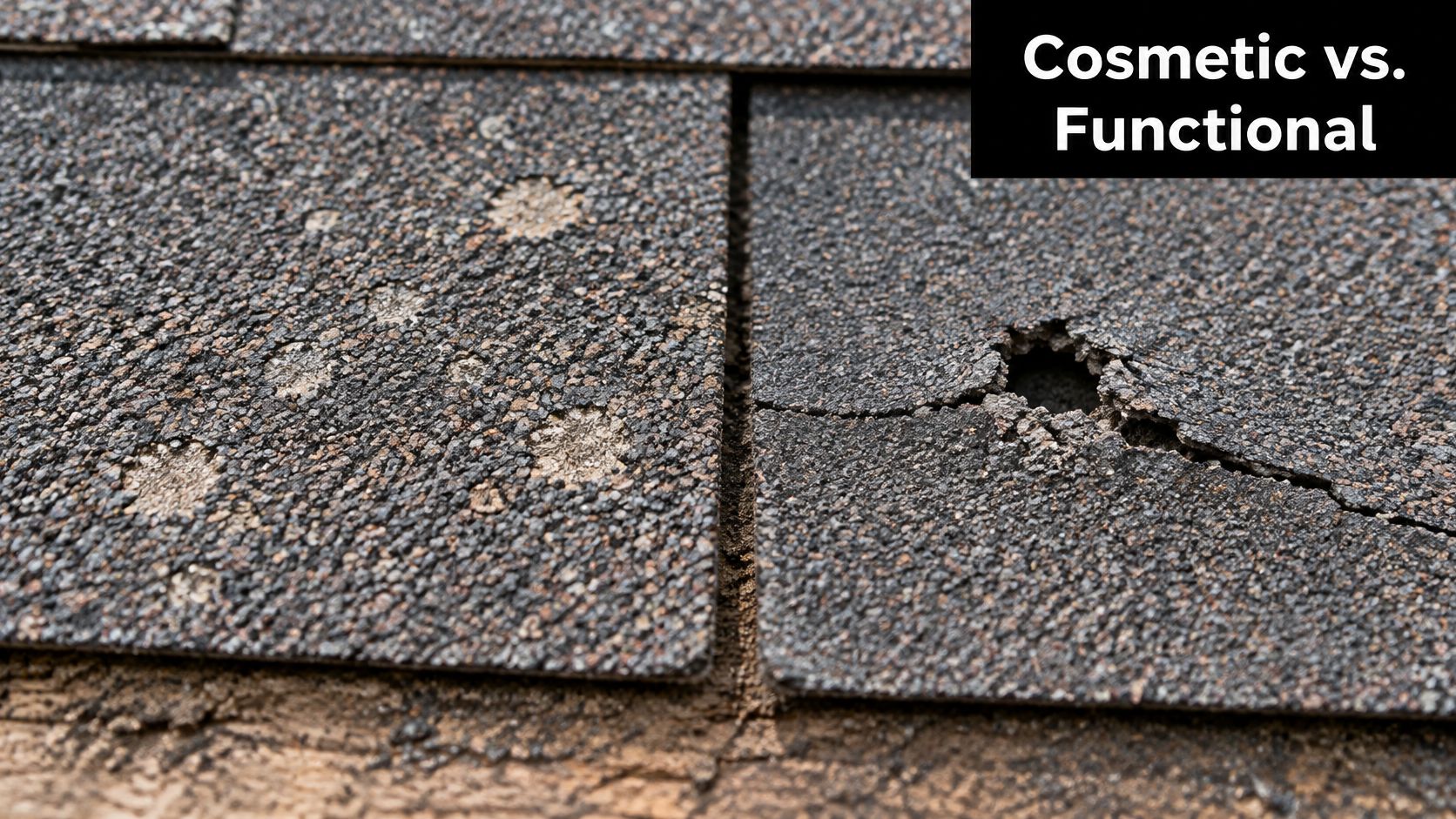
Here is how to sort the two groups when you are standing in front of the roof.
- Cosmetic signs: granule loss spread evenly across a slope, an intact mat, and shingles that still lie flat and stay sealed.
- Functional signs: exposed dark asphalt, a crack running through a tab, a soft spot found by hand, a puncture, or a tear.
- Ambiguous marks: a single bare spot on one shingle with no pattern and no matching dents on metal. Treat it as a question, not a verdict.
A bare spot is a question, not an answer. It becomes damage when the mat underneath is fractured or punctured.
The same white paper reports that in its long-term granule-loss study, fiberglass-mat shingles kept their water-shedding performance even after substantial granule removal. Granule loss without exposed or fractured mat is not, by itself, a reason to replace a roof. Exposed asphalt and fractured mats are a different story, because they let weathering accelerate and open a path for water. Replacing the whole roof after every storm is an unproven default, not the cautious move it sounds like.
Debris can hide either kind of mark, so clearing the surface comes first. Roof-care routines built for very different climates start the same way, and this guide to post-monsoon roof care for Valley homes is a good example: get the buildup off before you judge anything underneath it. Once the roof is clear and a seasonal turn in the weather has settled, walk each slope and look again.
Photograph each suspected mark next to a surrounding shingle so the comparison is visible in the same frame. Close-ups alone prove very little.
Matching the Repair or Replacement Decision to the Damage
Independent engineering evidence is more measured than the sales pitch. Asphalt shingles in mid-life or better condition generally need hail roughly 1 to 1.25 inches in diameter to rupture, while smaller stones can affect severely deteriorated or poorly supported shingles, according to this engineering analysis of sub-severe hail on asphalt shingles. The same analysis notes that testing has not established that sub-severe hail alone measurably shortens service life without demonstrable physical damage.
That matters in this metro. Hailstorms sweep through Kansas and Missouri every season, so a homeowner here can face the repair-or-replace question several times in a single year rather than once in a roof's life. Treat each storm as a fresh evidence question, not an automatic trigger for a claim.
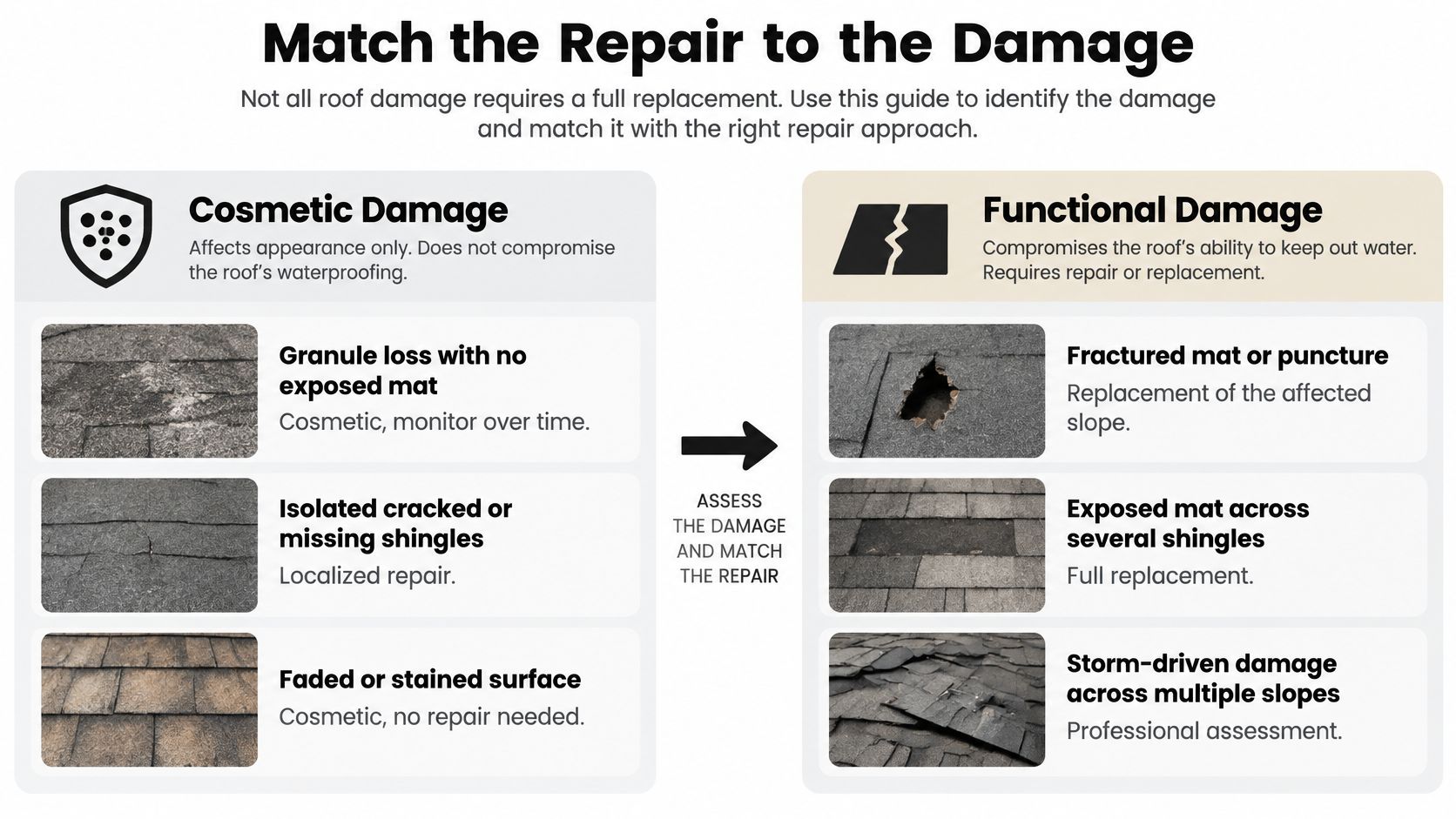
Match the condition you have to the response it calls for:
- Cosmetic granule loss, no exposed mat: document it and monitor. Nothing to file yet.
- Isolated cracks or a few missing shingles: localized repair, assuming matching shingles are available.
- Fractured mats or punctures across several slopes: replace the affected slopes.
- Widespread functional damage on an aged roof: price a full replacement before committing to piecework.
- Functional damage plus dents on gutters, vents, or AC fins: the collateral evidence strengthens both the diagnosis and the claim.
Then work the inputs in order: confirmed loss of shingle function, roof age and remaining life, whether a repair restores the assembly without disturbing adjacent shingles, matching material availability, and any code or insurance requirement. A repair works like a patch on a worn tire casing. The patch may hold air today, but the material around it decides how long the fix lasts, and a repair that leaves neighboring tabs brittle and unsealed isn't much of a repair.
The contrarian case: filing a claim or replacing a roof after every storm can be financially counterproductive when no functional damage is documented. Deductibles are real money, and a claim history follows the property.
Cost gives that argument weight. Use these benchmarks to sanity-check any quote you receive.
| Benchmark | Typical range | Context |
|---|---|---|
| Localized residential roof repair | A fraction of replacement cost | Repair pricing has climbed steadily in recent years |
| Full residential roof replacement | Several times the cost of a repair | Replacement pricing has risen faster than repair pricing |
| Hail damage per property after a severe storm | Commonly a few thousand dollars per home | Federal disaster case work shows wide variation by roof size, age and material |
| Roof-related share of residential claim value, 2024 | More than 25% | Verisk claim data |
Insurers feel the same pressure. In 2024, roof-related line items represented more than 25% of all U.S. residential claim value, according to Verisk's claim data. That volume is why adjusters ask for a documented scope of damage rather than a general sense that the roof looks worn.
If the choice comes down to patching versus starting over, this comparison of roof replacement versus repair lays out the tradeoffs. And if you're weighing a different roof system altogether, SPF roofing by Airtight Spray Foam Insulation explains how a foam assembly handles impact and ponding differently from shingles. Put the repair quote and the replacement quote side by side, line by line: scope, materials, warranty, and crew days on your property.
Protect Your Insurance Claim After a Storm
What did this specific storm do that years of ordinary wear did not? Every claim rises or falls on that single question, and reporting on how hail damage claims get complicated puts it directly: insurers have to separate a covered, date-specific loss from deterioration and prior repairs. Your file either helps them draw that line or leaves them to draw it for you.
A strong claim file works like a before-and-after photo pair. The "before" proves the roof was sound, and the "after" proves one dated event changed it. Build yours in this order.
- Pull pre-storm photos or the last inspection report. These establish the roof's condition before the loss, which is the single hardest thing to prove after the fact.
- Record the storm date and wind direction from a local weather record. This ties the damage to one event instead of a season of them.
- Photograph the roof from safe ground positions, with a ruler or coin in frame for scale, and keep the wide shots alongside the close-ups.
- Document related damage to gutters, downspouts, siding, window fins, and air-conditioning equipment. Matching dents corroborate hail size.
- Save displaced shingle fragments in a labeled bag. Physical samples answer questions that photos can't.
- Photograph interior leaks the day they appear, including stains on ceilings and wet insulation, because a stain's size tells a story about timing.
- Skip temporary repairs that erase evidence, except where they stop further damage, and keep every receipt for the mitigation you did pay for.
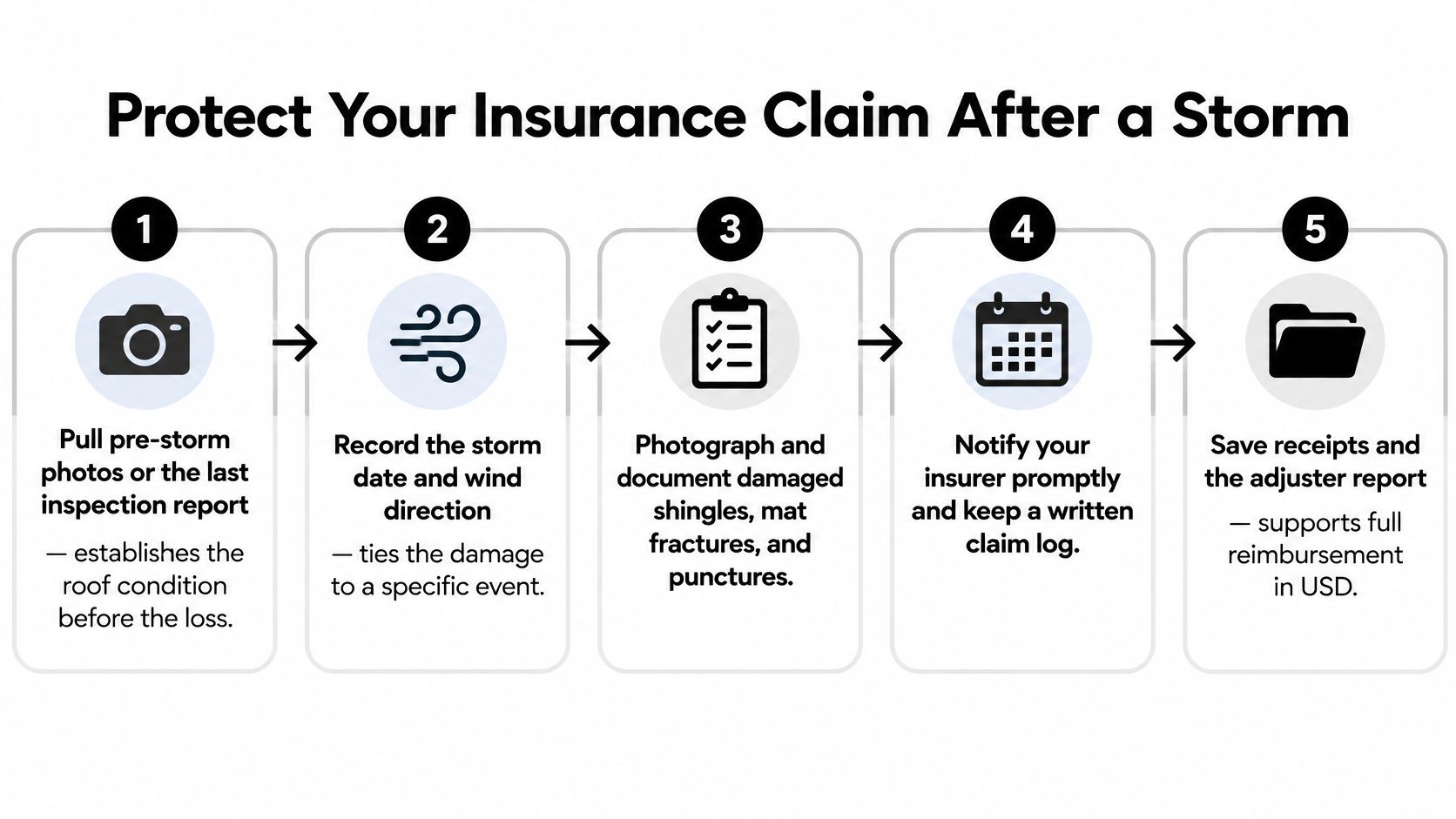
Notice the order: it runs before, during, and after the storm. The "before" evidence is the cheapest to gather and the hardest to reconstruct later, which is why it leads the list. Just as important is what you leave out. A file stuffed with cosmetic scuffs invites the adjuster to sort your evidence for you, so let the functional findings, exposed mat, fractures, punctures, and matching dents on metal, carry the claim.
Repair and replacement costs have climbed in recent years, and insured storm losses have risen along with them. A thin file costs real money at those prices. So does an overbuilt one: separating functional damage from cosmetic marks in writing keeps you from paying for a replacement the storm never caused.
If you're doing your own walkaround before anyone arrives, this guide on how to check your roof after a storm covers the sequence from the ground up. If a contractor is handling the paperwork, ask for that same chronology in writing, with dates, and keep a copy. Our team also handles roof hail damage insurance claims and can walk the roof with your documentation in hand.
A complete claim file holds the pre-storm condition, the dated weather record, scaled photographs of each roof plane, samples of displaced material, dated interior leak photos, mitigation receipts, and the adjuster's written report. Missing any one of those leaves a gap, and someone else will fill that gap for you.
Decide Whether to Book a Professional Inspection
Book the inspection if any of these is true:
- The storm met the threshold of 1 inch hail or 58 mph gusts over your address.
- You can see daylight or water stains from inside the attic.
- You found exposed mat, fractures, or punctures at any point on the roof.
- Gutters, downspouts, or soft metal vents carry matching dents.
- The roof is past mid-life and you're weighing whether to file at all.
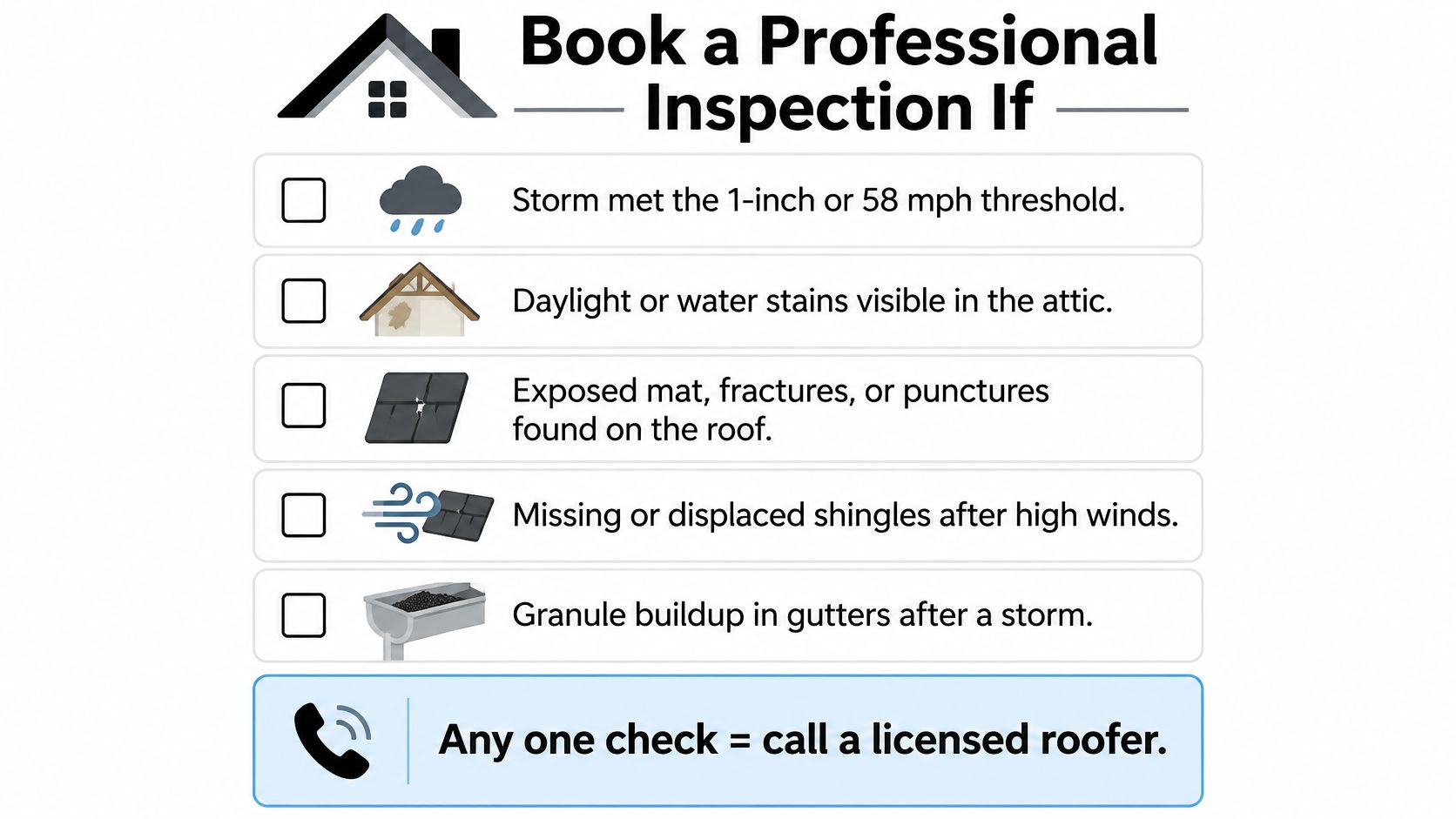
A thorough inspection maps every roof plane separately and records the number and type of functional defects on each one. It checks collateral damage on metal, then separates pre-existing anomalies, meaning scuffs, adhesive spots, blistering, and age-related wear, from anything the storm caused. That separation is the whole job.
Pattern is the strongest evidence. A directional concentration of bruises, consistent impact shape, and matching damage on soft metal components all strengthen the link to a specific storm. Random isolated marks require more caution, which is why a hail impact performance testing protocol evaluates impact location, shingle construction, and damage severity rather than stone diameter alone. Hail resistance is an impact-performance measurement, not a promise that a shingle survives every storm.
The inspector should also answer whether a repair restores the assembly without compromising adjacent shingles. Replacement rests on confirmed loss of function, roof age, material availability, and code or insurance requirements, not on cosmetic granule displacement.
Two actions follow. Schedule the inspection within a week of a qualifying storm, while the evidence is fresh. Call immediately if water is coming through now.
We inspect roofs annually or semiannually so homeowners have a baseline before storm season, our specialists look for the damage and the conditions that lead to expensive repairs later, and we're available 24/7 when a repair can't wait.
Hail season in the Kansas City metro doesn't ask permission, and the difference between a documented claim and an out-of-pocket replacement usually comes down to who looked at the roof and when. Two States Exteriors LLC has served Kansas and Missouri since 1997 as a GAF Certified contractor, handling hail and storm damage, roof repair and replacement, and insurance claims from the first inspection through the final cleanup, with free on-site inspections and no money upfront. Visit Two States Exteriors LLC to book an inspection or get an instant roof quote, and get a straight answer about what your shingles need.