
You're standing in the driveway after a Kansas City storm, looking at granules in the gutter and a tab that doesn't sit flat anymore. A neighbor calls it a composition roof. Your contractor's estimate says asphalt shingles. An insurer asks about age and impact rating. Those terms can sound like three different roofs, and that confusion makes it hard to judge a bid.
If you're asking what is composition shingle roof covering made of, start with the layers, not the label. Once you know what each layer does, you can tell a surface problem from a leak, compare types, and ask the right questions before you sign.
What a Composition Shingle Roof Is and How Its Layers Work
A composition shingle roof is a roof covered in layered asphalt shingles, each made from a reinforcing mat, asphalt, mineral filler, and ceramic-coated surface granules. It's called composition or composite because performance comes from combining several materials, not from one solid substance like a slate tile or a metal panel. No single ingredient does the whole job.
Think of each shingle as a small sandwich built in a factory. The mat in the middle holds the shape. Asphalt makes it water resistant. Granules on top take the sun and rain. If one part of that sandwich fails, the others are exposed faster than they should be.
The Mat at the Center
Modern shingles usually use a fiberglass mat. Older versions used organic felt made from paper or recycled fibers. The mat gives the shingle its dimensional stability, which means it helps the shingle keep its shape and resist tearing when a crew handles it, nails it, and leaves it to expand and contract through hot afternoons and cold nights.
Fiberglass doesn't absorb water the way organic felt can, and it doesn't rot in the same way. That matters at edges and cutouts, where the inside of a shingle is closest to weather. When you see pale fibers showing on a worn roof, you're looking at mat that has lost the asphalt and granules that were supposed to protect it.
Asphalt and Mineral Filler
Asphalt saturates or coats the mat. It waterproofs the shingle and binds the other materials together. Manufacturers mix mineral filler, often limestone or dolomite, into that asphalt to give it body and weight. Without the asphalt coating, the mat alone would be little more than a stiff sheet that water passes through.
The U.S. Environmental Protection Agency technical document on asphalt shingles lists typical shares by weight of 19% to 36% asphalt cement, 8% to 40% mineral stabilizer, 20% to 38% surface granules, and 2% to 15% backing. Those ranges are wide because a thin, simple shingle and a thick, laminated shingle aren't built to the same recipe.
| Layer | Typical share by weight | What it does |
|---|---|---|
| Asphalt cement | 19%-36% | Waterproofs the shingle and binds the other layers together |
| Mineral stabilizer (limestone or dolomite) | 8%-40% | Adds body and weight to the asphalt |
| Surface granules | 20%-38% | Shield the asphalt from UV light and rain and give the roof its color |
| Fiberglass or organic backing | 2%-15% | Reinforces the mat that holds every other material |
The backing looks small in that table, but weight isn't the same as importance. A shingle can be mostly asphalt, filler, and stone by weight and still fail early if the thin mat tears around fasteners or loses its coating. Judging a product by thickness or color alone misses that structure.
Granules on the Exposed Face
Crushed mineral granules form the surface you see from the street. They're often ceramic-coated to produce the color, whether that's weathered wood, charcoal, or a slate tone. Their protective job matters more than the color. Granules shield asphalt from ultraviolet light, rain, and general weathering, slowing the drying and cracking that make asphalt brittle.
That's why loose granules in a gutter deserve attention without panic. A new roof sheds some excess granules early. An older roof that keeps shedding them is losing its sun shield, so the asphalt underneath ages faster. The pattern matters too. Even, light loss across a slope tells a different story than one dark bare patch below a valley.
How Overlapping Courses Shed Water
A composition roof isn't a single waterproof membrane. It's a field of overlapping pieces. Each course, meaning each horizontal row, overlaps the course below it. That vertical overlap is headlap. Shingles in the same row also overlap or butt against their neighbors, and that side relationship is sidelap. Together, they keep water moving down and out instead of sideways or up under an edge.
Picture tiles laid on a steep hill. Rain should run from one exposed surface to the next and off the eave. Wind can push some water under a lifted edge, though, and a nail placed too high or too low can create a path. That's why the layer under the shingles matters. Our guide to what roof underlayment does under the shingle field explains that secondary drainage plane, which catches water that gets past the covering and directs it down before it reaches the deck.
A composition roof sheds water by overlap, not by being one sealed sheet. Break the overlap, the seal, or the flashing, and water finds the break.
The Assembly Around the Shingle
Six parts decide whether that shingle field works as a system:
- Roof deck: The wood surface that must be sound, flat, and dry enough to hold fasteners.
- Underlayment: The secondary drainage plane below the shingles.
- Flashing: Metal at chimneys, walls, skylights, and valleys where planes meet.
- Ventilation: Intake and exhaust that limit attic heat and moisture buildup.
- Fastener placement: Nails in the manufacturer's nailing zone, driven flush, not overdriven.
- Sealant strip: The adhesive that bonds one course to the next after sun warms it.
Granule loss, lifted tabs, and failed flashing are different problems with different remaining life. A roof can have a sound field of shingles and still leak at a vent collar. Another roof can look tired from the street yet stay dry because its flashing and underlayment are intact. Don't let one symptom stand in for the whole assembly.
To check your own roof from the ground, first confirm the covering. Composition shingles show a granular, sandpaper-like surface and visible horizontal courses with cut edges. Metal shows long panels or stamped pieces with a painted finish, and tile shows thick, curved or flat units with deep shadow gaps. Then look at valleys, vent collars, chimney edges, and any place a roof plane meets a wall, because leaks usually start at breaks in the assembly rather than in the middle of an unbroken slope.
Benefits and Drawbacks of Composition Shingle Roofs
Composition shingles dominate pitched residential roofs because they solve the most common homeowner problem at a manageable price. They give you a factory-made, water-shedding covering that most local crews know how to install and repair, in colors that suit brick, siding, and stone. That familiarity matters when you need a repair after a storm and can't wait for a specialty trade.
The benefits are practical, not glamorous:
- Lower upfront cost: Composition shingles cost less to buy and install than metal, tile, or slate, so a full replacement fits more household budgets.
- Light weight: They're relatively lightweight and factory made, and far lighter than tile or slate, so most existing roof structures can carry them without added framing.
- Wide choice: Colors, textures, and profiles can echo wood shake or slate looks, which helps on streets where roof appearance is visible and consistent.
- Repairability: A crew can replace individual damaged shingles, reseal a lifted tab, or repair flashing without tearing off the whole roof.
- Broad fit: They suit most pitched residential roofs, from simple gable shapes to cut-up roofs with dormers, hips, and valleys.
The drawbacks are just as plain. Composition shingles don't last as long as metal or tile, so you'll likely replace them more than once if you stay in the house for decades. Granules wear off over time, asphalt grows brittle, and tabs that once sealed flat can lift in wind. Heat trapped in a poorly ventilated attic speeds that aging from below.
Wind and hail performance is another limit you can't judge by category alone. Two products can both be called composition shingles and carry very different test ratings, warranties, and fastener requirements. A cheap shingle installed with misplaced nails won't perform like a rated shingle installed to its instructions, even if the colors match from the curb.
There's also the tear-off. When a composition roof wears out, the old material has to go somewhere, and that recurring waste is part of the true cost of choosing a shorter-lived covering.
The trade-off in one line: Composition shingles win on cost, choice, and repair access. They lose on longevity. The specific product rating and installation quality matter more than the word composition on the bid.
Types of Composition Shingles and How They Differ
A shingle roof is an assembly, not just a surface product. Start by comparing how each shingle is built, then consider how that choice affects appearance, expected lifespan, installation details, and what happens to the old roof when it is replaced. Lifespans below are typical manufacturer estimates, not a guarantee for a particular home.
| Type | Construction | Typical lifespan | Best fit |
|---|---|---|---|
| 3-tab | Single layer with cutouts | 15-20 years | Budget roofs with simple shapes |
| Architectural (laminated) | Two or more bonded layers | 25-30 years | Most homes built or re-roofed today |
| Impact-resistant Class 4 | Laminated with an impact-tested mat | 25-30 years when built as a laminated model, per the manufacturer's listing for that model | Hail-prone roofs where claims recur |
3-tab shingles are the budget reference point. Each has one layer and regular cutouts that create three visible tabs, giving the finished roof a flat, uniform look. Their simple construction can suit a basic ranch or rental roof where keeping material costs down matters. The thinner profile tends to show age sooner, and the cutouts create more edges exposed to wind and more visible lines where wear can appear.
Architectural shingles, also called laminated or dimensional shingles, bond two or more layers together. Their varied depth and shadow lines create a more textured look, closer to wood shake than a flat sheet. Architectural or laminated shingles are widely used as the default choice on re-roofing bids without a specific product requirement. For a general overview of asphalt shingle manufacturers, see the Thomas Industry overview.
Lamination adds thickness and weight, but it does not make every product or roof perform the same way. Lifespan depends on the manufacturer's installation instructions, including fastener placement, as well as flashing details, attic ventilation, and exposure. A laminated shingle may last longer than a 3-tab shingle when installed according to its instructions. Poor installation can still lead to an early leak at a valley, even while much of the shingle surface looks new.
Impact-resistant Class 4 shingles are usually laminated products with a mat and asphalt formulation tested for impact resistance. Their impact classification describes performance under a test, not protection from every hailstone. It also does not correct weak flashing, low-slope details, or poor ventilation. Choose this type for a roof where impact exposure matters, while judging the full assembly and installation separately.
When comparing products, ask for four details in writing:
- Thickness and construction: Is it a single layer or laminated, and what mat does the manufacturer use?
- Wind rating: What test class applies to that exact product, rather than to a general product category?
- Impact rating: Does the shingle carry a Class 4 listing?
- Warranty length and limits: What does the warranty cover, for how long, and which installation details does it require?
Then match the shingle to the roof's pitch, the neighborhood's appearance, and the home's exposure. Price alone cannot tell you whether a thin, flat shingle suits a steep, visible front slope exposed to prevailing wind. If you expect to sell soon, appearance and remaining warranty may carry more weight. If you plan to stay and have filed hail claims before, product durability and ratings may matter more than a small saving on a thinner option.
Finally, include disposal and local acceptance in the decision. A composition roof eventually needs replacement, and its old shingles must be removed or covered during re-roofing. Ask whether the plan is a complete tear-off or a recovery, and confirm how the removed material will be handled and whether local rules and facilities accept it. Those details affect the work as well as the long-term cost of choosing a roof covering.
Wind and Hail Ratings Kansas Roofs Should Meet
A spring storm can throw straight-line gusts, wind-driven rain, and hail at a Kansas or Missouri roof, and summer heat then bakes the surface that just took that hit. The label on the bundle is a lab score for a tested assembly: shingle, fasteners, starter, and the installation details the lab used. It is not a forecast for your street.
The FEMA guide to asphalt shingle roofing in high wind identifies ASTM D7158 as the uplift-force test method, with Class D associated with 115 mph, Class G with 150 mph, and Class H with 190 mph ultimate wind speeds under specified test conditions, and it recommends either a Class D or better under ASTM D3161 or Class H under ASTM D7158 for reducing wind damage. Treat those speeds as classification benchmarks. A passed test does not promise your roof will ride out a named storm with no loss.
| Rating or test | Ultimate wind speed or test | Where it fits |
|---|---|---|
| ASTM D7158 Class D | 115 mph | Lowest uplift class named in FEMA guidance |
| ASTM D7158 Class G | 150 mph | Mid-range uplift protection |
| ASTM D7158 Class H | 190 mph | FEMA-recommended option for reducing wind damage |
| UL 2218 or ANSI/FM 4473 Class 4 | Standardized impact test | Hail-prone roofs with recurring claims |
Keep the standards apart so a bid cannot blur them. ASTM D3462 is the product standard for fiberglass-mat asphalt shingles. ASTM D3161 and ASTM D7158 address wind resistance and uplift. UL 2218 and ANSI/FM 4473 address impact. A shingle can meet the basic product standard and still carry a modest wind class or no Class 4 impact listing. Wind class and impact class answer different questions, the way a door's lock rating and its fire rating do.
A Class 4 rating means the product resisted damage in a standardized impact test. Hail can still bruise the mat, loosen granules, dent soft metals, or split an aging shingle. If you are comparing hail-resistant shingles for a Kansas City roof, ask whether the rating belongs to the exact model on the bid and whether your insurer recognizes that listing. A wrapper photo from another product line is not proof.
Installation Details Behind the Rating
Ratings assume the crew installs the product the way it was tested. That includes the manufacturer's number and location of fasteners. FEMA states shingles should never receive fewer than four fasteners per strip shingle or two per individual shingle. Nails must land in the nailing zone and sit flush. A nail driven through the shingle, or left crooked, can cut the mat or hold the next course up so the sealant strip never grabs.
The starter strip at the eave deserves the same attention, because the first course anchors the edge wind tries to lift first. Ask the contractor to confirm the starter follows the manufacturer's instructions, and that the crew will not substitute cut shingles in a way those instructions do not allow. Write the wind class, the impact class, the fastener count, and the fastener placement into the contract, not only the brand and color.
Heat is the quieter exposure. High attic temperatures on south and west slopes with poor exhaust can dry sealant strips, so a roof that earned a strong wind class when it was new may not hold that resistance years later. A failed field often leaves the house as a tear-off. Before you buy the higher class, ask how your locality accepts asphalt shingles at end of life, because the rating you skip now can become a dumpster of torn material after one storm season.
Lifespan and the Signs Your Composition Roof Is Failing
A composition roof rarely fails all at once. More often, one slope ages faster, a vent flashing cracks, or a few tabs lose their seal after repeated hail and high wind while the rest of the field still sheds water. Your useful question isn't how old the roof is. It's which part of the assembly is failing, how fast, and whether water has reached the deck or attic.
Age still sets your expectations. As the granule shield thins, asphalt dries, sealant strips weaken, and small defects stop being isolated. Our breakdown of how long a shingle roof lifespan usually lasts can help you place your roof in context, but the signs on your own slopes and in your attic matter more than a birthday. A shaded north slope can look years younger than a baked south slope on the same house.
A close look at the surface, like the inspection shown here, separates loose granules from mat that's already exposed.
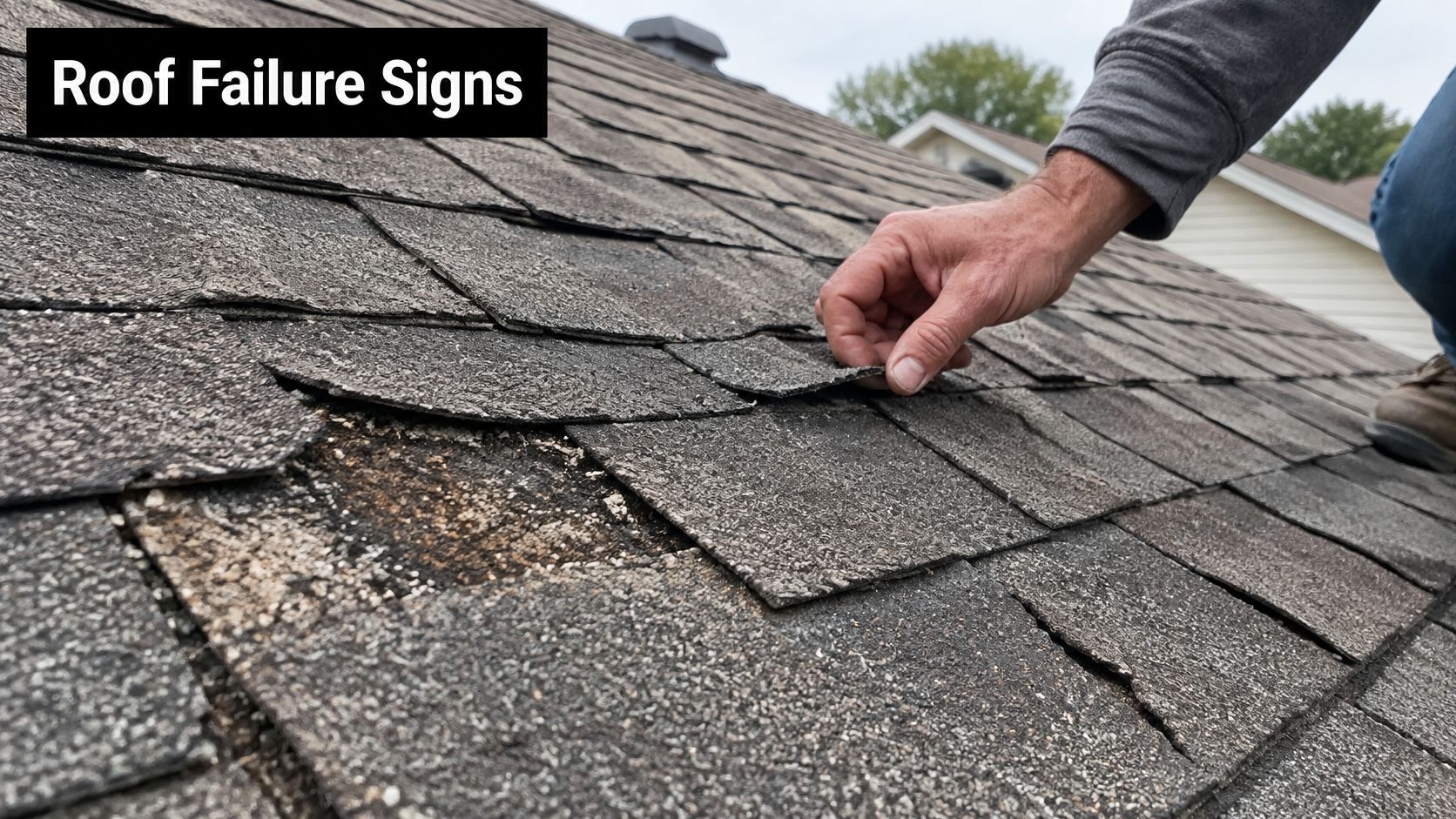
Use this table to match what you see with the likely condition and the next step.
| Sign | What it usually indicates | What to do |
|---|---|---|
| Granules in gutters or downspouts | Surface protection wearing off | Schedule an inspection to judge remaining life |
| Exposed mat or dark bare spots | Granule loss has reached the mat | Plan repair or replacement soon |
| Lifted, curling or cracked tabs | Brittle asphalt or wind uplift | Check fasteners and sealant, then replace damaged shingles |
| Daylight or water stains in the attic | Leak through shingles or flashing | Call for repair before the next storm |
| Worn flashing around vents or chimney | Sealant and metal breakdown | Repair the flashing; the field may still be sound |
Granule loss and an active leak aren't the same emergency. Granules in the gutter shorten remaining life because the asphalt loses protection, but they don't prove water is entering today. A stain that grows after rain, damp insulation, or daylight around a vent pipe points to a specific breakdown that needs prompt repair before the next storm drives more water through the same opening.
One bad sign also doesn't automatically mean full replacement. Say a chimney flashing splits on a roof whose field shingles still lie flat, hold granules, and seal at the edges. Repairing the flashing and surrounding courses can be the honest fix. The opposite case is widespread exposed mat, cracked tabs across several slopes, and fasteners backing out. Chasing individual shingles then becomes money spent on a covering near the end of its useful life.
The short video below is a useful visual refresher on what inspectors look for when they move from the street view to edges, penetrations, and damaged tabs.
Build a simple routine you can do safely from the ground and inside the house. After a storm, walk the perimeter and look for missing tabs, lifted ridges, debris in valleys, and shingle pieces in the yard. Check gutters and downspout outlets for a buildup of granules. After heavy rain, look in the attic with a flashlight for wet decking, stained insulation, and water trails around vents and chimneys.
Don't climb a steep or wet roof to confirm a suspicion. Binoculars from the ground and a flashlight in the attic will tell you enough to decide whether to call.
As a roof ages, a professional inspection once or twice a year gives you a better read on remaining life than a driveway glance. An inspector can test whether tabs still seal, probe soft decking, check nail exposure, and separate a repairable flashing failure from field-wide wear. That distinction decides whether you budget for a targeted repair this season or plan a tear-off before a leak forces the timing.
Confirm Your Shingle Choice and Tear-Off Plan
A replacement decision includes more than the new shingle. It also determines how the existing roof assembly is removed, sorted, and disposed of. Asphalt shingles are widely used, and most removed shingles still end up in landfills. That recurring waste is part of the project, even if it does not appear as a line on a sales brochure.
Recyclable and accepted for recycling locally are different things. Recycled asphalt shingles can be used in hot-mix asphalt, but that does not mean your contractor, hauler, transfer station, or paving plant will accept shingles from your tear-off. Acceptance can depend on the material's condition and the project schedule.
Ask where the tear-off material will go and whether any of it can be diverted from landfill. Roofing felt, wood, metal flashing, nails, and contaminated material may need separate handling. That affects sorting and disposal costs, as well as whether a recycling outlet will take the load. Confirm the destination before tear-off day, when the crew needs a plan for each trailer load.
An on-site inspection should assess the deck, flashing, ventilation, and roof condition, not just the color of the new shingles.
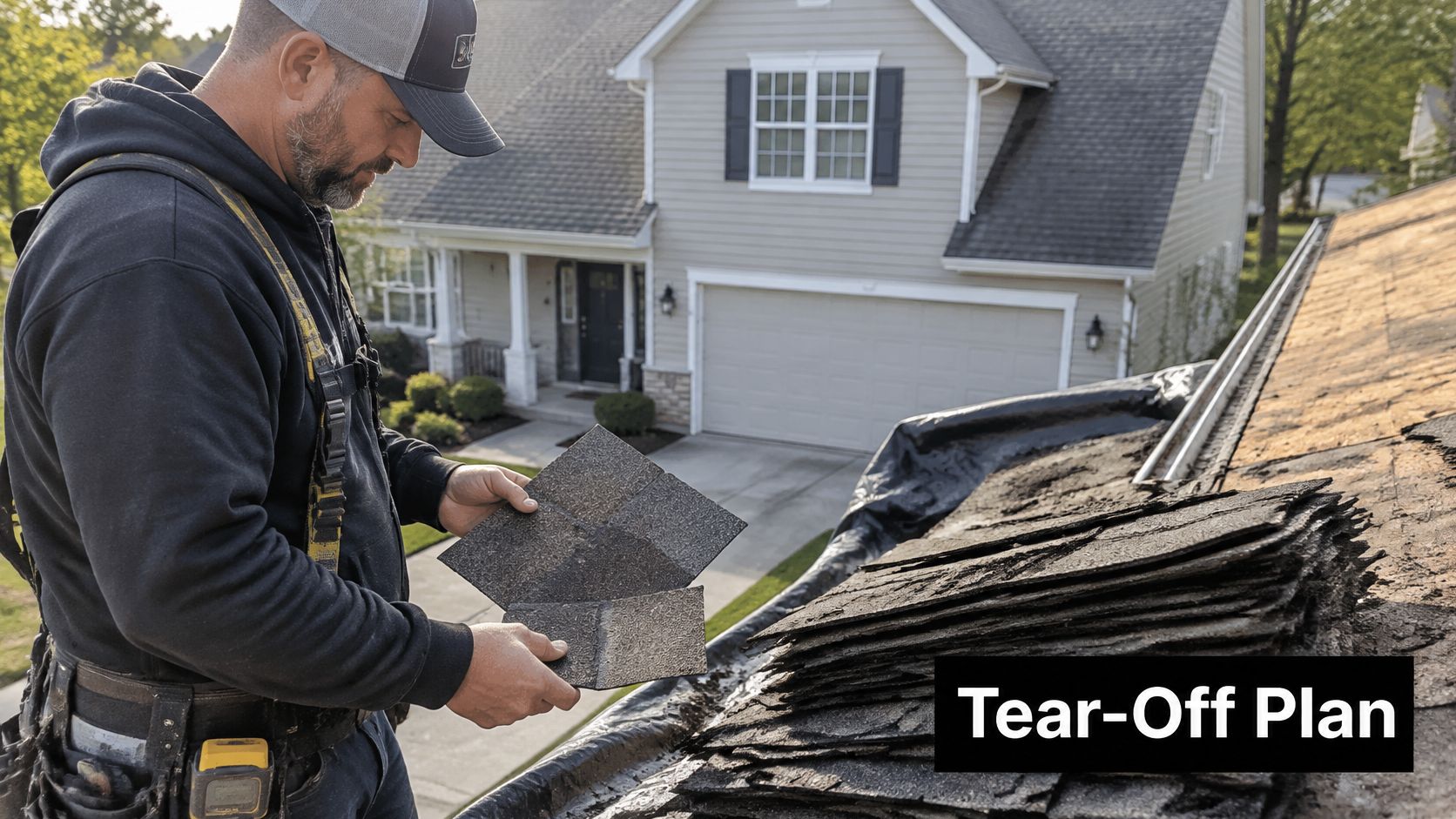
Bring three questions to a contractor meeting:
- Product and rating: Which shingle model, wind rating, and impact rating will you install? Can the contractor show the listing for that exact model?
- Tear-off destination: Where will the old materials go? Will any be diverted from landfill, and who will confirm that the receiving facility accepts them?
- Assembly plan: What fastener count and placement, starter strip, underlayment, and flashing details are included at vents, walls, valleys, and the chimney?
These answers make bids easier to compare than a square price alone. Two States Exteriors LLC performs annual or semiannual roof inspections, is a GAF Certified Contractor, and offers insurance claims services for hail and storm damage. Whether you hire this company or another contractor, ask for an inspection of the full assembly and its condition before approving a repair or replacement.
Get the shingle rating, tear-off destination, and installation details in writing. Compare bids for the same product class and flashing scope. A composition roof can suit many Kansas City homes, provided the chosen shingle, the layers beneath it, and the disposal plan all meet your needs.
If your roof is shedding granules, lifting after storms, or showing attic stains, Two States Exteriors LLC can inspect the assembly, explain repair and replacement options, and assist with hail and storm damage insurance claims. Request an on-site inspection to discuss the shingle, fastening, flashing, and tear-off plan for your home.