
Professionally installed fiber cement typically costs about $5–$14 per square foot, with a 2025 national average of $14,901 and most projects between $6,583 and $23,219. Those figures are a starting point, not a Kansas City price guarantee.
The bigger budgeting mistake is assuming that an installed rate covers everything your house needs. A written line-item scope sets the project price, especially when old siding conceals damaged sheathing or upper walls require scaffolding.
Fiber Cement Siding Cost and Why Labor Sets the Price
For planning, Hammerio's siding replacement guide places professionally installed fiber cement at about $5–$14 per square foot, with labor commonly accounting for 40%–60% of the installed price, or approximately $2–$8 per square foot. At that installed range, a siding area of 1,500 square feet implies $7,500–$21,000, before unusual repairs, premium detailing, or substantial removal costs.
For a national project reference, HomeAdvisor reported a 2025 average of $14,901, with most professionally installed projects ranging from $6,583 to $23,219, including materials and labor. That average doesn't tell you how much trim was included, how accessible the walls were, or whether the installer encountered damaged framing.
A narrower benchmark appears in the American Ceramic Society's fiber cement market discussion: approximately $6–$10 per square foot installed, implying $12,000–$20,000 for 2,000 square feet of siding, before unusual structural repairs or premium architectural details. Its labor comparison puts fiber cement near $4–$6 per square foot, versus $2–$3 for vinyl.
Fiber cement siding cost ranges for planning
The table organizes those published benchmarks. Siding area means exterior wall coverage, not the floor area on a real estate listing.
| Cost item | Low | Typical or high | What it includes |
|---|---|---|---|
| Installed price per sq ft | $5 | $14 | Materials and installation; confirm preparation separately |
| Common planning band per sq ft | $6 | $10 | Base installation before unusual repairs |
| Labor only per sq ft | $2 | $8 | Commonly 40%–60% of the job; narrower estimates run $4–$6 |
| HomeAdvisor project, 2025 | $6,583 | $23,219 | Most projects; reported average $14,901 |
| 1,500 sq ft of siding | $7,500 | $21,000 | Wide installed range before premium details |
| 2,000 sq ft of siding | $12,000 | $20,000 | Common band before structural repairs |
These ranges aren't competing promises. They describe estimates built with different assumptions about labor, preparation, products, and project size. A low national benchmark isn't evidence that a detailed local proposal is overpriced.
Why installation takes more than hanging boards
Think of vinyl as lightweight panels and fiber cement as heavy, rigid planks. An installer can move and position vinyl differently. Fiber cement requires deliberate handling, supported cutting, careful placement, and a fastening pattern that suits the product and wall.
The crew also has to manage the wall as a system. Flashing directs water away from openings. The weather-resistive barrier protects the sheathing behind the siding. Trim creates finished transitions around windows, doors, and corners.
Cutting deserves attention, too. Installers need equipment intended for fiber cement and a dust-control plan, not a general-purpose saw blade. Clean cuts, appropriate fasteners, and correct clearances help avoid chipped edges, cracked boards, and moisture problems.
Practical rule: A material quote tells you what the boards cost. An installation proposal should explain what the crew will do to make the wall ready for them.
Why equal wall areas produce unequal bids
Consider a rectangular ranch with open access beside each wall. Compare it with a house that has narrow side yards, porch roofs, recessed entries, and windows grouped under gables. Even with equal siding coverage, the installer faces different handling, cutting, and access requirements.
Finish selection changes the work sequence. Factory-finished boards arrive with their main coating applied, but the scope still needs to address cut edges, touch-ups, and trim. Primed boards require field painting, including preparation, application, and weather-dependent scheduling.
For homeowners considering our fiber cement siding installation, the useful comparison isn't just the product name. It's the complete assembly and the work included around it.
A useful proposal identifies:
- Measured area: The wall coverage and how openings are treated.
- Material quantity: The selected profile, trim, and waste allowance.
- Preparation: Removal, disposal, and the process for approving concealed repairs.
- Water management: Weather-resistive barrier, flashing, and transitions.
- Completion: Labor, finish work, cleanup, and applicable permit charges.
Don't assume an installed rate includes every item. Have the contractor identify exclusions before you compare totals.
Add-Ons That Change the Bid
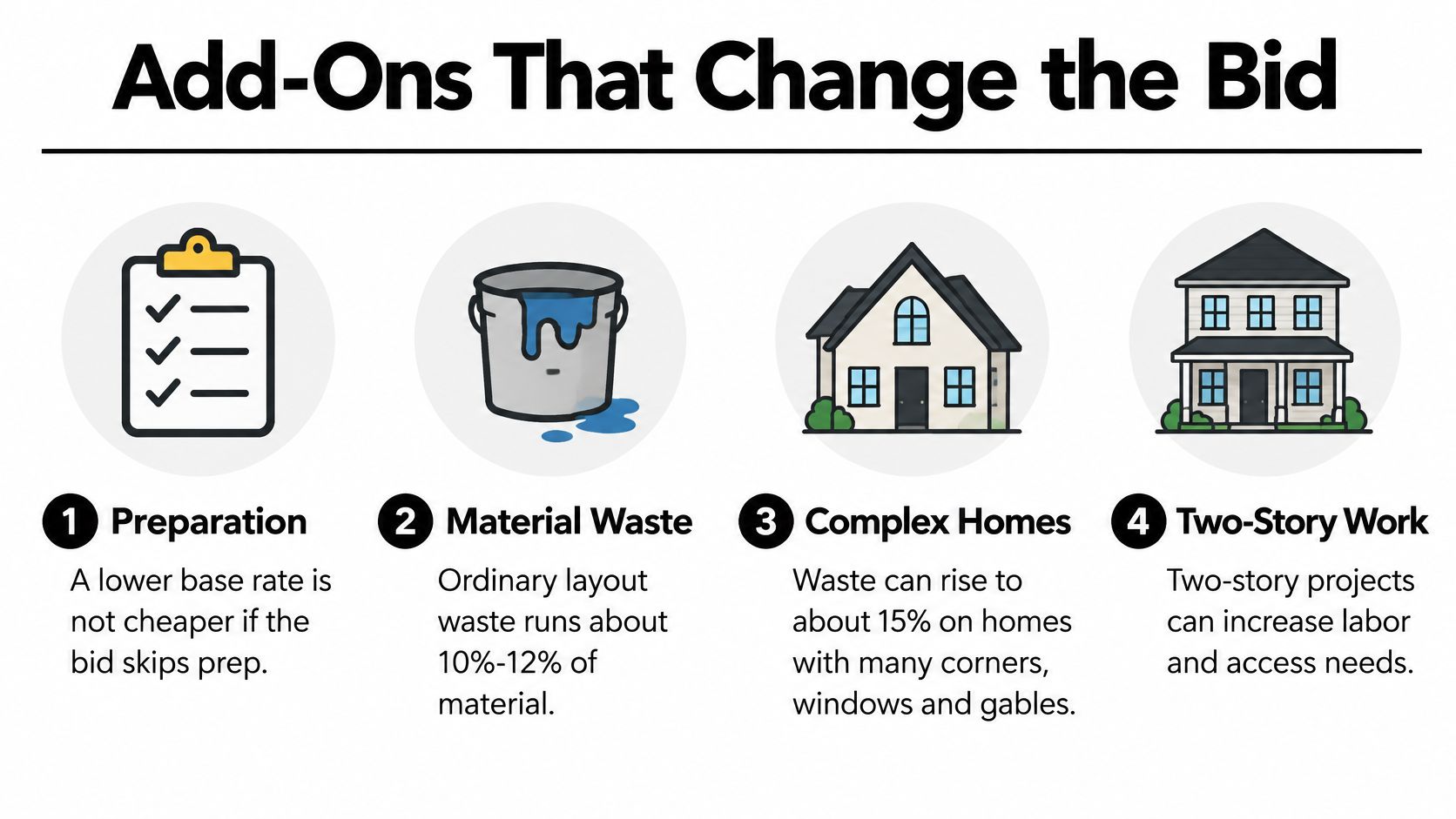
A lower base rate isn't cheaper if the bid skips preparation. The most important question is whether the proposal prices a finished, weather-protected exterior or just the boards and basic installation.
According to EZ Estimates' siding estimating guidance, ordinary material waste runs around 10%–12%, rising to about 15% on complex homes with numerous corners, windows, and gables. The same guidance estimates that two-story work can add roughly 20%–30% to labor when scaffolding and additional painting access are needed.
Material quantity isn't the same as wall coverage
Installers can't reuse every offcut. Window spacing, gable angles, and the chosen siding exposure affect how efficiently boards fit the layout. Ask whether the estimate already includes waste before adding another allowance yourself.
Height is a separate issue. An access charge applies to the work required above ground level, not automatically to the entire material bill. A contractor should explain whether scaffolding, setup, relocation, and painting access are included.
Use this checklist to identify common additions before comparing proposals.
Preparation can matter more than the board price
The less visible work deserves its own description:
- Tear-off and disposal: Identify which existing layers will be removed and who handles debris.
- Sheathing repairs: Establish how soft or deteriorated wall backing will be documented and priced.
- House wrap and flashing: Specify whether existing materials will be repaired or replaced and how window transitions will be integrated.
- Insulation board: Treat a thermal upgrade as a defined assembly change, including its effect on trim depth and fastening.
- Finish details: Name the trim material, caulking locations, paint responsibility, and treatment of penetrations.
For a hypothetical project, multiplying measured wall area by an installed rate gives a base calculation. It doesn't establish the cost of concealed rot, elaborate window trim, or difficult access. Don't add waste to the entire installed total unless the contractor explicitly prices it that way.
A repair allowance is money reserved for uncertain work. It isn't permission to perform unspecified work without your approval.
Older additions can create awkward junctions where rooflines, wall planes, and trim depths meet. Tight lots can limit staging space. After a storm, crew availability can also affect scheduling and bids, so ask how long the proposal remains valid rather than assuming today's price is open-ended.
Sample Budgets for Three Home Sizes
Budget from siding area, not living area. A sprawling ranch can have substantial exterior wall coverage, while a compact taller house can arrange its floor area within a smaller footprint. Gables and additions complicate the comparison further.
The examples below are hypothetical budgeting exercises, not published Kansas City averages or contractor quotations. Their base arithmetic uses the common installed planning band already established; additional work must be measured and priced rather than guessed.
Sample fiber cement budgets by home size
| Home example | Siding area | Planning pocket |
|---|---|---|
| Small one-story, simple corners | Hypothetical 1,200 sq ft | Calculated base of $7,200–$12,000; add separately priced preparation and trim |
| Medium, one and a half stories, several window banks | Hypothetical 1,800 sq ft | Calculated base of $10,800–$18,000; add access, detailing, and approved repairs |
| Large two-story with gables and older addition | Hypothetical 2,400 sq ft | Calculated base of $14,400–$24,000; could reach the mid-$20,000s or higher if separately quoted additions stack up |
A simple house keeps the estimate easier to define
For the small one-story example, accessible walls and uncomplicated corners make measuring and staging more straightforward. The key uncertainty may be what appears behind the old siding rather than the new installation itself.
A modest trim design can help control scope. Before accepting the number, ask: What measured area, waste allowance, and repair provision are included?
Windows and height change the middle example
The medium house has more transitions to complete around grouped windows. A porch roof or sloping yard may also affect how installers reach the upper walls, even when the house isn't a full-height two-story design.
A factory-finished option and a primed-and-painted option should be compared as completed jobs. Ask: Does this total include the access equipment and all finish work around those windows?
The larger house needs a repair process
For the large example, the older addition deserves close inspection at its connection to the original house. An installer may need to reconcile different wall depths, previous repairs, or flashing arrangements.
Don't turn that uncertainty into an invented all-in allowance. Ask the contractor to describe what can be inspected before demolition, what remains concealed, and how any change order will be approved.
The question here is: Which parts of this price are fixed, and which require authorization after removal? That answer is more useful than a rounded budget that appears precise but leaves the repair process undefined.
Kansas City Prices and Hail Claims
A nearby Midwest market can help screen a budget, but it can't price a Kansas City house. Angi reported that fiber cement installation in Columbus, Ohio, averaged $15,392 in 2025, with most homeowners paying $7,080–$25,782.
Kansas City proposals still need to account for local labor, applicable permits, wall condition, and access. An older addition or difficult elevation is a property-specific cost, not a flat city surcharge.
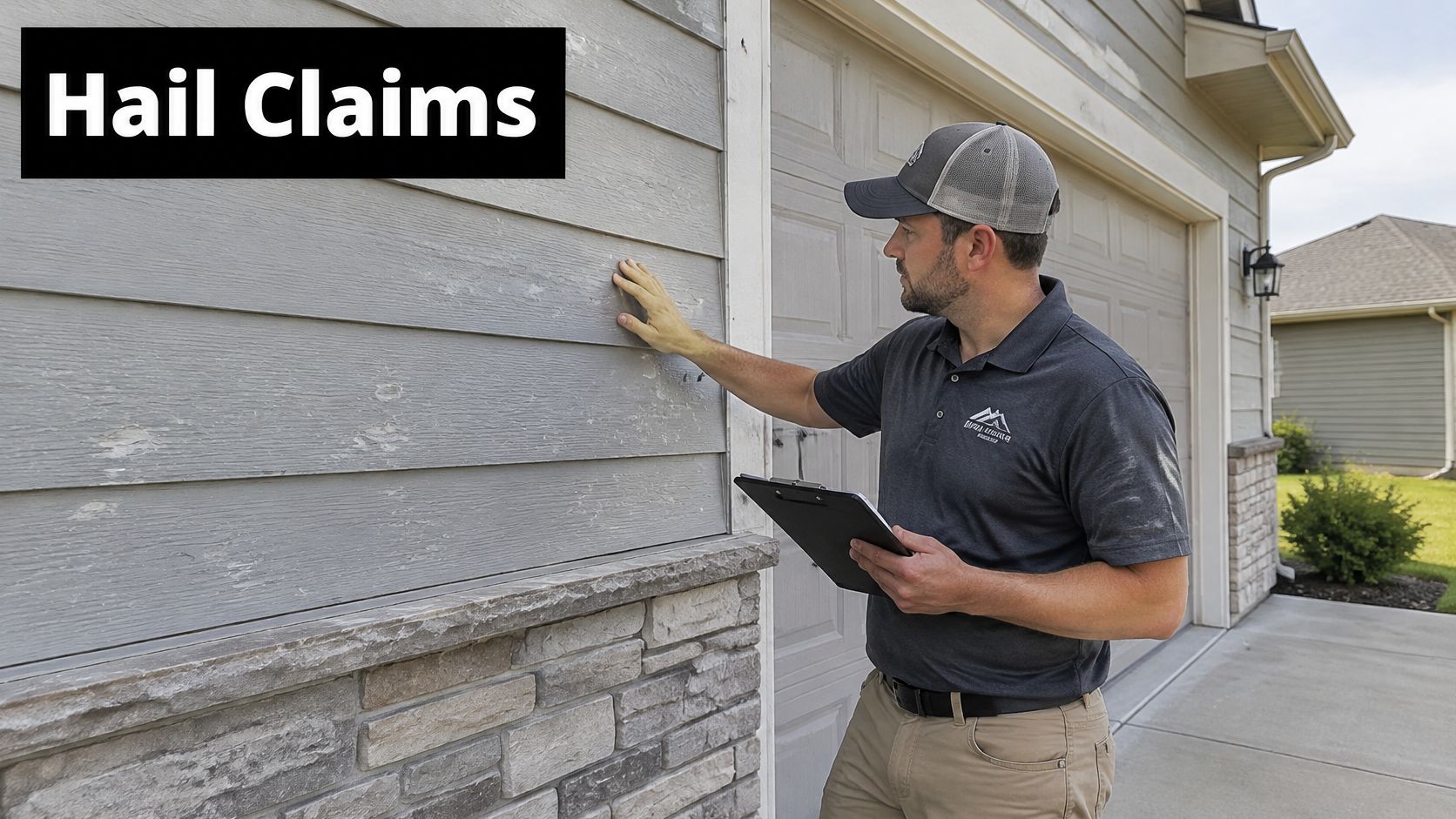
An inspection should distinguish surface marks from damaged boards and identify the affected wall sections.
Keep storm repair separate from remodeling
Hail can chip or crack fiber cement and affect roofing, gutters, and trim during the same event. That doesn't mean an insurer will authorize a complete siding replacement. Coverage, exclusions, deductibles, matching provisions, and the insurer's assessment all matter.
Our explanation of siding damage from hail can help homeowners understand what to document. Don't climb onto roofs or unstable ladders to collect evidence.
Follow a clear documentation process:
- Photograph the damage: Take dated close-ups and wider views that identify the affected elevation.
- Preserve evidence safely: Keep loose damaged pieces when practical until the adjuster has reviewed them.
- Separate repairs from upgrades: Request distinct pricing for storm restoration and optional changes such as insulation or decorative trim.
- Address matching: Identify the board profile, texture, exposure, and finish before assuming replacement pieces will blend.
This video offers additional visual context for the exterior review.
Require quantities before accepting a settlement scope
A repair estimate should identify damaged locations and measured quantities, rather than describe siding damage in general terms. Discontinued textures or unavailable profiles can complicate repairs, so obtain a written sourcing plan.
At Two States Exteriors LLC, we offer roofing, hail damage repair, siding, gutters, decks, interior and exterior painting, and emergency commercial and residential projects. We also offer roof insurance claims services for hail and storm damage.
Those services don't determine what an insurer pays. Keep the insurer's coverage decision separate from the contractor's construction scope, and request clarification whenever their descriptions don't match.
Fiber Cement Compared With Other Siding
Choose siding by balancing installation demands, appearance, repairability, and maintenance, not by declaring a universal winner. A product that suits a long-term owner may not fit a homeowner trying to complete a limited exterior repair.
Fiber cement versus other common siding
| Siding | Installed cost signal | Labor feel | Maintenance role |
|---|---|---|---|
| Fiber cement | Price the complete board, trim, and finish package | Heavy boards require deliberate handling and fastening | Maintain coatings, joints, and damaged areas |
| Vinyl | Request an installed package for the selected profile | Lightweight panels are quicker to handle | Clean surfaces; damaged panels may require replacement |
| Wood | Species, grade, profile, and finish set the quote | Skilled cutting and finishing | Plan for paint or stain upkeep |
| Engineered wood | Price the specific product and required accessories | Handling differs from cement-based boards | Protect cut edges and maintain moisture details |
A precise national installed range for every alternative isn't necessary to make a useful comparison. Comparable local scopes are more informative than unrelated headline prices.
Choose according to the compromise you can accept
Vinyl suits a cost-focused project when you like the available profiles and accept how panel repairs and color matching work. Ask to see the proposed corner posts, window treatments, and transitions, not just a flat siding sample.
Fiber cement suits an owner who wants a rigid, paintable exterior and can accommodate its installation requirements. Its resistance to rot and insects doesn't make the wall behind it waterproof, and the coating still needs attention.
Wood offers authentic grain and traditional detailing. That choice works best when the owner wants the material enough to maintain the finish, especially at exposed edges and weather-facing walls.
Engineered wood deserves a product-specific review rather than a blanket price ranking. Examine the installation instructions for cut-edge treatment, clearance, fastening, and water management.
Choose the material whose maintenance you're willing to perform, not the one described as needing none.
Before deciding, compare physical samples outdoors. Look at texture in direct sunlight and shade, then review a corner and window detail. The installed appearance depends on those transitions as much as the main wall surface.
For repair-focused work, also ask how an individual damaged piece would be removed without disturbing surrounding materials. That practical question can reveal a trade-off a showroom sample can't show.
Lifetime Cost, Financing and Resale Value
Lifetime cost is a schedule of expenses, not a promise of savings. Start with the completed installation, then consider cleaning, coating work, localized repairs, and borrowing costs.
Don't assume factory-finished siding eliminates future painting. Don't assume a lower initial material price produces a lower completed project cost, either.
Compare complete ownership paths
A useful ownership comparison describes what you'll pay for and when you might need it:
- Factory-finished path: Include installation, touch-up materials, routine washing, inspections, and an eventual coating assessment.
- Primed-board path: Include field painting in the initial contract, then evaluate later coating maintenance based on condition.
- Storm-repair path: Consider replacement-board availability, access costs, and the possibility that a localized repair needs broader finish work to blend.
Use the same assumptions when comparing materials. If one proposal includes painting and another excludes it, they aren't comparable even if their installed siding rates look similar.
For distant expenses, distinguish today's estimated service price from the amount you may pay later. Inflation and the timing of work can change the result, so avoid presenting a rough ownership worksheet as a guaranteed financial return.
Finance the defined project
Compare a home-equity option and a contractor payment plan using total repayment, interest, fees, and early-payoff terms. A smaller monthly payment can still mean a more expensive loan.
Keep discretionary upgrades separate from urgent repairs. That lets you decide whether decorative trim or a color change justifies additional borrowing without confusing those choices with restoring damaged siding.
Resale value also requires local judgment. A home's existing condition, neighborhood expectations, workmanship, and appearance affect how buyers respond; a national return figure can't settle that question.
Our discussion of whether new siding increases home value offers context for that decision. Before committing primarily for resale, ask a local real estate agent whether replacement is likely to solve a buyer objection or just replace an exterior buyers already find acceptable.
Hire With a Written Line-Item Scope
Hire when the scope is clear. Wait when major exclusions remain unresolved. A verbal assurance that everything is included won't help much when demolition reveals a problem.
The maintenance discussion belongs in that decision, too. An AOL comparison of vinyl and fiber cement notes that factory finishes may need touch-up or refinishing after roughly 15 years in demanding conditions. Treat that as a planning consideration, not a guaranteed service interval or proof that one material always costs less over time.
Check the proposal before signing
- Get an on-site measure: Use actual wall dimensions rather than a phone estimate based on living area.
- Require defined work: Look for quantities, preparation, water-management details, trim, finish, and permit responsibilities.
- Verify credentials: Check applicable licensing, insurance, and references yourself.
- Identify responsibility: Confirm who installs the siding, completes painting, and authorizes concealed repairs.
- Compare complete totals: Resolve exclusions before choosing the lowest price.
Marketing can help you find contractors, but it can't verify their workmanship. Homeowners curious about how remodelers attract inquiries can review contractor lead strategies from ThroughTheGrapevine.ai; use marketing visibility to build a shortlist, not as a substitute for checking proposals and references.
Make the next step measurable
Two States Exteriors LLC offers siding installation in Holton, KS, and Kansas City, KS, and we provide free estimates requested through our website form or by calling. We're one local option for beginning the estimating process; apply the same checks to every contractor you consider.
Ask for a written proposal you can compare side by side. If a bid can't explain removal, waste, and the repair-approval process, it isn't ready for your signature.
Two States Exteriors LLC offers siding installation and free estimates to help you move from a general fiber cement siding cost range to a project-specific proposal. Visit Two States Exteriors LLC to request an estimate through the website form or call to discuss your siding project, including existing damage, finish preferences, and the work you want itemized.