You walk outside after a Kansas City hailstorm and find dimples in the gutters, spatter marks on the siding, and leaves scattered across the driveway. Your metal roof still looks mostly straight from the yard. Inside, the ceiling's dry. That's reassuring, but it doesn't tell you whether the storm changed the roof's long-term condition.
After a Hailstorm on a Metal Roof
The morning after a Midwest storm, the obvious damage gets your attention first. You notice the downspout beside the garage or the fresh marks on the air-conditioning cabinet. The roof is harder to judge because you're looking up at a large surface from a poor angle.
A panel can look smooth from the driveway and show indentations when viewed from another direction. You also can't judge a seam, a fastener connection, or a small break in the protective finish from across the yard. A ground-level view is a starting point, not a roof assessment.
A watertight roof can still be a damaged roof.
Why a dry ceiling isn't the whole answer
Hail isn't an unusual reason to evaluate a roof. NOAA's hail guidance reports more than $1 billion in annual damage to crops and property, with damaging hail occurring somewhere in the United States on an average of 158 days each year.
That national context doesn't prove anything about your particular house. It explains why a noticeable storm deserves a deliberate response rather than a quick glance followed by an assumption that everything's fine.
The opposite assumption is just as unhelpful. A dented gutter doesn't prove your roof needs replacement, and a neighbor's roofing project doesn't establish the condition of your panels. Your roof needs its own evidence.
Start with the right questions
You don't need to decide whether to file a claim while you're still picking branches out of the yard. Start by separating what you know from what needs a closer look.
- What happened at the property? Establish the storm's timing and preserve evidence before another weather event complicates the picture.
- What changed on the roof? Look for a professional explanation of appearance changes versus damage to protection or connections.
- What response fits the evidence? Monitoring, localized work, and replacement solve different problems. They shouldn't be interchangeable recommendations.
The practical goal is to avoid both expensive overreaction and delayed maintenance. You want to know which marks can wait, which conditions need a contractor's attention, and what records to keep before a claim deadline or another storm.
For a homeowner, that means getting a clear answer without being pushed toward a tear-off. For a property manager, it means knowing whether the building remains protected and whether a repair can preserve a useful roof asset.
A sound assessment starts with how the hail struck, continues with dated documentation, and ends with a written explanation of the work needed. The insurance conversation is easier when those questions already have concrete answers.
How Hail Damages Metal Roofing
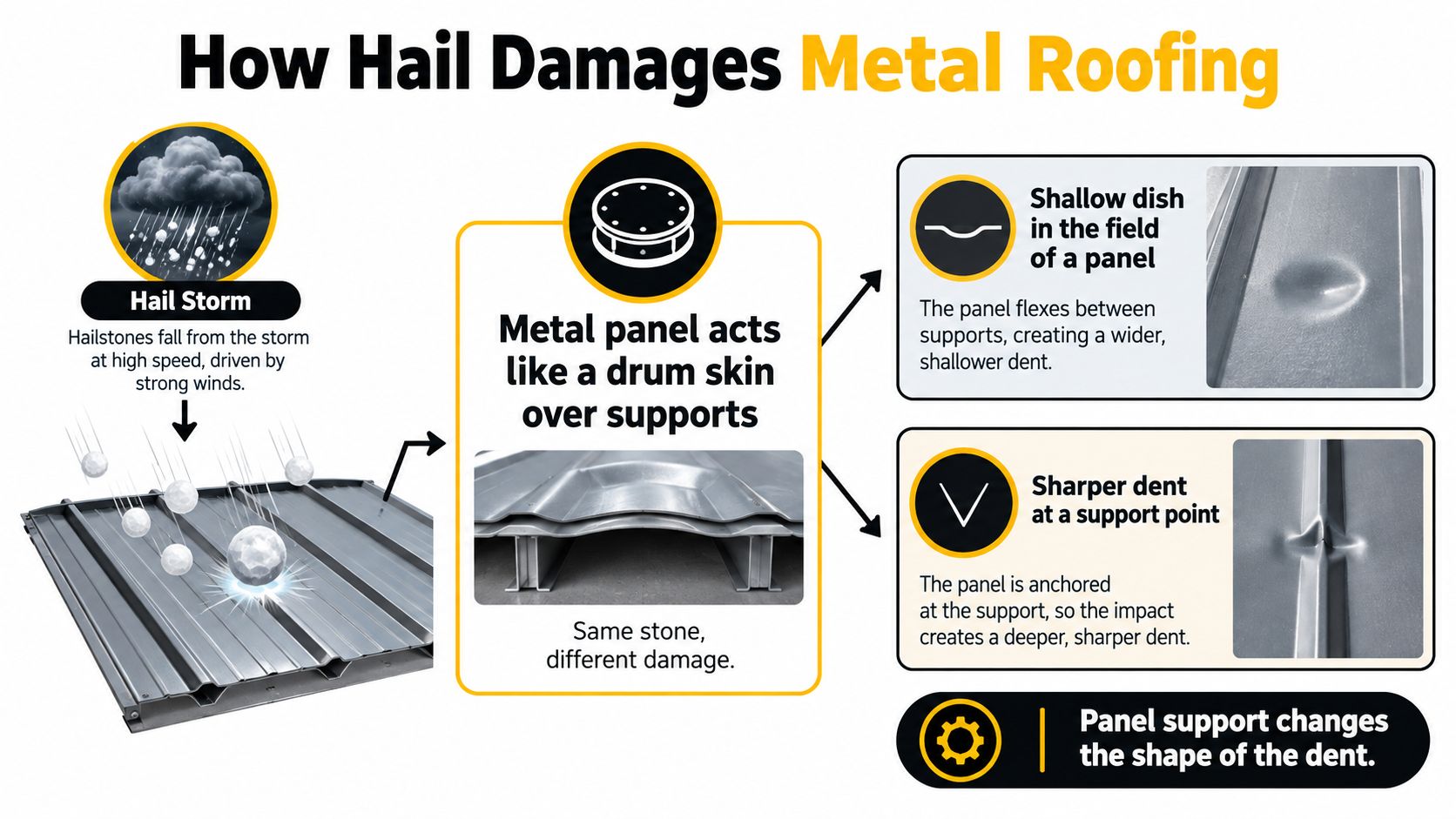
Think of a metal panel as a drum skin stretched over supports. The sheet can flex differently between supports than it can beside a seam, clip, or fastener. The same hailstone can therefore leave a shallow dish in an open panel area and a sharper crease where the metal has less room to move.
That analogy isn't a damage calculation. It explains why dent location matters alongside dent size and why neighboring panels don't always show identical marks.
The illustration below shows how support conditions change the shape of an impact.
A dent and a failed protective finish are different problems
A visible indentation doesn't automatically mean water can enter. IBHS guidance for low-slope metal roofs explains that small dents generally don't impair weatherability when the panel's protective paint remains intact. The concern changes when an impact cracks, chips, or flakes the coating and exposes metal to corrosion.
Think of the finish as protection, not decoration. A depression with a continuous protective surface is different from a crease with a split through that surface, even if both are about equally noticeable from the yard.
That distinction also prevents an unsupported leap in the other direction. You shouldn't assume every dent contains an invisible coating failure. A contractor needs evidence of the condition, not a blanket statement that all hail marks shorten roof life.
- Cosmetic change means the impact altered appearance without demonstrated loss of the roof's protective function.
- Coating damage means the finish no longer provides continuous protection at the affected location.
- Connection damage means the impact disturbed a component that helps hold the system together or manage water.
Trouble doesn't always look like a hole
Metal roofs rely on more than uninterrupted sheets. Side laps, end laps, concealed clips, exposed fasteners, and flashing all contribute to performance. A panel may remain unpunctured while damage beside a connection creates a separate problem.
For example, a shallow depression in the middle of a panel isn't equivalent to a deformation that pulls a lap out of position. Likewise, bent flashing around a penetration deserves attention even if the surrounding field panels look relatively clean.
IBHS's guidance calls for evaluating the roof system's design limits and missing or displaced components when considering repairs. That's why a useful assessment describes what happened to the assembly rather than just labeling the roof "dented."
The working distinction is straightforward: a mark is cosmetic only when the protective finish, connections, and water-shedding function remain serviceable. Appearance alone can't establish that conclusion, but appearance alone can't disprove it either.
How to Inspect and Document Hail Damage
Start with the storm record, not a ladder. A homeowner's photo set is most useful when it helps answer whether hail reached the property, which direction it came from, and whether the marks could belong to an earlier event.
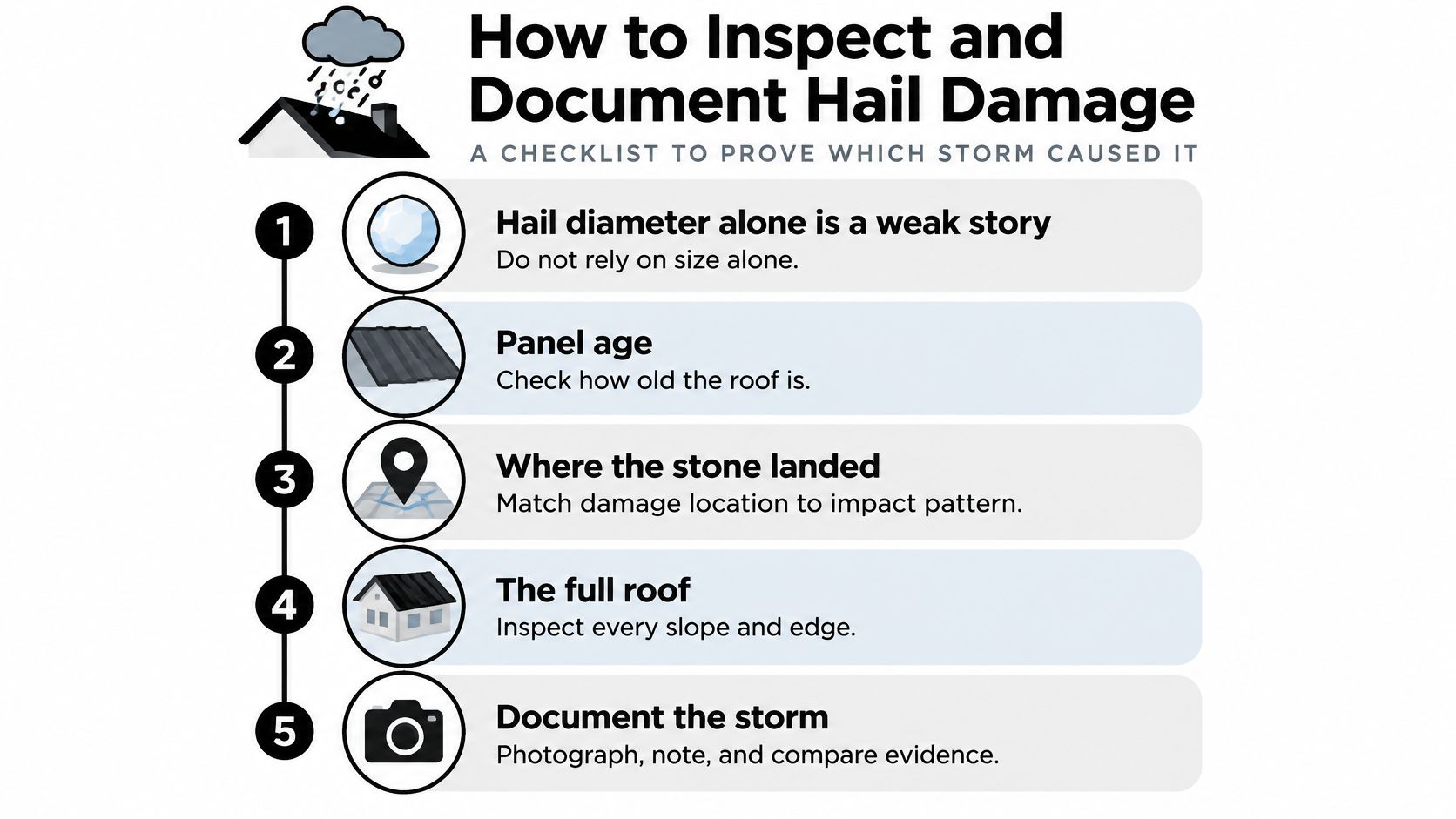
Hail diameter alone is a weak explanation of the result. Panel condition, impact location, supports, and previous hits all affect how you should interpret what you see.
Use this checklist to organize the evidence before arranging a close inspection.
Establish when the damage could have happened
Record the storm's date and approximate time while it's fresh in your memory. Save available weather reports, messages, and existing property photographs. Keep the original image files rather than relying only on cropped screenshots.
Repeated impacts deserve particular care. A finite-element study of metal-panel hail impacts found plastic deformation above 3-inch hail, and subsequent same-size impacts could increase damage extent by as much as 20%. Those are findings under the study's conditions, not a universal safe-size threshold for installed roofs.
The practical lesson is to avoid attributing an entire dent field to the latest storm without comparison evidence. The research also doesn't establish that every smaller follow-up storm enlarges old dents.
Work from accessible areas:
- Capture the property context. Take broad photographs showing the building and affected elevations before moving into detail shots.
- Record nearby impact evidence. Photograph gutters, siding, fencing, and exposed equipment, including spatter patterns and dents.
- Compare exposure. Where visible safely, compare sheltered porch or eave areas with exposed slopes and record the direction each faces.
- Preserve earlier views. Listing photographs, maintenance records, and prior inspection images may help establish what was already present.
Clusters on a particular exposure, matching impacts on nearby soft metal, and apparently fresh coating breaks can support a storm assessment. They aren't a reliable calendar by themselves. A qualified inspector should consider those clues together.
Let a qualified person handle close inspection
Don't walk a steep or wet metal roof to improve your photo set. Ask the inspector to connect overview photographs with close-ups so you can tell where each condition sits on the building.
The written record should identify panel deformation, seam and clip condition, fastener engagement, coating breaks, penetrations, and interior moisture evidence. If concealed components can't be evaluated without further work, the report should say so rather than implying they were inspected.
For visual orientation, these hail-damaged roof pictures can help you understand what contractors document. Photographs of other buildings aren't proof of what happened to yours.
The video below provides another visual reference to accompany your records.
A useful handoff isn't a folder full of unexplained close-ups. It's a dated set of images tied to named slopes, locations, and observations, with uncertainty clearly identified.
When Metal Roof Hail Damage Needs Repair
What exact evidence makes a dent worth watching, locally repairable, or replacement-worthy? That's the question a contractor's recommendation should answer.
A documented engineering investigation of hail-dented metal roofing found that dents hadn't exposed the underlying steel or measurably reduced panel service life where the coating remained uncompromised. That finding supports careful evaluation, not an assumption that every dented roof is fine.
Repair, Monitor, or Replace
| What you see | Coating and connections | Practical next action |
|---|---|---|
| Scattered shallow dents without openings | Protective finish remains continuous, seams stay tight, and drainage remains serviceable | Document the condition and establish professional monitoring rather than assuming replacement is necessary |
| Localized finish fractures or deformation around laps, clips, or fasteners | A limited area needs restored protection or corrected connections | Obtain a defined scope for compatible coating work, connection correction, or panel repair or replacement |
| Punctures, open seams, displaced flashing, wet decking, or widespread finish loss | The assembly has broader functional problems or cannot be restored reliably with isolated work | Evaluate affected-slope replacement or full replacement based on the extent and system condition |
When keeping the roof makes sense
Suppose the report describes scattered shallow dishes, intact finish, and undisturbed connections. There's no demonstrated functional reason to remove the whole roof just because the sunlight makes those dishes visible.
Monitoring should still have a purpose. Ask the contractor to establish a condition record and identify what would justify another visit. If an isolated finish defect needs touch-up, that treatment should be compatible with the roof system, not an improvised coat of paint over an unexplained problem.
Practical rule: Ask what the proposed work restores, not just how much dented metal it removes.
Residential owners may still care about appearance, especially on a prominent front slope. That's a legitimate preference, but it's different from saying the roof no longer protects the house. A commercial owner may place greater weight on preserving a still-performing assembly.
When localized work or replacement is justified
A concentrated problem calls for a concentrated explanation. If a damaged lap can be corrected or an affected panel replaced without compromising adjacent work, a targeted scope may address the actual failure.
The contractor should explain access, compatibility, and whether nearby components must be disturbed. “Repairable” should mean the proposed work can restore a dependable assembly, not merely conceal the visible mark.
Broader damage changes that trade-off. Where multiple areas have failed, the substrate is wet, or an older roof has widespread finish loss, repeated spot repairs may not address the underlying condition. Replacement of a slope or the entire system deserves consideration when the contractor can explain why narrower work won't reliably restore protection.
Age alone isn't a replacement verdict. Dent count alone isn't one either. The recommendation should connect observed conditions to the limits of a workable repair.
Insurance Claims for Hail Damage Metal Roofs
The claim file needs to distinguish what changed in appearance from what changed in performance. Those categories may receive different treatment under the policy, particularly when a cosmetic-damage endorsement applies.
Don't assume all metal-roof policies use the same wording. Ask your carrier or agent to identify the provisions that apply to your roof and explain how they treat dents, coating failure, and damage to connections. A contractor can describe physical conditions, but coverage needs a policy-specific answer.
Build a file someone else can follow
Organize the evidence so an adjuster doesn't have to guess which photograph belongs to which slope. A labeled overview should lead to the detail photograph and the inspector's written observation.
Keep these records together:
- Before-and-after evidence. Preserve pre-storm photographs when available, along with dated post-storm images and weather records.
- A slope-by-slope map. Identify the location of dented areas and distinguish them from documented finish or connection problems.
- Component observations. Include notes and photographs for seams, flashing, fasteners, skylights, vents, and related exterior damage.
- Inspection conclusions. Request an explanation of what remains serviceable, what is exposed or corroding, and what has moved or opened.
- Work records. Keep temporary-protection documentation separate from the proposed permanent restoration scope.
A dent count alone doesn't explain why work is necessary. A statement such as “deformed flashing at the penetration” is more useful when it's tied to a location, clear photograph, and explanation of the affected function.
For help preparing that handoff, use this guide to a roof hail-damage insurance claim alongside your own policy documents. Treat general guidance as preparation, not a promise of payment.
Preserve evidence without leaving the building exposed
Report the loss promptly and ask about applicable notice requirements. If the roof needs emergency protection, don't leave the interior exposed just to preserve an untouched damage scene. Have the condition documented as safely and thoroughly as circumstances allow.
Before permanent work conceals or removes evidence, coordinate with the adjuster or ensure the contractor has adequately documented it. Keep the temporary dry-in description distinct from the final scope so everyone can see what addressed the immediate problem and what remains proposed.
Scope discussions should also address practical restoration questions. Ask whether matching panels are available, whether a color has been discontinued, and how damaged gutters or accessories will be handled. These questions can affect the proposed work, but they don't automatically establish that an entire roof is covered for replacement.
For the adjuster conversation: Ask which documented conditions are being treated as cosmetic, which are being evaluated as functional damage, and which policy provisions support that distinction.
If an assessment differs from your contractor's report, ask for the specific disagreement in writing. A focused discussion about a coating break or displaced connection is more productive than arguing that every visible dent must be paid for.
Impact Ratings and How to Choose Protection
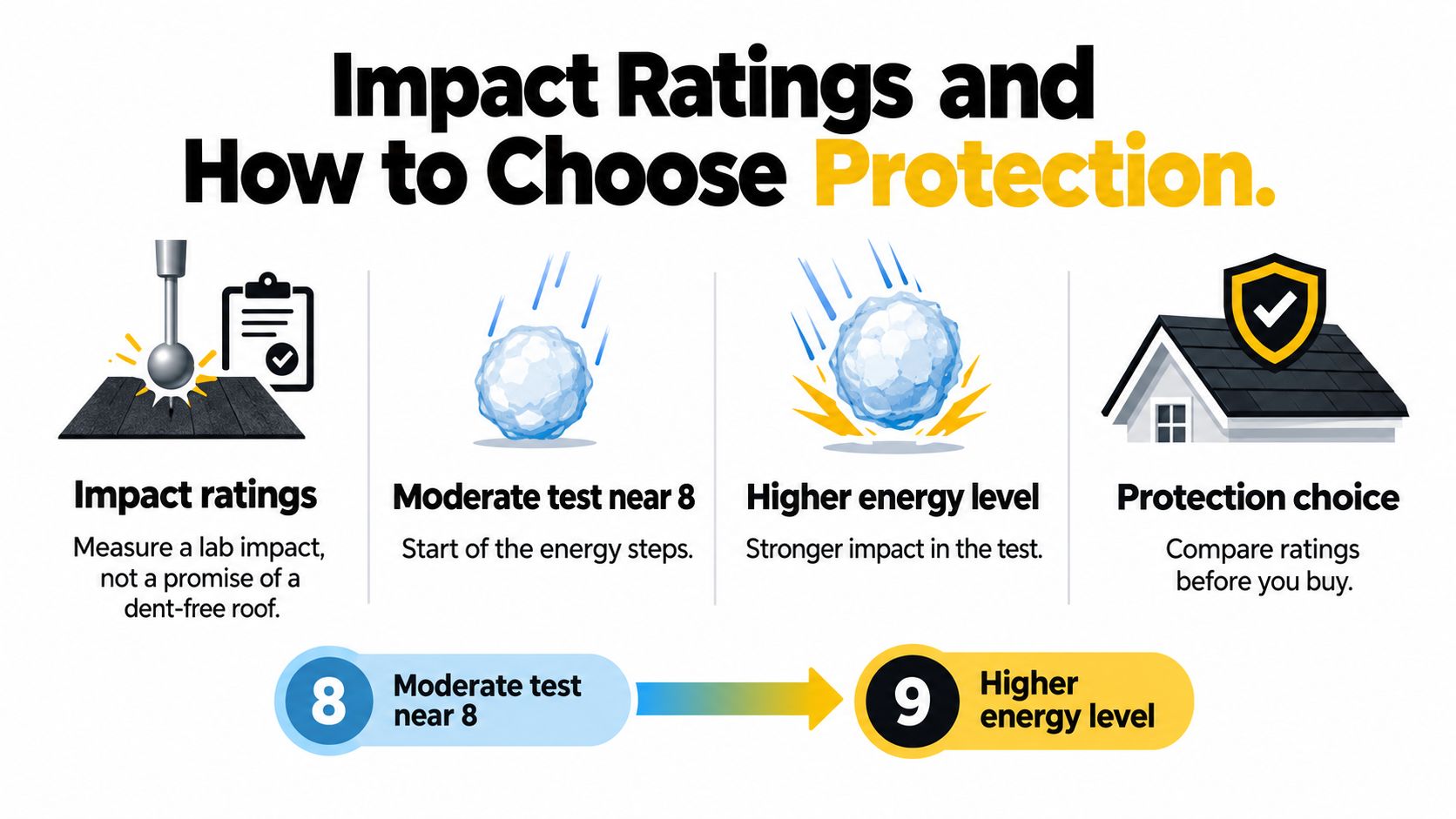
An impact rating is a comparison tool, not a promise that a roof will stay dent-free. Before choosing a replacement product, ask what was tested and whether the proposed installed assembly matches that documentation.
The distinction matters because a panel sample and a completed roof aren't the same thing. The roof on your building includes its supports, connections, protective layers, and installation details.
This graphic summarizes the difference between a laboratory impact classification and a protection choice.
What the laboratory test tells you
FM Approvals testing information describes moderate-hail testing at about 8 foot-pounds, severe-hail testing at about 14 foot-pounds, and very-severe-hail ice-ball testing at approximately 53–58 foot-pounds, with the latter described as equivalent to hailstones up to 2.5 inches in diameter.
In plain language, the test controls the impact so products can be evaluated under defined conditions. It doesn't reproduce every combination of wind, angle, existing wear, or impact location that your building might experience.
IBHS research on low-slope metal-roof impact performance identifies FM 4473 as a relevant rigid-roofing impact standard and emphasizes assembly performance. Panel thickness, profile, substrate, span, seams, and fastening influence the result.
Ask for documentation covering the actual proposed system:
- Panel and finish. Confirm the profile, gauge, and protective finish rather than accepting “heavy metal” as a specification.
- Supporting assembly. Identify the deck, insulation, underlayment, and support arrangement included in the proposal.
- Connections and installation. Ask how clips, fasteners, seams, and edge details will match the specified system.
A thicker panel doesn't erase an unsuitable fastening arrangement. Likewise, a rating attached to a different assembly shouldn't be presented as proof of your installed roof's performance.
Choose the scope before choosing an upgrade
Keeping a repairable roof avoids removing useful materials. Upgrading damaged slopes may be worth discussing where the interfaces can be designed properly. If replacement is already justified, comparing documented impact-resistant assemblies becomes part of that larger decision.
This overview of types of metal roofing can help you discuss panel options with a contractor. Ask how each option fits your building rather than shopping by appearance or rating label alone.
Realistic maintenance still matters. Maintain protective finishes as recommended, preserve records of existing gutter and soft-metal conditions as future hail references, and have questionable connections evaluated. None of those steps makes a roof hailproof.
Local help is another part of the choice. Two States Exteriors LLC is an option serving Kansas and Missouri with free on-site storm inspections, insurance-claim support from assessment through restoration, roof repair or replacement, and related gutter and siding work. The company describes itself as GAF Certified, licensed, bonded, and insured, with around-the-clock emergency response and a no-money-upfront policy.
Whichever contractor you choose, ask for the installed condition and proposed work in writing. Credentials support the selection process, but they don't replace a roof-specific assessment.
What to Do After You Find Hail Damage
You don't have to choose between ignoring the roof and authorizing replacement immediately. The useful sequence is calmer: establish the storm and exposure, determine whether the damage affects protection, and match the proposed work to the documented condition.
That order matters. If you start by arguing about insurance payment, you may still lack a clear explanation of what the building needs. If you start by assuming replacement, you may overlook a defensible repair.
Match the response to the condition
When the finish and seams are sound, arrange a professional assessment and retain the condition record. Don't let the visibility of dents alone decide whether a working assembly gets removed.
Ask what follow-up is appropriate and what change would justify another evaluation. Monitoring is most useful when everyone understands the baseline, not when it means forgetting about the roof until the next storm.
When coatings or laps are damaged, request a written repair scope before the next rain. The scope should identify affected locations, the intended corrective work, and any uncertainty that needs resolution during the job.
You should be able to explain the recommendation in ordinary language. For example, the work may restore a damaged protective finish or correct a connection rather than replace every panel that shows a mark.
When water is inside or connections are displaced, treat the situation as urgent. Arrange safe temporary protection and professional evaluation while preserving whatever evidence can reasonably be recorded.
Don't climb onto the roof to improvise a permanent fix. Ask the responding contractor to distinguish emergency protection from restoration so you understand what has been made temporarily secure and what still needs attention.
Leave the conversation with a written answer
A useful contractor visit should reduce uncertainty, not replace it with a sales pitch. You should know what was accessible, what was inspected, and what remains unknown.
Before agreeing to permanent work, make sure you have:
- A condition explanation. The report separates appearance changes from demonstrated protection or connection failures.
- A defined recommendation. The proposed scope explains why monitoring, repair, or replacement fits the evidence.
- A practical handoff. You know what goes to the carrier, what needs prompt attention, and who coordinates the next step.
For Kansas City homeowners and property managers, the aim is a defensible decision before another storm complicates the record. Keep a serviceable roof when the evidence supports it, correct limited failures when that will restore protection, and replace the assembly when narrower work can't do the job reliably.
Request a free on-site hail inspection from Two States Exteriors LLC so a licensed, insured crew can map the affected slopes and explain repair versus replacement in writing. For Kansas City metro homes and commercial properties, the team offers storm-restoration planning and insurance-claim support with no money due upfront.