
A hailstorm can leave your roof looking normal from the driveway. The gutters may be dented, a few granules may collect near the downspouts, and there may be no ceiling stain or active leak. That's why many Kansas and Missouri homeowners don't ask how long to claim hail damage on a roof until weeks have passed and the first sign of trouble appears indoors.
The danger is that your policy and state law may impose different deadlines. Your insurer may expect prompt notice under the policy, while a separate legal deadline can govern how long you have to sue after a denial or underpayment. The safest approach is simple: document the storm immediately, inspect the property safely, and notify your insurer as soon as you reasonably can.
Why Timing Is Your Most Critical Factor After a Storm
A large storm moves through the Kansas City metro area. Hail rattles the gutters, knocks leaves from the trees, and disappears almost as quickly as it arrived. You walk around the house, see no obvious hole, and decide the roof probably survived.
That decision can become expensive. Weeks later, a bathroom renovation exposes a ceiling stain. Or a buyer's inspection finds moisture near a roof penetration. By then, the insurer may ask why the damage wasn't reported sooner and whether later weather, deferred maintenance, or ordinary aging contributed to the loss.
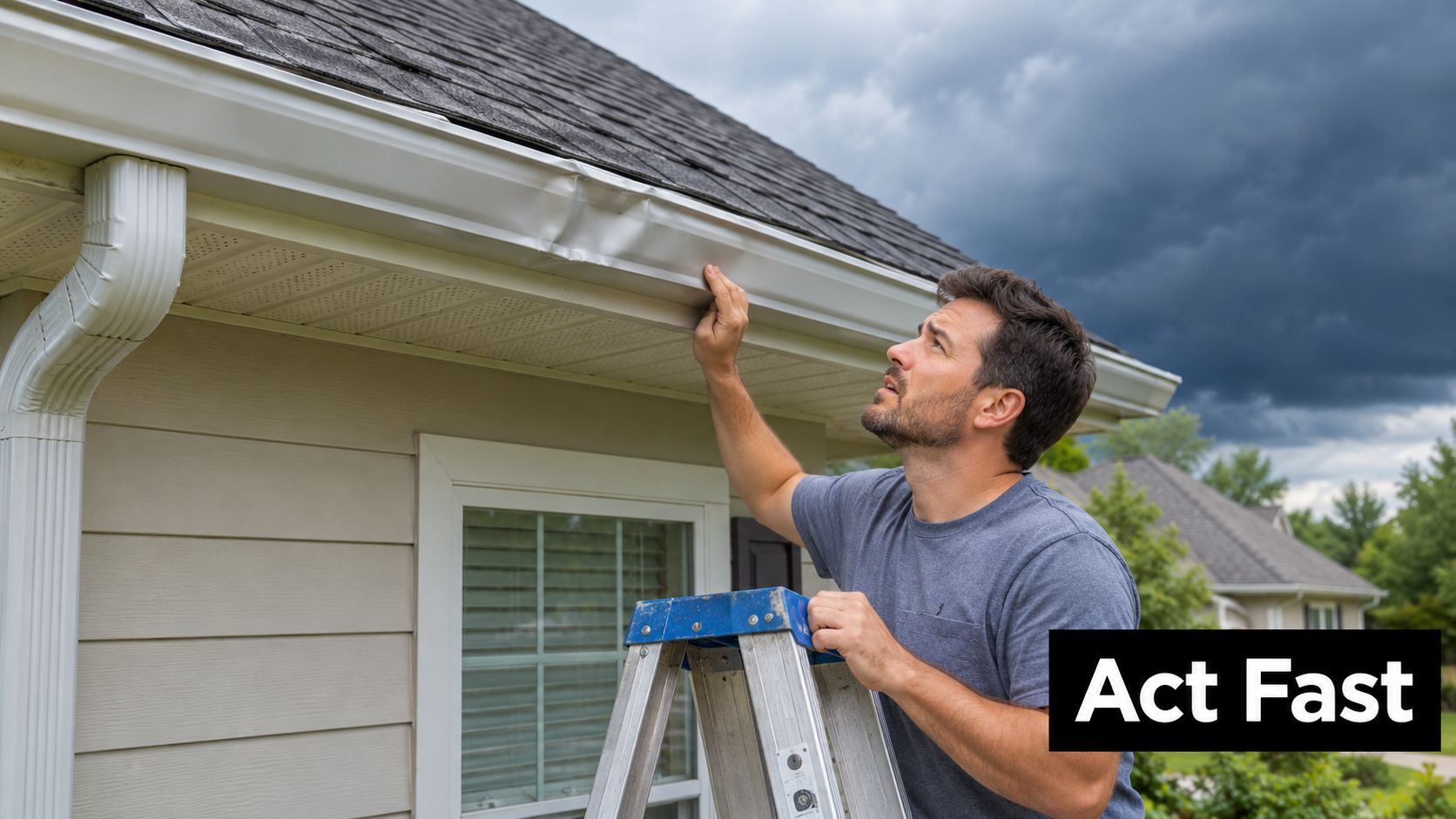
The evidence gap starts before the leak
Hail damage often begins as something subtle. A shingle may lose protective granules without breaking open. A metal vent may dent. Flashing can develop a small fracture that allows water to enter only during wind-driven rain. None of those conditions guarantees immediate interior damage, but each can make later causation harder to prove.
Prompt notice matters because it connects three things while they're still clear:
- The weather event: Record the storm date and approximate time while the event is fresh in your memory.
- The physical condition: Photograph gutters, siding, vents, screens, and visible roof components from safe ground-level positions.
- The inspection record: Ask a qualified roofing professional to document suspected damage before repairs, additional weather, or routine maintenance changes the evidence.
Most homeowners policies treat hail as a covered peril, but eligibility still depends on the policy language and timely reporting. Independent insurance guidance recommends reporting a hail roof claim as soon as practical because documentation can tie the loss to a specific date, time, and weather event. See the homeowners guidance on hail and roof coverage for that coverage principle.
Practical rule: If you suspect hail damage, don't wait for a leak before creating a record.
Waiting a few days doesn't automatically erase a legitimate claim. It does, however, give the insurer more room to question when the damage happened and whether another cause contributed. A contractor who inspects soon after the storm can separate fresh impact marks from long-term wear more reliably than someone examining the roof after months of exposure.
Understanding the Two-Layer Timing Rule
Many homeowners look for one answer to the question, “How long do I have to file?” Insurance claims usually require a more careful answer because two separate clocks can affect your rights.
The first clock comes from the insurance contract. Your policy may contain a notice-of-loss requirement in a section often titled “Duties After Loss” or something similar. Neutral insurance guidance commonly describes policy notice windows as often 30 to 60 days after discovering damage, although some policies allow up to one year or more. Those are general ranges, not a substitute for reading your own policy. The exact language, trigger, and exceptions matter.
The second clock comes from state law. If the insurer denies the claim, underpays it, or otherwise creates a dispute, the applicable state limitation period can control how long you have to file a lawsuit. Many states provide about 1 to 3 years for that type of action, but the applicable period can depend on the claim, contract language, and jurisdiction. The guide to hail-damage claim timing describes this combined system and why homeowners should not treat the longest possible period as their working deadline.
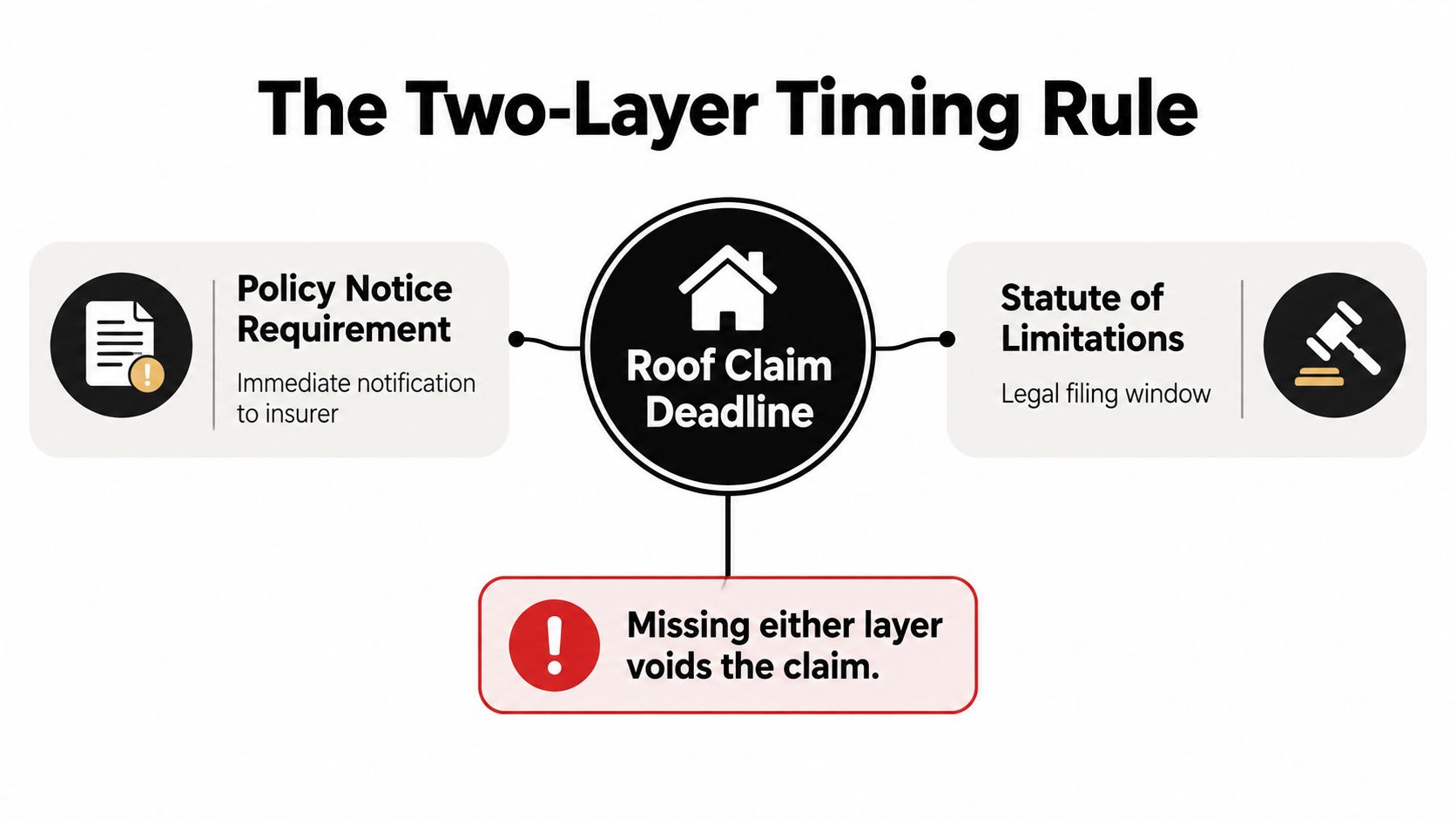
The shorter clock controls your practical decision
These deadlines don't necessarily begin in the same way. A policy may measure notice from the storm, from discovery of damage, or from another event described in the contract. A legal limitation period may have its own starting rule. That's why a homeowner shouldn't assume that discovering damage later automatically provides unlimited additional time.
Think of the system this way:
| Timing layer | What it controls | What to check |
|---|---|---|
| Policy notice requirement | When you must notify the insurer of a loss | Notice clause, storm-related endorsements, duties after loss |
| State limitation period | When a legal action must be filed after a dispute | State law, policy terms, denial or underpayment date |
| Evidence timeline | How clearly the damage can be tied to one storm | Photos, inspection records, weather documentation, repair history |
The practical filing window is usually the shorter of the applicable deadlines, not the longest one. A homeowner who waits until the final day of a policy window may discover that another legal requirement has already become a problem. A homeowner who focuses only on the lawsuit deadline may miss the contract's notice requirement long before litigation is even considered.
Policy interpretation can also affect repair decisions. For example, questions about whether an existing roof can be repaired or whether a replacement involves overlaying a roof should be addressed with the policy and the property's actual condition in mind. Don't authorize major work before documenting the existing damage and understanding what the insurer needs to inspect.
Kansas and Missouri Specific Deadlines and Requirements
Kansas City metro homeowners may live only a short distance apart while facing different state-law questions. A homeowner in Kansas and a homeowner in Missouri shouldn't assume their policies, legal deadlines, or claim procedures work identically. Both should begin with the same document, the insurance policy, and then confirm how state law applies to the specific dispute.
Start with the policy, not a calendar found online
Look for the declarations page, endorsements, and the section describing duties after a loss. Search for terms such as hail, wind, notice of loss, proof of loss, suit against us, and limitations period. Write down every time requirement and identify whether it runs from the storm, discovery, notice, denial, or another defined event.
Then confirm the jurisdiction. The property's location controls the relevant state framework, not the address of your insurance agent or the contractor who performs the inspection. If the insurer cites a missed deadline, ask for the precise policy provision and the date the carrier believes the clock began.
Build the file before the adjuster arrives
Kansas and Missouri homeowners should preserve a consistent record containing:
- Storm details: Note when the storm occurred, what you observed, and whether nearby properties reported damage.
- Property photographs: Photograph the exterior, gutters, downspouts, siding, screens, vents, and any interior staining.
- Roof condition: Use ground-level images unless a qualified professional says a closer inspection is safe.
- Communication history: Keep claim numbers, emails, letters, inspection dates, and summaries of phone calls.
- Temporary work: Save invoices and receipts for reasonable measures that prevent additional damage, and photograph the condition before work begins.
The insurer may still investigate whether the roof was already worn, whether maintenance was deferred, or whether later weather caused the reported problem. A clear timeline gives the adjuster facts rather than guesses.
A late discovery is a reason to act immediately, not a reason to abandon the claim.
If the carrier denies the claim or offers less than the documented scope, don't rely on a contractor's general assurance that the deadline is flexible. Review the denial, preserve every document, and obtain advice from a qualified insurance professional or attorney licensed in the relevant state. For practical preparation before that conversation, use this guide on getting insurance to pay for a new roof.
How Insurers Process Claims and Typical Timelines
A hail claim can stall at any handoff, from first notice to inspection, scope review, or payment decision. The first clock starts when the storm occurs. The second starts when you report the damage. Hidden damage may not be recognized until weeks later, so homeowners often have to identify the problem and notify the carrier while the available reporting window is already shrinking.
The process begins when you give notice to the carrier. The insurer records the loss, assigns a claim number, and typically arranges an inspection by an adjuster or another representative. Prompt notice does not guarantee a quick settlement, but it gives the carrier a clear event to investigate before later weather or deterioration creates competing explanations.
The inspection may involve roof access, ground photographs, drone images, interior review, and questions about prior repairs. The adjuster compares the observed condition with the reported storm event and the policy's coverage terms. The carrier then prepares an initial assessment, which may approve some items, exclude others, or request additional information.

What happens at each stage
Notice: Give the insurer the property address, storm information, observed damage, and a reliable way to contact you. You do not need to diagnose every shingle before opening the claim. State what you know, and avoid guessing or overstating areas you have not inspected.
Inspection: Be present if possible, or make sure someone responsible can provide access. Share photographs and the contractor's written observations, but do not alter damaged areas before inspection unless temporary protection is necessary to prevent further loss.
Scope and decision: Read the estimate line by line. Check whether it addresses roof slopes, flashing, vents, gutters, siding, interior damage, tear-off, ventilation, and code-related work where the policy applies. Ask written questions about every omitted component.
Repair or dispute: Once the covered scope is clear, select a qualified contractor and retain agreements, receipts, permits, and completion photographs. If the assessment misses documented damage, request reconsideration with focused evidence instead of sending an unrelated collection of photos.
Storm volume, access, documentation, and carrier workload all affect the pace. The roof insurance claims process provides a useful framework for understanding the handoffs between homeowner, insurer, adjuster, and contractor.
A delayed inspection can leave two explanations for the same condition. Older photographs may show only a general roof surface, while a later inspection may reveal deterioration without proving when it began. Reporting promptly protects the connection between the storm, the observed damage, and the claim.
The Hidden Dangers of Delayed Discovery
Hail damage isn't always a dramatic hole or a shingle lying in the yard. A roof can look intact while losing granules, developing impact depressions, or suffering damage around penetrations and metal components. From the ground, those defects may be impossible for a homeowner to identify confidently.
The idea that “no leak means no damage” is especially risky. Water may not enter until the next wind-driven rain, and a small roof defect may first show up as staining, damp insulation, peeling paint, or a musty odor indoors. By that point, the roof has already been exposed to additional conditions that can complicate the inspection.
Ordinary storms can create ordinary-looking claims
Verisk reported that 16 U.S. states had 20% or more of their roofs impacted by severe hail in 2025, compared with 12 states in 2024. The same Verisk report on the state of America's roofs also supports the broader point that hail exposure affects many properties, not only homes with immediately visible catastrophic damage.
Industry coverage cited in that report indicates that non-catastrophic wind and hail roof claims rose from 17% to 25% of all residential claims between 2022 and 2024. That movement matters for homeowners because a claim can arise from a routine-seeming storm, with damage that remains hidden until a later inspection or weather event.
The discovery problem creates a difficult balance. You may not know about the damage until a contractor, buyer, or leak reveals it. Yet waiting to investigate gives weather, foot traffic, maintenance work, and aging more opportunity to change the roof's condition.
What to do after a late discovery
Don't backdate the loss or claim certainty you don't have. Record when you first noticed the interior stain or suspected roof issue, identify the storm you believe may be connected, and preserve the condition before anyone repairs it.
A useful late-discovery file includes:
- The first observation: Write down where the stain, leak, or exterior sign appeared.
- The storm history: List the likely hail event and any photographs or weather records you already possess.
- The inspection opinion: Ask the contractor to distinguish likely impact damage from age, installation defects, and maintenance-related deterioration.
- The untouched evidence: Avoid unnecessary cleaning, replacement, or pressure washing before documentation.
Cosmetic language can also mislead homeowners. A dented vent or loss of granules may not look structural, but it can help establish that the storm affected the roof system. Have the entire assembly assessed instead of deciding from the driveway that the problem is harmless.
Immediate Actions and The 72-Hour Checklist
The first 72 hours after a hail event are valuable because the condition is fresh and your memory is reliable. They're also long enough to create a useful record without putting yourself on a roof or rushing into an irreversible repair.
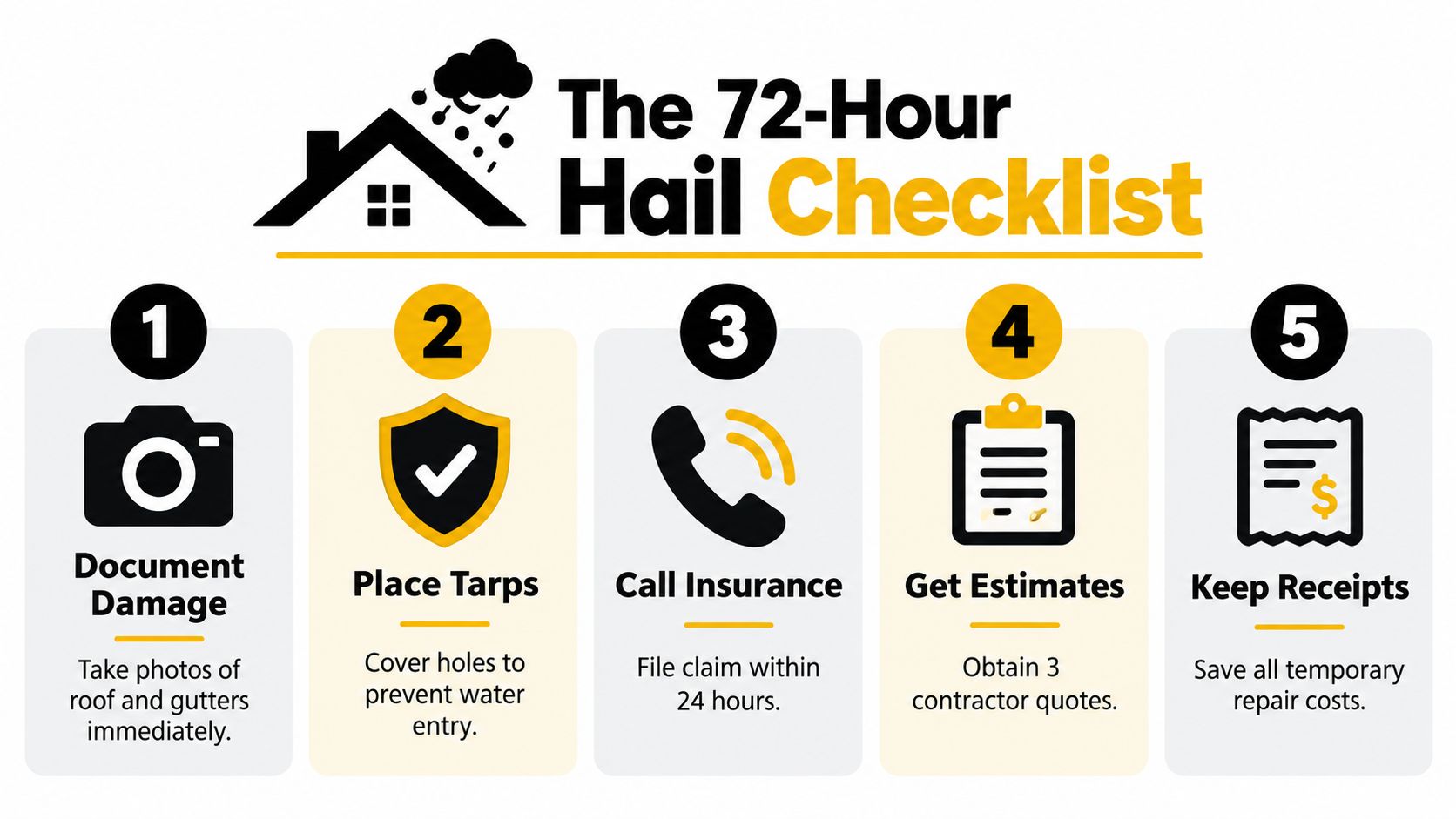
Follow the safe order of operations
Document from the ground. Take timestamped photographs of gutters, downspouts, siding, windows, screens, vents, landscaping, and visible roof areas. Photograph the same feature from multiple angles, and don't climb onto a wet or damaged roof.
Check for immediate water entry. Look in attics and upper-level rooms for active leaks, wet insulation, ceiling stains, or dripping around fixtures. If you find water, protect belongings and contact an appropriate emergency professional.
Prevent additional damage. If wind or hail created an opening, arrange safe temporary protection. Don't make permanent repairs before the condition is documented unless waiting would cause greater damage.
Notify the insurer promptly. Use the carrier's approved phone, website, or app, and save confirmation of the report. Describe what you observed without trying to decide coverage yourself.
Arrange a professional assessment. Choose a local, established contractor who can inspect safely, photograph the roof, identify affected components, and provide a written scope.
A gutter full of granules can be worth photographing, but it doesn't prove every roof component needs replacement. Conversely, a clean gutter doesn't prove the roof is undamaged. Use visible clues to trigger an inspection, not to make the final diagnosis.
The following video can help homeowners understand the practical sequence after a storm.
Don't allow a sales representative to pressure you into signing a repair agreement before you understand the damage and the insurance scope. Speed protects your claim. Rushed decisions can create a different problem.
DIY Inspection vs. Professional Assessment
A homeowner can perform a useful ground-level screening, but a screening isn't the same as a roof assessment. From the yard, you may notice dents in gutters, chipped siding, missing shingles, or exposed underlayment. Those observations help establish that the storm affected the property.
Roof access introduces safety risks, especially when shingles are wet, granules are loose, or the structure has hidden damage. A homeowner may also mistake weathered shingles for hail impacts, overlook damage around vents, or fail to recognize a fracture that only becomes visible at close range.
| DIY ground check | Professional assessment |
|---|---|
| Safe observation from the property perimeter | Controlled inspection of roof surfaces and components |
| Useful photographs of visible exterior clues | Written findings that distinguish impact, age, and maintenance conditions |
| Fast first record after the storm | More complete evidence for the carrier's inspection and scope review |
| Cannot reliably confirm hidden roof damage | Can identify areas that require closer evaluation |
The best use of DIY inspection is documentation, not diagnosis. Photograph what you can safely see, note interior symptoms, and leave roof climbing to trained personnel. Don't scrape, bend, or test shingles yourself because those actions can alter the evidence.
A qualified contractor should also explain uncertainty. Hail damage isn't automatically a full replacement, and an old roof isn't automatically a denied claim. The assessment should connect observed conditions to the storm while identifying unrelated wear or pre-existing issues fairly.
That balanced report protects you better than an exaggerated one. Insurers scrutinize unsupported scopes, while homeowners need an accurate understanding of what must be repaired to keep the property watertight.
Protecting Your Home and Your Claim
The answer to how long to claim hail damage on a roof isn't a single universal number. Your policy may impose a notice window, state law may impose a separate deadline for legal action, and the evidence can become harder to interpret long before either formal deadline expires.
Protect your position by following four rules:
- Report promptly: Notify the carrier once you suspect a covered loss, even if you're still arranging a detailed inspection.
- Read both timing layers: Check the policy notice clause and the applicable state-law deadline. Treat the shorter practical window as the urgent one.
- Preserve the condition: Photograph before repairs, keep written records, and save receipts for reasonable temporary protection.
- Use qualified help: Choose professionals who can inspect safely, document the scope, and communicate clearly without promising an outcome the evidence doesn't support.
A denied claim isn't always the end of the conversation, but a weak record makes reconsideration harder. Keep the denial letter, estimates, photographs, inspection reports, and all correspondence together. If the dispute turns on policy interpretation or a legal limitation period, consult a licensed attorney rather than relying on an informal deadline found online.
For Kansas and Missouri homeowners, local experience can help identify storm-related conditions, prepare a clear scope, and keep the repair process organized. The homeowner still controls the policy relationship, but accurate documentation gives every party a better foundation for evaluating the loss.
Two States Exteriors LLC offers storm-damage roof inspections, claim documentation, and roof repair or replacement support for Kansas and Missouri homeowners. Visit Two States Exteriors LLC to request an inspection and start building a clear record before a hidden hail problem becomes a larger one.