
You're probably looking at the same backyard from two angles. A patio appears to be the obvious budget choice, while a deck seems better suited to a raised back door or a sloping lot. Then the contractor walks the property, points out the grade, drainage path, retaining wall, and stair access, and the simple comparison becomes much less simple.
For Kansas City homeowners, deck vs patio cost depends on more than the surface you can see. A patio may be less expensive on naturally level ground, but grading, drainage, steps, and retaining walls can narrow or erase that advantage. A deck may cost more per square foot, yet its structure can bridge uneven terrain without requiring the same amount of earthwork.
Deck vs Patio Cost Overview for Kansas City
A deck is a raised structure supported by posts, beams, joists, footings, and fasteners. A patio is a ground-level surface installed over a prepared base. That distinction drives the first price difference, but it doesn't determine the final price by itself.
On a flat Kansas City yard with good drainage, a patio often gives you more usable space for the initial investment. It sits close to the ground, usually needs fewer structural components, and can connect naturally to a lawn, garden, or fire-pit area. A deck makes more sense when the back door is raised, the yard drops away from the house, or you want a level platform above uneven ground.
Local terrain changes the calculation quickly. Many metro-area properties have slopes, walk-out basements, drainage swales, or compacted fill around the foundation. A patio on that kind of site may need excavation, imported base material, grading, drainage improvements, a retaining wall, or steps. Those items aren't visible in a basic per-square-foot estimate, but they can account for a substantial part of the installed project.
The practical cost question
The right question isn't “Which material is cheaper?” Ask instead:
- Is the proposed surface naturally level?
- Will water move away from the foundation after construction?
- Does the patio need a retaining wall or raised edge?
- How will people reach the space from the house?
- Will the structure need to meet a higher doorway?
A useful patio installation resource for Kansas City homeowners can help you understand the local scope before comparing bids.
Practical rule: Compare complete, installed designs on your actual lot. A low material allowance doesn't mean a low project cost if the site needs major preparation.
“Cheaper” depends entirely on topography. A level yard can preserve a patio's price advantage. A sloped yard can make a deck the more economical way to create a level outdoor room, even though the deck's base construction costs more.
Baseline Installation Costs Per Square Foot
Before adding site-specific work, the national comparison shows a clear gap. Installed decks typically cost about $25 to $50 per square foot, while patios generally cost about $5 to $35 per square foot, depending on the material, according to HomeGuide's deck and patio cost comparison.
For a standard 10 by 20 foot footprint, those ranges translate to approximately $5,000 to $10,000 for a deck and $2,000 to $3,400 for a patio, using the same source's estimates. That difference reflects the construction system, not merely a preference for wood, composite, concrete, or pavers.
Average base cost estimates
| Project Type | Cost Per Sq Ft | Typical 10×20 Total |
|---|---|---|
| Deck | $25 to $50 | $5,000 to $10,000 |
| Patio | $5 to $35 | $2,000 to $3,400 |
A deck needs a supporting frame, footings, joists, fasteners, and often railings and stairs. Those components require layout, structural connections, and more labor than a surface installed at grade. A patio generally needs excavation, a compacted base, the finished surface, and careful slope for drainage. The exact scope changes with material and site conditions.
In practical comparisons, the same outdoor living area can cost about two to three times more as a deck than as a patio, particularly when a wood deck is compared with a concrete or paver patio, as explained in the HomeGuide cost analysis. That comparison is useful as a starting point, but it assumes the patio site doesn't require unusual earthwork.
What the base number leaves out
A base estimate may not include substantial grading, drainage correction, retaining walls, complex stairs, demolition, difficult access, or design changes required by the house. It may also treat a simple ground-level patio and a raised, terraced patio as if they were the same type of project.
Labor is another area homeowners should examine closely. Ask whether the proposal includes footings, framing, railing, stair construction, excavation, base preparation, compaction, drainage, cleanup, and permits where applicable. A guide to deck-building labor costs can help you identify labor-related line items before you compare contractor totals.
The baseline tells you why patios usually start cheaper. It doesn't tell you which option will cost less on your property. That answer requires a site evaluation.
The Hidden Costs of Site Preparation
A patio stops being the cheaper option when the ground beneath it becomes the main project. On a sloped Kansas City lot, creating a stable, level patio may require much more than placing pavers or pouring concrete.
Contractor guidance cited by Decks.com's comparison of decks and patios describes a ground-level patio that can start around $4,500 for 300 square feet. The same guidance places a raised patio with a boulder wall and steps at a starting point around $8,000, close to or above a simple deck at roughly $9,000 for the same area.
Those figures don't establish a universal Kansas City price. They illustrate the point that the site can change the relationship between the two options.
Where patio site work grows
A patio on a hillside may require several connected operations:
- Grading: Crews may need to cut into the slope, remove soil, or bring in material to create a level platform.
- Retaining walls: A wall may hold back soil and protect the patio edge from movement.
- Drainage: The finished surface must shed water away from the house and avoid concentrating runoff against walls or neighboring areas.
- Base preparation: The aggregate base must be properly placed and compacted to reduce settling.
- Steps: A raised patio needs safe access from the home, lawn, or another outdoor level.
Each item affects the next. Poor grading can overload drainage. Inadequate drainage can contribute to settling or erosion. A weak base can leave pavers uneven or concrete unsupported.
Why a deck can win on a slope
A deck's posts and beams allow the finished surface to pass over uneven ground. The structure still needs engineered support, stable footings, appropriate connections, and safe stairs, but it may avoid the volume of excavation and retaining work required to force a patio into a hillside.
That doesn't make every sloped-lot deck inexpensive. Tall decks can require deeper footings, additional bracing, railings, and more complicated stair systems. The point is narrower and more useful: compare the cost of creating level ground, not just the cost of the finished surface.
On a hill, a patio isn't only a paving project. It's a grading, drainage, and structural-edge project before the visible surface is installed.
Ask each contractor to show the proposed elevations and water-management approach. If one bid lists a patio surface but says little about the slope, drainage, or wall requirements, it isn't yet a complete comparison.
Material Choices and Long-Term Durability
Kansas City weather tests every outdoor surface. Moisture, humidity, ultraviolet exposure, hot summers, and freeze-thaw movement all influence how a deck or patio ages. Material choice affects maintenance, repairability, appearance, and the point at which an inexpensive installation becomes a recurring expense.
Historical consumer pricing summaries show the same broad pattern over time. One widely cited estimate places the average deck at about $7,900 and the average patio at about $3,800, according to Bob Vila's deck and patio cost overview. Those averages don't replace a project estimate, but they reinforce that decks generally carry a premium because they require more structural construction.
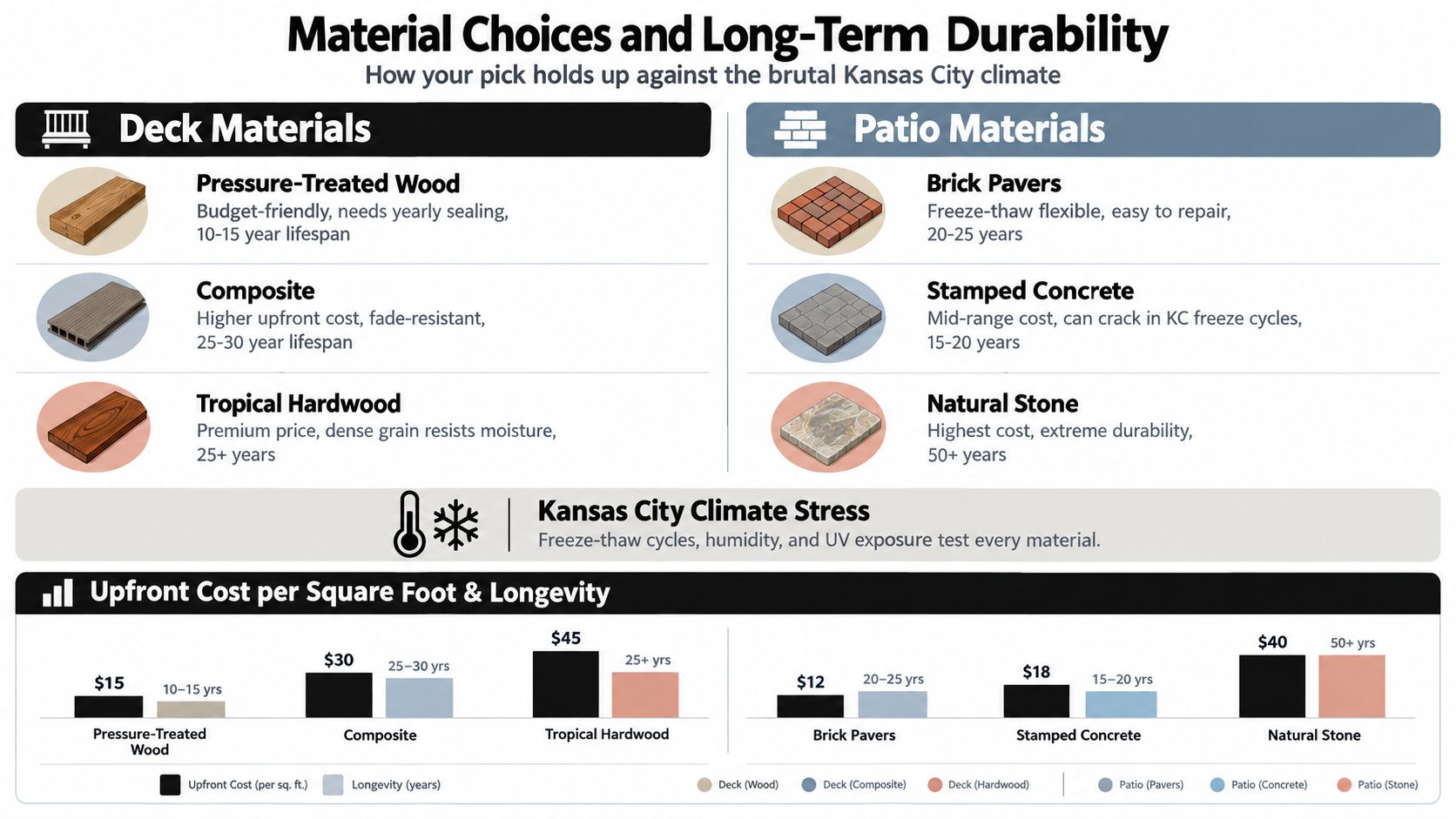
Deck materials
Pressure-treated wood usually offers the most accessible starting point for a deck. It brings warmth and can work well when the owner accepts regular cleaning, sealing, and inspection. In Kansas City's wet and changing conditions, neglected wood is more vulnerable to moisture-related deterioration, surface wear, and board replacement.
Composite decking costs more at installation but reduces the refinishing routine associated with wood. It still needs cleaning, and its underlying frame remains important, but the surface resists many of the common problems that affect untreated or poorly maintained wood.
Tropical hardwood creates a premium appearance and has dense natural grain, but the material and installation commitment are higher. It still needs a maintenance plan suited to the product and the homeowner's expectations.
Patio materials
Pavers provide a practical advantage when localized repairs matter. If one unit settles or breaks, a qualified crew can often address the affected area without removing the entire surface. That flexibility is useful where soil movement or drainage creates isolated problems.
Poured and stamped concrete offer a continuous surface and broad design flexibility, but cracking or heaving can be difficult to hide and may require more involved repair. Natural stone can deliver strong visual character and durability, though its material, preparation, and installation requirements place it in a higher finish category.
Material decision: Choose the surface you can maintain and repair, not only the one that looks best on installation day.
For a closer look at the trade-off between initial price and upkeep, compare composite decking with wood decking. The right choice depends on whether you value a lower starting cost, less routine maintenance, a particular appearance, or repair flexibility.
Maintenance Requirements and Lifespan Analysis
The lowest installation bid isn't automatically the lowest ownership cost. A deck or patio sits outside through seasonal moisture, sun, temperature swings, and foot traffic, so the owner should evaluate what must happen after the crew leaves.
Wood decks demand the clearest maintenance commitment. Cleaning, sealing, staining, fastener checks, and occasional board replacement help protect the surface and the frame. Skipping those tasks can turn a manageable upkeep item into a larger repair.
Composite decking changes that routine. It generally costs more upfront than wood and much more than a basic patio, but it reduces the need for recurring refinishing. It still requires cleaning and inspection, especially around fasteners, stairs, ledger connections, and the supporting frame.
How patios age
Patios usually avoid the recurring surface refinishing associated with wood decks. Concrete and pavers still need attention, though. Concrete can crack, settle, or heave, while pavers can shift when the base or drainage performs poorly.
Pavers offer a targeted repair path because individual units can be lifted, the base corrected, and the surface reset. A concrete repair may be more visually noticeable, particularly when the replacement material doesn't match the original surface.
A better ownership comparison
Rather than pretending to calculate an exact long-term total without a site-specific bid, evaluate these questions:
- Maintenance tolerance: Will you schedule routine wood-deck care, or would a lower-maintenance surface better fit your household?
- Repair exposure: Would a cracked slab create a major access or appearance problem, or can the selected material be repaired in sections?
- Site movement: Does the property have drainage or soil conditions that could cause settling, erosion, or heaving?
- Replacement risk: If the surface eventually needs substantial work, can the affected material be replaced without rebuilding the entire system?
- Structural inspection: Will the deck's frame, footings, stairs, and connections receive periodic attention?
National guidance summarized by The Federal Savings Bank's deck and patio comparison emphasizes that total cost of ownership includes maintenance, lifespan, and replacement risk over 10 to 20 years. It also notes that material selection changes the long-term math. A patio can be economical to maintain, but poor drainage or a weak base can create repairs. A composite deck can reduce surface upkeep, but its higher initial investment needs to fit the owner's time horizon.
Making the Final Decision for Your Home
The most reliable decision framework starts with the yard, not the material sample. Stand at the back door and follow the ground away from the house. Note whether the surface falls sharply, where water travels after rain, how high the doorway sits above the yard, and whether a level entertaining area already exists.
Choose a patio when the site supports it
A patio is often the sensible choice when:
- The yard is naturally level: You can limit excavation and avoid a large retaining structure.
- The home meets the ground: A slab-level or low threshold makes direct access straightforward.
- You want low-profile outdoor living: A patio connects easily with lawns, planting beds, and fire-pit areas.
- You prefer repairable hardscape: Pavers allow localized work when individual sections move or break.
- Your budget favors a lower starting cost: The base installation range generally begins below a comparable deck.
A concrete or paver patio can deliver strong value on a flat, well-drained lot. The design still needs proper slope, compaction, edge restraint where appropriate, and a base suited to the soil and weather conditions.
Choose a deck when elevation solves the problem
A deck can be the better financial decision when:
- The yard slopes away from the house: The structure can create a level surface without flattening the entire site.
- The back door is raised: The deck can meet the doorway directly, reducing the need to build a raised patio with extensive steps and walls.
- You want a defined outdoor room: Railings, stairs, seating, lighting, and multiple levels can shape the space around how you entertain.
- You need to preserve the yard: A deck may reduce excavation compared with forcing a large patio into a hillside.
- You accept structural maintenance: Footings, framing, connections, stairs, and the surface all deserve periodic inspection.
A deck isn't automatically the right answer for every slope. Its height, access, guard requirements, foundation conditions, and drainage below the structure still need careful design. A contractor should explain how water will move around the footings and how the deck will connect to the house.
Compare proposals by scope
Request proposals that show the same footprint, access, finish level, demolition assumptions, drainage work, and site preparation. Then compare the line items rather than focusing on the headline total.
Budget test: If a patio estimate doesn't clearly address grading, drainage, walls, steps, and base preparation, compare it with caution. Those omissions can surface later as change orders.
Long-term value also depends on how the space fits the home. A well-built deck may improve daily access and usability on an older or high Kansas City property. A carefully installed patio may offer better value where the yard is flat and the owner wants a durable, low-profile surface. Neither option guarantees a particular resale return, so prioritize sound construction, appropriate drainage, and a design that matches the neighborhood and the house.
A useful contractor should inspect the lot, identify hidden work, explain material trade-offs, and provide a written scope. That process is more valuable than choosing a surface from a price-per-square-foot chart.
Two States Exteriors LLC provides deck and patio builds for Kansas City Metro homeowners, with site evaluations and detailed project plans that account for terrain, drainage, access, and finish choices. Visit Two States Exteriors LLC to request an assessment and compare a complete installed plan for your property.