GAF roofing refers to products manufactured by GAF, North America's largest roofing and waterproofing maker since 1886, best known for Timberline HDZ shingles and system-level warranties that require certified installation. GAF's history includes 139 years of roofing firsts, but the roof over your home still depends on the complete assembly and the crew installing it.
After a Kansas City hailstorm, the question usually comes from the driveway. You're looking at loose granules in the gutters, bruised shingles, or a ceiling stain, and a contractor has mentioned a “GAF roof.” That phrase sounds specific, but it can hide several different decisions about materials, installation, storm resistance, warranty eligibility, and insurance documentation.
A GAF label doesn't tell you whether the roof was installed correctly. It tells you who manufactured the roofing products. The practical difference matters in Midwest weather, where wind-driven rain, hail, ice, and rapid temperature changes test every layer of the assembly. A reliable decision starts by separating manufacturer quality from installer quality.
What Homeowners Mean When They Ask What GAF Roofing Is
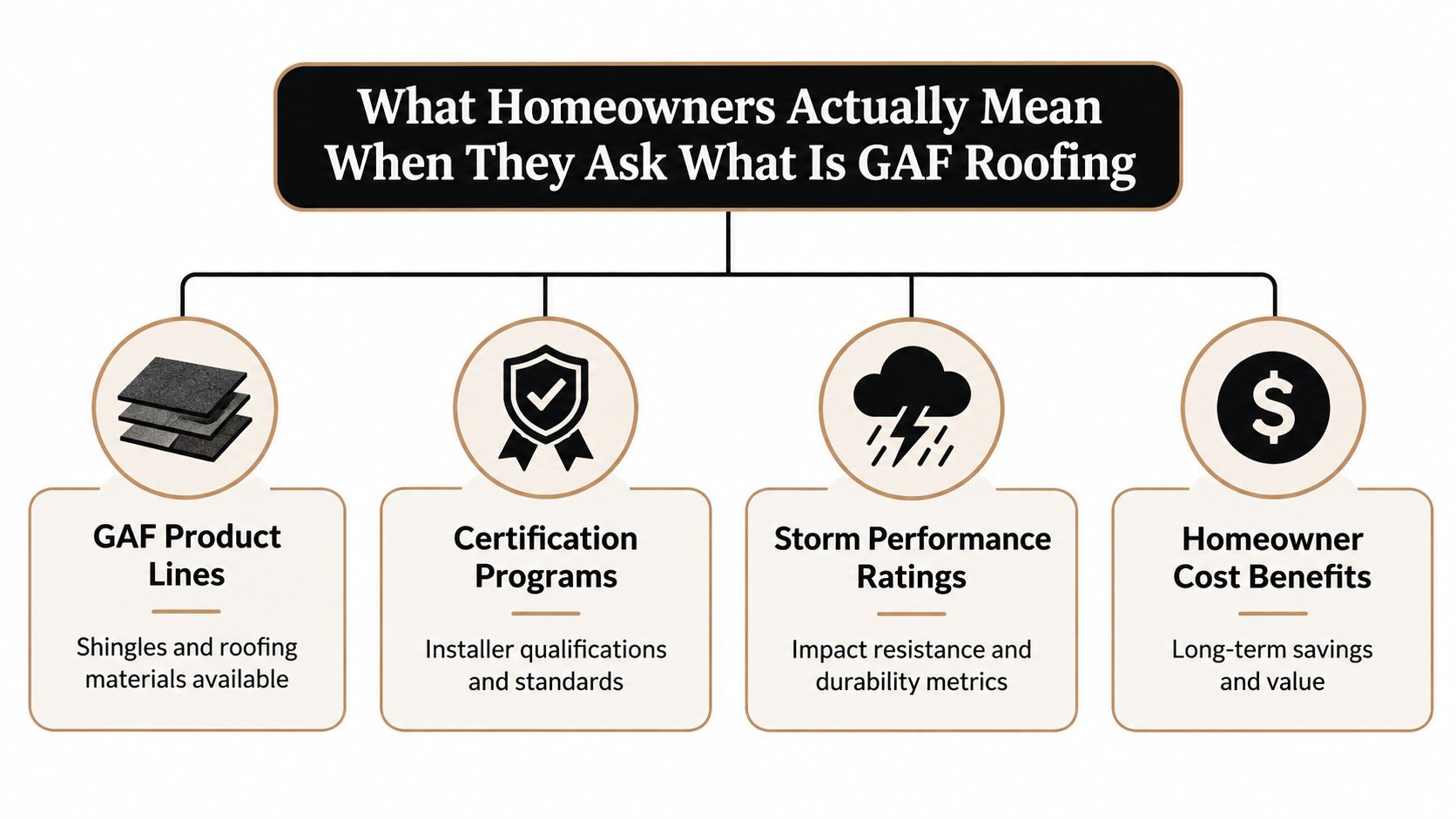
A Kansas City homeowner usually asks this after hail has filled the gutters with granules or wind has lifted a shingle. They want to know whether “GAF roofing” names a product, a service, or a promise about performance. GAF is a manufacturer, not a roofing service. The company began in 1886 as the Standard Paint Company in Bound Brook, New Jersey, and now produces residential and commercial roofing and waterproofing products. Its range includes asphalt shingles, commercial membranes, coatings, metal roofing, and accessories, as outlined in GAF's company history and its residential product information.
A GAF roof could mean Timberline HDZ shingles on a house, a TPO membrane on a commercial building, or a complete roof assembly using underlayment, leak barriers, starter strips, ventilation, ridge caps, and other components. The visible shingle is only one part of the job.
The brand and the builder are different
GAF sets product specifications, testing standards, installation requirements, and warranty terms. The contractor inspects the roof, prepares the deck, installs flashing and fasteners, manages ventilation details, cleans the site, and records the work. Those responsibilities are connected, but they belong to different parties.
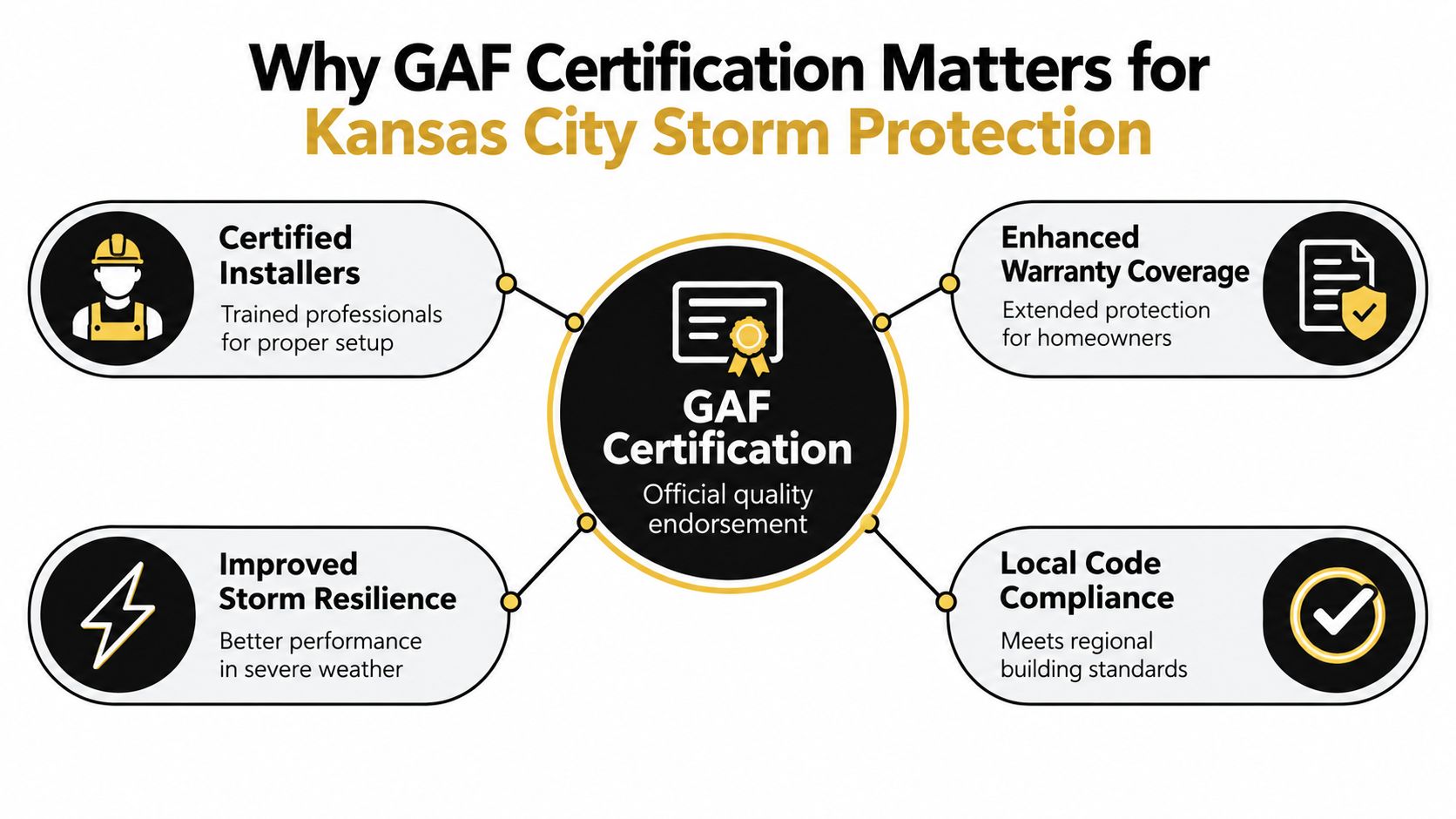
A certified contractor may qualify a project for enhanced manufacturer warranty coverage when the selected products and installation requirements meet GAF's conditions. Certification does not make the contractor a GAF employee. Homeowners still need to verify licensing, insurance, references, workmanship, and the written scope.
Practical rule: Buy the GAF product together with a qualified crew, sound roof design, a clear scope, and completed warranty registration.
After a Kansas City storm, inspect more than the shingles you can see from the driveway. Hail and wind can affect flashing, perimeter fastening, and roof accessories. A contractor who evaluates the full assembly can identify what failed, what remains serviceable, and which repairs or upgrades have a clear reason. That distinction often matters more than the brand name printed on the shingle.
How GAF Product Systems Work Beyond Just Shingles
A roof isn't a pile of independent products. It's an assembly in which each layer has a job, and those layers must work together under the conditions expected at the building.
GAF publishes 3-part CSI specifications and installation manuals for system-level assemblies. Those documents help architects, specifiers, and contractors coordinate the substrate, membrane, attachment method, accessories, and design requirements. GAF's roofing specifications and design resources cover systems that include TPO, PVC, asphaltic roofing, coatings, and built-up roofing.
What the system controls
On a residential pitched roof, the visible shingle sheds most rainwater, but the underlayment provides secondary protection, leak barriers protect vulnerable transitions, starter strips help secure the lower edge, and ridge caps finish the roof peak. Ventilation influences how heat and moisture leave the attic. Flashing directs water around chimneys, walls, skylights, and penetrations.
On a commercial low-slope roof, the decisions change. A TPO or PVC membrane may be mechanically attached, adhered, or otherwise installed according to the specified assembly. Asphaltic systems can use multiple membrane layers, while coatings serve a different purpose from a replacement membrane. The correct choice depends on the substrate, drainage, exposure, code requirements, and building use.
This is why a product that works in one assembly may be unsuitable in another. An adhesive, fastener pattern, or underlayment can't be selected from a catalog in isolation. Compatibility and attachment details belong in the written system specification.
Read the scope, not just the shingle name
Ask the contractor to identify every major layer and explain where the installation manual governs the work. If you want a clearer explanation of secondary water protection, review this guide to roof underlayment and its role.
A useful proposal should identify the shingle or membrane, deck preparation, underlayment, leak barrier, flashing, ventilation, accessories, removal and disposal, and warranty registration. It should also state what happens if the contractor finds damaged decking after tear-off.
The system approach works when the installer follows the requirements and documents the work. It doesn't work when a contractor uses a premium shingle but substitutes incompatible accessories, skips preparation, or treats flashing as an afterthought.
Understanding GAF Roofing Warranty Options
GAF warranties aren't a single blanket promise attached to every roof carrying a GAF label. Eligibility depends on the products installed, the accessories used, the contractor's certification level, and whether the installation follows GAF requirements. Homeowners should ask for the exact warranty name and the written terms before signing.
Match coverage to the installation
Start with the base manufacturer warranty for the products in the proposal. Then ask whether the contractor can offer enhanced coverage through a qualifying certification program. Enhanced protection may require a defined combination of GAF products, documented installation, and registration after completion.
The important question isn't "How long is the warranty?" Ask what the warranty covers, what it excludes, whether coverage is transferable, how workmanship claims are handled, and whether the roof must be inspected or registered within a stated period. Manufacturing defects, installation workmanship, cosmetic changes, storm damage, and maintenance issues are separate categories.
For a practical explanation of how warranty language affects a replacement project, review this roof replacement warranty guide.
Verify before the crew arrives
Use this checklist during the sales process:
- Certification: Ask for the contractor's current GAF certification level and verify it through GAF's contractor resources.
- Product combination: Confirm that the proposed shingles, starter strips, ridge caps, leak barriers, and roof deck protection meet the stated warranty requirements.
- Registration: Get written confirmation of who registers the warranty and when you'll receive the documentation.
- Workmanship: Ask whether the contractor provides a separate workmanship warranty and what it excludes.
- Transfer rules: If you may sell the home, ask how transferability works and whether a deadline or inspection applies.
A contractor who won't identify the warranty terms in writing is giving you a sales pitch, not a dependable roofing plan. A warranty also won't correct poor ventilation, unresolved structural movement, or storm damage outside its scope. It can support you when the installation and documentation meet the requirements, but it isn't a substitute for careful construction.
The Evolution of GAF Roofing From 1886 to Today
GAF's history helps explain why the company is more than a label on a shingle bundle. Its work began with roofing materials and manufacturing, then expanded through changes that shaped how asphalt roofing is produced, tested, and installed.
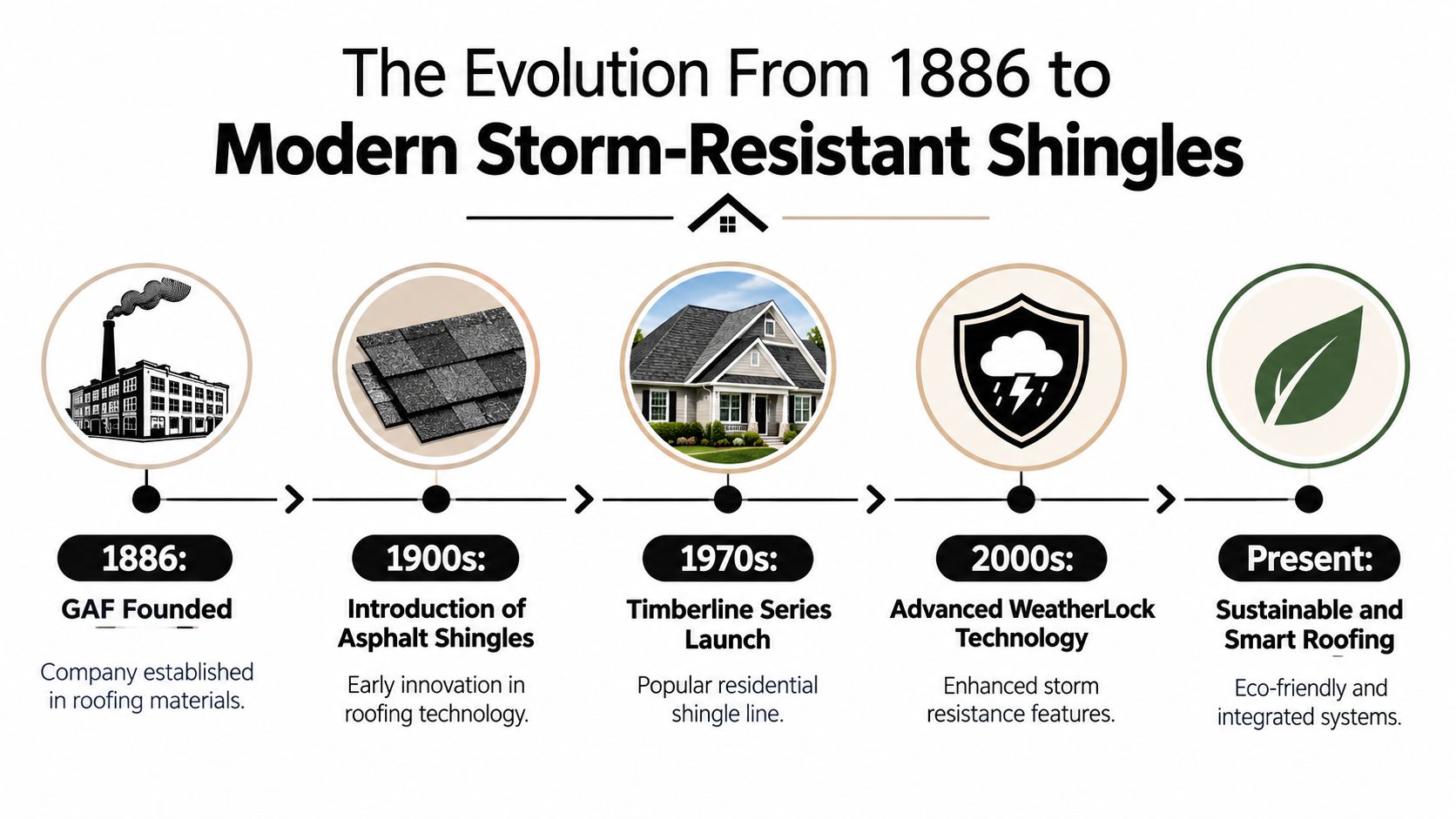
The company was founded in 1886 as the Standard Paint Company with 18 employees in Bound Brook, New Jersey. GAF describes a record of 139 years of roofing firsts, including the launch of the world's first nailable solar shingle in 2022. Those milestones show a long shift from individual materials toward coordinated roofing systems.
In 1892, the company introduced ready-to-lay asphalt roofing. In 1904, it embedded colored granules into roofing material. In 1912, it developed the first individual asphalt shingle. Each step addressed practical concerns such as installation, surface protection, and weathering.
Why Timberline changed the residential market
In 1967, GAF launched Timberline, a laminated shingle that became North America's best-selling shingle. Lamination created a more dimensional appearance than a basic strip shingle and helped establish the style many homeowners recognize today.
The product history does not guarantee performance on every roof. Manufacturing methods, testing, accessory design, and installation instructions have developed together, but the roof still depends on proper fastening, alignment, sealing, and edge treatment.
That distinction matters after Kansas City storms. A stronger shingle cannot correct a weak roof deck, poor flashing, or careless installation. Storm resistance comes from the complete assembly and the contractor's execution, not from the manufacturer's name alone.
Watch this overview for a visual look at roofing technology and installation considerations:
The newest GAF developments also extend beyond conventional asphalt. The company's nailable solar shingle combines weather protection and energy generation in one installed surface. Solar shingles will not suit every home, but the product reinforces GAF's broader direction as a roofing systems manufacturer. For homeowners, the practical question remains who will install that system, how the components work together, and whether the completed roof matches local storm demands.
Why GAF Certification Matters for Kansas City Storm Protection
A GAF roof isn't automatically storm-ready because the bundle carries a familiar name. In Kansas City, resilience comes from the selected assembly, fastening and sealing details, installer training, and the standard used to evaluate the completed work.
GAF and the Institute for Business and Home Safety announced an alliance in 2025 to make FORTIFIED roofs more accessible. By February 2026, GAF said it had trained more than 1,100 roofing professionals in FORTIFIED roof installation, and it reported that approximately one-third of newly designated FORTIFIED homes in 2025 used GAF shingles. Those figures appear in GAF's roofing innovation announcement.
Certification is about execution
A storm-resilient roof may include stronger perimeter attachment, more deliberate sealing at vulnerable edges, improved protection around penetrations, and documentation that confirms the required work. The exact measures depend on the FORTIFIED designation, the home, and the applicable requirements. A contractor must understand those details before promising a resilience upgrade.
GAF certification and FORTIFIED training aren't the same credential. GAF certification concerns participation in a manufacturer program and the ability to offer qualifying products and warranty options. FORTIFIED training relates to installing a roof to a resilience standard. A contractor may hold one, both, or neither, so ask specifically.
In a hail or wind claim, your insurer may request photographs, invoices, product information, permits, or proof of completed work. No contractor can guarantee that an insurer will approve a claim or provide a discount. Good documentation can still make the process clearer and help distinguish storm damage from ordinary aging.
Verify the person doing the work
Search the contractor through official manufacturer resources instead of relying on a logo in an advertisement. Then ask for the crew's name, the project supervisor, the written scope, and the documents that will be supplied after installation. You can also review local options through a GAF-certified installer resource.
A certified label matters only when the people on your roof follow the installation requirements attached to that label.
For Kansas City homes, the practical priority is a complete inspection. Hail can bruise shingles without creating an obvious leak, while wind can disturb edges and accessories before water enters the living space. A qualified inspection should record the roof condition, explain the proposed upgrade, and separate necessary work from optional improvements.
Shingle Performance Ratings and What They Mean for Your Home
Performance ratings turn marketing language into test categories. They don't predict exactly how a roof will behave in every storm, but they tell you what a product has been tested to resist.
GAF's Timberline HDZ specification sheet lists these classifications:
| Test area | Timberline HDZ listing | What it tells you |
|---|---|---|
| Fire | UL 790 Class A | The product meets a high fire-performance classification |
| Wind uplift and tear | ASTM D7158 Class H | The shingle meets a defined wind-resistance class |
| Wind-driven rain and uplift | ASTM D3161 Class F | The product meets a defined fan-induced wind test class |
| Asphalt shingle construction | ASTM D3018 Type 1 | The product meets a specified asphalt-shingle classification |
| Impact | UL 2218 Class 3 | The product meets a defined impact-resistance test level |
These classifications come from the Timberline HDZ specification sheet.
The ratings don't mean a homeowner can skip proper installation. A shingle can meet a wind or impact test and still fail prematurely if the deck is unsound, fasteners miss the required nailing area, or flashing allows water behind the covering.
Compare risk, not slogans
For a Kansas City property, wind and hail exposure deserve more attention than a color name. Impact resistance may matter in hail-prone neighborhoods, while fire classification can support code requirements in applicable markets. Higher ratings can be useful, but they may also involve higher product cost or specific accessory requirements.
DIY installation and uncertified installation create a different risk profile. You may save on labor in the short term, but mistakes in layout, fastening, ventilation, and flashing can create leaks and complicate warranty eligibility. A certified professional installation gives you a defined scope and a clearer path to manufacturer documentation, but you should still inspect the contract and verify the credential.
Choosing the Right Contractor for Your GAF Roof Project
Choose the contractor before you choose the color. A competent installer should be able to explain why a particular GAF product and assembly fit your roof, your storm exposure, and your budget without reducing the conversation to a brand slogan.
Start with these questions:
- Which GAF certification do you currently hold? Ask for the exact program and verify it through GAF.
- Are you trained for FORTIFIED installation? If resilience is the goal, request the relevant credential and written scope.
- Which products make up the complete system? Require names for the shingle, underlayment, leak barrier, starter, ridge cap, ventilation, and flashing.
- How will you document storm damage? Ask for roof photographs, measurements, and an explanation that distinguishes repairable damage from replacement conditions.
- Who handles warranty registration? Get the answer in writing and keep the final documents.
- What happens if the deck or flashing is damaged? A fair contract explains change orders before tear-off begins.
Credentials don't replace workmanship
Look for a licensed, bonded, and insured company with a local operating history, but don't stop there. Ask to see recent references for comparable roofs, confirm who supervises the crew, and make sure the proposal states whether subcontractors will perform the work.
Insurance support also requires restraint. A contractor can document conditions and help organize the claim, but nobody should promise approval, coverage, or a specific payment before the insurer evaluates the loss. Be cautious of anyone asking you to sign over claim rights or encouraging you to exaggerate damage.
Two States Exteriors LLC is a Kansas City Metro Area contractor serving Kansas and Missouri since 1997, with GAF certification and services that include roof repair, roof replacement, storm-damage assistance, gutters, siding, decks, and painting. Its published process includes free on-site inspections, detailed project plans, emergency availability, and a No Money Upfront policy.
A sound project ends with more than new shingles. You should receive a clean site, photographs or completion records, warranty information, and an explanation of maintenance responsibilities. That paperwork protects the value of the system you paid for.
If your Kansas City roof has hail or wind damage, Two States Exteriors LLC offers free on-site inspections, insurance-claim support, and GAF-certified roof repair or replacement for homes and businesses. Contact the team for a documented assessment and a written plan that explains the complete roofing system, installation work, and warranty path before you commit.