
A Kansas City downpour can expose a gutter problem in minutes. Water spills over the front edge, mulch washes away below the corners, and the siding darkens where runoff lands. The first assumption is often a clog, but overflow can also mean the roof is delivering more water than the trough and downspouts can move.
That's where the 6 inch gutters vs 5 inch decision becomes practical rather than theoretical. A larger gutter isn't automatically the right answer, and a standard 5-inch system isn't automatically inadequate. The right choice depends on your roof planes, pitch, valleys, run lengths, outlet placement, and how quickly a Midwest storm sends water off the roof.
Why Gutter Size Matters More During Midwest Storms
A short, intense storm puts a different demand on a gutter system than a light, steady rain. Water arriving from a broad roof plane can concentrate at one valley or rush toward the end of a long run. If the trough fills faster than the outlet and downspout can carry water away, the result is overflow even when the gutter itself is clean.
Kansas City homes show this problem in several ways. A two-story house with intersecting rooflines may send runoff from multiple planes toward one section. A steep roof accelerates runoff into the eaves. A ranch home with short, simple runs may spread water more evenly and place less stress on each outlet.
Practical rule: Overflow at one corner doesn't prove the entire house needs larger gutters. It tells you that the affected roof section, outlet layout, pitch, or trough capacity needs to be evaluated.
A clogged gutter usually leaves debris in the channel and creates a localized backup. A sizing or layout issue may produce clean, fast-moving overflow during heavy rain, especially at valleys, inside corners, and the ends of long runs. Those symptoms can overlap, so replacing the trough without checking the drainage path can leave the underlying bottleneck untouched.
This guide is for Kansas City homeowners comparing a replacement system, planning a roof project, or trying to understand why existing gutters fail during storms. It treats 5-inch and 6-inch K-style gutters as complete systems, not isolated pieces of metal. That distinction matters because a wider trough paired with an undersized downspout can still struggle when peak flow arrives.
The answer is conditional. 5-inch gutters remain a sensible fit for many standard residential rooflines, while 6-inch systems provide more room for demanding geometry and intense runoff. The useful question isn't which size sounds stronger. It's which size gives your specific roof enough operating margin without adding unnecessary cost or visual bulk.
Understanding 5 Inch and 6 Inch Gutter Basics
The size refers to the opening across the top of a K-style gutter. A 5-inch K-style gutter has a narrower trough, while a 6-inch K-style gutter has a wider opening and a deeper overall profile. Both use the familiar shaped front that resembles the letter K, a profile common on residential homes.
Gutters are formed on site from a continuous coil and cut to match each roofline. The installer mounts the trough along the fascia, gives it a controlled pitch toward an outlet, and connects that outlet to a downspout. The size of the trough is only one part of that path.
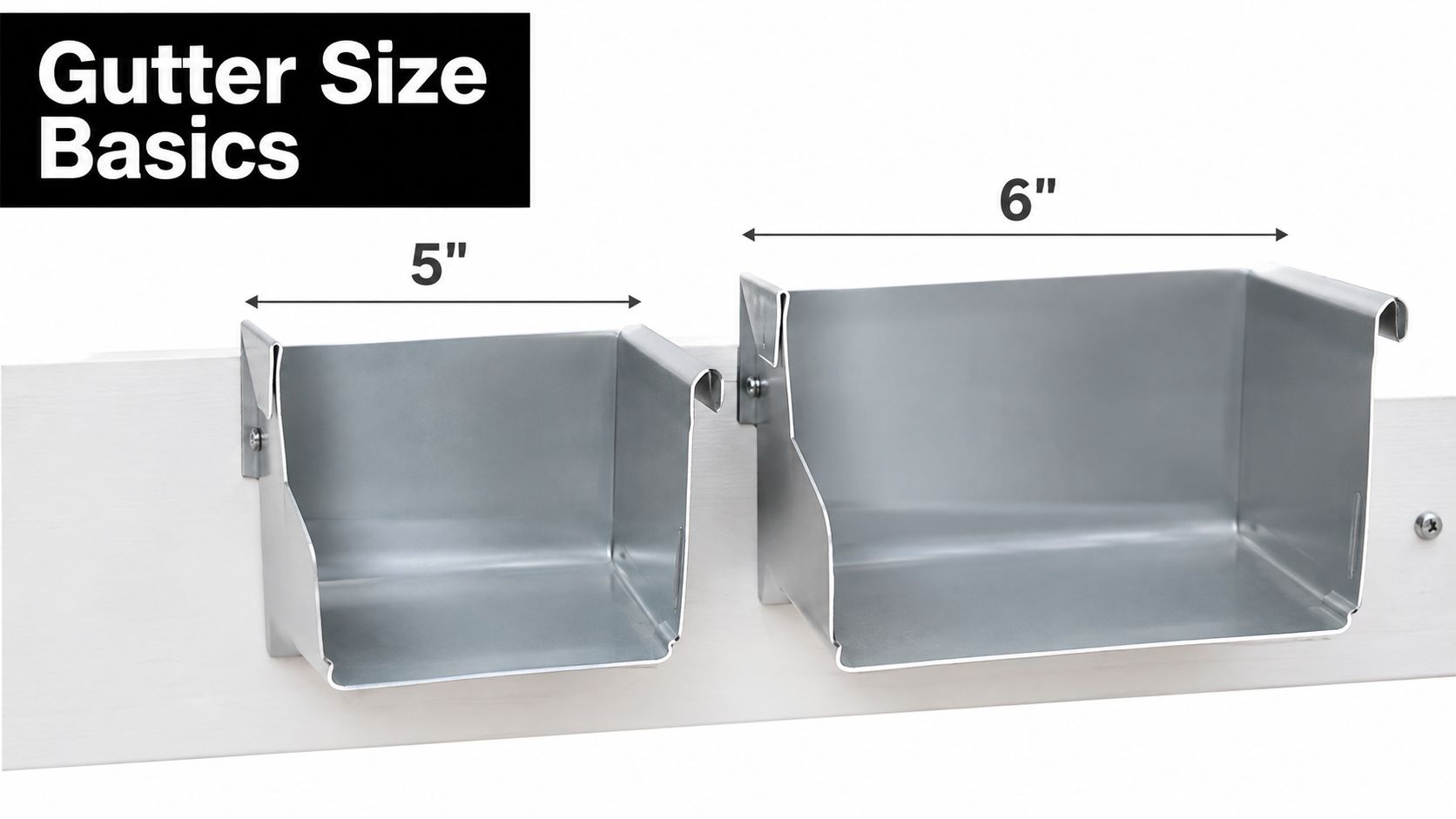
What the measurement does and doesn't tell you
A wider opening gives leaves and roof runoff more room to enter, but it doesn't guarantee good drainage. The installer still has to account for fascia condition, roof-edge discharge, gutter pitch, hanger support, outlet size, and downspout routing. If the outlet is too small or the downspout is restricted, the extra trough volume may not translate into reliable removal.
The 5-inch profile became the residential baseline because it fits many conventional homes without appearing oversized. It also works well with common fascia proportions and standard downspout arrangements. For a modest roof with uncomplicated slopes and properly placed outlets, that familiar configuration can be a sound choice.
A 6-inch profile is the larger residential option. It occupies more visual space on the fascia and generally calls for a larger outlet and downspout package. On broad rooflines, larger fascia, steep slopes, or valley-heavy designs, that scale often looks intentional rather than excessive.
Think of the system in four connected parts:
- Roof surface: Determines how much water reaches the eave.
- Gutter trough: Receives and temporarily carries that runoff.
- Outlet: Controls the transition from horizontal channel to vertical drainage.
- Downspout and discharge point: Move water away from the structure.
The most common mistake is choosing a trough by width alone. A contractor should size the roof sections and inspect where water concentrates before recommending either profile.
How 6 Inch and 5 Inch Gutters Compare on Capacity
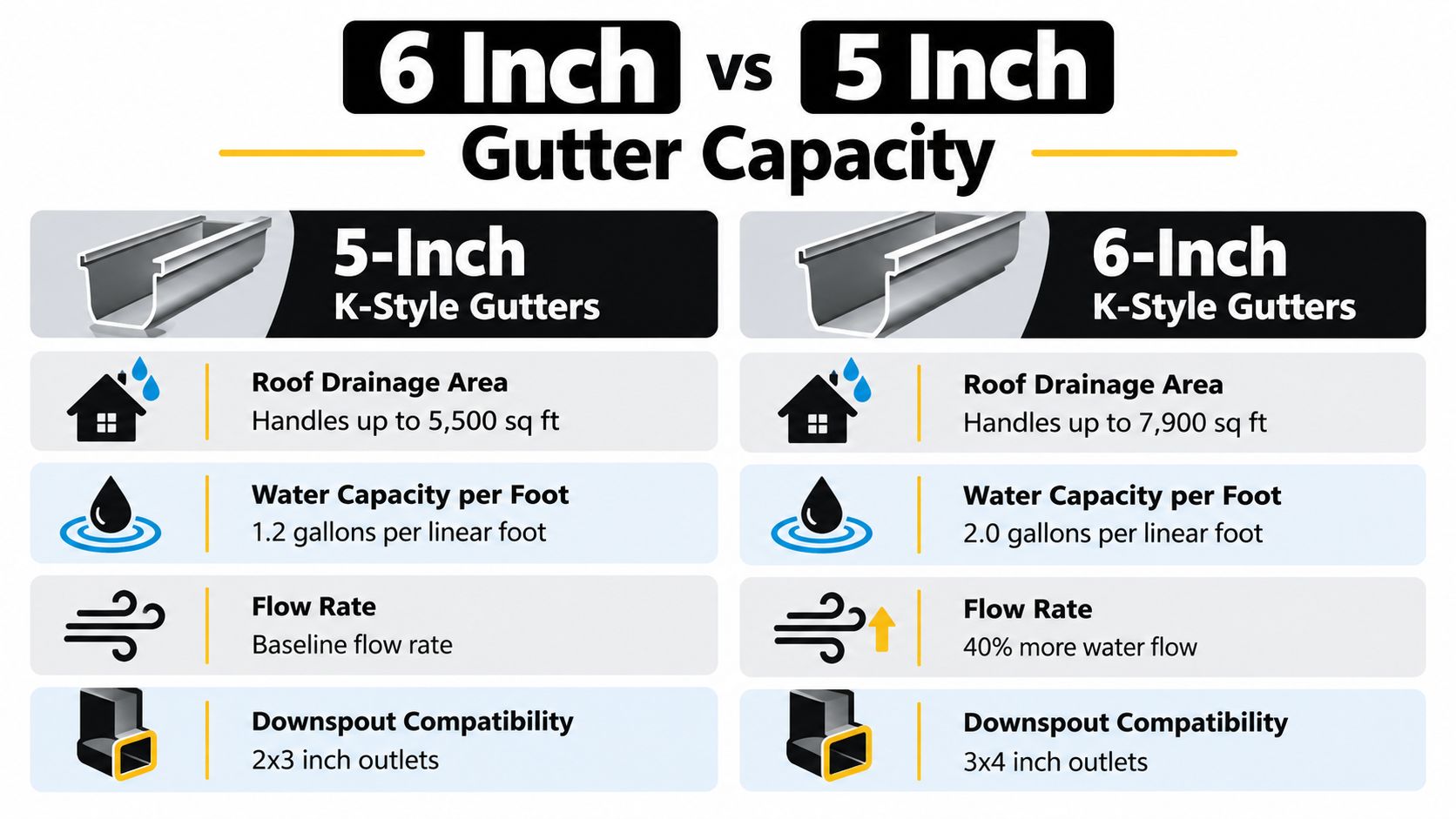
The capacity difference is substantial enough to matter during Kansas City cloudbursts, but it needs to be read in context. Published sizing references rate a 5-inch K-style gutter for about 5,520 square feet of roof drainage area and a 6-inch K-style gutter for about 7,960 square feet under the same sizing assumptions, a difference of roughly 44%. The figures and the assumptions behind them are outlined in this 5-inch versus 6-inch gutter sizing reference.
Roof drainage area
The roof-area rating shows why the larger profile helps on broad or complicated roofs. Under the cited assumptions, the 5-inch system handles about 5,520 square feet, while the 6-inch system handles about 7,960 square feet. Those are not universal limits for every Kansas City roof because rainfall intensity, pitch, valley concentration, and downspout placement change the calculation.
A steep roof can deliver water more aggressively than a low-slope roof with the same plan area. Likewise, a valley can send runoff from more than one plane into a short section of gutter. That's why a roof can experience overflow even when its total area appears reasonable for the gutter size.
Water volume per linear foot
The trough-volume comparison is even more pronounced. A 5-inch K-style gutter holds about 1.2 gallons per linear foot, while a 6-inch K-style gutter holds about 2.0 gallons per linear foot, an increase of roughly 67%, according to this gutter size capacity guide.
That additional volume gives water more room before it reaches the front edge. It can be particularly useful below dormers, at valleys, and along sections where several roof surfaces discharge into one channel.
Flow rate
One sizing table lists a 5-inch K-style gutter at about 32 gallons per minute and a 6-inch system at about 52 gallons per minute. That represents a difference of 20 gallons per minute, or approximately 62.5%, in that table's comparison. Flow rates depend on the sizing method and system configuration, so they should guide an assessment rather than replace one.
| Capacity Metric | 5 Inch K-Style | 6 Inch K-Style | Difference |
|---|---|---|---|
| Roof drainage area | About 5,520 sq. ft. | About 7,960 sq. ft. | Roughly 44% more for 6-inch |
| Water volume per linear foot | About 1.2 gallons | About 2.0 gallons | Roughly 67% more for 6-inch |
| Listed flow rate | About 32 gallons per minute | About 52 gallons per minute | 20 gallons per minute, about 62.5% |
| Typical system pairing | Standard outlet and downspout arrangement | Larger outlet and 3×4-inch downspout pairing | Full-system design matters |
The important difference: 6-inch gutters provide more buffer, but the outlet and downspout must be large enough to use that capacity.
For a practical discussion of how trough dimensions connect with outlet and downspout planning, review this guide to gutter and downspout sizes.
A 5-inch gutter can perform well when the roof sections are moderate, the runs are properly pitched, and outlets are placed where water naturally collects. A 6-inch system earns its place when the roof geometry repeatedly pushes water toward the limits of the smaller profile.
Cost Appearance and Installation Trade Offs You Should Weigh
A larger gutter is not automatically a better investment. In Kansas City, the right choice depends on how the roof looks from the street, how much fascia is available, and whether the installation includes the outlets and downspouts needed for heavy storm runoff.
A 6-inch system usually costs more because it uses a larger trough, larger outlets, compatible downspouts, and installation details suited to greater water volume. Compare the complete drainage package rather than the gutter material alone. This guide to gutter installation cost factors can help when reviewing proposals.
A 5-inch system can be the better value when it fits the roof. It generally looks more restrained on a small ranch, narrow fascia, or compact elevation. Selecting it is a sound decision when the installer has accounted for roof area, slope, concentration points, outlet locations, and discharge paths.
Where the larger profile earns its place
A 6-inch gutter often looks proportional on a large two-story home, broad fascia, or roof with substantial overhang and multiple planes. Its deeper line can suit the scale of the exterior instead of appearing out of place. Matching the gutter color to the roof trim and siding helps either size blend into the design.
On a small facade, the larger profile may look bulky. A low, narrow elevation can draw attention to the eave, particularly when oversized downspouts are poorly positioned. The profile can still work, but the layout needs to be deliberate.
Installation details affect the finished result
Both sizes require sound fascia or another suitable mounting surface. A full gutter carries water and debris, so loose wood, damaged trim, or weak attachment points should be repaired before new trough material covers them.
The 6-inch option may need more careful hanger placement and stronger attachment because it is designed to handle greater volume. Spacing and fastening depend on the product, substrate, roof edge, and local installation practice. A reliable proposal should identify those details instead of applying one method to every roofline.
Ask for separate descriptions of trough size, outlet dimensions, downspouts, elbows, discharge extensions, fascia repairs, and removal of the old system. The wrong cost reduction is pairing a 6-inch trough with a restrictive outlet or downspout. The wrong upgrade is placing a larger system on a simple roof without a drainage reason. Value comes from matching the complete system to the roof, not from selecting the largest visible component.
Choosing the Right Size for Your Roof and Rainfall
Kansas City homeowners should evaluate the roof section feeding each gutter run, not just the footprint of the house. A wide hip roof, a steep gable, and a valley-fed addition can place very different demands on separate sections of the same property.
Start with roof geometry. Broad planes collect more water, steep slopes move it toward the eave faster, and valleys concentrate discharge. Long runs also deserve attention because water has farther to travel before reaching an outlet, especially when outlets are limited or positioned at only one end.
Rainfall intensity changes the margin you need. The cited sizing guidance explains that the 6-inch option's advantage matters most during intense storms, when a larger profile provides more room before overtopping. That's why a home that behaves well during ordinary rain may still spill water during a short, heavy burst. The condition-based approach is summarized in this guide to deciding between 5-inch and 6-inch gutters.
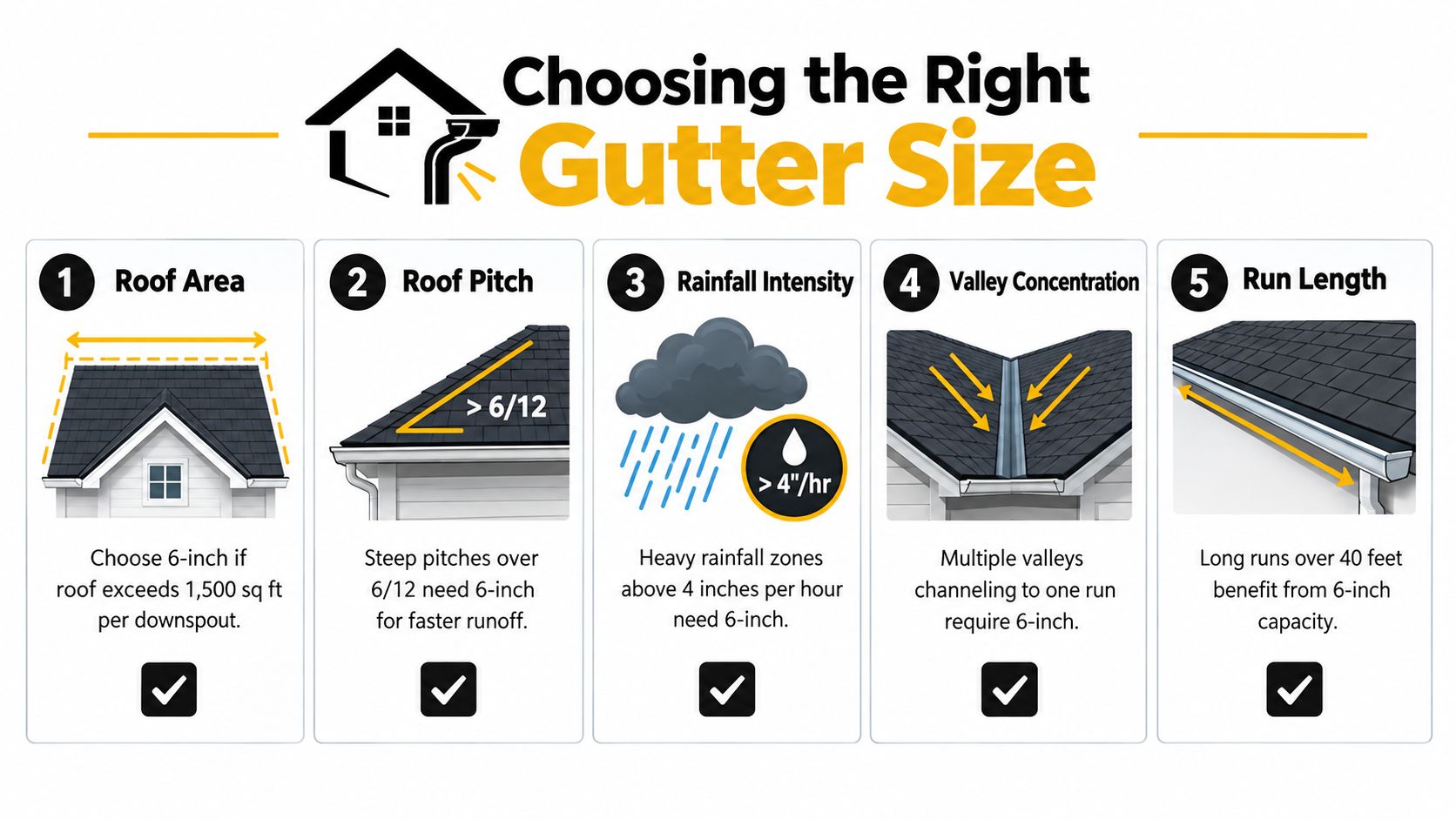
A quick decision matrix
| Roof condition | More likely fit | Reason to examine |
|---|---|---|
| Smaller roof planes, modest pitch, short runs | 5-inch | Water is distributed without severe concentration |
| Large roof planes or multiple roof sections | 6-inch | More runoff reaches individual gutter runs |
| Steep roof feeding a narrow eave | 6-inch | Faster runoff can challenge a standard profile |
| Several valleys entering one section | 6-inch | Concentrated flow can create local overtopping |
| Existing 5-inch system with clean drainage and no overflow | 5-inch may remain suitable | Replacement doesn't automatically require an upgrade |
| Repeated overflow despite clean gutters | Evaluate 6-inch and the full system | The cause may be capacity, outlets, pitch, or downspouts |
A single-story ranch with simple rooflines, short gutter runs, and well-distributed downspouts often has a strong case for 5-inch gutters. That choice keeps the appearance proportional and avoids paying for capacity the roof doesn't need.
A steep two-story with intersecting planes, valley-fed sections, and past overflow deserves a closer look at 6-inch gutters. The same applies when water shoots over a particular corner during storms even after cleaning. In that situation, the contractor should trace the roof area feeding that location and verify whether the outlet and downspout can accept the flow.
Metal roofing, roof-edge details, and additions can also change how water enters the trough. Don't accept a size recommendation based only on the home's square footage. Ask the installer to identify which planes feed each run, where the outlets go, and what happens at the discharge point.
What Changes With Installation and Ongoing Maintenance
Upsizing from 5-inch to 6-inch should change more than the trough. The installer should check the fascia, establish a reliable pitch toward each outlet, use appropriate hangers, and fit outlets and downspouts that won't restrict the larger system.
The downspout pairing deserves particular attention. A 6-inch gutter is commonly matched with a 3×4-inch downspout, while 5-inch systems are commonly paired with smaller standard arrangements. The larger downspout and outlet can matter more than the extra inch of trough during peak flow because they determine how quickly water leaves the horizontal channel. This full-system point is also emphasized in the comparison of 5-inch and 6-inch gutter systems.
Installation checks that prevent bottlenecks
- Inspect the fascia: Replace or reinforce deteriorated wood before fastening new gutters.
- Plan outlet locations: Put outlets where roof runoff naturally concentrates, rather than forcing excessive water along a long run.
- Match the downspouts: Don't install a wide trough with a restrictive vertical component.
- Protect the discharge area: Use extensions or suitable drainage planning so water doesn't collect beside the foundation.
A larger opening can reduce the chance that leaves form a complete blockage, but it doesn't make the system maintenance-free. Pine needles, shingle granules, nests, and storm debris can still obstruct either size. Gutter guards also need to match the roof edge and the gutter profile, and they still require inspection.
Cleaning should follow the property's tree cover, roof debris, and storm exposure. If you're doing the work yourself, follow a safe process outlined in this guide to cleaning gutters safely. Never treat a larger gutter as permission to ignore loose hangers, separated seams, blocked outlets, or downspout discharge problems.
The most reliable installation conversation is specific. Ask whether the proposal includes 3×4-inch downspouts where needed, how many outlets each run receives, how the trough will be supported, and where the water will discharge.
Our Recommendation for Kansas City Area Homes
For many Kansas City homes with standard roof planes, moderate slopes, short runs, and properly placed downspouts, 5-inch K-style gutters are still the practical choice. They offer a clean appearance and appropriate performance when the roof doesn't concentrate excessive runoff into a limited section.
Choose a full 6-inch system when the roof has large planes, steep pitches, several valleys feeding one run, long stretches with limited outlets, or a history of overflow during heavy storms. In those cases, the upgrade should include the outlets and downspouts needed to move the additional water. A wider trough alone isn't a complete solution.
Past overflow deserves a diagnosis, not a sales pitch. The contractor should distinguish between a clog, poor pitch, inadequate outlet placement, undersized downspouts, damaged fascia, and a gutter that lacks enough capacity for the roof section.
Two States Exteriors LLC has served the Kansas City Metro Area since 1997 and offers free on-site inspections for gutter and exterior projects. An inspection can confirm the drainage area, roof geometry, fascia condition, outlet layout, and whether 5-inch or 6-inch gutters make more sense for the property.
Schedule a free on-site evaluation with Two States Exteriors LLC to review your Kansas City roof geometry, existing overflow, downspout layout, and fascia condition. Their team can recommend and install a complete gutter system, whether your home needs a properly designed 5-inch setup or a coordinated 6-inch upgrade.